Two parties release an investigational medicinal product to a UK site. A Qualified Person releases the batch by certifying that it was made, checked and packaged to the standard the trial authorisation requires. The sponsor then releases that certified stock to one named site by confirming the site may begin dispensing. A first participant is dispensed only after both releases are complete.
This guide covers what Qualified Person certification is, who holds the authorisation behind it, how an imported product reaches a UK site, what the sponsor’s green light adds, and which release documents a pharmacy files. It sits under the guide to IMP accountability in clinical trials.
- QP certification is a product-level act, and says nothing about any site.
- The MHRA states that manufacture of even one dose for immediate use requires an MIA(IMP) and QP certification.
- Product imported from a listed country is verified by the UK QP rather than certified again.
- The sponsor’s green light is a site-level decision, and pharmacy files evidence of both releases.
What Is QP Release?
QP release is the certification of a batch of investigational medicinal product by a Qualified Person named on a manufacturing authorisation for investigational medicinal products, an MIA(IMP). The Qualified Person is a named individual with defined qualifications, and the certification is a personal act recorded against that individual. Certification makes a batch lawfully available for use in a trial. The Medicines for Human Use (Clinical Trials) Regulations 2004 carry the requirement, and the MHRA guidance on good manufacturing practice for investigational medicinal products sets out how the agency applies it.
Certification attests to four things about the batch.
- Manufacture to good manufacturing practice. The batch was made under the conditions the authorisation sets, which lets a site treat the contents of a sealed pack as known.
- Agreement with the trial dossier. The batch meets the specification submitted with the clinical trial application, so a participant receives the product the regulator assessed.
- Correct packaging and labelling. The pack carries the particulars UK law requires, which lets pharmacy identify a unit on receipt.
- A complete batch record. The supporting documentation gives an inspector a route from a dispensed kit back to its manufacture.
Certification travels with the batch. Permission to dispense does not.
One batch may supply forty sites across several countries, and the certification is identical for all of them. Nothing in it records that a particular pharmacy was ready. The sponsor’s release closes that gap.
Who Holds an MIA(IMP), and What Does It Cover?
An MIA(IMP) is held by the organisation that manufactures, assembles or imports the product, and the MHRA issues it after inspection. The MHRA Inspectorate guidance on manufacture of investigational medicinal products states that an organisation cannot act as a contract batch certification site only. Certification stays attached to real manufacturing or importation activity.
The boundary matters to hospital pharmacy, because some preparation at a trial site counts as manufacture and some does not. The same guidance draws the line at what is done to the product.
| Activity at the site | Position under UK law |
|---|---|
| Dissolving or dispersing the product for administration | Reconstitution, and no MIA(IMP) is required |
| Weighing out, adding other materials, or combining IMPs | Manufacture, and an MIA(IMP) with QP certification applies |
| Manufacture of a single dose for immediate use | Manufacture, and an MIA(IMP) with QP certification applies |
| Applying an expiry date, investigator name or protocol number after certification | Permitted at a trial site under documented controls |
| Preparation of a diagnostic radiopharmaceutical IMP | Regulation 37A allows this at sites holding a manufacturer’s specials licence |
A trials pharmacist reads that table before agreeing to a preparation step. The three permitted post-certification labelling operations are covered in IMP labelling requirements for UK trials. Which products attract this treatment follows from the classification set out in what an investigational medicinal product is, and the record difference against a comparator is covered in the comparison of IMP and NIMP records.
Also Read: What Is a Clinical Trial Pharmacy and How Does It Differ from Routine Dispensing?
How Does an Imported IMP Reach a UK Site?
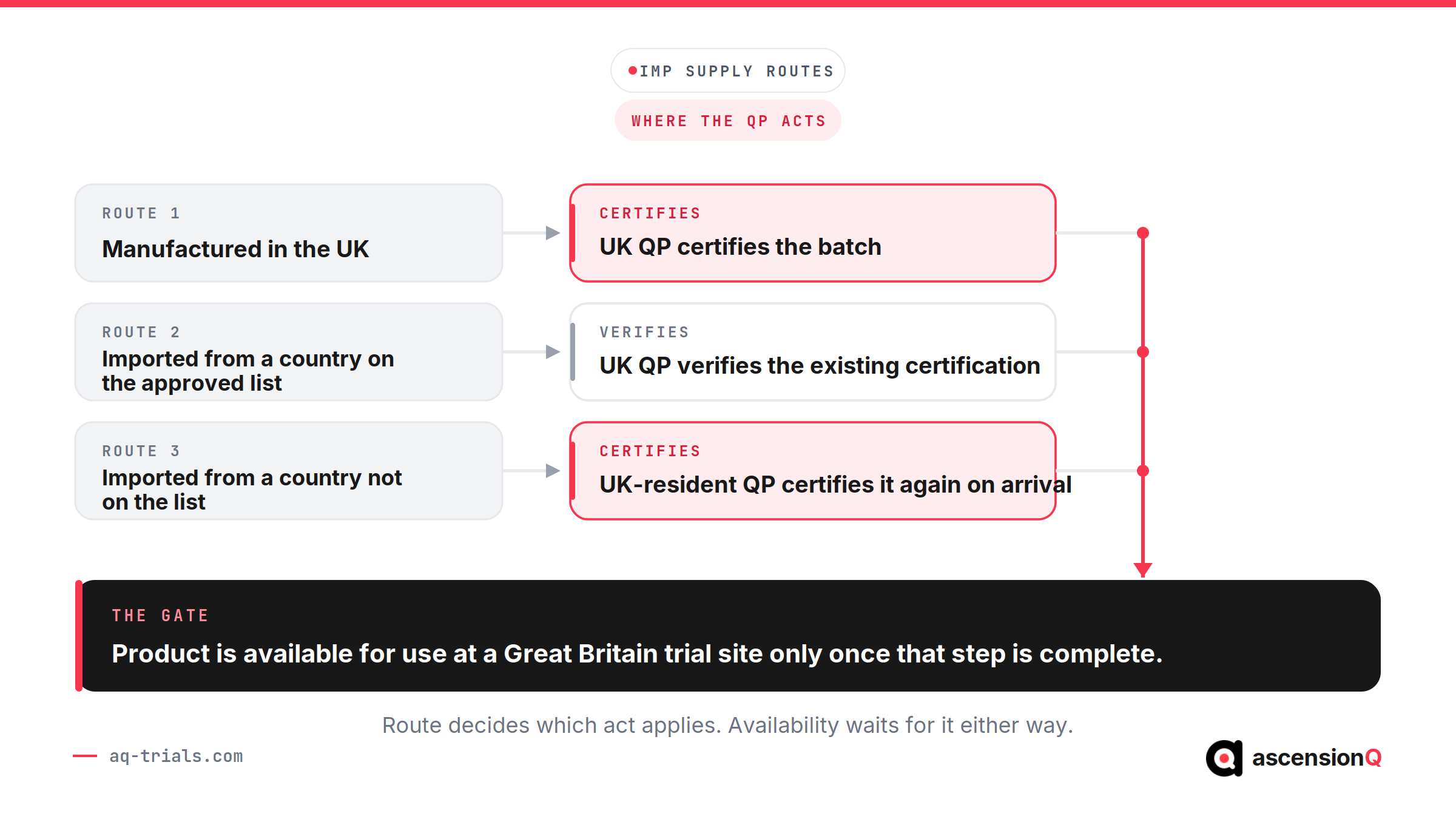
An imported product reaches a UK site by one of two routes, and the route decides whether a UK Qualified Person certifies the batch or verifies someone else’s certification. The MHRA guidance on importing investigational medicinal products into Great Britain sets both out.
- Import from a country on the approved list. The guidance states that the product does not require recertification. The Qualified Person named on the UK MIA(IMP) verifies the original certification instead, and may delegate the routine verification tasks to appropriate personnel.
- Import from a country not on the list. The guidance states that any manufacturing activity or importation from a non-listed country must be certified by a Qualified Person resident in the UK, so the batch is certified again on arrival.
The guidance fixes the moment the product becomes usable. It states that investigational medicinal products are not made available for use in Great Britain clinical trial sites until the certification in a listed country has been verified by the Qualified Person named on the UK MIA(IMP). Verification is the gate, and a site holding stock ahead of it holds product it may not dispense.
The paperwork arriving with a shipment differs between the two routes, so a team that knows its route knows which document to expect.
What Is the Green Light to Dispense?
The green light is the sponsor’s written confirmation that one named site holds every approval the trial requires and may begin dispensing. UK sponsors and clinical trials units commonly run this as a defined step with its own procedure and sign-off. The decision turns on conditions unrelated to the batch.
- Regulatory and ethics approval covering that site. The confirmation ties the site to an approved protocol version, so the product is used inside the trial authorisation.
- A signed agreement and confirmed capacity. The site has accepted the study contractually, which fixes who is responsible for the stock on arrival.
- Named, delegated and trained pharmacy staff. The people who receive and dispense are authorised on the day, which makes each later entry evidence.
- Storage and equipment ready. The conditions the label requires can be met and monitored, so the stock stays usable on arrival.
The two releases answer different questions, and a site needs both in writing.
| Aspect | QP batch certification | Sponsor release to site |
|---|---|---|
| Question answered | Is this product fit to be used in the trial? | May this site start dispensing it? |
| Who decides | A named Qualified Person on an MIA(IMP) | The sponsor, or the clinical trials unit acting for it |
| Unit of decision | One batch, for every site it supplies | One site, for the study |
| Basis of the decision | Manufacturing records, specification, packaging and labelling | Approvals, agreement, delegation, training and facilities |
| Record produced | A certification statement held by the MIA(IMP) holder | A written authorisation issued to the site |
| Effect of its absence | The product may not be used in the trial at all | The product may not be dispensed at that site |
A certified batch in an unreleased pharmacy is stock, and it is not yet a trial medicine.
Responsibility for the product at the site stays with the investigator or institution throughout, as what ICH E6(R3) requires of IMP management at the site sets out. Which roles hold that accountability is covered in who is accountable for IMP at a trial site, and the authorised and trained condition behind every entry is covered in delegation and training records for pharmacy. The specialist pharmacy questions settled nationally beforehand are covered in HRA Technical Assurance for pharmacy and radiation.
Which Release Documents Does a Site Receive and File?
A site receives release documentation from two directions, and the pharmacy file holds enough of it to prove the product was usable and the site was permitted to use it. The exact set varies by sponsor, and the function of each document does not.
- Confirmation of QP certification for the batch. The document evidences that the stock on the shelf was lawfully available for trial use, which is the first question a monitor asks of a kit number.
- The sponsor’s written authorisation to dispense. The document fixes the date from which the site could act, so a dispensing entry before that date is visible immediately.
- The shipping and packing documentation. The list of kit numbers, batches and expiry dates is what the receipt check counts against.
- Transit temperature evidence. The record shows the conditions the stock met in transit, and the investigational product storage records checklist covers the set it joins.
- Study-specific pharmacy instructions. The manual states how this sponsor expects receipt, storage and accountability to run at the site.
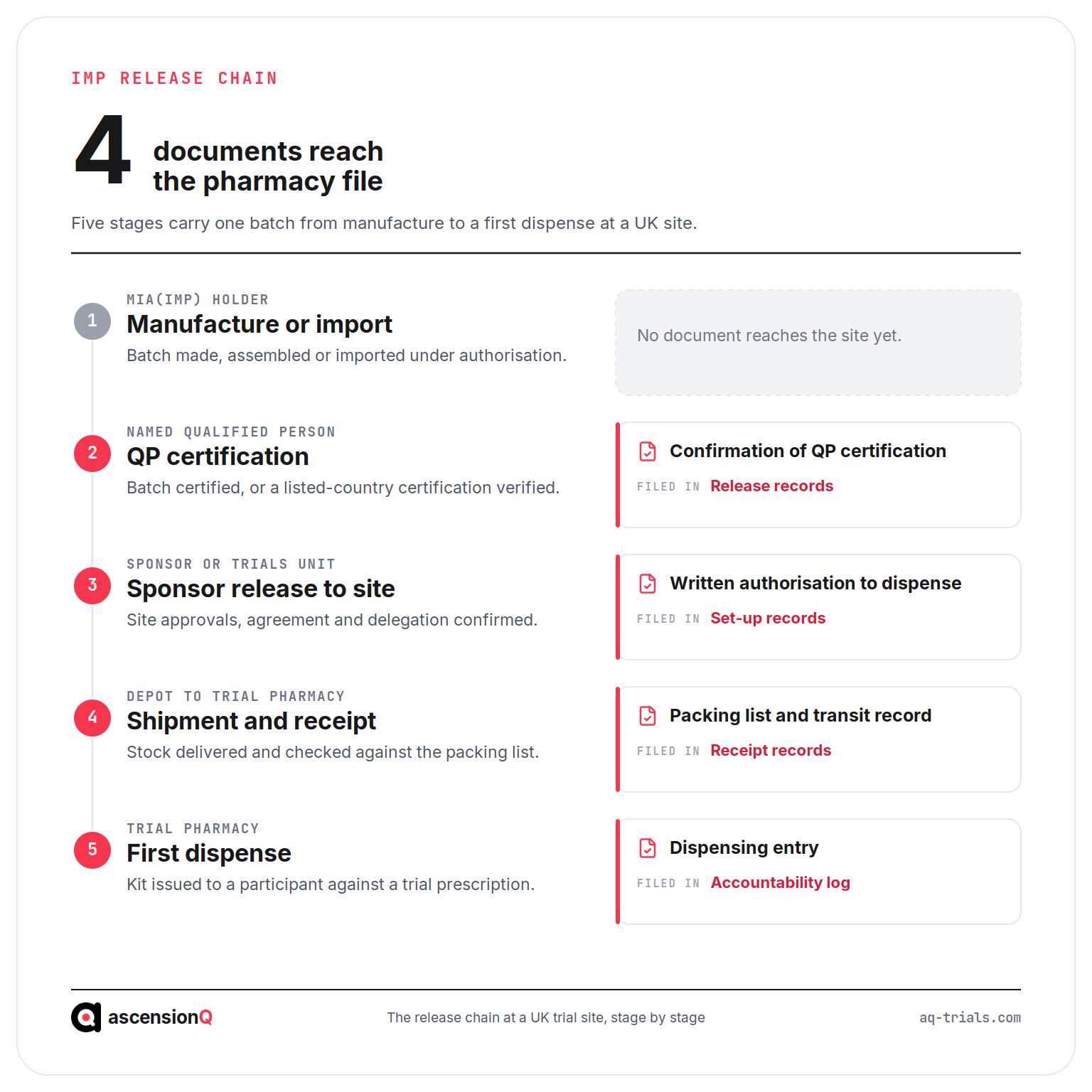
A worked example shows what survives. Study NGH-017 at Northgate General (SITE 01) receives thirty kits of batch B-3104 on 14 September. The sponsor authorised dispensing on 2 September, and the shipment carries a packing list, a transit logger readout and confirmation that the batch was certified. Pharmacy files all four, and the first dispense on 21 September has an unbroken line behind it. Where each document sits in the numbered file structure is set out in what belongs in a pharmacy site file, and the handovers either side are set out in the twelve steps a trial medicine takes.
Also Read: Paper Accountability Logs vs an Electronic Pharmacy Record
Where Does the Release Record Break?
The release record breaks at the join between a document held centrally and an action taken locally. Four failures recur.
- A dispense dated before the sponsor’s authorisation. The kit was fine and the site was not yet released, so the entry stands as a deviation against a clean log.
- Stock accepted into usable storage on arrival. The delivery reached the shelf ahead of any release decision, so the log shows available stock that nobody authorised.
- Release documentation held only by the sponsor. The site can describe its permission and cannot evidence it, which turns a short inspection question into a request to the sponsor.
- A protocol amendment the release never caught up with. The site holds an authorisation against a superseded version, so the document on file no longer describes what the site does.
Each of these is a filing condition rather than a clinical error. The product was correct in every case, and the evidence of entitlement went missing. A shelf count that reconciles against a log proves custody, and it does not prove permission.
Frequently Asked Questions
What is QP release?
The certification of a batch of IMP by a Qualified Person named on a manufacturing authorisation for investigational medicinal products, an MIA(IMP).
Who releases IMP to a UK site?
Two parties. A Qualified Person releases the batch by certifying it, and the sponsor then releases that certified stock to a named site.
What is the green light to dispense?
The sponsor’s written confirmation that one named site holds every approval the trial requires and may begin dispensing.
Release documents, kit records and the dispensing entries that depend on them belong to one study record. AQ’s electronic pharmacy site file page sets out how AQ approaches pharmacy documentation as part of one connected site file. Book a live demo to talk through how your release evidence and dispensing record hold together.