An investigational medicinal product needs a trial-grade record, and a non-investigational medicinal product needs the record its protocol specifies. A trial-grade record accounts for every unit by number, from receipt to destruction. The classification decides which standard applies, and it follows the role the protocol gives a product rather than what the product is on the shelf.
This article covers what makes a record trial-grade, who fixes each product’s class, the record each class attracts at a UK site, the obligations a non-investigational medicinal product (NIMP) carries in its own right, and how a misclassification surfaces in the pharmacy record. The unit-by-unit standard itself is set out in the complete guide to IMP accountability in clinical trials.
- The sponsor fixes each product’s class in the protocol, and the site applies that class.
- ICH E6(R3) section 2.10.4 writes the accountability standard for the investigational product, so the unit-level record follows investigational medicinal product (IMP) status.
- A NIMP record comes from the protocol and the pharmacy manual, so its depth varies between studies.
- NIMPs carry manufacturing and labelling obligations of their own, and one labelling concession open to IMPs is closed to them.
What Makes a Record Trial-Grade?
A record is trial-grade when it accounts for every unit individually and reconciles against an independent record of those units. ICH E6(R3) section 2.10.4 sets that standard, and it sets it for the investigational product. It asks the investigator, institution, pharmacist or other appropriate individual to maintain records of “the product’s delivery, the inventory, the use by each participant” and its “return to the sponsor and destruction or alternative disposition”.
The same section fixes the fields each record carries: “dates, quantities, batch/serial numbers, expiration dates (if applicable) and the unique code numbers assigned to the investigational product(s) and trial participants”. Five obligations follow.
- Delivery. Every arrival is recorded against the shipment that brought it, which gives the ledger an opening balance.
- Inventory. A running balance stays current between transactions, which makes a physical count meaningful at any point.
- Use by each participant. Each unit is tied to one participant and the doses the protocol specifies, which turns a stock figure into per-participant evidence.
- Return and disposition. Every unit leaves the ledger by a recorded route, which closes each line.
- The identifiers. Batch numbers, expiry dates and the code numbers of product and participant travel with each entry, which lets two records be matched unit by unit.
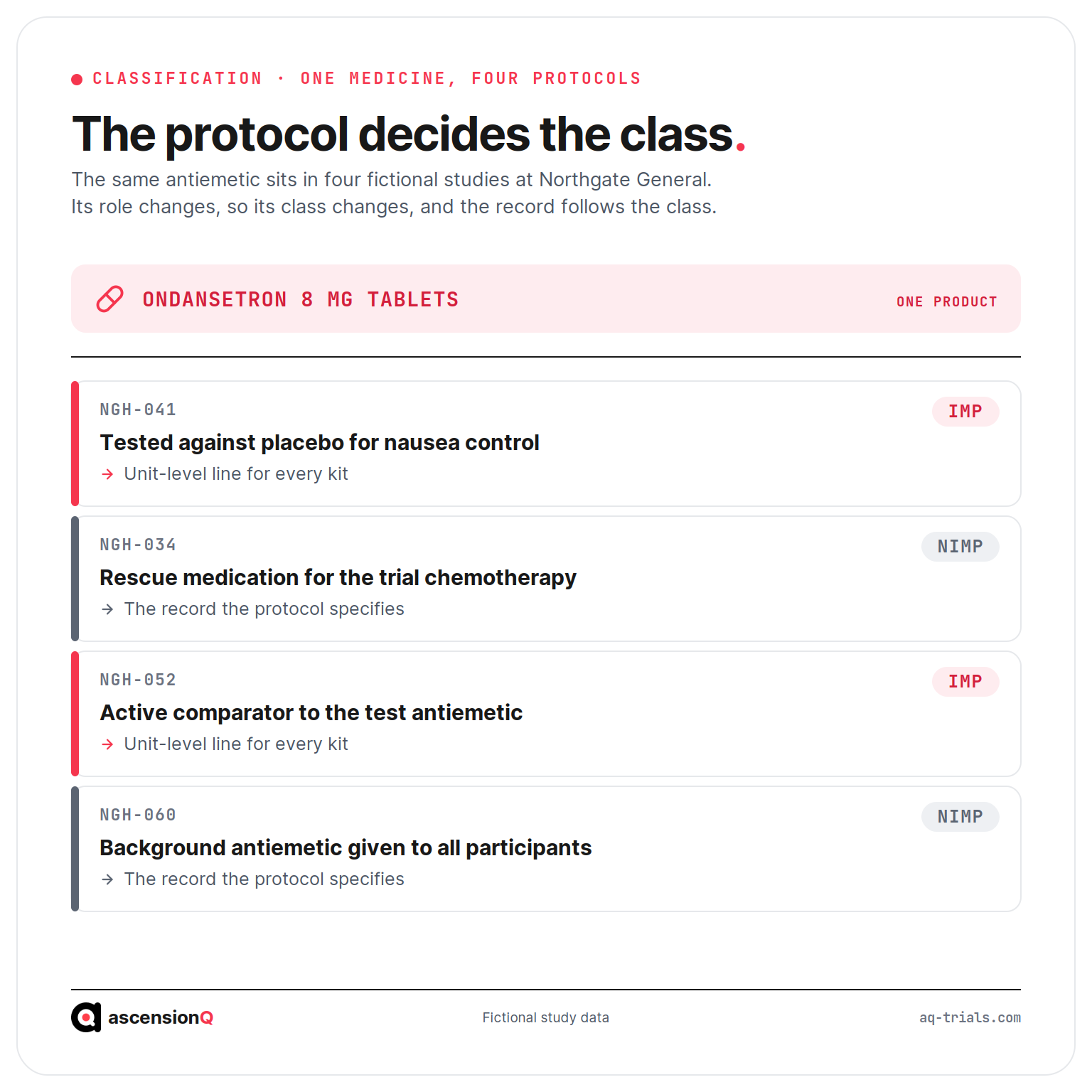
The class decides the standard. The protocol decides the class.
Who Decides Whether a Product Is an IMP or a NIMP?
The sponsor decides, and the decision travels into the clinical trial application with the protocol. Regulation 2 of the UK Clinical Trials Regulations supplies both definitions, a NIMP being “a medicinal product used or to be used in a clinical trial, as described in the protocol, but not as an investigational medicinal product”. Each definition, and the related EU term auxiliary medicinal product, are covered in what an investigational medicinal product is under UK law.
Four parties touch the classification, and one of them sets it.
| Party | What it does with the classification | Where it appears |
|---|---|---|
| Sponsor | Assigns each product a class and justifies the choice | The protocol, and the cover letter for non-medicinal products |
| Clinical trial application | Carries the quality information each class needs | An IMP dossier, plus “a dossier that contains details of the quality of any NIMP” under Schedule 3 |
| MHRA | Assesses the application carrying the classification | The authorisation decision for the trial |
| Site pharmacy | Applies the class the protocol gives each product | The pharmacy manual, the set-up record and every entry that follows |
Two points matter. A site applies the classification rather than forming its own, and a pharmacist who reads the protocol differently raises it with the sponsor before the first delivery. MHRA guidance on non-investigational medicinal products expects an authorised NIMP in the ordinary case, and asks for “clear justification” in the protocol where the sponsor uses an unauthorised one.
The question stays live through the study, because a protocol amendment can change a product’s role and the record set has to move with it. The parties who hold, record and read the resulting entries are separated tier by tier in who is accountable for IMP at a trial site.
What Record Does Each Class Attract at Site?
An IMP attracts the full unit-level record set, and a NIMP attracts the record the protocol and pharmacy manual specify. The difference is sharpest where a record has to identify a single unit and the participant who received it.
| Obligation at site | Investigational medicinal product | Non-investigational medicinal product |
|---|---|---|
| Unit-level accountability line | Required for every unit under ICH E6(R3) 2.10.4 | As the protocol specifies, often at batch or supply level |
| Kit number and sponsor allocation | Each pack carries a code number tied to the sponsor’s supply system | Usually absent, the product sitting outside the randomisation |
| Receipt check against a packing list | Performed and recorded for every delivery | Performed to the standard the protocol sets |
| Storage conditions evidence | Stored as the sponsor specifies under 2.10.5 | Stored to the product’s own conditions |
| Link to a trial prescription | Dispensed against a prescription from an authorised prescriber | Supplied by the route the protocol describes |
| Returns count from the participant | Counted and reconciled against what was dispensed | Counted where the protocol asks for it |
| Sponsor authorisation before destruction | Required in writing before any unit is destroyed | Local policy unless the protocol states otherwise |
| Reconciliation at monitoring visits | Tested from shipment, prescription, returns and shelf | Reviewed against the protocol’s requirement |
The right-hand column carries a warning. Its content comes from the protocol, so it differs between studies in a way the left-hand column does not, and a pharmacy that assumes a house standard for NIMPs will meet a protocol that asks for more. The sponsor’s system holds the allocation side of the IMP column, and that boundary is drawn in which record the RTSM holds and which the pharmacy holds.
Also Read: From Depot to Patient: The Twelve Steps a Trial Medicine Takes
Is a NIMP the Lighter Option?
A NIMP carries a lighter site accountability record and a comparable set of quality obligations. The reduction sits in the unit-level ledger. Obligations that travel with the product itself stay close to those of an IMP, and in one respect they are tighter.
- Manufacture. MHRA guidance states that “all NIMPs (regardless of authorisation status) must be manufactured or assembled in accordance with the principles and guidelines for Good Manufacturing Practice”, which keeps a NIMP in the same quality framework as an IMP.
- Batch certification. The same guidance states there is “no requirement for formal QP batch certification”, which removes one release gate that IMP supply depends on.
- Labelling. Regulation 46A makes NIMPs subject in most cases to the same labelling requirements as IMPs, so a NIMP label is a controlled document by default.
- The closed concession. MHRA guidance states that “unlike IMPs, NIMPs authorised in the UK, EU or an ICH region that are to be exclusively administered in a hospital or health centre taking part in the clinical trial cannot be labelled in accordance with regulation 46(3) and 46(4)”, which withholds from NIMPs the abbreviated label that hospital-only IMPs may use.
- Safety reporting. A serious adverse event suspected to be related to a NIMP follows MHRA safety reporting guidance, which keeps the product inside the trial’s safety record.
A NIMP is lighter on which unit reached whom, and firm on how the product was made and labelled.
How Does a Misclassification Break the Record?
A misclassification breaks the record in one of two directions, and both start at study set-up. An IMP treated as an ordinary medicine loses its unit-level line. A NIMP logged as an IMP generates entries that fail their own reconciliation.
- Under-recording an IMP. A licensed comparator is issued from routine stock, so no accountability line exists for the units a participant received, and only reconstruction closes the gap.
- Over-recording a NIMP. A rescue medicine enters the IMP log, so the pharmacy carries a balance that no sponsor shipment or allocation will match.
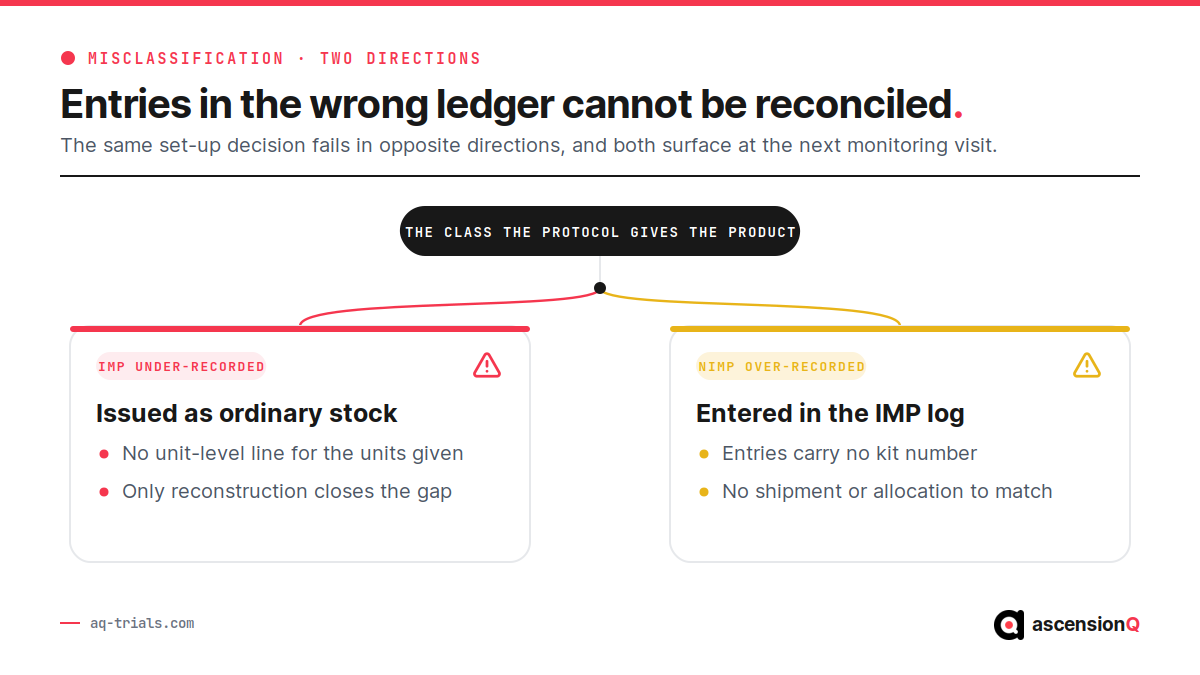
A hypothetical example shows the second direction. Study NGH-034 at Northgate General (SITE 01) names an anti-emetic as rescue medication. Pharmacy adds it to the IMP accountability log and draws supplies from ward stock as participants need them. The log now holds forty-one dispensing entries with no kit numbers, no sponsor shipment behind them and no allocation to reconcile against.
Every dose in that example reached the right participant at the right time. The record failed anyway, because a class that does not fit the product produces entries that cannot be reconciled. The correction is a set-up decision rather than a counting error. A trust’s stock control system records the comparator case the same way, and the evidence it cannot carry is set out in why a hospital pharmacy stock system is not a trial record.
A correct action in the wrong ledger is still a finding.
The cost of that correction depends on the log format, compared in paper accountability logs against an electronic pharmacy record.
What Should Pharmacy Confirm Before the First Delivery?
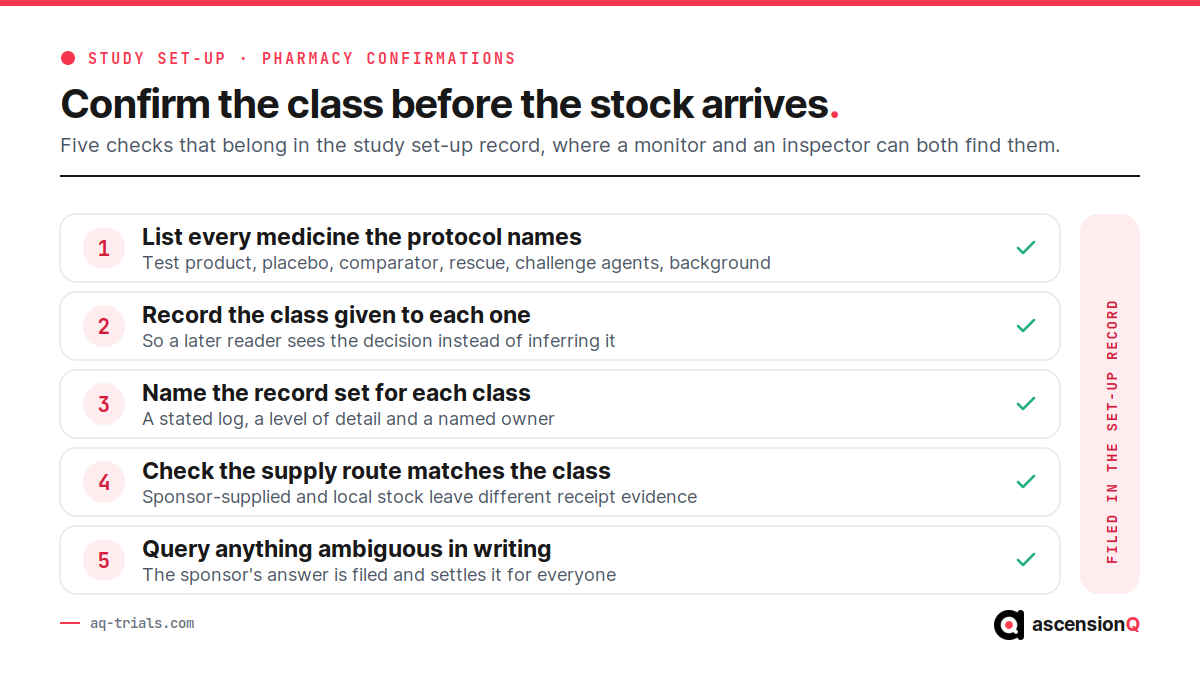
Pharmacy should confirm each product’s class, and the record set that class requires, before any stock arrives. The confirmation belongs in the study set-up record, available to a monitor and an inspector. Five checks cover it.
- List every medicine the protocol names. The list covers test product, placebo, comparator, rescue medication, challenge agents, endpoint assessment products and background treatment.
- Record the class the protocol gives each one. A later reader then sees the decision rather than inferring it.
- Name the record set for each class. Each product gets a stated log, a level of detail and a named owner before the study opens.
- Check the supply route matches the class. Sponsor-supplied and locally sourced stock leave different receipt evidence, and the log has to suit the route.
- Query anything ambiguous with the sponsor in writing. The answer becomes part of the pharmacy file and settles the question for everyone on the study.
These confirmations are filed rather than remembered. The section that holds them, and the person who signs it, are set out in what belongs in a pharmacy site file. The service that carries this work across a portfolio is described in how a clinical trial pharmacy differs from routine dispensing.
Also Read: Investigational Product Storage Records: A Compliance Checklist
Frequently Asked Questions
Who decides whether a product is an IMP or a NIMP?
The sponsor decides, and the decision travels into the clinical trial application with the protocol. Regulation 2 of the UK Clinical Trials Regulations supplies both definitions.
What makes a pharmacy record trial-grade?
It accounts for every unit individually, from receipt to destruction, and reconciles against an independent record of those units. ICH E6(R3) section 2.10.4 sets that standard for the investigational product.
Is a NIMP the lighter option for a pharmacy?
Only partly. A NIMP carries a lighter site accountability record but a comparable set of quality obligations. The reduction sits in the unit-level ledger.
A pharmacy that knows each product’s class still has to keep the resulting records in agreement with the rest of the study evidence. AQ’s electronic pharmacy site file page sets out how AQ approaches pharmacy records as part of one connected site file. Book a live demo to talk through how your pharmacy records connect to your study evidence.