A paper accountability log and an electronic pharmacy record hold the same facts about the same units of investigational medicinal product. They differ in what each can prove about how those facts arrived. A paper log carries the entry as it now reads. An electronic record carries the entry and every version before it.
That difference decides what the record costs a pharmacy. It shows when an entry is wrong, when a discrepancy surfaces months later, and when the study closes. This guide compares the two formats on five points: where errors enter, how a correction is made, what a retrospective reconciliation costs, the storage and retrieval effort, and the monitoring effort. The record set itself, and everything it reconciles against, is set out in the guide to IMP accountability in clinical trials.
- ICH E6(R3) section 2.10.4 fixes what the accountability record must contain, and it names no medium.
- Paper takes its errors at the point of writing. An electronic record takes them at the point of choosing.
- A paper correction leaves one line of history. An electronic correction leaves a version history.
- Paper costs least at set-up and most at reconciliation. An electronic record moves that effort to the front.
What Must Both Records Contain?
Both records must contain the same information. The requirement is written about content rather than format. ICH E6(R3) section 2.10.4 asks the investigator, institution or pharmacist to “maintain records of the product’s delivery, the inventory, the use by each participant … and the return to the sponsor and destruction or alternative disposition of unused product(s)”. The same clause lists the fields each record carries.
- Dates for every movement.
- Quantities at each movement.
- Batch or serial numbers.
- Expiry dates, where they apply.
- Unique code numbers for the product and the participant.
E6(R3) names no medium. A pharmacy satisfies the clause with a bound paper log, a controlled spreadsheet, or a purpose-built electronic record. The format decides how the record behaves after the entry is made. The wider pharmacy file, section by section, is set out in what belongs in a pharmacy site file.
Where Do Errors Enter Each Record?
Errors enter the two formats at different moments. A paper log takes its errors at the point of writing. An electronic record takes its errors at the point of choosing. Five paper failures recur.
- Transcription. A kit number is copied from the pack by hand, and one digit changes.
- Legibility. An entry is clear to its writer and ambiguous to later readers.
- Arithmetic. The running balance is worked out by hand, so one wrong subtraction carries forward down the page.
- Omission. A dispense happens out of hours, the log sits in pharmacy, and the entry is never written.
- Sequence. Entries go on the next free line, so a late entry sits out of order unmarked.
An electronic record removes those five and introduces four of its own.
- Selection. The wrong participant or kit is picked from a list that offers both.
- Carry-forward. A previous entry is copied as a starting point, and one field is left unchanged.
- Workaround. The system is unreachable at the moment of the action, so the entry goes on paper and is typed in later.
- Shared access. An entry is made under a login belonging to more than one person, which removes attribution. MHRA GXP data integrity guidance states that shared or generic logins “should not be used” where the system design supports individual user access.
Both sets produce a wrong record. The formats separate on what the record can tell an investigator afterwards.
Also Read: RTSM and IRT vs the Pharmacy Record: Which Holds What?
Paper Log vs Electronic Record: What Actually Differs?
The two formats differ on nine operational points.
| Operational point | Paper accountability log | Electronic pharmacy record |
|---|---|---|
| Who made the entry | Handwritten initials, read against a signature log | The named account, captured by the system |
| When it was made | The date the writer wrote down | The date and time the system recorded |
| Legibility | Varies with handwriting, degrades with each copy | Constant, whoever opens it |
| The running balance | Worked out by hand at each movement | Derived from the entries |
| Finding a discrepancy | Surfaces when a person counts and compares | Surfaces when the comparison runs |
| Making a correction | One strike-through, one set of initials, one reason | A new version, the previous one retained |
| Two people needing it at once | One volume, in one place | Concurrent access, bounded by permission |
| Retrieving one kit’s history | Read every page the kit could appear on | Filter on the kit number |
| What a monitor reviews | The pages, in pharmacy, during a visit | The record, within the access granted |
A paper log keeps the answer. An electronic record also keeps the working.
How Is a Correction Made in Each Record?
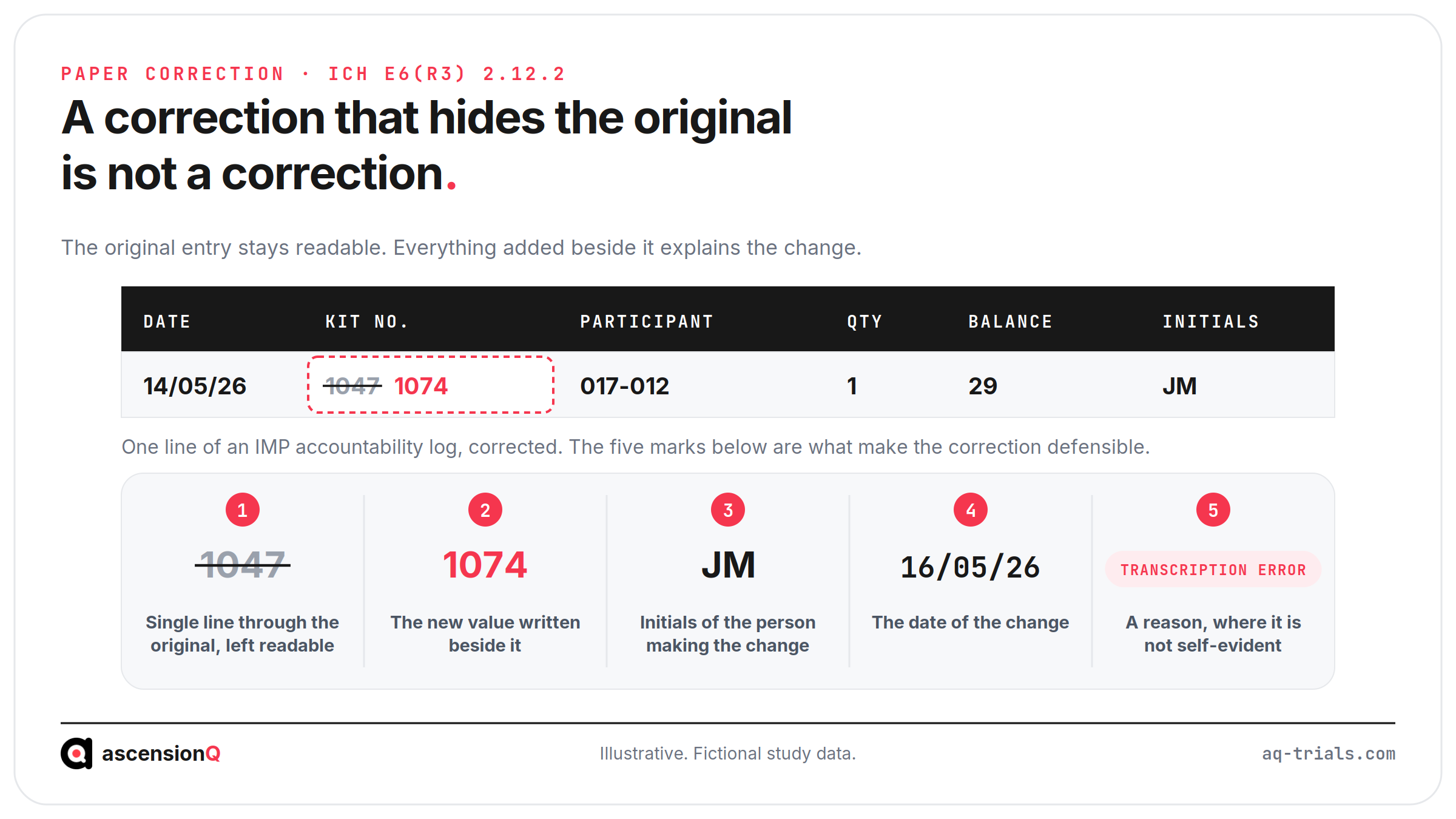
A correction on paper is made by striking the original entry once, writing the new value beside it, and initialling and dating the change. A correction in an electronic record is made by saving a new version, which leaves the previous version in place. Both routes answer the same clause. ICH E6(R3) section 2.12.2 requires that changes to source records “should be traceable, should not obscure the original entry and should be explained if necessary (via an audit trail)”. Five marks make a paper correction defensible.
- A single line through the original, thin enough to leave it readable.
- The new value, written beside the original rather than over it.
- The initials of the person making the change.
- The date of the change, which is rarely the date of the entry.
- A reason, wherever the change is not self-explanatory.
An electronic record produces those five marks as metadata. MHRA GXP data integrity guidance expects system design to provide “retention of audit trails to show all changes to, or deletion of data while retaining previous and original data”. The same guidance accepts an alternative where audit trail functionality does not exist, “for example defining the process in an SOP, and use of log books”.
The paper route stands up. It stands up while every person writing in the log applies all five marks every time, and while a second reader catches what the first missed.
What Does a Retrospective Reconciliation Cost?
A retrospective reconciliation costs more than a contemporaneous one. The evidence that explains a difference decays faster than the difference itself. An entry that disagrees with the sponsor’s supply system on the day it is made is settled by asking the person who made it. The same disagreement found eleven months later is settled by inference.
A hypothetical close-out at Northgate General shows the shape of it. On study NGH-017 at SITE 01, the paper log and the sponsor’s shipment record disagree on two kits from a month three delivery. The pharmacist who received it has left. The receipt entry carries initials and a date, and nothing else. The difference is real, unexplained, and now a finding rather than a query.
- The age of a difference decides whether the person who made the entry can still explain it.
- The density of the record decides whether an explanation exists in writing at all.
- The number of open differences decides whether the reconciliation closes before the site does.
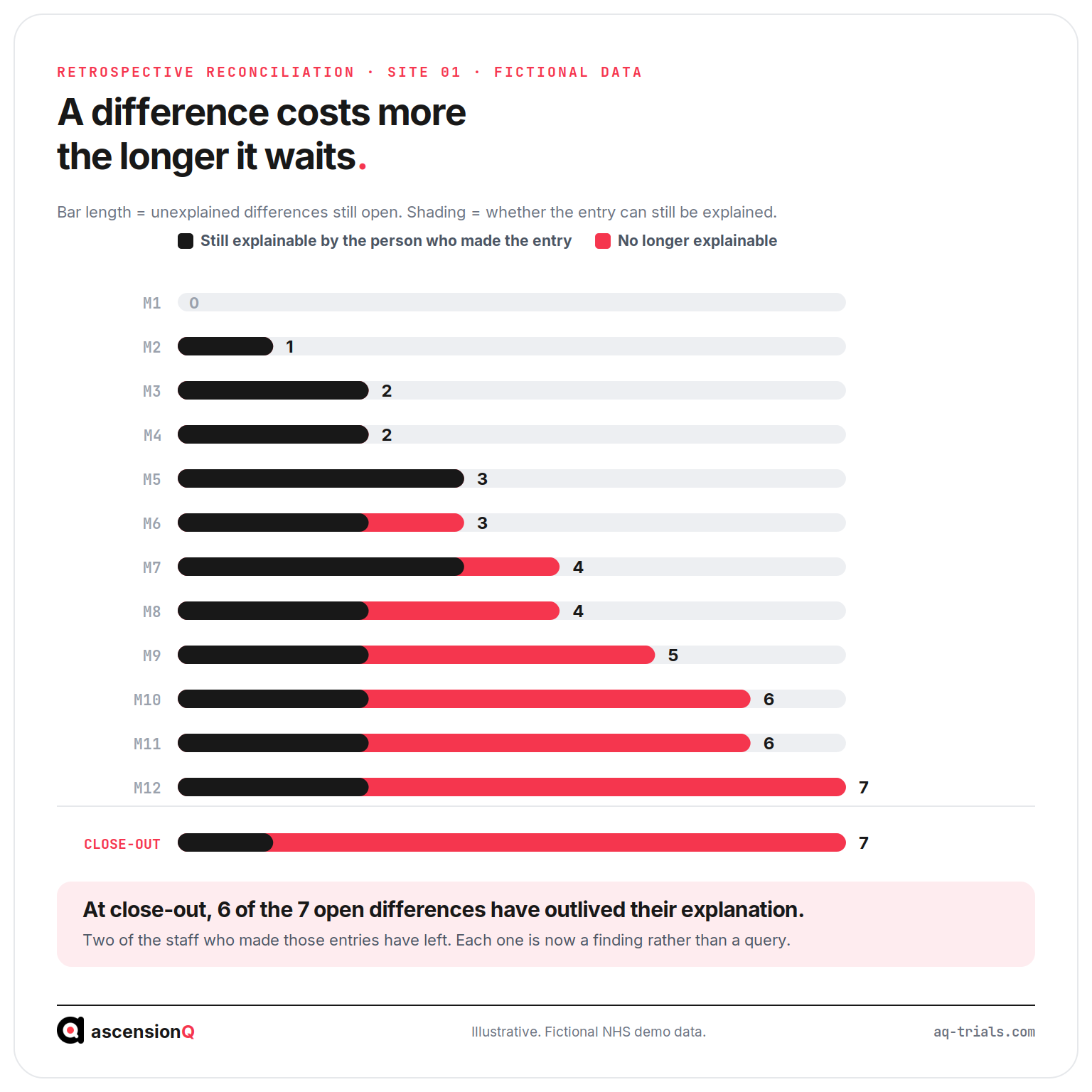
The format decides how cheaply the comparison runs, and so how short that age stays. The four checks a monitor makes are set out in the guide to IMP accountability.
How Much Storage and Retrieval Effort Does Each Carry?
Storage effort differs in kind rather than degree. A paper log is a physical object, held securely for the period the UK regulations and the sponsor require. An electronic record is a dataset, backed up and kept readable as software changes.
- Paper occupies space that grows with the portfolio. Each study adds a volume, and each volume stays for its full retention period.
- Paper exists in one copy. A lost binder is a lost record, and pharmacy holds no second source for it.
- Paper retrieval is manual. A question about one kit is answered by reading pages until it appears.
- Electronic storage moves the burden to the system. The site still produces the record, with its audit trail, in readable form for the whole retention period.
- Electronic exit is a contract question. The record must leave in a form that still opens if the supplier changes.
Temperature and calibration records follow the same logic under their own rules. The storage record set and the excursion workflow are covered in the investigational product storage records checklist.
What Does Monitoring Effort Look Like in Each Record?
Monitoring effort is the work of proving the record to someone who did not write it. ICH E6(R3) section 3.11.4.5.3 asks a monitor to confirm that receipt, storage, use, return and disposition of the investigational product are controlled and documented adequately. The question is identical in both formats. The path to the answer is not.

- Scheduling. Paper review happens while the monitor is in the building.
- Sampling. The sample is drawn from what the visit leaves time to read.
- Query turnaround. A paper query is raised in the visit report and answered at the next visit.
- Evidence of review. Paper review leaves a signature on the page. Electronic review leaves an access record.
Inspectors examine the same records afterwards, without the benefit of the visit. What auditors open first is covered in what auditors actually check in a drug accountability log, and the findings the MHRA publishes across trial documentation are set out in the most common MHRA GCP inspection findings.
Also Read: Who Is Accountable for IMP at a Trial Site?
Which Record Can a Pharmacy Defend?
A pharmacy can defend either record. The formats ask different things of the people keeping them. A paper log asks every individual for the same discipline at every entry, and relies on a second reader. An electronic record asks the organisation for control at the front: named accounts, permissions that follow the study delegation log, documented evidence that the system does what it is specified to do, and a route to get the record out again.
- Paper suits a pharmacy running few studies, with a stable team and a strong second-check habit.
- An electronic record suits a pharmacy running many studies across more than one site, where one standard has to hold without everyone in the same room.
- Both formats fail in the same place: an entry made after the action instead of with it.
The format changes what the record costs. It never changes what the record has to prove.
Frequently Asked Questions
What is the difference between a paper accountability log and an electronic pharmacy record?
Both hold the same facts about the same units of IMP. They differ in what each can prove about how those facts arrived: a paper log shows the entry as it now reads, while an electronic record also keeps who made each entry and every change.
How is a correction made in each format?
On paper, the original entry is struck once, the new value is written beside it, and the change is initialled and dated. In an electronic record, the correction is saved as a new version that leaves the original readable.
Why does a retrospective reconciliation cost more?
The evidence that explains a difference decays faster than the difference itself, so a reconciliation done later has less to work from than one done at the time.
AQ’s electronic pharmacy site file page sets out how AQ approaches pharmacy records as part of one connected site file. Book a live demo to talk through how your accountability records sit beside the rest of your study evidence.