IMP labelling requirements for UK trials are set by regulation 46 of the Medicines for Human Use (Clinical Trials) Regulations 2004, as substituted by the 2025 Amendment Regulations and in force from 28 April 2026. The regulation fixes what must appear on the packaging of an investigational medicinal product supplied to a UK site. The label carries the trial, the participant and the product on one surface, so it is the smallest part of the accountability record and the only part that travels with the medicine.
This guide covers the particulars a full UK label must show, which labelling set applies to which product, what changes on small containers and blinded packs, who may apply or change a label, and how an expiry date is extended at site. It sits under the guide to IMP accountability in clinical trials.
- Regulation 46(1) sets the full label, and regulation 46(3) and 46(4) set a reduced label for defined cases.
- Labelling belongs to the holder of an MIA(IMP), and three named operations may follow Qualified Person certification.
- An expiry extension label states the new date and leaves the original batch number readable.
- A label difference between packs can reveal a treatment arm in a blinded trial.
What Must Appear on an IMP Label in the UK?
A full UK IMP label must carry the trial, the participant, the product and its instructions for use, together with the words “for clinical trial use only”. The MHRA guidance on labelling clinical trial medicines sets out the regulation 46(1) particulars.
- Trial identity. The sponsor, a contact person, a way of reaching them and a trial reference let any holder of the pack trace it to one protocol.
- Participant link. A participant identification number, or the equivalent the protocol specifies, ties the pack to one person, which makes a per-participant accountability line possible.
- Product identity. The common name of the active substance, the strength, the pharmaceutical form, the contents and the batch or code number identify what a reconciliation counts.
- Use and handling. Directions for use, the route, the expiry date and any storage precaution tell the site how the pack is given and held.
- The child safety warning. A warning to keep the product out of the reach and sight of children applies to every full label, except where the product is given only in a hospital or health centre.
Every other trial record stays at the site. The label ships.
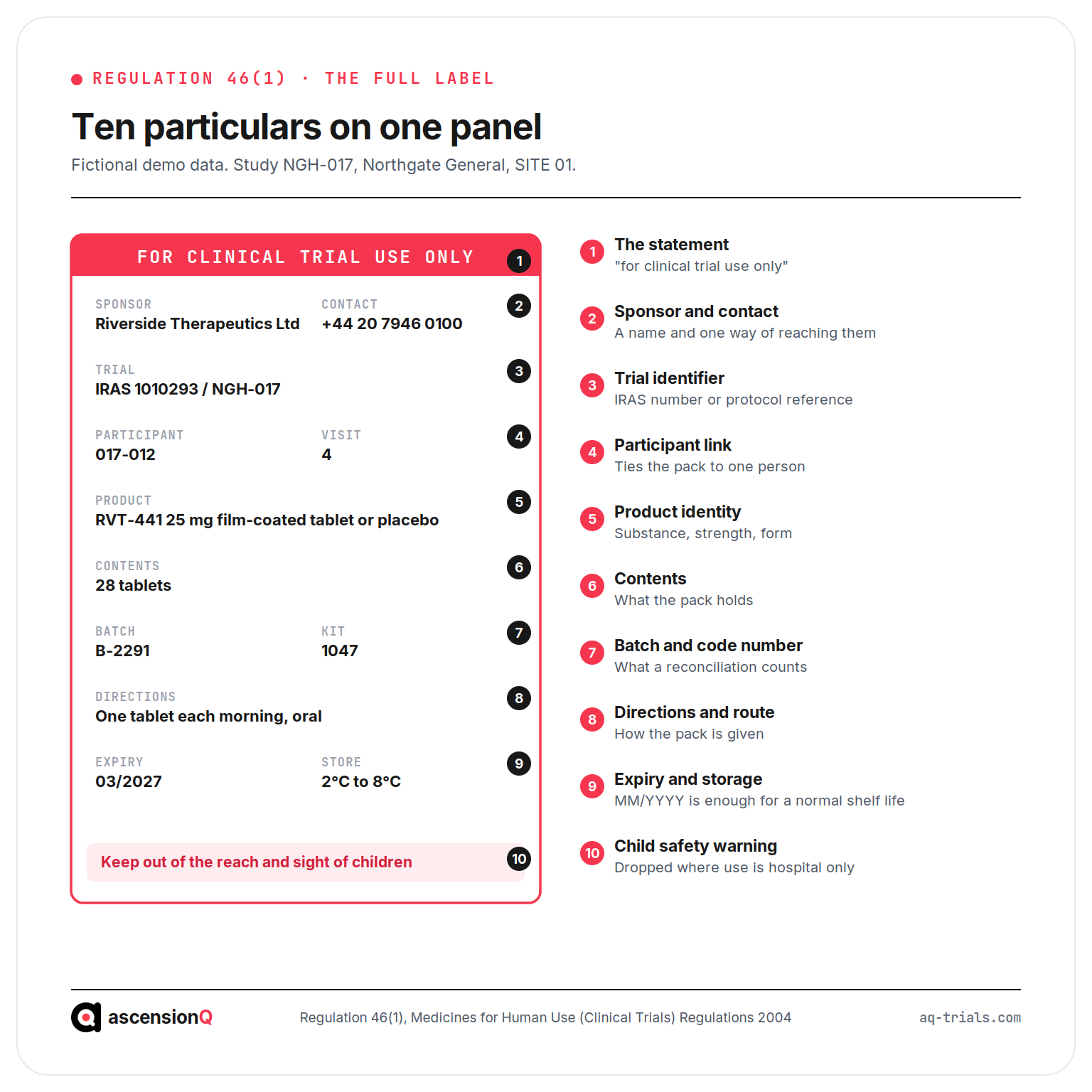
The guidance prefers the IRAS number or the protocol reference as the trial identifier, and treats a single contact telephone number as sufficient. It asks for “for clinical trial use only” rather than a local variant such as “clinical study use”. How a pack is classified under UK law is covered in what an investigational medicinal product is.
Which Labelling Set Applies to Which Product?
The labelling set a product needs follows three questions: whether it holds a marketing authorisation, whether it is used within that authorisation, and where it is administered. The MHRA publishes a decision tree for this. The table sets out the common positions at a UK site.
| Product at the site | Labelling required |
|---|---|
| Unauthorised IMP | Full set, regulation 46(1) |
| UK-authorised, unmodified, used within its authorisation | Full set, regulation 46(1), or the pharmacy dispensing label under Part 13 of the Human Medicines Regulations 2012 with trial identification, sponsor details and “for clinical trial use only” added |
| UK-authorised and given only in a hospital or health centre, or a diagnostic radiopharmaceutical | Reduced set, regulation 46(3) and 46(4), without the child safety warning |
| UK-authorised, modified or used outside its authorisation | Full set, regulation 46(1) |
| Authorised in the EU or another ICH region, not in the UK | Full set, regulation 46(1), by default, with reduced sets on request in defined cases |
| Non-investigational medicinal product | Pharmacy dispensing label with trial markers, or the full 46(1) set; the 46(3) and 46(4) reduced set is unavailable |
| Point of care product given in full immediately after manufacture | None under regulation 46B, with a participant identifier recommended |
The sponsor settles this before the trial opens. A request to depart from the standard requirements goes with the clinical trial application and carries a justification, and a change after approval is a substantial modification. The record difference between an IMP and a NIMP is covered in the comparison of IMP and NIMP records.
Also Read: What Is an Investigational Medicinal Product?
What Changes on Small Containers and Blinded Packs?
Two situations change what a label shows. Blisters, ampoules and small vials are the first. The full particulars move to the secondary packaging, and the primary container keeps what identifies the unit in the hand: sponsor and contact details, the trial identifier, the participant link, the route, the active substance with its strength and form, the contents, and the batch number. The expiry date belongs on the primary packaging unless its absence is justified.
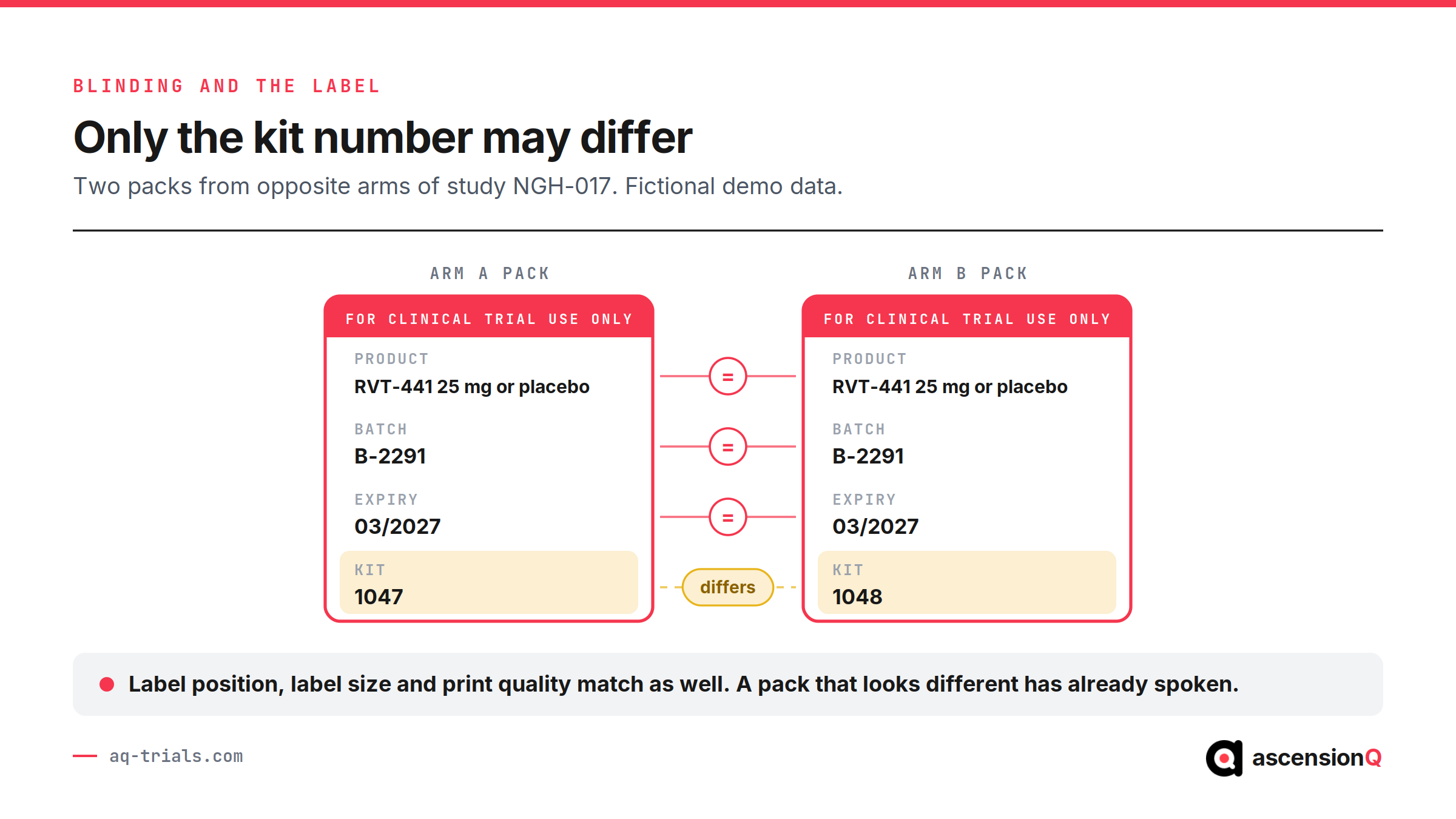
The blind is the second. A pack that differs visibly from its comparator tells a blinded observer that a difference exists, whatever the label says. The guidance sets four controls on the label.
- Batch numbers or expiry dates that differ between arms let a reader group packs by treatment, which defeats the kit numbering the record relies on. An extension applied to one arm before the other creates the same signal.
- Label position or size that varies makes two packs distinguishable across a bench without either being read.
- Print quality that varies separates a relabelled pack from an original.
- The comparator must be named, and the guidance accepts a construction such as “or placebo” where naming both would reveal the allocation.
Pharmacy holds the last chance to catch this. A technician receiving a shipment sees every pack side by side, and that is where a print difference first becomes visible. How a pharmacy keeps the blind, and what happens when it is lost by accident, is covered in blinding in the pharmacy and emergency code breaks.
Who May Apply or Change an IMP Label?
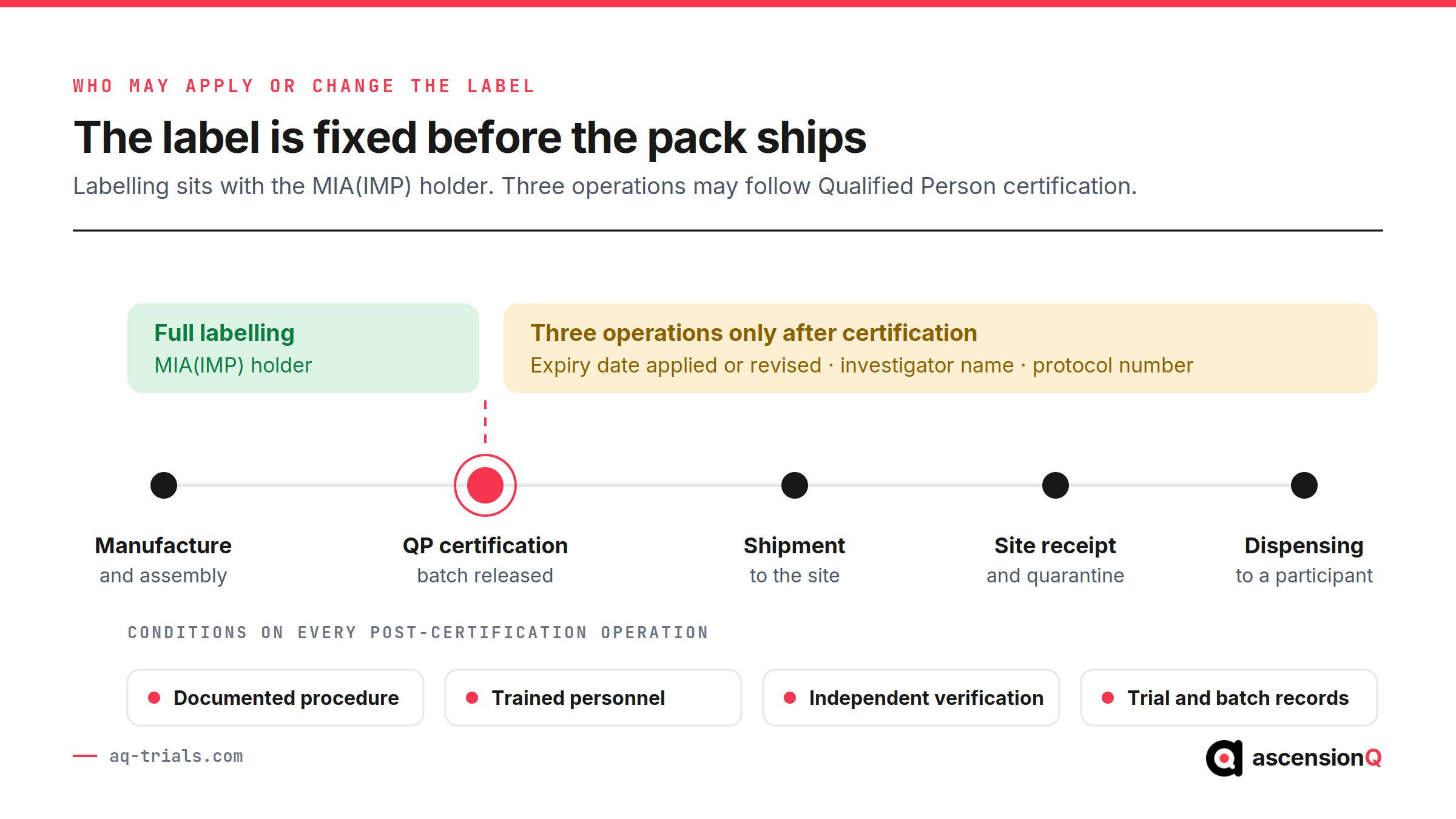
An IMP label is applied by the manufacturer or importer holding a manufacturing authorisation for investigational medicinal products, an MIA(IMP), before the Qualified Person certifies the batch. Three operations may follow certification: applying or revising an expiry date, adding the investigator’s name, and applying the protocol number. The guidance states that these should take place at a location holding an MIA(IMP) unless transport would create an unacceptable risk to product quality, and it attaches four conditions.
- A documented procedure governs the operation, so the site follows the sponsor’s written instruction rather than a local habit.
- Trained personnel perform the work, which ties the activity to the study delegation log.
- Independent verification follows, so a second person confirms each relabelled pack against the instruction.
- Full documentation lands in the trial and batch records, which proves the change was authorised and completed.
- No approval from the licensing authority is needed for the operation itself. The control is the procedure and the record.
A hospital trial pharmacy therefore relabels only where the sponsor has made that arrangement in writing and the site can meet those conditions. Responsibility for IMP management stays with the investigator throughout, as what ICH E6(R3) requires of IMP management at the site sets out. Whether the named individual was authorised and trained on the day sits behind every entry, and the authorised and trained condition covers it. Which roles hold accountability is covered in who is accountable for IMP at a trial site.
Also Read: From Depot to Patient: The Twelve Steps a Trial Medicine Takes
How Is an Expiry Date Extended at Site?
An expiry date is extended by applying a new label that states the revised date and repeats the batch number, on the sponsor’s written instruction and on the strength of stability data the sponsor holds. The operation is one of the three permitted after Qualified Person certification, so the conditions above apply in full. The mechanics of the label are specific.
- The new label may cover the old expiry date. It leaves the original batch number readable, which keeps the pack traceable to its certified batch.
- MM/YYYY is enough for a normal shelf life, and refers to the last day of the month stated.
- DD/MM/YYYY applies to a very short shelf life, where the day decides whether the pack may be given.
- A re-test date cannot stand in for an expiry date. The guidance states this directly.
A worked example shows what the record carries afterwards. Study NGH-017 at Northgate General (SITE 01) holds fourteen kits of batch B-2291 expiring 09/2026. The sponsor issues an instruction extending that batch to 03/2027 and supplies the labels. A technician labels each kit, and a pharmacist checks each pack against the instruction and signs.
The accountability line has to survive that change. The log records the fourteen kit numbers, the instruction reference, the old and new dates, who applied the labels, who verified them and when. A kit dispensed before the extension keeps its original expiry in its dispensing entry, because that is what the participant received. Storage conditions on the label are checked against the conditions the stock was held in, and the investigational product storage records checklist covers that record set.
Where Do Label Errors Break the Pharmacy Record?
Label errors break the pharmacy record where the pack and the log are supposed to say the same thing. The pack is the physical evidence. The log is the claim about it. Four failures recur at UK sites.
- A kit number on the log that differs from the pack. The transcription error surfaces at the next reconciliation, by which point the pack has gone.
- A relabelling that was never logged. The pack shows 03/2027, the log shows 09/2026, and neither explains the gap.
- A participant identifier added to the label at the clinic. The addition sits outside any procedure and traces to nobody authorised.
- A damaged or illegible label. The pack can no longer evidence its own identity, so it goes to quarantine for the sponsor to decide.
The pack and the log are one record kept in two places.
The label sample itself is a filed record. ICH E6(R3) lists a sample of the investigational product label among a trial’s essential records, and section 11.5 states that labelling should follow applicable regulatory requirements. Where the sample and the relabelling instructions sit is set out in what belongs in a pharmacy site file. The 28 April 2026 change reaches beyond labelling, and the guide to the new UK clinical trials regulations covers what else moved.
Frequently Asked Questions
Which regulation sets IMP labelling requirements in the UK?
Regulation 46 of the Clinical Trials Regulations 2004, as substituted by the 2025 Amendment Regulations and in force from 28 April 2026.
What must appear on a full UK IMP label?
The trial, the participant, the product and its instructions for use, together with the words “for clinical trial use only”.
How is an expiry date extended at site?
By applying a new label stating the revised date and repeating the batch number, on the sponsor’s written instruction and on the strength of stability data the sponsor holds.
Label samples, relabelling instructions and the kit entries they change belong to one study record. AQ’s electronic pharmacy site file page sets out how AQ approaches pharmacy documentation as part of one connected site file. Book a live demo to talk through how your pharmacy records hold together across a study.