Blinding in the pharmacy means holding the treatment allocation for every kit out of reach of the people running the trial, and releasing it for one participant when a clinical emergency requires it. The pharmacy sits on both sides of that arrangement. It accounts for every unit by kit number while the blinded team works, and it operates the mechanism that identifies a product when a treating clinician needs to know what a participant received.
This guide covers who may know what is inside a kit, what ICH E6(R3) section 2.11 requires of the site, how an emergency code break runs at a UK site, what the record captures afterwards, and the point at which an unblinding becomes a protocol deviation. It sits under the guide to IMP accountability in clinical trials, which covers the unit-level record the blind is maintained within.
- The kit number carries the accountability record, and the treatment behind that number stays with the sponsor’s system or a named unblinded person.
- ICH E6(R3) section 2.11 requires the site to be capable of unblinding “without undue delay and hindrance” from the start of the trial.
- The code break mechanism is tested before the first participant is dosed, including the out-of-hours route.
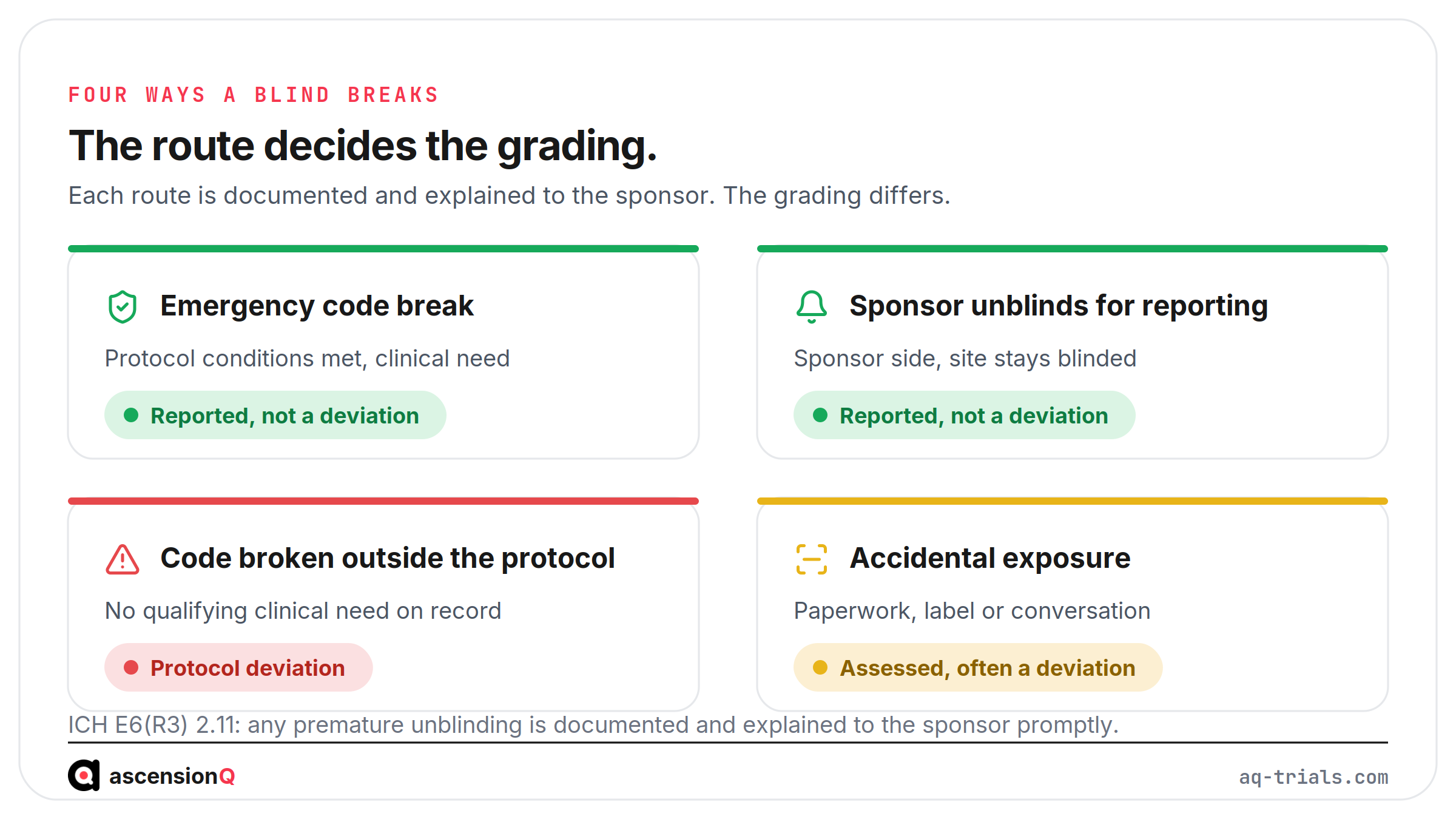
- Any premature unblinding is documented and explained promptly to the sponsor, whatever the reason for it.
Who May Know What Is Inside a Kit?
The people who may know what is inside a kit are the ones the protocol places outside the blind, and everybody else works from the kit number alone. ICH E6(R3) defines blinding as “a procedure in which one or more parties to the trial are kept unaware of the treatment assignment(s)”. A trial pharmacy usually straddles the line, because the service that dispenses to a blinded clinical team often holds unblinded information to do so.
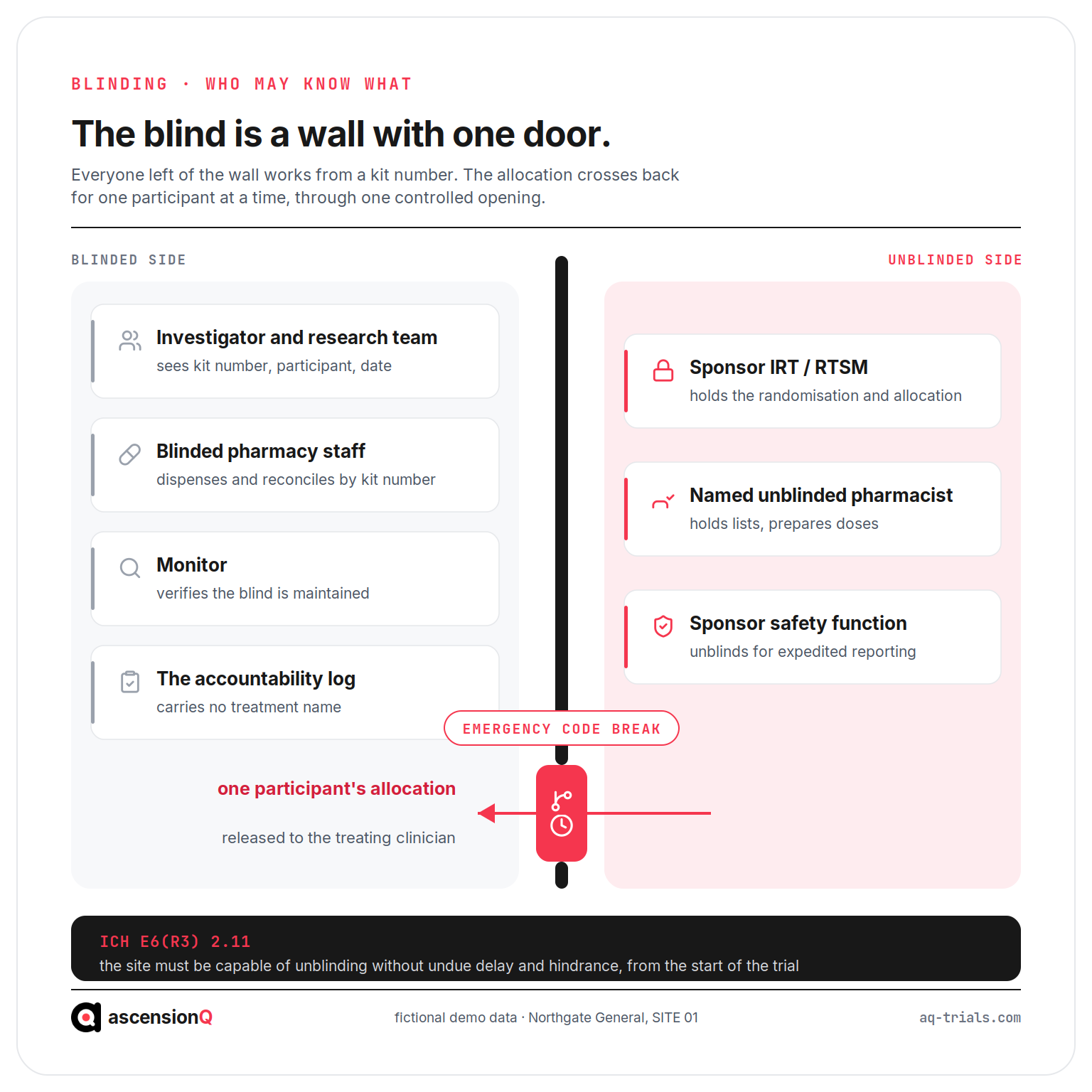
Three groups sit in different positions, and the pharmacy record has to respect all three at once.
- The blinded team. Investigators, research nurses, monitors and most pharmacy staff see kit numbers, participants and dates, which lets them run the study and reconcile stock while the allocation stays hidden.
- Named unblinded staff. An unblinded pharmacist or technician handles randomisation lists, dose preparation or code break envelopes, which is why their working records are stored apart from the blinded pharmacy file.
- The sponsor’s systems and nominated roles. The interactive response technology holds the allocation, and which record the sponsor’s IRT holds and which the pharmacy holds sets out where the boundary runs.
The blinded record proves the movement. It never names the treatment.
Separation of duties makes this workable. A pharmacy that keeps one member of staff unblinded for dose preparation keeps that person off the independent check for the same participant, so the blinded record retains a blinded signatory. Which roles hold accountability and which only record is set out in who is accountable for IMP at a trial site.
What Does ICH E6(R3) Section 2.11 Require?
ICH E6(R3) section 2.11 requires the investigator to follow the trial’s randomisation procedures and to break the treatment randomisation code only in accordance with the protocol. The section then adds a capability duty and a reporting duty. The capability duty reads: “In the case of an emergency, to protect participant safety, the investigator should be prepared and capable from the start of the trial to perform unblinding without undue delay and hindrance.”
The reporting duty follows in the same section. The investigator documents and explains any premature unblinding to the sponsor promptly, and the guideline gives accidental unblinding, emergency unblinding to protect a participant, and unblinding due to a serious adverse event as examples. Section 2.11 places the whole of this on the investigator, so a pharmacy operating the mechanism does so under delegation. The conditions attached to that delegation are covered in what ICH E6(R3) requires of IMP management at the site.
The sponsor carries matching obligations, and the site depends on them. Section 3.15.2 requires the sponsor to establish “a procedure and mechanism that permits the investigator to rapidly identify the product(s) in case of a medical emergency where unblinding is considered necessary”, together with a mechanism that protects the trial’s blind where an allocation is unblinded for safety reporting. Section 3.11.4.5.2 then puts verification that the blinding is maintained into the monitor’s task list.
UK law reinforces the guideline. Paragraph 1 of Part 2 of Schedule 1 to the Medicines for Human Use (Clinical Trials) Regulations 2004, as substituted from 28 April 2026, requires trials to be conducted in accordance with the ICH GCP Principles. Labelling rules carry their own blinding constraint, and the MHRA guidance on labelling clinical trial medicines warns that differing batch numbers or expiry dates across packs can reveal that a difference exists.
Also Read: What Does ICH E6(R3) Require of IMP Management at the Site?
How Does an Emergency Code Break Work at a UK Site?
An emergency code break works by releasing the allocation for one named participant, through a mechanism the protocol specifies, to the clinician who needs it for that participant’s care. The trigger is clinical. A treating team needs to know what a participant received because the management of an event depends on it, and the protocol sets out who may make that call.
UK sites run one of four arrangements, sometimes two in parallel for redundancy. The table sets out how each holds the code and what the site verifies before the first participant is dosed.
| Mechanism | Where the code sits | What the site verifies before first dose |
|---|---|---|
| Sponsor’s IRT or RTSM system | In the sponsor’s randomisation system, released to an authorised user | That each named user holds a live account, and that the route works outside office hours |
| Sealed code break envelopes held at site | One sealed envelope per participant, held in pharmacy or with the on-call team | That the set is complete and sequenced, and that the out-of-hours team can reach it |
| Sponsor’s 24-hour medical service | With the sponsor or its nominated provider, released by telephone | That the number is current, answered, and known to the clinical team |
| Unblinded pharmacist holding the randomisation list | With a named individual, stored apart from the blinded pharmacy file | That a trained deputy is named for absence and leave |
The capability duty in section 2.11 makes the rehearsal part of study set-up rather than a later improvement. A test transaction in the IRT, or a check that the envelope set is complete and reachable at three in the morning, is what evidences readiness. Emergency code breaking sits on the pharmacy delegation log as an activity in its own right, and the authorised and trained condition behind every pharmacy action applies to it as it applies to dispensing.
Sponsor-side unblinding runs on a separate track. The MHRA Inspectorate states that it expects “a procedure in place to protect the blind for the study team for those SARs unblinded by the sponsor for regulatory reporting purposes”. A pharmacy usually learns nothing about those cases, and that silence is the control working.
What Is Recorded After the Code Is Broken?
The record after a code break has to answer who knew what, when they knew it and why. One entry serves the sponsor’s explanation, the monitor’s verification and the inspector’s later reconstruction, so the fields are fixed before the event rather than assembled after it.
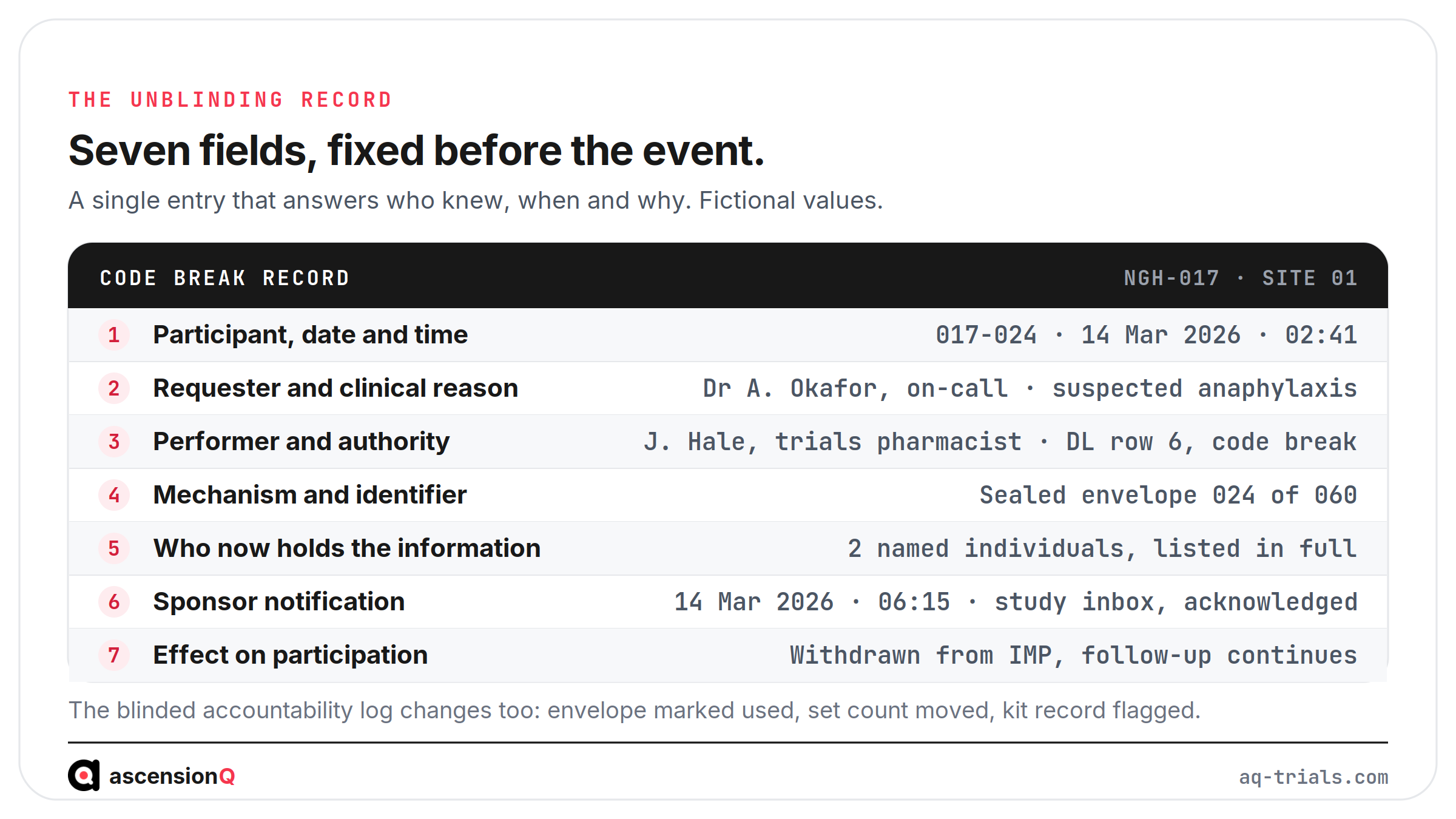
- Participant, date and time. The allocation was released for one participant at one moment, which fixes the boundary of what is now known.
- Requester and clinical reason. The named clinician and the event behind the request show that the protocol’s conditions were met.
- Performer and authority. The person who broke the code traces to the delegation log for that activity on that date.
- Mechanism and its identifier. An envelope number or an IRT transaction reference ties the entry to a physical or system event that can be verified independently.
- Who now holds the information. A list of the people unblinded limits the spread and tells the monitor which signatures remain blinded.
- Sponsor notification. The date and route of the notification evidences the promptness section 2.11 asks for.
- Effect on participation. The protocol decides whether the participant continues, and the record states the decision taken.
The blinded accountability log changes as well. A broken envelope is marked as used, the envelope set count moves, and the kit record for that participant carries a flag that an unblinding occurred. The entry belongs in the study’s pharmacy file, and what belongs in a pharmacy site file places it alongside the delegation and accountability sections.
Also Read: Who Is Accountable for IMP at a Trial Site?
When Does an Unblinding Become a Protocol Deviation?
An unblinding becomes a protocol deviation when the code is broken outside the conditions the protocol sets, or when the blind is lost through a failure of the controls. A code break performed correctly for a genuine clinical emergency follows the protocol, and it is reported rather than treated as a breach. Four routes recur at UK sites.
A hypothetical example shows how the fourth route arrives without anyone deciding anything. Study NGH-017 runs at Northgate General (SITE 01). A replacement shipment arrives with a delivery note listing two product descriptions against consecutive kit numbers. A blinded pharmacy technician files the note in the study folder. Two weeks later a monitor reads the same note and can infer the arm for two participants.
Nobody broke a code. The blind broke anyway.
The site documents the event, explains it to the sponsor, and records which individuals were exposed. The sponsor assesses the effect on the data for those participants. A cause that would recur, such as a shipping paperwork step that never passed through an unblinded reviewer, moves into the site’s corrective and preventive action process. Findings of this kind at inspection are covered in the guide to the most common MHRA GCP inspection findings.
Frequently Asked Questions
Who may know what is inside a blinded kit?
Only the people the protocol places outside the blind. Everybody else works from the kit number alone.
How does an emergency code break work at a UK site?
The allocation is released for one named participant, through the mechanism the protocol specifies, to the clinician who needs it for that participant’s care. The trigger is clinical.
When does an unblinding become a protocol deviation?
When the code is broken outside the conditions the protocol sets, or when the blind is lost through a failure of the controls. A code break performed correctly for a genuine clinical need is not a deviation.
Retrieval time is the practical test. An inspector asks for every unblinding on a study and expects the requests, authorities, notifications and accountability flags to line up without a search through three filing systems. AQ’s electronic pharmacy site file page sets out how AQ approaches pharmacy records as part of one connected site record. Book a live demo to talk through how your unblinding records sit alongside the rest of your study evidence.