The UK clinical research delivery key performance indicators exclude studies on four separate grounds: the type of study, the completion of the step being measured, the state of the recorded data, and membership of the national portfolio. The published methodology names the grounds that apply to each indicator. A study can sit outside a headline figure with no judgement having been made about how well it was set up.
Three exclusions are named by study type: rare disease studies, other low recruitment studies, and extension studies. Two further grounds remove studies mechanically. An indicator that measures a completed step counts only the studies that completed it, and an indicator built on recorded dates drops any study whose dates are missing or out of sequence.
This guide sets out what the seven indicators measure, which studies each one excludes and on what published basis, which periods of time are removed from the clocks themselves, which research never enters the measurement at all, and what an NHS research office should read from its own portfolio as a result.
Key takeaways
- The 150-day indicator excludes rare disease, low recruitment and extension studies, along with advanced therapy trials and the entire non-commercial portfolio.
- The two local indicators count only studies that recorded the step. A study that never opened leaves the population rather than scoring against the target.
- A missing date or an out-of-sequence date removes a study from the count, so record keeping and delivery performance are indistinguishable in the published figure.
- The regulatory clocks pause while an applicant answers a request for further information. The measured duration is shorter than the elapsed time.
- Every indicator draws on CPMS, so a study never adopted onto the NIHR RDN Portfolio appears in none of them.
- Exclusions carry money. NIHR RDN payments to sites in England take the site-level exclusions into account.
What Do the UK Trial Set-Up KPIs Measure?
The Department of Health and Social Care publishes seven indicators covering the journey from a regulatory application to a recruiting study. Four of them are time-bound clocks with targets. The remaining three describe volume and delivery against plan. Each one carries its own eligible population, and the populations differ from each other.
| Indicator | What it measures | Target | Latest published |
|---|---|---|---|
| 1. 150-day set-up | First participant within 150 days of applying for regulatory approval | 95% | 100% |
| 2. Combined review | Approval within 60 days, or 90 days for advanced therapy trials | 99% | 98% |
| 3. Opening to recruitment | Study open within 60 days of the approval letter | 90% | 56% |
| 4. First participant | First participant within 30 days of opening | 90% | 61% |
| 5. Recruitment to time and target | Open studies on track against plan | 80% | 82% |
| 6. Monthly recruitment | Average monthly participants across all clinical studies | No target | 77,862 |
| 7. New portfolio studies | Studies added to the NIHR RDN Portfolio | No target | 181 |
Five of the seven carry explicit exclusion rules in the methodology. The rules differ enough that the same study can be inside one indicator and outside the next. A full reading of the current figures sits in the UK clinical research delivery KPI breakdown, and this guide covers the population behind them.
Which Studies Are Excluded by Study Type?
The methodology for the 150-day indicator excludes “studies where recruitment of the first participant is not expected within 150 days of applying for regulatory approval (that is, rare disease and other low recruitment studies, extension studies and studies where the sponsor has notified NIHR RDN as such)”. The same three categories reappear in the site-level guidance published by the UK Clinical Research Delivery group, and that guidance attaches a numeric definition to two of them.
| Category | Published definition | Where the exclusion applies |
|---|---|---|
| Rare disease study | A condition affecting 5 or fewer people per 10,000 of the UK population | 150-day indicator, the 30-day first participant metric and the combined 90-day site metric |
| Low recruitment study | A study expected to recruit fewer than one participant per month | 150-day indicator, the 30-day first participant metric and the combined 90-day site metric |
| Extension study | A continuation of an existing study rather than a new recruiting trial | All of the above, and also the 60-day site set-up metric |
| Advanced therapy trial | An advanced therapy investigational medicinal product study | Outside the 150-day indicator, and allowed 90 days rather than 60 for combined review |
| Non-commercial study | A study without a commercial contract sponsor | Outside the 150-day indicator entirely |
The 60-day site set-up metric applies a narrower rule than the two that follow it. It excludes extension studies alone, so a rare disease study is measured on how long it takes to contract and confirm, then drops out of the measure of how long it takes to recruit. One study can therefore appear in a trust’s set-up figure and be absent from its recruitment figure.
These categories carry a financial consequence as well as a reporting one. The site-level guidance states that for sites in England, the exclusions are also taken into account in payments from the NIHR Research Delivery Network. An exclusion decision therefore changes both the number a trust is judged on and the money attached to it.
Also Read: Hitting the 150-Day Study Set-Up Target: An NHS R&D Playbook.
Why Does an Unfinished Step Remove a Study From the Count?
The largest exclusion in the whole set carries no category name. Four of the seven indicators count only the studies that completed the step being measured, so a study still in progress leaves the population instead of counting against the target. The methodology is explicit about it for each one.
- Combined review. The indicator “does not include studies that did not receive combined review approval”, so the denominator holds approvals rather than applications.
- Opening to recruitment. “Only studies that have recorded opening to recruitment are included”, and studies that have not yet opened are excluded.
- First participant. “Only studies that have reported recruiting their first participant are included”, so a study open for eight months without a participant sits outside the figure.
- New portfolio studies. Studies “are removed from the indicator if they are withdrawn from the NIHR RDN Portfolio during the set-up phase and do not progress”.
The indicators describe the studies that finished the step. The studies that stalled leave the page.
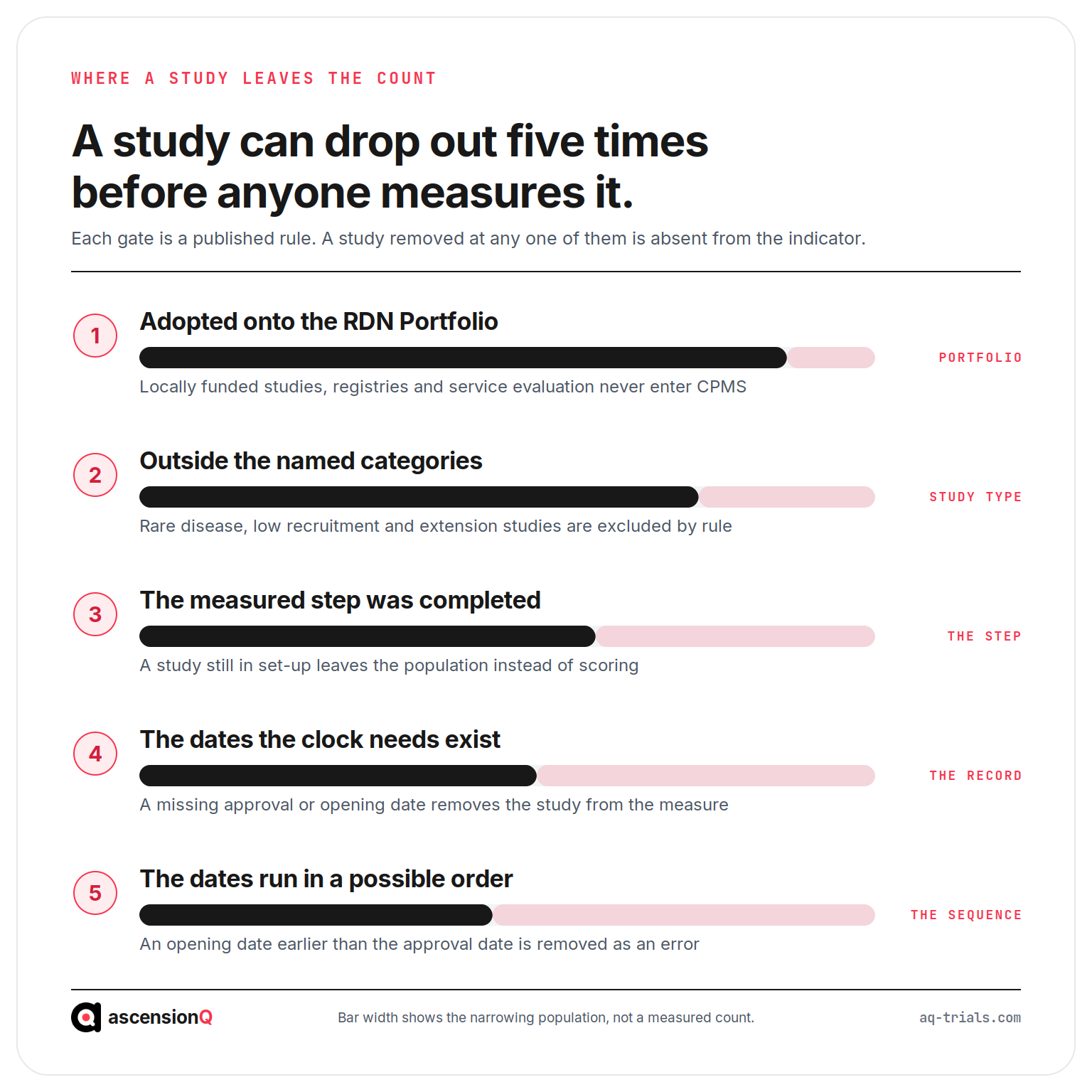
An illustrative case makes the arithmetic visible. A trust opens eight commercial studies in a reporting year. Two are extension studies and one is a rare disease study, which removes three of them from the 30-day recruitment measure. Two more remain in set-up at the reporting date with no recorded opening date, which removes them from the 60-day measure. Three studies then carry the published figure for a portfolio of eight, and the two that are still stuck contribute nothing to it.
The direction of the effect matters for anyone reading a number. The removal of incomplete studies raises a percentage whenever those studies are the slow ones, which is the usual case. A published figure at 56% describes the studies that opened, and the studies that never opened sit outside it.
What Happens When a Date Is Missing or Out of Sequence?
The indicators are calculated from dates entered in the Central Portfolio Management System. The methodology applies three data rules that remove studies before any performance is calculated, and each rule acts on the record rather than on the delivery behind it.
- An unrecorded approval date removes the study. Studies that have not recorded their HRA approval date are not included in the 60-day opening measure, so the segment cannot be calculated at all.
- An unrecorded opening date removes the study. The same rule applies to the 30-day measure, which needs an opening date to start its clock.
- An impossible sequence removes the study. Studies recording an opening date earlier than their approval date are removed, and studies recording a first participant date earlier than their opening date are removed on the same logic.
The methodology also states the underlying cause plainly: “many of the data fields relevant to the indicators are not mandatory and are sometimes incomplete”. A trust with a data entry backlog and a trust with a genuine set-up delay produce the same absence in the published table. The published figure cannot separate them, and only the local record can.
Also Read: CPMS and LPMS: What Sites Must Enter and When.
Which Time Is Excluded From the Clock Itself?
Two of the clocks stop and restart during the period they appear to measure. The excluded time is real elapsed time for the sponsor and the site, and it sits outside the published duration by design in both cases.
| Clock | Time that counts | Time removed | Reason given |
|---|---|---|---|
| Combined review | MHRA and REC joint assessment, including the decision after a response | The applicant’s time answering a request for further information | The measure covers regulator assessment time |
| Site set-up, from January 2026 | Site selection through to the last contract signature | The period between site confirmation and the sponsor green light | The period is outside the control of the site |
The methodology states the regulatory rule directly: “the clock stops once the applicant has been sent a RFI and starts again once a complete response has been submitted”. A study that takes four calendar months from application to approval can therefore report a compliant 60-day review, and both statements are accurate against their own definitions.
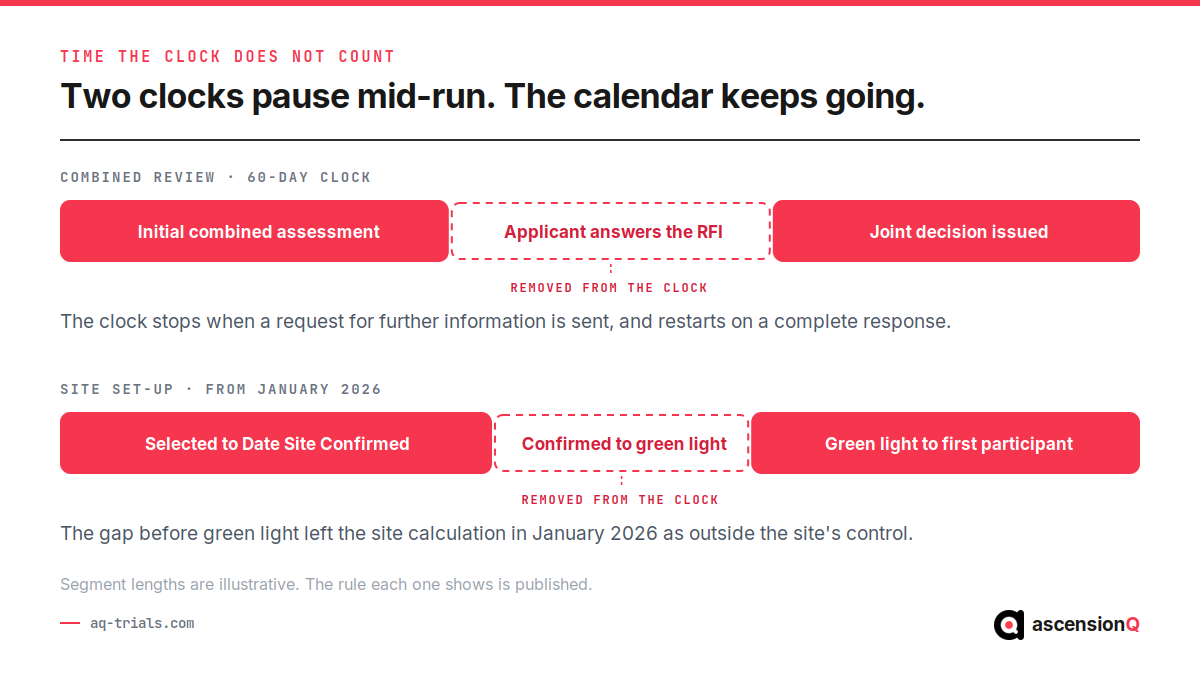
The site-level change has the same shape and a different owner. The gap between Date Site Confirmed and the sponsor green light left the site calculation in January 2026, which removes a real waiting period from the reported figure. A site reading only its published number will not see that waiting period at all.
Which Studies Never Enter the Measurement at All?
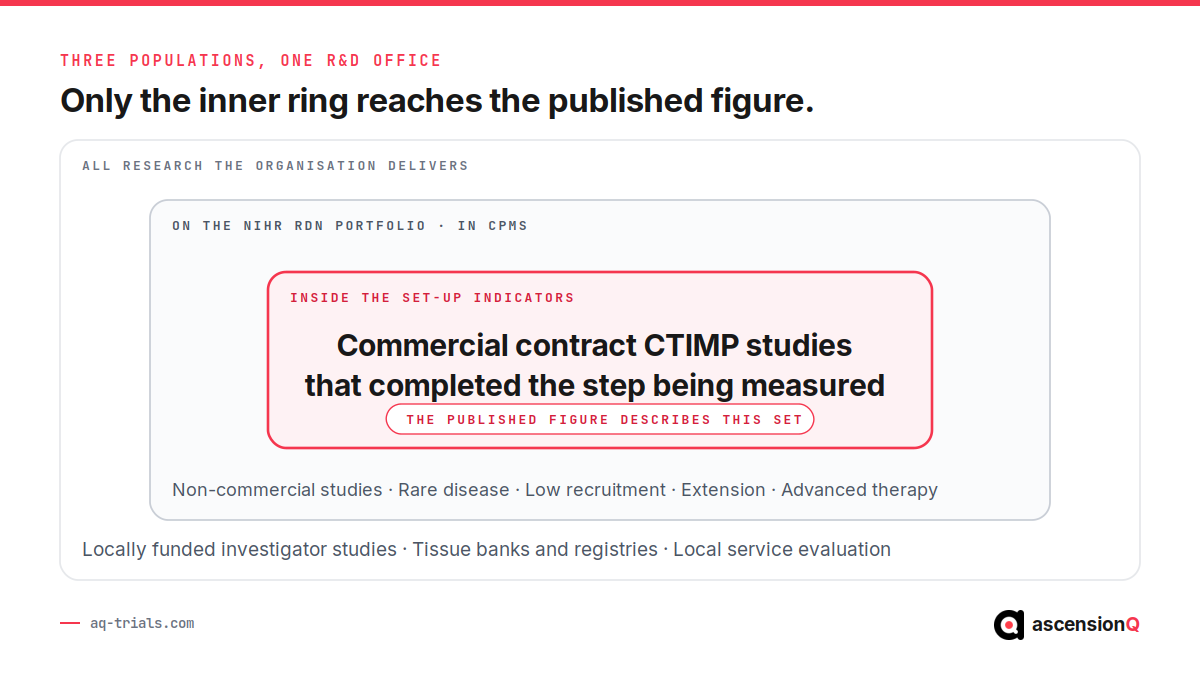
Every indicator except combined review is calculated from CPMS, the national record of studies on the NIHR RDN Portfolio. Portfolio adoption is therefore the first gate, and a study that fails it is absent from the entire measurement system rather than excluded from one indicator. NIHR publishes the eligibility criteria, and several common categories of research fall outside them.
- Studies funded by the host organisation. University, college and NHS trust funded studies do not fulfil the criteria for NIHR RDN Non-commercial Partner status, which excludes a large share of investigator-initiated work.
- Tissue banks and disease registries. A bank or registry established without a research question does not, in itself, constitute a research project.
- Local service evaluation. Evaluation of a service in a single organisation falls outside the definition unless the outcomes are extrapolatable to a broader patient population.
- Studies close to completion. A study in the final six months of recruitment is ineligible, on the basis that there is insufficient time for network support to have an effect.
The consequence for a research office is a matter of scale. A trust running a commercial portfolio alongside investigator-initiated and locally funded research is measured on one part of its workload, and it staffs, contracts and governs all of it. The academic research portfolio in particular sits largely outside the published indicators while consuming the same set-up capacity.
How Should a Research Office Read Its Own Numbers?
The exclusions are legitimate and they are published, so the useful response is to read the national figure for what it describes and to hold a second view locally. Five practices follow from the rules above.
- Count the excluded studies separately. A list of studies removed by category, by incompleteness and by missing data turns an unexplained gap between local reality and the published table into a reconciled one.
- Treat a missing date as an open action. A date absent from CPMS removes the study from the measure and from the funding calculation behind it, so the entry task carries the same weight as the delivery task.
- Track elapsed time as well as measured time. The clocks pause and the calendar does not, so a site holding its own dates can see the waiting the indicator removes.
- Read the trust-level report with its threshold in mind. The published report separates organisations delivering three or more studies from those delivering two or fewer, because smaller samples produce disproportionate variation in a percentage.
- Record the reason for a delay locally. The site-level guidance states that reasons for delay are not included in published reports or factored into performance-related funding in England, which leaves the local record as the only place the explanation survives.
A national indicator reports a filtered population. A research office runs the unfiltered one.
Also Read: CTMS vs Spreadsheets: Why Site Capacity Planning Breaks Without One.
What Should a Trust Be Able to Evidence?
The same dates serve three audiences: national reporting, sponsor site selection and an MHRA inspection. A single dated record satisfies all three, and separate spreadsheets per audience produce the reconciliation problem the exclusions then obscure.
- Every milestone date with an owner and an audit trail, covering site selection, capacity and capability confirmation, Date Site Confirmed, green light, site open and first participant first visit.
- The exclusion status of each study, recorded against the study rather than remembered, so a reported figure can be reconstructed months later.
- The full portfolio in one view, commercial and non-commercial together, because the studies outside the indicators still consume set-up capacity.
- Cost attribution evidence for non-commercial work, which the SoECAT carries and which no national delivery indicator reports.
- A dated reason against each stalled study, held locally, since the published report will not carry it.
Teams selecting a system to hold this record should test it against national reporting and inspection at the same time. The 2026 buyer’s guide for NHS trusts covers the reporting and assurance questions, and inspection-ready study management covers the evidence side.
How Does AQ Support Portfolio-Level Set-Up Reporting?
AQ Trials holds set-up as one dated record across every study an organisation runs, including the studies no national indicator reports.
The CTMS records each milestone with its date and its owner, which makes days elapsed a live figure rather than a retrospective calculation, and it holds commercial and non-commercial studies in the same portfolio view. Study-level fields carry the exclusion category and the reason for a delay, so the difference between a local position and a published table can be reconstructed rather than argued. The electronic Investigator Site File keeps essential documents, delegation and training evidence current, which is what a green light decision rests on. The electronic Pharmacy Site File tracks the pharmacy set-up that often gates that decision. Live recruitment visibility covers the thirty days between opening and a first participant. Each of those dates is the evidence an NHS research office reports upward and an inspector reads later.
- One dated milestone per study and site, which allows a national return and a local position to be produced from the same record rather than reconciled after the fact.
- An exclusion category held on the study, which allows a published figure to be reconstructed months later without a reconstruction exercise.
- Commercial and non-commercial studies in one portfolio view, which allows set-up capacity to be planned against the whole workload rather than the reported part of it.
AQ does not set the exclusion rules or enter data into CPMS on a trust’s behalf. It gives a research office one dated, owned view of every study it runs, which is the view the national indicators were never designed to provide. Book a live demo to see how AQ tracks set-up across a full research portfolio.
Frequently Asked Questions
Which studies are excluded from the 150-day set-up target?
Studies where recruitment of a first participant is not expected inside 150 days are excluded, which the methodology defines as rare disease studies, other low recruitment studies, extension studies, and studies the sponsor has notified to the NIHR RDN. Advanced therapy trials and non-commercial studies also sit outside the indicator.
What counts as a rare disease or low recruitment study?
The site-level performance reporting guidance defines a rare disease as a condition affecting 5 or fewer people per 10,000 of the UK population, and a low recruitment study as one expected to recruit fewer than one participant per month.
Does a study that never opens count as a failure in the KPIs?
No. The 60-day opening indicator includes only studies that have recorded opening to recruitment, and the 30-day indicator includes only studies that have reported a first participant. A study that never reaches the step leaves the population rather than scoring against the target.
Are non-commercial studies included in UK set-up reporting?
Non-commercial studies sit outside the 150-day indicator, which covers commercial contract trials of investigational medicinal products. Non-commercial studies on the NIHR RDN Portfolio do appear in the portfolio-wide indicators for recruitment and new studies added.
Why can a 60-day regulatory clock take longer than 60 days?
The combined review clock pauses once a request for further information is sent and restarts when a complete response is submitted. The applicant’s response time is real elapsed time and sits outside the measured duration.
Sources
- UK Clinical Research Delivery key performance indicators: methodology (GOV.UK)
- UK Clinical Research Delivery key performance indicators: data to July 2026 (GOV.UK)
- Guidance on detailed definitions and processes for site-level performance reporting (UKCRD)
- Study Set-Up: Trust level set-up report (UKCRD)
- Study eligibility for Research Delivery Network support: FAQs (NIHR)