“We’re looking for a trial platform with AI features.” A UK research site buys four of them in practice: drafting, document classification, cross-record flagging and natural-language retrieval. Each one reaches a named role, proposes something, and waits for that person to confirm it. Recruitment and protocol models belong to the sponsor.
That is the site-side inventory in full, and it is shorter than a vendor feature list suggests. This guide sets out what each of the four does for a research nurse, a principal investigator, a trial pharmacist and a quality assurance lead across a working week, and which advertised capabilities a site never buys at all. The stage-by-stage view of the same ground, from set-up to close-out, sits in How is AI used in clinical trials?. Evaluation of a platform against those features is a separate exercise, covered in the guide to AI for compliance and inspection readiness.
- A feature only counts at site level where a person on the delegation log touches it and signs for the result.
- Three of the capabilities that dominate search results for AI in clinical trials serve a sponsor’s decisions. A site reads their output and buys none of them.
“We’re Looking for a Trial Platform with AI Features”: The Four a Site Actually Buys
That sentence opens most of these procurements. It invites a demonstration of everything a platform can do, and a site then evaluates capabilities nobody at the site will ever open. A UK research site shortlisting an AI clinical trial platform should start from four feature classes, which account for almost all genuine site-side use. Each one produces a proposal rather than a record.
| Feature class | What it produces | Who touches it most | What that person confirms |
|---|---|---|---|
| Drafting | A first version of narrative text, built from records the site already holds | Research nurse, trial pharmacist | The wording, before it becomes part of the record |
| Document classification and filing | A proposed document type and a proposed filing location | Research nurse, quality assurance lead | The type and the location, per document |
| Cross-record flagging | A signal that two records disagree, or that one is absent or out of date | Quality assurance lead, principal investigator | Whether the signal is a quality issue, with a reason |
| Natural-language retrieval | An answer assembled from records the user already has permission to see | All four roles | The source record the answer points to |
Several items sold alongside these four run on fixed rules rather than a model. A visit-window alert that fires on a date is automation, and it carries a different evidence burden from a proposal that varies with its input. The guide to automation versus AI in a trial platform classes a platform’s features one by one.
AQ’s AI proposes, flags and drafts across all four classes, and a named person reviews and confirms before anything becomes part of the record.
A site buys the AI that four named people touch. The rest of the feature list belongs to somebody else.
Do AI Features in Trial Platforms Help Sites or Sponsors?
Most published AI capability in clinical research serves a sponsor’s decisions. Patient recruitment modelling, site selection and protocol design all sit with the organisation that designs and funds the trial, and a research site holds none of those decisions. ICH E6(R3), adopted on 06 January 2025, places trial design with the sponsor at section 3.1.2, which requires sponsors to “incorporate quality into the design of the clinical trial by identifying factors that are critical to the quality of the trial”, and at section 3.1.4, which requires the sponsor to “ensure that all aspects of the trial are operationally feasible”.
The regulators frame AI the same way. EMA and the FDA published ten joint principles for good AI practice on 14 January 2026, and the EMA announcement describes their scope as “AI use in evidence generation and monitoring across all phases of a medicine, from early research and clinical trials to manufacturing and safety monitoring”. Evidence generation across a medicine’s lifecycle is a sponsor programme. A site contributes records to it.
| Advertised capability | Whose decision it serves | Why a site never buys it | What the site buys instead |
|---|---|---|---|
| Patient recruitment and pre-screening models | The sponsor’s enrolment forecast across a portfolio of sites | The model runs on population or multi-site data a single site does not hold | Drafting and retrieval against its own screening log, so a screening record is written once |
| Site selection and feasibility scoring | The sponsor’s choice of which sites to place a trial with | A site is the subject of the score rather than its user | Drafting support for its own feasibility response, confirmed by the research team |
| Protocol design and amendment modelling | The sponsor’s design decisions under section 3.1.2 | The site receives the protocol and implements it | Cross-record flagging that compares site records against the protocol version in force |
| Central statistical monitoring | The sponsor’s or the contract research organisation’s oversight of data across sites | The analysis needs the pooled dataset | Its own quality signals, raised on records the site owns |
AI assistants answering a site’s question tend to return the sponsor list, because that is where the published material sits. A site reading a vendor’s AI page should sort every feature into one of two piles first: decisions my team makes, and decisions made elsewhere that arrive as instructions.
Which AI Features Does a Research Nurse Actually Use?
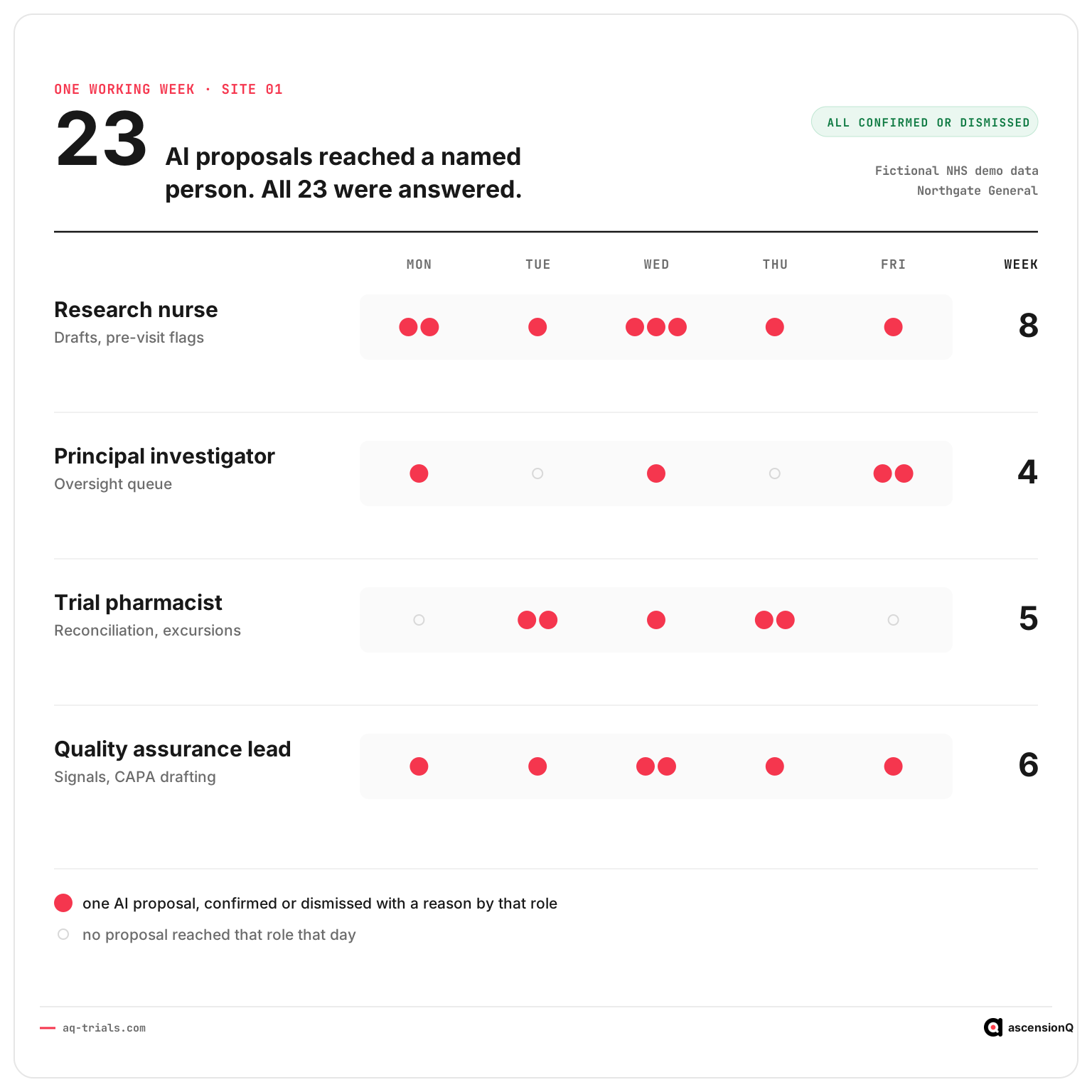
AI for research nurses earns its place in the minutes between a participant leaving and the next one arriving. Three uses recur across a working week, and all three end with the nurse confirming something.
- Drafting a visit record or a deviation description. The draft is assembled from the source entries already made, so the nurse edits and confirms wording rather than composing it from a blank field. The confirmed text is the record, and the draft is not.
- A pre-visit completeness check. A flag raised the day before a visit names the consent version in force, the delegation covering the planned activities and any certificate expiring inside the visit window. The nurse acts on it before the participant arrives rather than at monitoring.
- Retrieval in the nurse’s own words. A question such as “what is the window for visit four on this protocol” returns the answer with the protocol section behind it. The source record is the thing the nurse checks, so the answer is a route to evidence rather than the evidence itself.
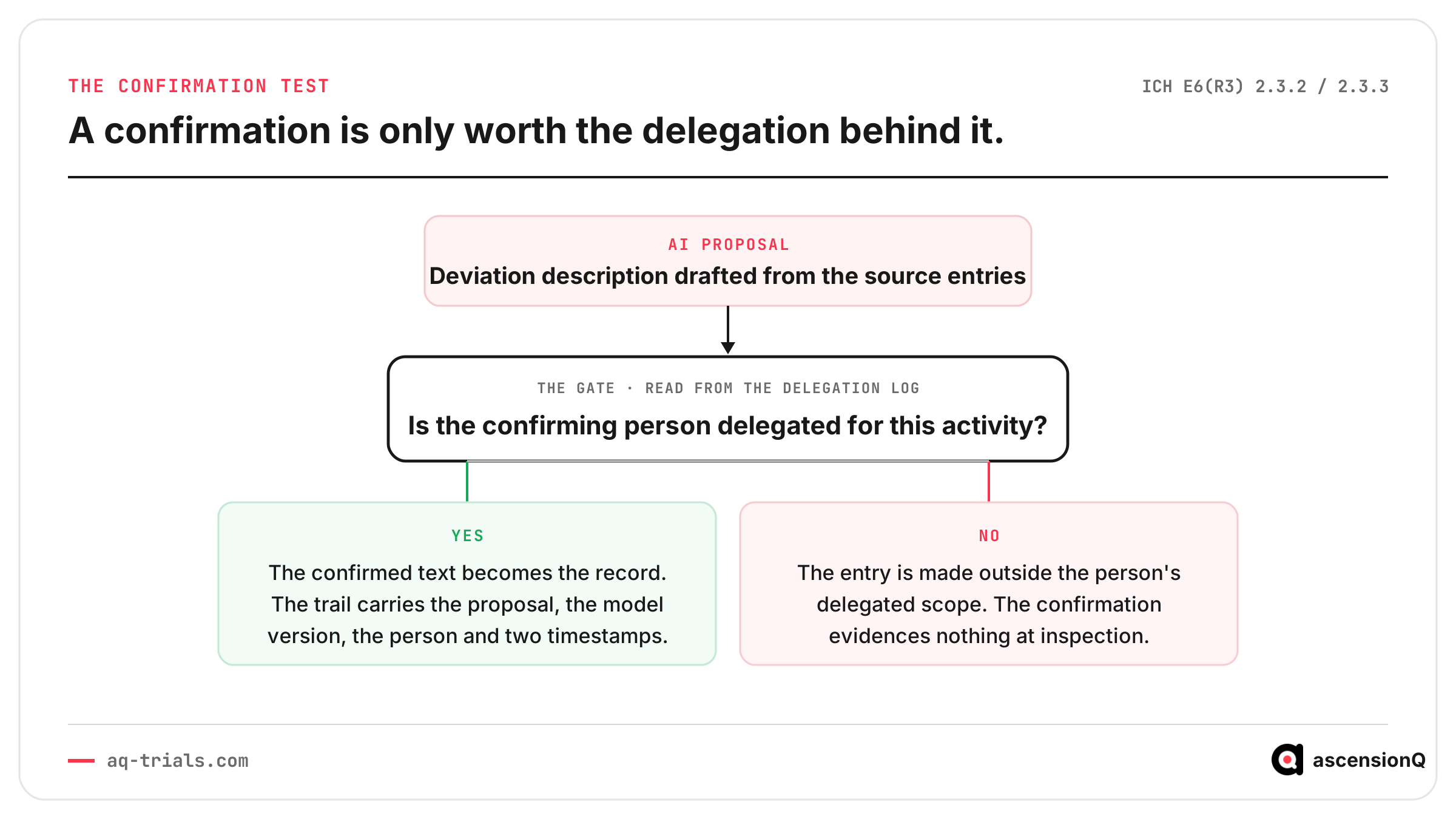
One constraint governs all three. ICH E6(R3) section 2.3.2 requires the investigator to ensure that persons to whom activities are delegated “are appropriately qualified and are adequately informed”, and section 2.3.3 requires a record to be maintained of those persons and parties. A nurse confirming an AI proposal for an activity outside her delegated scope produces a confirmation that evidences nothing, so the feature is only usable where the delegation of authority record authorises that person for that activity.
Also Read: Is It Safe to Use AI in GxP Clinical Trial Systems? What MHRA Expects sets out the activity-by-activity line between what a model may propose at a site and what it must never do.
What AI Does a Principal Investigator Use?
A principal investigator uses one feature heavily and the rest barely at all. The heavy use is the oversight view: the short list of items waiting on a confirmation only the investigator can give, ordered by what reaches a participant first.
- An oversight queue rather than a dashboard. Section 2.3.1 of ICH E6(R3) states that the investigator who delegates activities “retains the ultimate responsibility and should maintain appropriate oversight”. A queue of named decisions evidences that oversight. A completeness percentage does not.
- Deviation significance proposals. A flag arrives with the deviation, the protocol section it departs from and the records compared. The investigator determines whether the deviation is important, and that determination is a judgement the model never makes.
- Nothing at all in the clinical decision. Section 2.7.1(a) requires that “a qualified physician or, where appropriate, a qualified dentist who is an investigator or a sub-investigator for the trial should have the responsibility for trial-related medical care and decisions”. Eligibility, dose and safety sit outside the feature set entirely.
The signals that reach this queue come from comparisons across records rather than from inside one module. Which four patterns those are, and the record that confirms each, is covered in AI-assisted quality risk detection for UK research sites.
What AI Does a Trial Pharmacist Use?
Responsibility for investigational medicinal product (IMP) management, including accountability, handling, dispensing, administration and return, rests with the investigator and the institution under section 2.10.1 of ICH E6(R3). A trial pharmacist therefore uses AI on the paperwork around that responsibility and never on the responsibility itself.
| Pharmacy task in a working week | What the feature proposes | What the pharmacist confirms |
|---|---|---|
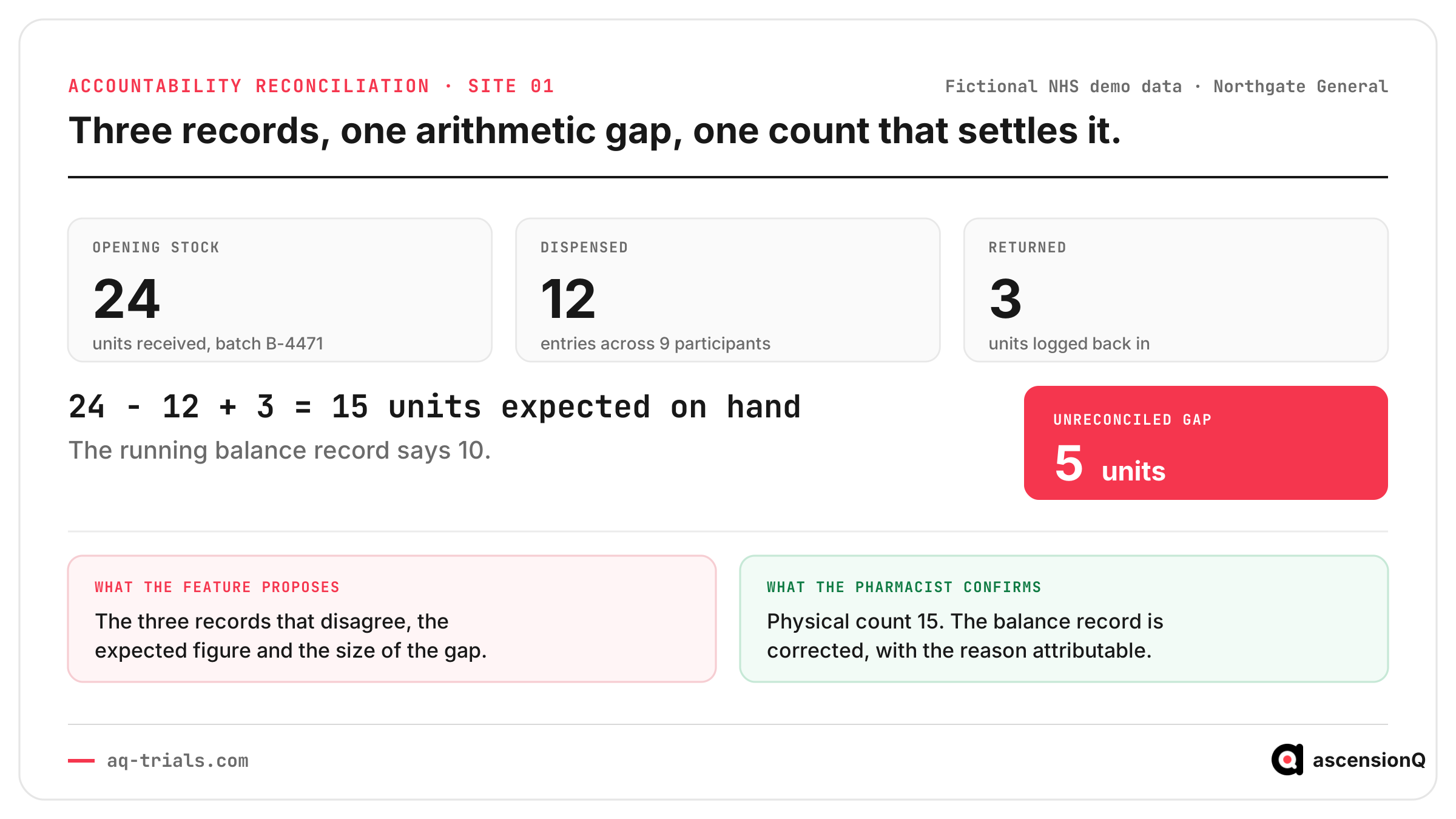
| Accountability reconciliation | The units where a dispensing entry, a return and the running balance disagree | The true balance, against the physical count |
| A temperature excursion record | A drafted description built from the logger reading, the affected units and the storage record | The description, the units quarantined and the sponsor notification |
| Expiry and labelling checks | Units reaching expiry inside the next dispensing window, read against the protocol | The action on each batch |
| Clinical trial pharmacy site file currency | Documents absent or past review in the clinical trial pharmacy site file | The filing decision, per document |
Each row produces a proposal a pharmacist can reject in one action. The reconciliation case is the clearest test of whether a feature is useful: a proposal naming the three records that disagree saves the search, and the count in the fridge settles the answer. The module behind this work is clinical trial Pharmacy.
What AI Does a Quality Assurance Lead Use?
A quality assurance lead is the heaviest user of cross-record flagging and the only role that uses all four feature classes in one task. A single quality event moves through drafting, classification, flagging and retrieval before it closes.
- Signal triage. Deviation trends, repeat corrective and preventive actions on one root cause, and training lapses against delegated activity arrive as proposals with the records compared. The significance test stays with the quality function.
- Drafting a corrective and preventive action. A first version of the problem statement and the action plan, assembled from the deviation record, shortens the gap between a cause and a written action.
- Periodic review scheduling. Documents past review, weighted by what the study is doing now, give a review schedule driven by study activity rather than by calendar date.
- Retrieval during an inspection response. An answer that points to the record behind it turns a two-hour search into a check, which matters most inside a deadline the inspector sets.
These four tasks sit in the quality management system and the electronic investigator site file, so the feature’s value depends on those records sharing one store rather than exchanging files.
Does a Site Need AI Features to Pass an Inspection?
No. An inspector reads the records and the oversight behind them, and a site with complete, contemporaneous, attributable records passes with no AI in the building. The features change how early a gap becomes visible, which is a different benefit and worth stating honestly in a business case.
- The record passes, never the tooling. No platform is approved or certified by the MHRA, and a supplier claiming otherwise has misread the regime.
- An AI feature adds its own evidence burden. The feature is a computerised system function, so it needs validation for the intended use a site writes down, and the audit trail must show the proposal and the person who confirmed it.
- The honest benefit is timing. A gap found in week two of a study is an administrative task. The same gap found during a notice period is a finding in progress.
Also Read: What is Inspection Readiness in Clinical Trials and How Does It Work Across a CRDC Network?
AI Features by Role Inside the AQ Platform
AQ runs its AI as Connected Intelligence across the modules a site works in, with AQ Assist as the in-platform assistant a user types into. The rule holds in every role: AQ’s AI proposes, flags and drafts, and a named person reviews and confirms.
- Research nurse. Drafts and pre-visit flags sit in AQ CTMS and AQ eISF, and the confirmation is checked against the person’s entry in AQ Digital DoA.
- Principal investigator. The oversight queue lists the items awaiting an investigator confirmation, each carrying the records it was raised from.
- Trial pharmacist. Reconciliation and excursion drafting sit in AQ Pharmacy, against the same study record the rest of the site works on.
- Quality assurance lead. Signals, drafting and review scheduling sit in AQ QMS and AQ CAPA, so one quality event stays in one thread from detection to verified closure.
- Every role. Every AI action is written to the audit trail, so the proposal, the model version and the human confirmation are retrievable alongside manual entries.
AQ is validated to GxP standards with every release, covering installation, operational and performance qualification with a 21 CFR Part 11 and EU Annex 11 assessment. The platform is UK-hosted, holds NHS DSPT Standards Met for 2026 and Cyber Essentials certification, and runs ISO 27001-aligned controls. It supports MHRA compliance and is built for MHRA GCP inspection.
AQ was built by Phase 1 trial doctors and has been in continuous daily NHS use for six years, with 13 sites on one connected record and 70 concurrent studies, at organisations including University Hospitals of Liverpool Group, Royal Free London and Liverpool School of Tropical Medicine. Book a live demo to watch one proposal reach a named role and land in the audit trail.
Frequently Asked Questions
We’re looking for a trial platform with AI features. What should be on the list?
Four feature classes cover almost all genuine site-side use: drafting narrative text from records already held, proposing a document type and filing location, flagging a disagreement across two records, and retrieval in a user’s own words. Ask which named role touches each one in a working week, and what that person confirms. A capability nobody at the site opens is not a reason to choose a platform.
What AI features should a UK research site look for in a trial platform?
Look for features that read across the records a site actually holds, route every proposal to the role that owns the record, and write the proposal and the confirmation to one audit trail. A feature confined to a single module reports that module’s contents back. The confirmation step should be enforced by configuration rather than by a policy document.
Which AI features does a research nurse actually use?
Three: a drafted visit record or deviation description built from entries already made, a pre-visit completeness flag naming the consent version and any expiring delegation or certificate, and retrieval that answers a protocol question with the protocol section behind it. Each ends with the nurse confirming the output, and the confirmation is only meaningful where the delegation log authorises that person for that activity.
Do AI features in trial platforms help sites or sponsors?
Most published capability serves sponsors. Patient recruitment modelling, site selection scoring, protocol design and central statistical monitoring all support decisions a sponsor or a contract research organisation makes, and ICH E6(R3) section 3.1.2 places trial design with the sponsor. A site buys drafting, classification, cross-record flagging and retrieval, which run on records the site owns.
What AI does a trial pharmacist use?
Accountability reconciliation flags where a dispensing entry, a return and the running balance disagree. Drafting produces a temperature excursion description from the logger reading and the storage record. Checks propose units reaching expiry inside the next dispensing window. The pharmacist confirms each one, because responsibility for investigational medicinal product management rests with the investigator and the institution under ICH E6(R3) section 2.10.1.
Does a site need AI features to pass an inspection?
No. A site with complete, contemporaneous and attributable records passes an inspection with no AI involved. The features change how early a gap becomes visible, and they add their own evidence burden, because an AI feature is a computerised system function that needs validation for its intended use. No platform is approved or certified by the MHRA.