Does the EU AI Act apply to clinical trial software? It applies to the vendor that places the system on the EU market and to the sponsor or site established in the EU that uses it. A UK research site sits outside the Regulation itself. It meets the Act through its sponsor, its vendor and its contracts.
Does the EU AI Act Apply to Clinical Trial Software?
Regulation (EU) 2024/1689, the Artificial Intelligence Act of 13 June 2024, binds roles rather than products. Article 2(1) lists seven categories of person it reaches. Three of them decide the question for a trial platform.
- Article 2(1)(a). Providers placing an AI system on the market or putting it into service in the Union, including providers established outside it.
- Article 2(1)(b). Deployers of AI systems that have their place of establishment or are located within the Union.
- Article 2(1)(c). Providers and deployers established in a third country, where the output produced by the system is used in the Union.
Article 3(3) defines a provider as the party that develops a system and places it on the market under its own name. Article 3(4) defines a deployer as the party that uses a system under its authority for a professional purpose. A trial platform has one provider and many deployers. The table reads the test against the parties around a UK study. Our guide to how AI is used in clinical trials maps the wider picture, and the questions to put to a vendor sit in our guide to AI for compliance and inspection readiness.
| Party | Role under the Act | Bound directly | What decides it |
| A vendor selling a trial platform to EU customers | Provider | Yes | Article 2(1)(a), placing the system on the Union market |
| A vendor selling only to UK customers | None under this Regulation | No | The system reaches no Union market and no Union deployer |
| A sponsor or CRO established in the EU | Deployer | Yes | Article 2(1)(b), established or located within the Union |
| A UK research site on a UK-only study | None under this Regulation | No | Outside the Union and producing no output used there |
| A UK research site whose system output is used in the Union | Deployer in a third country | Possibly | Article 2(1)(c), assessed by the sponsor and the vendor |
The last row is the one that reaches a UK site, and the assessment behind it belongs to the sponsor and the vendor. A site asks for that assessment in writing rather than making it alone.
What Is in Force Today, and What Is Still Ahead?
The Act applies in stages, and the stages moved in 2026. Regulation (EU) 2026/1744 of 8 July 2026, the Digital Omnibus on AI, entered into force on 27 July 2026 and amended the timetable. Recital 40 sets the new application dates for the high-risk tiers at 2 December 2027 for systems classified under Article 6(2) and Annex III, and 2 August 2028 for systems classified under Article 6(1) and Annex I.
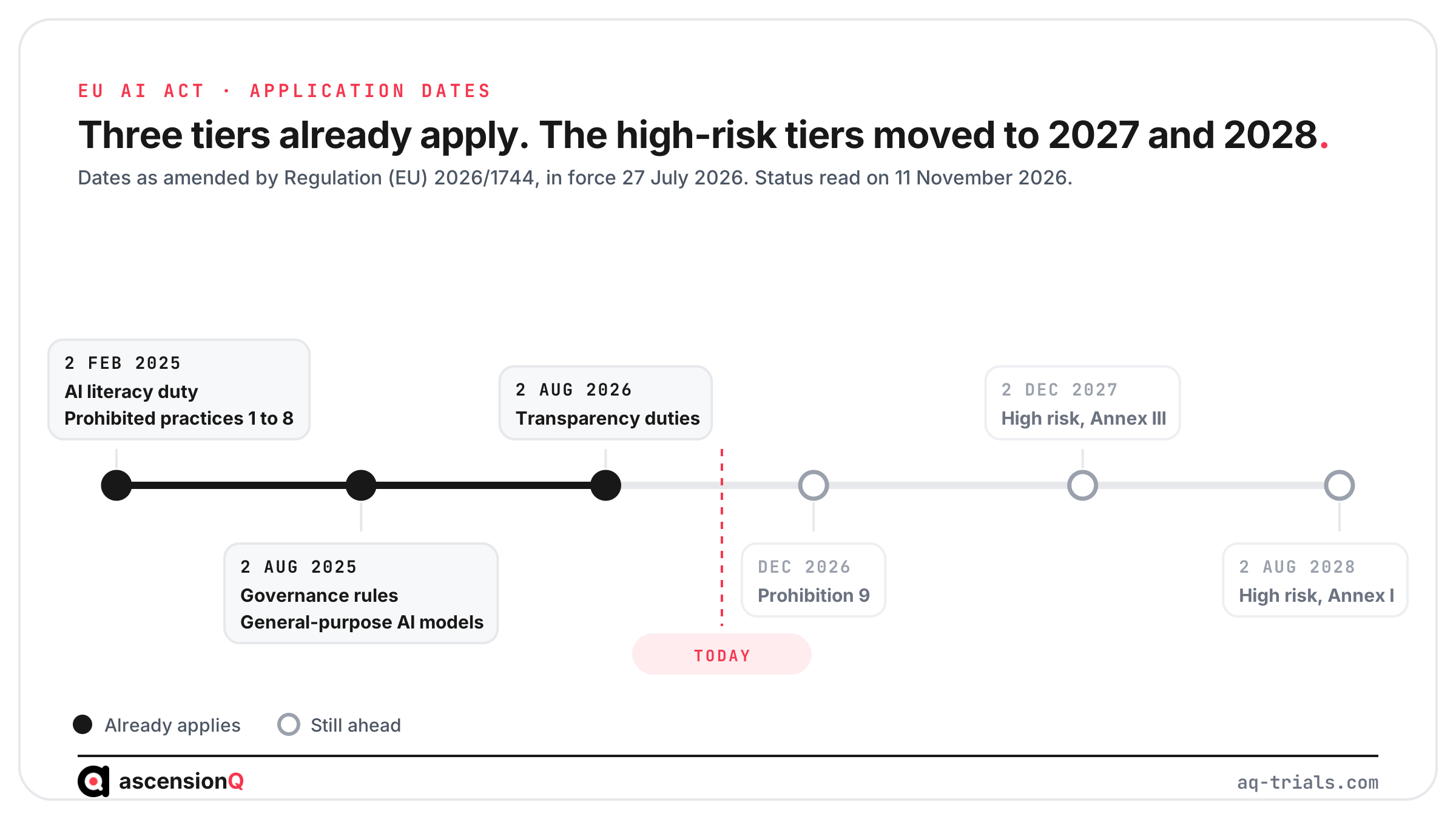
The European Commission timetable sets out the full sequence. Three tiers already apply on the date this guide was written.
- 2 February 2025. The AI literacy duty and the first eight prohibited practices.
- 2 August 2025. The governance rules and the obligations on general-purpose AI models.
- August 2026. The transparency duties, covering disclosure that a person is dealing with an AI system and identification of AI-generated content.
- December 2026. The ninth prohibition, on non-consensual sexually explicit content.
- 2 December 2027 and 2 August 2028. The two high-risk tiers.
The AI literacy duty is the one already landing on an EU deployer. Regulation (EU) 2026/1744 amended Article 4 so that providers and deployers of AI systems take measures to support the development of AI literacy of their staff. A sponsor established in the EU carries that duty for the people who operate its systems, and it tends to push the question down to the sites that use them.
Also Read: The EMA and FDA Good AI Practice Principles: What They Mean for Clinical Trials
How Does the Act Classify Clinical Trial Software?
Classification decides the weight of the obligations, and it turns on use rather than on the label a vendor puts on a feature. Four tiers run from banned practices down to systems the Act leaves largely alone.
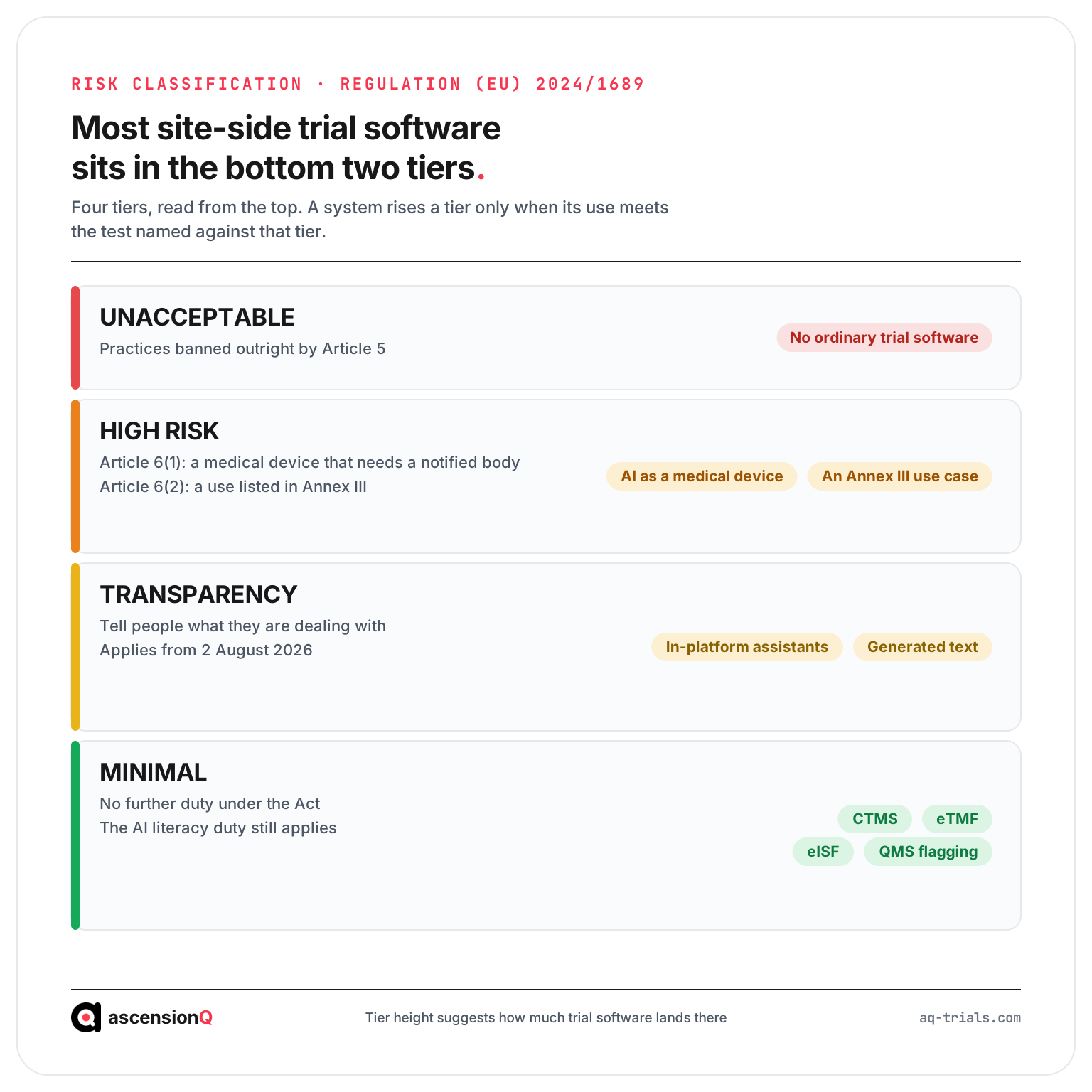
Article 6 carries the high-risk test, and it has two routes. Article 6(1) treats a system as high-risk where it is a safety component of a product, or is itself a product, covered by the Union harmonisation legislation listed in Annex I, and where that product must undergo third-party conformity assessment. Article 6(2) treats the uses listed in Annex III as high-risk. Article 6(3) allows an Annex III system out of the tier where it poses no significant risk of harm to health, safety or fundamental rights, and that relief falls away where the system profiles natural persons.
The medical device route is the one that touches research software most often. MDCG 2025-6, the June 2025 FAQ on the interplay between the Medical Devices Regulation, the In Vitro Diagnostic Medical Devices Regulation and the AI Act, states the two conditions together. The AI system is a medical device or a safety component of one, and the device is subject to third-party conformity assessment by a notified body. The table in that FAQ puts notified body involvement and high-risk status together for MDR Class IIa, IIb, III and Annex XVI devices, and for IVDR Class B, C and D.
- A CTMS, an eTMF or an eISF. These systems hold records about a study. They carry no medical purpose, so the Article 6(1) route closes.
- A quality flag across a deviation log. The output proposes a review to a named person. The decision stays with that person.
- An in-platform assistant. The transparency tier reaches it, because a user is told what produced the text in front of them.
- Software with a medical purpose. Diagnostic or treatment-decision software is assessed under the device rules first, and the AI Act classification follows that assessment.
A site that asks a vendor for its classification gets a defensible answer or a silence. Both are informative.
Does the Scientific Research Exemption Cover a Trial Platform?
Two exemptions in Article 2 look as though they answer the whole question for research, and they are narrower than they read. Article 2(6) takes AI systems and models, and their output, outside the Regulation where they are developed and put into service for the sole purpose of scientific research and development. Article 2(8) takes research, testing and development activity outside the Regulation where it happens before a system is placed on the market or put into service, and it holds testing in real-world conditions inside the scope.
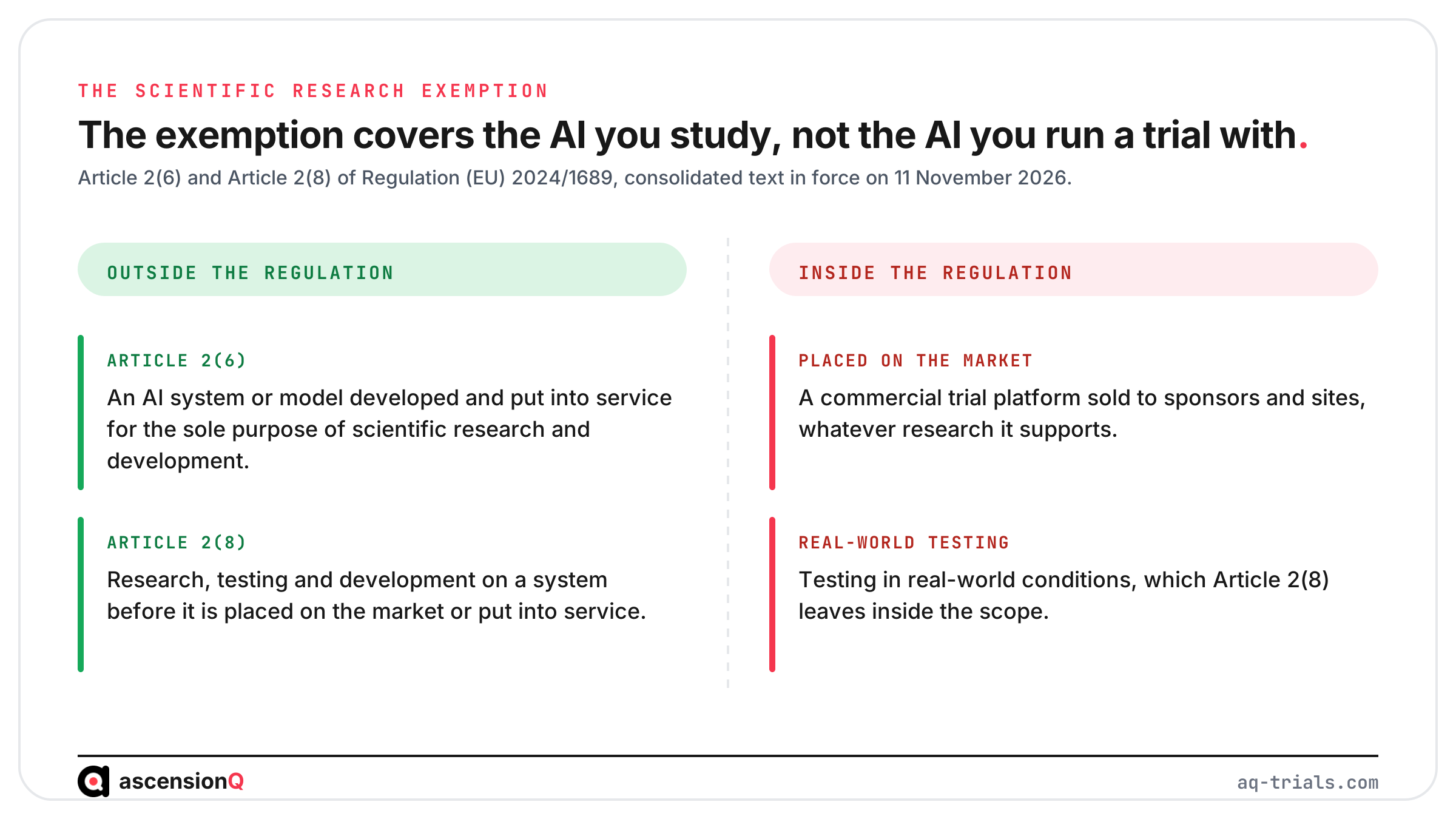
The distinction is between the AI a team studies and the AI a team runs a trial with. A model built inside a research group to answer a research question falls within Article 2(6). A commercial platform sold to sponsors and sites was placed on the market, so the exemption passes it by, whatever research the platform supports. Article 2(12) sits alongside these with a separate exemption for free and open-source systems, which closes where the system is high-risk or falls under the prohibition and transparency articles.
One practical consequence follows for an academic unit. A tool written in-house and used only within the unit’s own research sits outside the Regulation. The same tool, licensed to another organisation, becomes a system placed on the market, and the unit becomes its provider.
What Does a Provider Have to Do, and What Does a Deployer Have to Do?
The split matters to a site because the heavy engineering duties sit with the vendor and the operating duties sit with the user. Article 16 lists the provider obligations for a high-risk system. Article 26 lists the deployer obligations for the same system.
| Area | Provider, Article 16 | Deployer, Article 26 |
| Conformity | Complete the conformity assessment before the system is placed on the market, draw up the EU declaration of conformity and affix the CE marking | Use the system in accordance with the instructions for use, through technical and organisational measures |
| People | Operate a quality management system and keep the technical documentation | Assign human oversight to natural persons who have the necessary competence, training and authority |
| Data | Meet the data and data governance requirements for the system | Ensure input data is relevant and sufficiently representative for the intended purpose, where the deployer controls it |
| Records | Keep the logs the system generates automatically, when under their control | Keep the logs under their control for at least six months, or longer where the intended purpose requires |
| In-life | Take corrective action and inform the authorities where the system is non-conforming | Monitor operation, notify the provider and the market surveillance authority of a risk, and suspend use |
| Telling people | Meet the registration obligations and demonstrate conformity on a reasoned request | Inform workers’ representatives and affected workers before workplace use, and inform people subject to an Annex III decision |
Read the deployer column against a research office and the shape is familiar. Competent named people, written instructions followed, retained logs, monitoring and escalation. The validation position behind the provider column is covered in our guide to validating an AI feature in a regulated clinical trial system.
Also Read: Who Is Accountable When AI Gets It Wrong at a Trial Site?
What Changes for a UK Site With an EU Sponsor?
An EU sponsor carries deployer duties for the systems it puts into a study. Those duties travel to a UK site through the clinical trial agreement and the sponsor’s own procedures. Five changes show up at site level.
- A classification question arrives earlier. Sponsors ask vendors, and increasingly ask sites, which AI features a system runs and how they are classified.
- Training evidence is requested by name. The amended Article 4 attaches to staff who operate the system, so a sponsor looks for a training record against each named user.
- Oversight has to be a person, not a process. Article 26(2) asks for natural persons with competence, training and authority, which is the delegation log read in another language.
- Log retention appears in the contract. Article 26(6) sets six months as a floor for a high-risk system, and trial retention periods run far longer.
- An incident route is named. Article 26(5) requires a deployer to notify the provider and to suspend use where a risk arises, so the site needs a route into the sponsor that does not depend on one person’s inbox.
A UK site stays outside the deployer definition in the Regulation. The site becomes the place the sponsor’s evidence has to come from.
Which EU AI Act Duties Match Records a UK Site Already Keeps?
Most of the deployer column lands on records a UK research site holds already. ICH E6(R3), adopted at Step 4 on 6 January 2025, requires at Principle 9.3 that computerised systems used in clinical trials are fit for purpose, achieved through risk-based validation where appropriate. A site that meets that standard has most of the raw material.
| What the Act asks of a deployer | The record a UK site already keeps | Where the gap usually is |
| Human oversight by a competent, trained, authorised person | The delegation log and the training record for that activity | AI-assisted activities are rarely named on the delegation log |
| Use in accordance with the instructions for use | The site procedure for the system and its training assignment | The procedure predates the AI feature and was never revised |
| Logs retained and available | The audit trail behind each entry in the system | The trail records the entry without recording what proposed it |
| Monitoring, notification and suspension | The deviation and corrective action route | No category exists for a system-performance issue |
| Input data relevant and representative | Source data governance across the study record | Nobody has written down which records the feature reads |
The UK has no equivalent cross-sector statute, and our guide to UK AI regulation in healthcare and clinical research covers the direction of travel here. The MHRA position on AI inside GxP systems sits in our guide to AI in GxP clinical trial systems, and the data protection duties that run in parallel sit in our guide to UK GDPR for clinical trial sites.
Also Read: How Should a Research Site Govern the Use of AI?
AI Rules That Cross Borders Inside the AQ Platform
Connected Intelligence is the AI capability in AQ Platform, and AQ Assist is the in-platform assistant. AQ’s AI proposes, flags and drafts, and a named person reviews and confirms. Every AI action is in the audit trail with the confirmation that followed it, which is the evidence a sponsor asks for when it carries a deployer duty of its own.
- The oversight person is on the record. AQ Digital DoA holds the delegated activity and the training behind it, so the person who confirmed a proposal is identifiable afterwards.
- The procedure sits beside the system. AQ QMS holds each controlled procedure with its review cycle and training assignment.
- A system issue has somewhere to go. AQ CAPA carries the investigation and the corrective action, which is the route an escalation needs.
AQ Platform is UK-hosted, holds NHS DSPT Standards Met (2026) and Cyber Essentials certification, and operates ISO 27001-aligned controls. It is validated to GxP standards with every release, covering IQ, OQ and PQ with a 21 CFR Part 11 and EU Annex 11 assessment.
Book a live demo to see how an AI proposal, the person who confirmed it and the record it changed sit on one audit trail.
Frequently Asked Questions
Does the EU AI Act apply to clinical trial software?
The EU AI Act applies to the provider that places a system on the EU market and to the deployer established in the Union that uses it. Article 2(1) of Regulation (EU) 2024/1689 also reaches a provider or deployer in a third country where the output produced by the system is used in the Union. A UK research site falls outside the Regulation itself and meets it through its sponsor and its contracts.
Is a CTMS or an eTMF a high-risk AI system under the EU AI Act?
A CTMS or an eTMF holds records about a study and carries no medical purpose, so the Article 6(1) route to high-risk status closes. High-risk status under Article 6(1) requires the system to be a medical device or a safety component of one, with third-party conformity assessment by a notified body, as MDCG 2025-6 sets out. Article 6(2) applies to the uses listed in Annex III.
Does the EU AI Act apply to UK research sites?
The Regulation is EU law and binds deployers established or located in the Union. A UK site on a UK study sits outside it. A UK site working for an EU sponsor meets the Act through the clinical trial agreement and the sponsor’s procedures, and through Article 2(1)(c) where the output produced by the system is used in the Union.
When do the EU AI Act high-risk rules start to apply?
Regulation (EU) 2026/1744 of 8 July 2026 entered into force on 27 July 2026 and moved both high-risk dates. Systems classified under Article 6(2) and Annex III apply from 2 December 2027. Systems classified under Article 6(1) and Annex I apply from 2 August 2028.
Does the research exemption in the EU AI Act cover clinical trials?
Article 2(6) covers AI systems and models developed and put into service for the sole purpose of scientific research and development. Article 2(8) covers research, testing and development before a system is placed on the market, and holds real-world testing inside the scope. A commercial trial platform was placed on the market, so neither exemption reaches it.
What is the difference between a provider and a deployer under the EU AI Act?
Article 3(3) defines a provider as the party that develops an AI system and places it on the market under its own name. Article 3(4) defines a deployer as the party using a system under its authority for a professional purpose. Article 16 sets the provider obligations and Article 26 sets the deployer obligations.
What should a UK research site do about the EU AI Act now?
A site asks each vendor and each EU sponsor for the classification of the AI features in use, names AI-assisted activities on the delegation log, records training against each named user, and checks that the audit trail shows what the system proposed and who confirmed it. Those four records answer most of what an EU sponsor’s deployer duty requires from a site.