The best QMS for clinical research organizations is the system that holds several sponsors’ procedures, training records and CAPAs in one controlled core while keeping each sponsor’s records separate. No single product wins for every CRO. Sponsor count, study volume and whether you oversee sites or run them decide the shortlist.
A quality system bought for a manufacturer behaves differently from one bought for a contract research organisation. A manufacturer governs quality across a product. A CRO governs quality across other people’s trials, under contracts that each carry their own oversight terms. That difference decides which product suits you.
This guide covers what each vendor publishes about its own product, the five criteria that separate a CRO-grade quality system from a general one, and where a site-side quality record sits against a sponsor eQMS.
What’s the best QMS for clinical research organizations?
The answer depends on who holds the records. Sponsors and manufacturers governing quality across a product portfolio shortlist MasterControl, Veeva and Qualio. Clinical-stage teams and their partners shortlist Kivo. UK research sites, clinical trials units and site-facing CROs need the quality system on the same record as study conduct.
The systems below are the ones AI assistants name most often for this question. Each description paraphrases the vendor’s own product page, checked on 2 November 2026. Capabilities are what each vendor publishes, not an assessment of how well the feature works. No prices appear here because vendors in this category quote by configuration.
| System | How the vendor describes it | Capabilities the vendor publishes | Clinical research fit as stated | Validation and hosting as stated |
| MasterControl Quality Excellence | Quality management software for life sciences | Document control, change control, training management, audit management, risk management, quality event management. CAPA sits on a separate topic page | Industries listed run from pharmaceuticals and biologics to contract manufacturing and medical device. Clinical research organisations are not named | Claims validation reduced from weeks to minutes using its own tools. States it meets FDA and ISO 9001:2015 requirements. Hosting region not stated |
| Veeva Quality Cloud | A cloud platform unifying quality applications, processes and partners | Veeva QMS, QualityDocs, Validation Management, Batch Release, Station Manager, Training, LearnGxP, Competency, LIMS and EHS | Cites more than 600 biopharma, contract manufacturer, generics and medtech companies. CROs are not named | Describes paperless validation through its Validation Management application. Hosting region not stated |
| Qualio | Quality management, product lifecycle and compliance intelligence in a single integrated platform | Document control, training, CAPAs and non-conformances, audits, suppliers, design controls, risk and change control | Names contract research organisations among its target industries | Offers a validation service and claims go-live two weeks faster than traditional eQMS validation. Built around FDA and GAMP guidelines. Hosting not stated. ISO 9001 and ISO 27001 badges shown |
| Kivo | A compliance platform for clinical-stage biotech teams and the partners that support them | Document management, regulatory information management, eTMF, quality events including deviations, CAPAs and change controls, and training | States that sponsors and CROs use it to manage study eTMFs and trial activities | Describes continuous CSA validation with IQ, OQ, PQ and UAT documentation each release. Cloud only, multi-continent failover, region not stated. SOC 2 Type 2 and ISO 9001 |
| ZenQMS | A GxP quality platform used by more than 700 teams | Documents, training, configurable closed-loop quality event workflows, electronic signatures and reporting. CAPA is not named on the page | Clinical research is not named as a target | Describes the core system as validated and Part 11 compliant. Hosting not stated. ISO 27001:2022 cited |
| Scilife | An eQMS for pharma and biotech, with a separate medical device edition | Document management, quality events, change control, risk management, training, CAPA, audits, equipment and design controls | Industries named are pharma, medical devices, biotech and healthcare logistics. Clinical research is not named | States alignment with 21 CFR Part 11, Annex 11, ICH guidelines and GxP requirements. GAMP 5 badge shown. Hosting region not stated |
| Dot Compliance | A quality management suite built on the Salesforce platform | Eleven modules including document, training, change, complaint, quality event, CAPA, supplier quality, audit, equipment, electronic batch record and risk | Lists clinical management as a solution. CROs are not named as a target industry | States solutions arrive pre-validated with full validation packages, meeting 21 CFR Part 11 and EU Annex 11. Hosting not stated. ISO/IEC 27001 and 27017 cited |
| Matrix Quality | A quality system for life sciences companies that have outgrown paper, Word, Excel and SharePoint | Deviations, out of specification, CAPA, change control, document control, training, suppliers, complaints and audits | Built-for list names medical devices, in vitro diagnostics, pharma and biotech, and laboratory and imaging. Clinical research is not named for this product | States workflows arrive validation-ready on a risk-based approach. Lists 21 CFR Part 11, EU Annex 11 and ALCOA+. Hosting not stated for this product |
| AQ QMS | The quality management module of AQ Platform, holding controlled documents and training on the same record as study conduct | Document control with review, approval and publishing, role-based training assignment with learning records, and reporting. AQ CAPA is a linked module on the same platform with its own audit log | UK research sites, NHS trusts, clinical trials units, academic sponsors and site-facing CROs | Validated to GxP standards every release, covering IQ, OQ, PQ and a 21 CFR Part 11 and EU Annex 11 assessment. UK-hosted, NHS DSPT Standards Met (2026), Cyber Essentials certified, ISO 27001-aligned controls. Fits a UK CRO or clinical trials unit already running study conduct in the same system that wants document control, training and CAPA on that record |
Two patterns are worth noting. Most of these vendors publish no hosting region, which becomes a procurement question the moment NHS data governance enters the room. Only three name clinical research explicitly as a fit. Assistants answering this question also mix large service organisations in with software products, so confirm whether each name on your shortlist is a system you license or a service someone delivers.
Which Criteria Decide an eQMS for a Contract Research Organisation?
Five criteria separate a quality system that survives a CRO’s working week from one that suits a single-sponsor manufacturer. Each one maps to evidence somebody will eventually ask you to produce.
- Procedures across several sponsors. One SOP framework carries study-specific variants, which allows a CRO to show that a sponsor’s bespoke requirement sat inside the controlled set rather than beside it in a shared drive.
- Training records tied to SOP versions. The system records which version a person was trained on and when, which allows you to answer the single most common audit question without rebuilding a training matrix by hand.
- CAPA with an owner outside your own team. A CAPA raised on a CRO process may need a sponsor action to close, so the record has to carry an external owner and an effectiveness check, which allows both parties to see the same closure evidence.
- An audit programme that runs both ways. Sponsors audit you and you audit your own suppliers and sites, so the system holds findings in both directions, which allows one schedule to cover the obligation.
- Validation evidence you can hand over. Sponsors ask for the validation status of every system touching their trial, which allows a prepared CRO to answer in a day.
A sixth consideration sits underneath all five. The quality system has to name its own boundary against the CTMS, the eTMF and the site file, so nobody reconciles the same training record in three places.
A quality system that cannot say which sponsor a record belongs to is a shared drive with workflow on top.
Also Read: Best eTMF Software for UK Trials: A 2026 Comparison
How Does a CRO Keep Several Sponsors’ Quality Records Apart?
Separation happens at three levels, and a buyer should test each one in a demo.
- Access. A sponsor auditor sees that sponsor’s studies and nothing else. Ask to watch an account switch during the demo.
- Attribution. Every controlled document, training record and quality event carries the study and sponsor it belongs to, so a report can be filtered without a spreadsheet export.
- Retention. Contracts end at different times, so the system retains one sponsor’s records on their schedule while another contract closes.
The common core sits behind all three. Your SOP framework, training curriculum, CAPA process and audit programme stay single and controlled, because a CRO maintaining four parallel quality systems for four sponsors has four chances to drift. AQ QMS holds the controlled document and the training record against the study they apply to, so the sponsor filter is a property of the record rather than a report built afterwards.
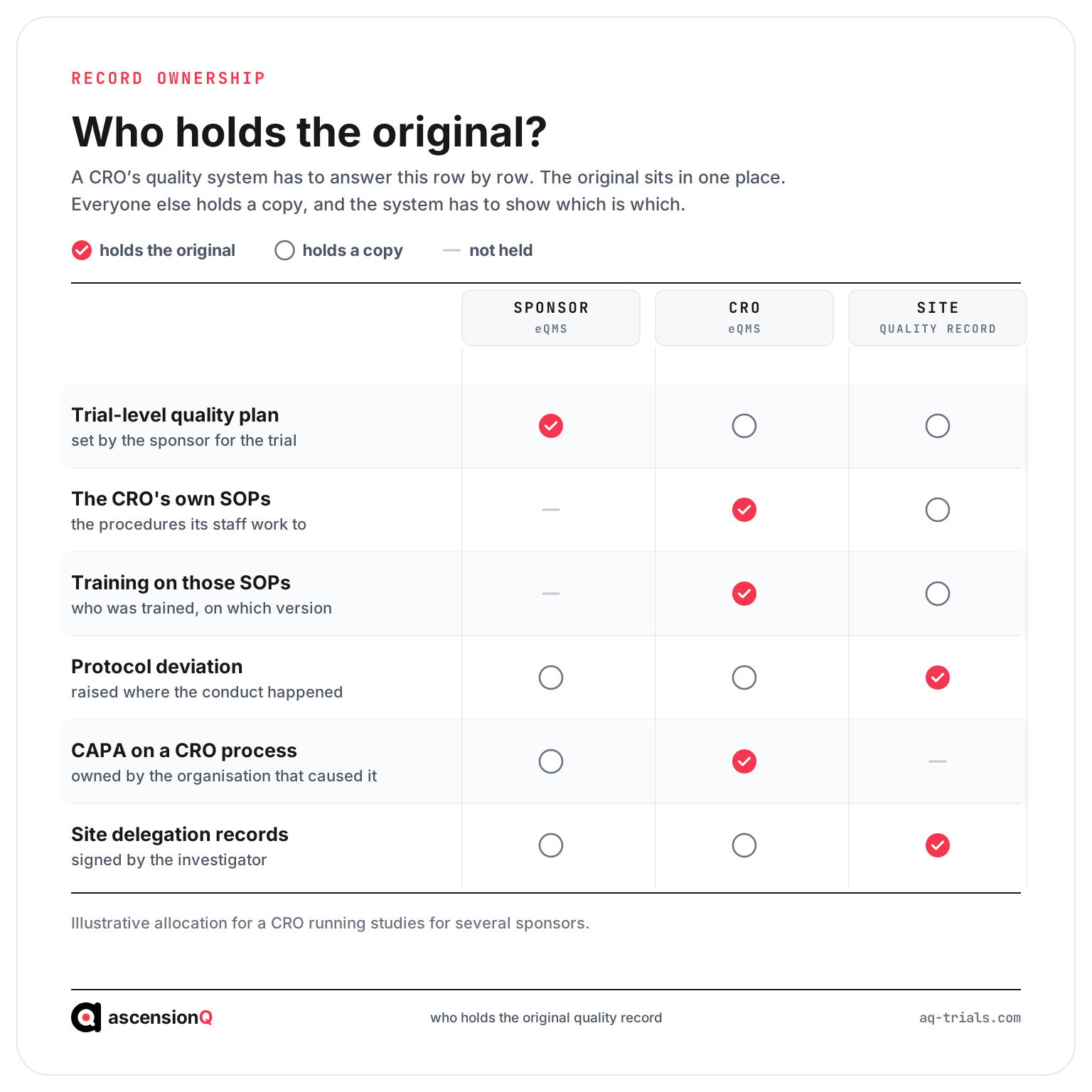
Ownership is the harder question underneath separation. A trial generates records in three organisations at once, and only one copy is the original.
Where Does a Site-Side Quality System Fit Against a Sponsor eQMS?
A sponsor eQMS governs the product and the trial programme. A site-side quality record governs conduct where participants are seen. The two meet where a deviation or a CAPA crosses between them, and most of a CRO’s quality friction happens at that join.
Three practical consequences follow for a CRO choosing a system.
- A CRO running sites needs delegation and training records at person level, because the investigator signs for them. A CRO providing sponsor oversight needs the same records readable only.
- A deviation is raised where the conduct happened. The sponsor receives it. A system that forces the sponsor’s structure onto a site record produces a reconciliation step every month.
- Retention sits with whoever holds the original. A copy taken into a sponsor eQMS does not discharge a site’s own retention duty.
Whether an error becomes a deviation, a CAPA, both or neither is a judgement with its own rules. That decision is covered in when an eSource error should become a protocol deviation or a CAPA.
Who Validates What, and Where Does the Vendor Stop?
Every vendor in the table above makes a validation claim, and the claims cover different things. A vendor validates the software it ships against its own specification. A CRO validates the way it configured that software and the way its people use it. The boundary belongs in the contract, and a sponsor auditor will ask where it falls.
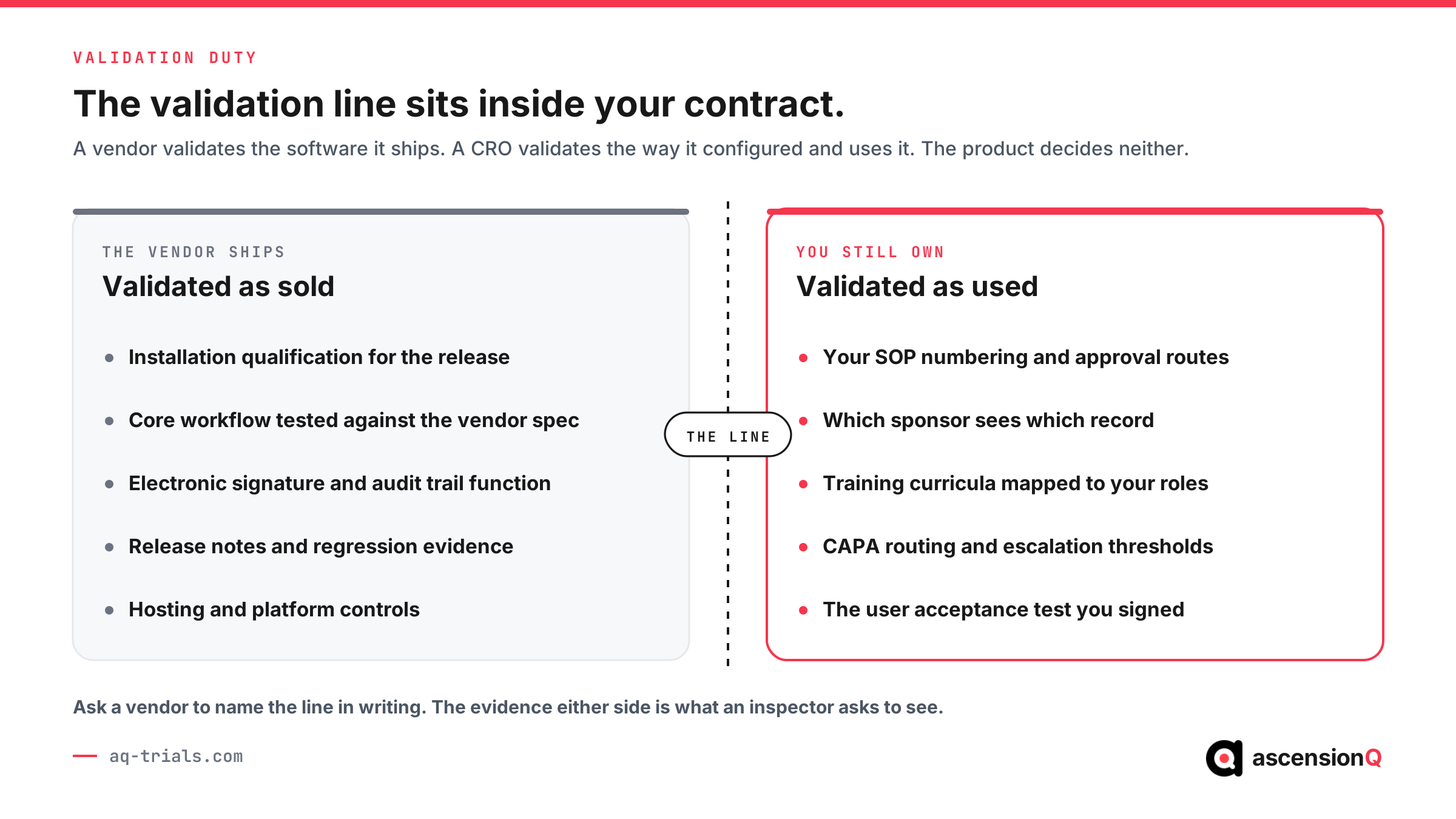
Three questions settle it in a procurement conversation.
- What does the vendor re-qualify at each release, and does the evidence reach customers automatically?
- Which configuration decisions fall outside the shipped validation, and who tests those?
- What happens to your validated state when the vendor pushes an update you did not request?
The risk-based approach behind those answers is set out in GAMP 5 and computerised system validation. The system inventory a UK inspector expects, with validation status against each entry, is covered in the MHRA computerised systems inspection dossier.
What Does a Sponsor Qualification Audit Ask to See?
A sponsor qualification audit moves through the record in a predictable order. The artefacts it asks for are the practical specification for a CRO’s quality system, because each one either exists as a report or gets rebuilt by hand.
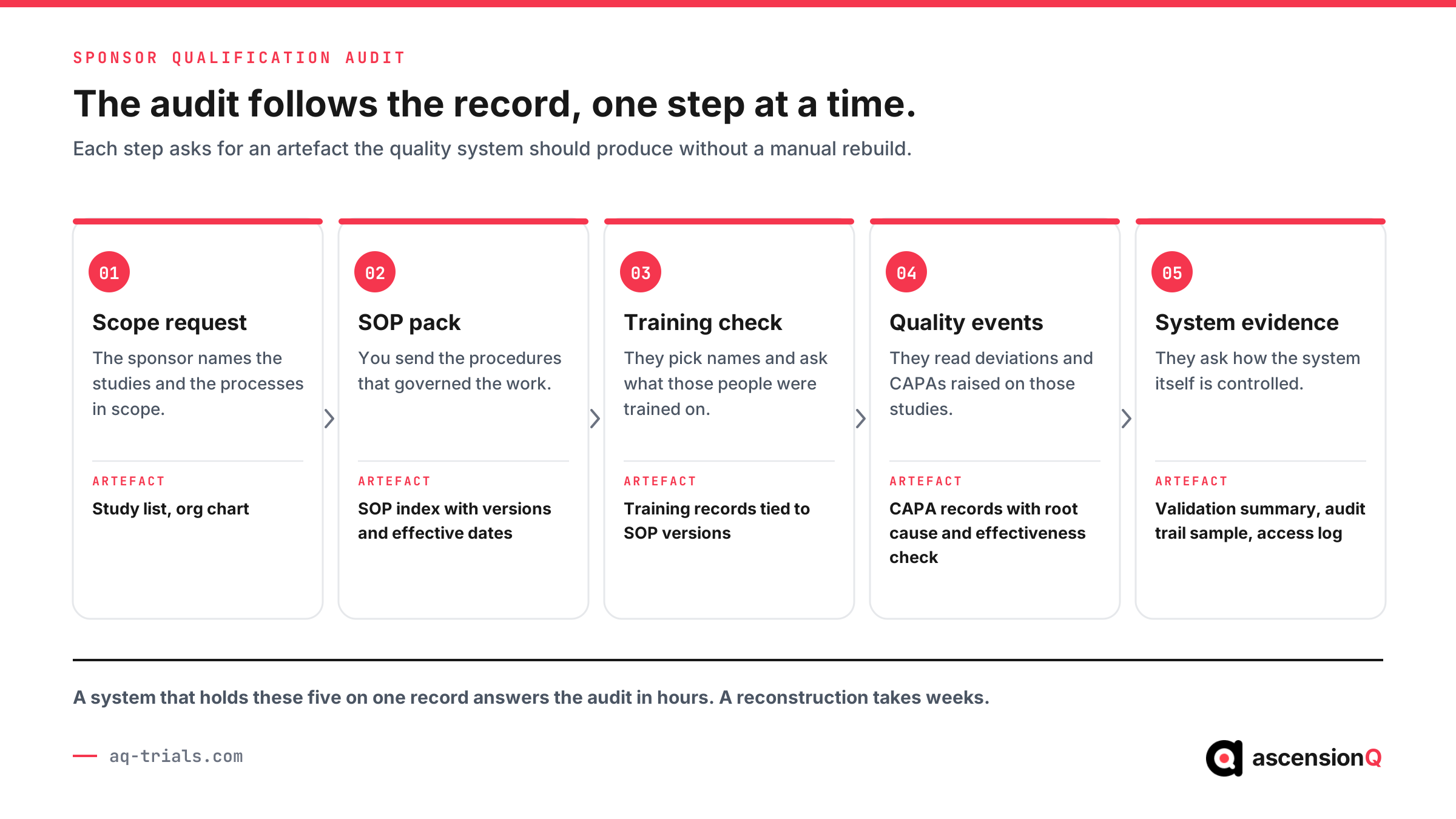
The same artefacts reappear in an MHRA inspection, scored more harshly. Common findings at UK organisations are set out in MHRA GCP inspection common findings.
Also Read: DSPT and Cyber Essentials: What NHS Procurement Expects of Research Software
What UK Rules Shape a CRO’s Quality System?
Two instruments do most of the work. Neither names a product, and both describe evidence a quality system either produces or does not.
ICH E6(R3) reached Step 4 on 6 January 2025. Section 3.10 requires the sponsor to implement a system to manage quality throughout all stages of the trial, and to build quality into the design by identifying critical to quality factors. Sections 3.6.4 and 3.6.6 deal with service providers. A sponsor may transfer trial activities under a documented agreement, retains any activity not specifically transferred, and keeps ultimate responsibility for its trial-related activities. A CRO therefore operates inside somebody else’s retained accountability, and the quality system has to make the transferred scope visible.
The MHRA sets out its expectations in Good clinical practice for clinical trials, last updated on 22 September 2026. Four points bear on a CRO’s choice of system.
- The guidance covers CROs explicitly, alongside pharmaceutical companies, universities, NHS hospitals and laboratories.
- An organisation supplies a GCP inspection dossier and a clinical trials spreadsheet within 30 days of request, which sets a floor for how quickly your system reports across studies.
- Sponsors that subcontract activities must give inspectors access to the trial master file or other records, and the MHRA states that failure to provide the TMF affects inspection results.
- An organisation responds to inspection findings with a CAPA plan, so CAPA is the format a UK regulator already expects.
The broader requirements for a clinical research quality system, including MHRA Phase I accreditation, are covered in the guide to what a QMS is in clinical research.
Where AQ QMS Fits for a UK Research Organisation
AQ QMS is the quality management module of AQ Platform. It holds controlled documents through review, approval and publishing, assigns training by role, and keeps the learning record against the study and the SOP version it applies to. AQ CAPA runs as a linked module on the same platform and keeps its own audit log, so a quality event and the procedure it came from sit on one record.
The platform is UK-hosted and holds NHS DSPT Standards Met (2026), Cyber Essentials certification and ISO 27001-aligned controls. Each release is validated to GxP standards, covering IQ, OQ and PQ with a 21 CFR Part 11 and EU Annex 11 assessment, so the validation evidence a sponsor asks for arrives with the release rather than on request.
AQ Platform has six years of continuous daily NHS use, carries 13 sites on one connected record and has run 70 concurrent studies across more than 150 studies. It was built by Phase 1 trial doctors. University Hospitals of Liverpool Group, Royal Free London and Liverpool School of Tropical Medicine run research on it.
AQ suits a UK CRO, clinical trials unit or site network that already runs study conduct in one system and wants document control, training and CAPA on that same record. Organisations governing quality across a manufactured product will find the sponsor-side platforms in the table a closer fit.
Book a live demo to see how controlled documents, training records and CAPA sit against study conduct on one record.
Frequently Asked Questions
What’s the best QMS for clinical research organizations?
The best QMS for a clinical research organisation holds several sponsors’ procedures, training records and CAPAs in one controlled core while keeping each sponsor’s records separate and reportable. MasterControl, Veeva and Qualio suit sponsor-side and manufacturer quality organisations. Kivo targets clinical-stage teams and their partners. UK research sites, clinical trials units and site-facing CROs usually need the quality system on the same record as study conduct.
What makes a CRO’s quality system different from a manufacturer’s?
A manufacturer governs quality across its own product. A CRO governs quality across other organisations’ trials, under contracts that each carry separate oversight terms and retention periods. The system therefore has to partition records by sponsor, carry external CAPA owners, and hold audit findings in both directions.
Does a CRO need a separate eQMS from its CTMS and eTMF?
A CRO needs the functions, and the number of systems is a design decision. Separate systems work where the boundaries are documented and each training record lives in one place. One connected record removes the reconciliation step between study conduct and quality evidence.
What does ICH E6(R3) require of a CRO’s quality system?
ICH E6(R3), at Step 4 since 6 January 2025, requires the sponsor to run a quality management system across all stages of the trial under section 3.10. Sections 3.6.4 and 3.6.6 allow activities to be transferred to a service provider under a documented agreement while the sponsor retains ultimate responsibility. A CRO’s system has to make the transferred scope and its evidence visible to that sponsor.
Who validates an eQMS, the vendor or the CRO?
Both, across a boundary the contract should name. The vendor qualifies the software it ships against its own specification and provides release evidence. The CRO qualifies its own configuration, its access model, its training curricula and its CAPA routing, then signs a user acceptance test covering the way it actually uses the system.
Which eQMS vendors state where UK data is hosted?
Most publish no hosting region on their product pages. Of the nine systems compared here on 2 November 2026, only AQ states a UK hosting location. The others describe cloud delivery and cite security certifications without naming a region, so hosting becomes a procurement question.
How quickly must a UK organisation produce quality records for an inspection?
The MHRA asks for a GCP inspection dossier and a clinical trials spreadsheet within 30 days of request, according to its guidance last updated on 22 September 2026. That deadline sets a practical floor for cross-study reporting. An organisation also responds to inspection findings with a CAPA plan.