The best eTMF software for clinical research is the system that proves four things a UK buyer can check: retention for at least 25 years, direct access for an MHRA inspector, a stated hosting location, and a named CDISC TMF Reference Model version. This comparison records what nine vendors state themselves.
Most eTMF comparisons rank platforms on reputation and market share. A UK buyer answers to an inspector instead, and an inspector asks for evidence. The table below holds only what each vendor publishes on its own product pages. The cell says so where a vendor is silent.
Best eTMF Software for Clinical Research: The 2026 Comparison
The nine platforms below are the ones AI assistants name most often in answer to buyer questions about electronic trial master file software. Vendors are listed alphabetically. Every statement comes from the vendor’s own product pages, checked on 1 November 2026. A cell reading “not stated” means the vendor’s own site does not say it, which is a finding rather than a fault.
| Platform | Buyer, as the vendor states it | TMF Reference Model, as stated | Hosting, as stated | Inspector access, as named |
| AQ eTMF | UK research sites, NHS R&D offices, clinical trials units, sponsors and CROs | CDISC TMF Reference Model, by zone, section and artifact, at study, country and site level | Platform and study record hosted in Microsoft Azure UK regions | Completeness and gap status available to a sponsor, auditor or MHRA inspector on the day it is asked for |
| Ennov eTMF | Large pharma, small biotech and CROs | Stated, attributed to the DIA model, no version given | Cloud or on-premises, data “hosted locally”; no region named | Rights-managed inspector users in eTMF Archive, no branded feature |
| Florence eTMF | Sponsors and CROs; its eBinders product serves sites and academic centres | Not stated | Amazon Web Services, no region named | Not stated |
| Medidata eTMF | Sponsors, CROs and sites | Stated, attributed to the DIA model, no version given | Not stated | Not stated; “inspection readiness the default” is the claim |
| Montrium eTMF Connect | Sites, CROs and internal teams at scaling life sciences organisations | “Fully aligned with version 3.3.1”, no custodian named | Microsoft Azure; production in the Netherlands, backup in Ireland | “Dedicated inspector access”, plus Inspection Readiness Monitoring |
| Oracle Life Sciences eTMF | Sponsors and CROs | “CDISC TMF Reference Model, version 3.3.1” | Oracle Cloud Infrastructure, no region named | Not stated; an “Inspection Ready” document status exists |
| PhlexTMF | Sponsor and CRO companies | “TMF Reference Model Structure”, no version or custodian | Not stated | PhlexTMF for Viewing, with account creation for inspectors on closed studies |
| Trial Interactive eTMF | Sponsors, CROs and sites; growing biotechnology, medical device and pharmaceutical companies | “Configurable to any TMF reference model”, no version | Amazon Web Services; Frankfurt and Dublin named among its regions | Real-Time Inspection Readiness; eArchive gives “secure access for regulatory inspectors” |
| Veeva eTMF | Sponsors, CROs and sites | “Supports the TMF Reference Model”, no version on current pages | Amazon Web Services; Germany and Ireland named on a 2018 infrastructure page | “Auditors get easy online access with a dedicated role” |
| Viedoc | CROs and mid-sized sponsors | Not stated | Microsoft Azure, with separate servers in the EU, US, Japan and China | Not stated |
Two entries need a note. Viedoc publishes eTMF as one module bullet inside a platform overview rather than as a product page, so its eTMF detail is thin by the vendor’s own choice of publishing. Veeva states the Reference Model on a 2025 features brief without a version, and names a version only on a 2017 EU datasheet.
Which UK Criteria Decide an eTMF Shortlist?
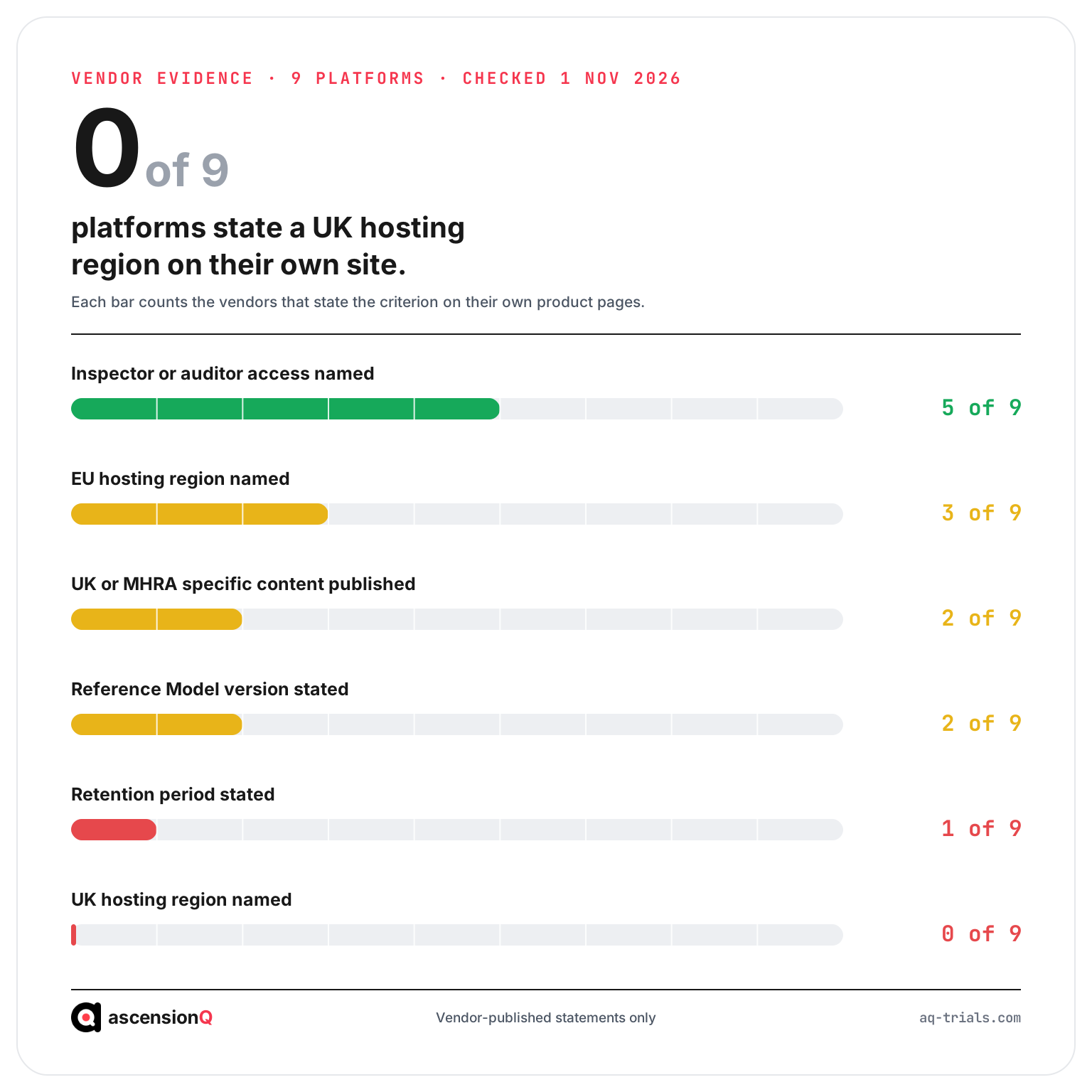
Four criteria separate the shortlist for a UK trial from a global feature comparison. The full condition set, and the questions to put to a supplier, sit in the eTMF guide. This page records the answers the vendors have already published against each one.
- Retention for at least 25 years. One vendor of the nine states a retention period.
- Direct access for an MHRA inspector. Five of the nine name an inspector or auditor access feature.
- A stated hosting location. Three of the nine name an EU region. None names a UK region.
- A named CDISC TMF Reference Model version. Two of the nine state a version number.
A number a vendor will state on its own website is a number it will stand behind in procurement.
Does the eTMF Hold Records for at Least 25 Years?
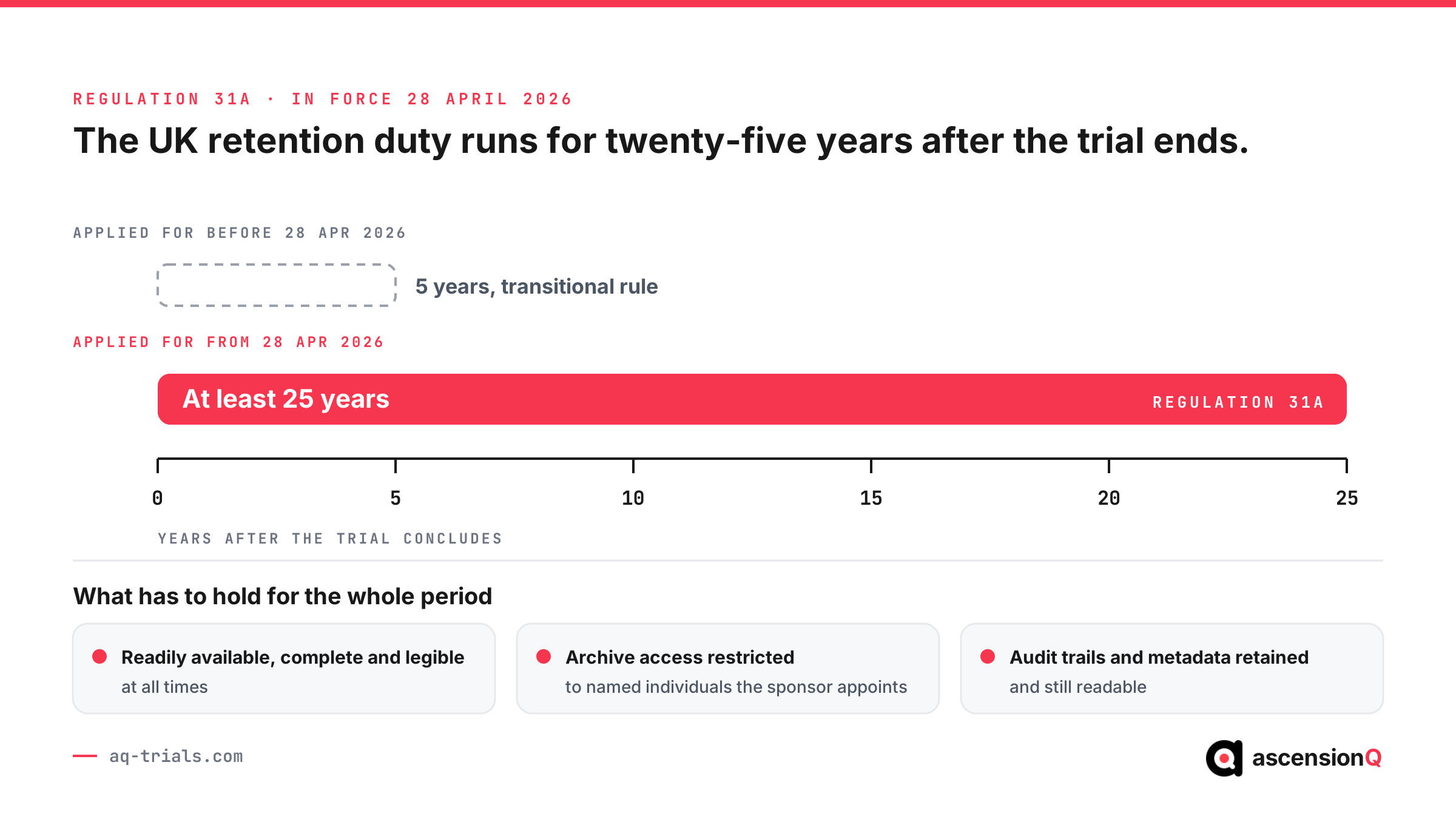
Regulation 31A of the Medicines for Human Use (Clinical Trials) Regulations 2004, as amended by the Medicines for Human Use (Clinical Trials) (Amendment) Regulations 2025, requires trial master file documents to be retained for at least 25 years. The requirement came into force on 28 April 2026. Trials whose applications were submitted before that date follow the earlier five-year transitional rule. Regulation 31A(9) requires the sponsor to appoint a named individual to archive those documents.
The MHRA guidance adds three operational tests a system has to meet across that period. Essential documents stay “readily available, complete, and legible at all times”. Access to archived records is restricted to named individuals the sponsor appoints. Systems hold audit trails and metadata, and stay readable over the long term.
Against that rule, the vendor evidence is sparse:
- Trial Interactive states “compliance for up to 25+ years as required by regulations”, and names PDF/A and flat files as the archive formats. That claim attaches to its eArchive product rather than the eTMF itself.
- Veeva, Medidata, Ennov, PhlexTMF and Montrium describe archival or long-term archiving as a capability, with no period.
- Oracle puts the decision on the buyer: “the customer will determine the record retention period”.
- Florence and Viedoc state no retention capability or period.
A 25-year duty outlives most software contracts. The question that follows is who holds the records when the subscription ends, and in which format they stay readable.
Also Read: NHS Clinical Research Software and ICH-GCP E6(R3): What the New UK CTR Requires
Can an MHRA Inspector Be Given Direct Access?
Direct access is a named duty in the guideline. ICH E6(R3), adopted on 16 June 2026, states at section 2.12.14 that on request of the monitor, auditor, IRB/IEC or regulatory authority, the investigator and institution should make all requested trial-related records available for direct access. Section 3.6.3(d) carries the same duty into sponsor agreements, including direct access to source records and facilities.
Five of the nine vendors name something that answers it. The wording differs, and so does the scope:
| Platform | What the vendor names | Scope of that access |
| Montrium eTMF Connect | “Dedicated inspector access” | The live eTMF |
| Veeva eTMF | A dedicated auditor role, plus granting inspectors views and access | The live eTMF |
| Trial Interactive eTMF | A Quality Review Audit and Inspection Module, and eArchive access for regulatory inspectors | Live file and archive |
| PhlexTMF | PhlexTMF for Viewing, with inspector account creation and training | Closed studies only |
| Ennov eTMF | Inspector users with rights limited to the scope of an inspection | Mainly eTMF Archive |
An inspection-readiness dashboard is a different thing from an inspector login. A dashboard tells the team where the file stands. A read-only inspector role removes the export, the covering email and the version question that an export creates. The findings the MHRA publishes turn on evidence the site can produce on the day, which is why the distinction is worth testing in a demo.
Where Is the Data Hosted?
Hosting location is the plainest question on the list, and it produced the clearest result. None of the nine states a UK hosting region on its own site.
- EU regions named: Montrium (Netherlands, with Ireland for backup), Trial Interactive (Frankfurt and Dublin among its data centres), Veeva (Germany and Ireland, on a 2018 page).
- Provider named, region not: Florence (Amazon Web Services), Oracle (Oracle Cloud Infrastructure), Ennov (cloud or on-premises, with Microsoft and OVH as partners).
- Nothing stated: PhlexTMF, Medidata.
- Regions by continent: Viedoc names separate servers in the EU, US, Japan and China.
Hosting location drives two separate conversations at a UK organisation. One is the transfer and minimisation assessment under UK GDPR. The other is the Data Security and Protection Toolkit submission an NHS organisation makes for its suppliers. Florence is the only vendor in the set that publishes UK-specific compliance content covering both, including a Data Security and Protection Toolkit self-assessment and a Digital Technology Assessment Criteria submission. Ennov publishes an MHRA TMF inspection finding checklist. The other seven publish no UK-specific product or compliance page.
Which CDISC TMF Reference Model Version Does the System Support?
The current released version of the model is TMF Reference Model V3.3.1, released on 11 August 2023. The forum that maintains it describes itself as a community group now part of CDISC. The model is therefore the CDISC TMF Reference Model, whatever a vendor’s older marketing still calls it.
Vendor wording has not caught up, and the split matters when a sponsor and a CRO compare file plans:
- Version and custodian both stated: Oracle, which names the “CDISC TMF Reference Model, version 3.3.1” in its release notes.
- Version stated, custodian not: Montrium, “fully aligned with version 3.3.1”.
- Still attributed to DIA: Medidata and Ennov.
- Model stated, no version: Veeva, PhlexTMF, Trial Interactive.
- Not stated: Florence, Viedoc.
A version number is the difference between two file plans that reconcile and two that do not. Ask which version the structure ships with, and what happens to an open study when the model is revised.
Also Read: CTMS vs eTMF vs EDC vs eISF: Which System Do You Actually Need?
Sponsor-Run and CRO-Run eTMF: Which Model Fits?
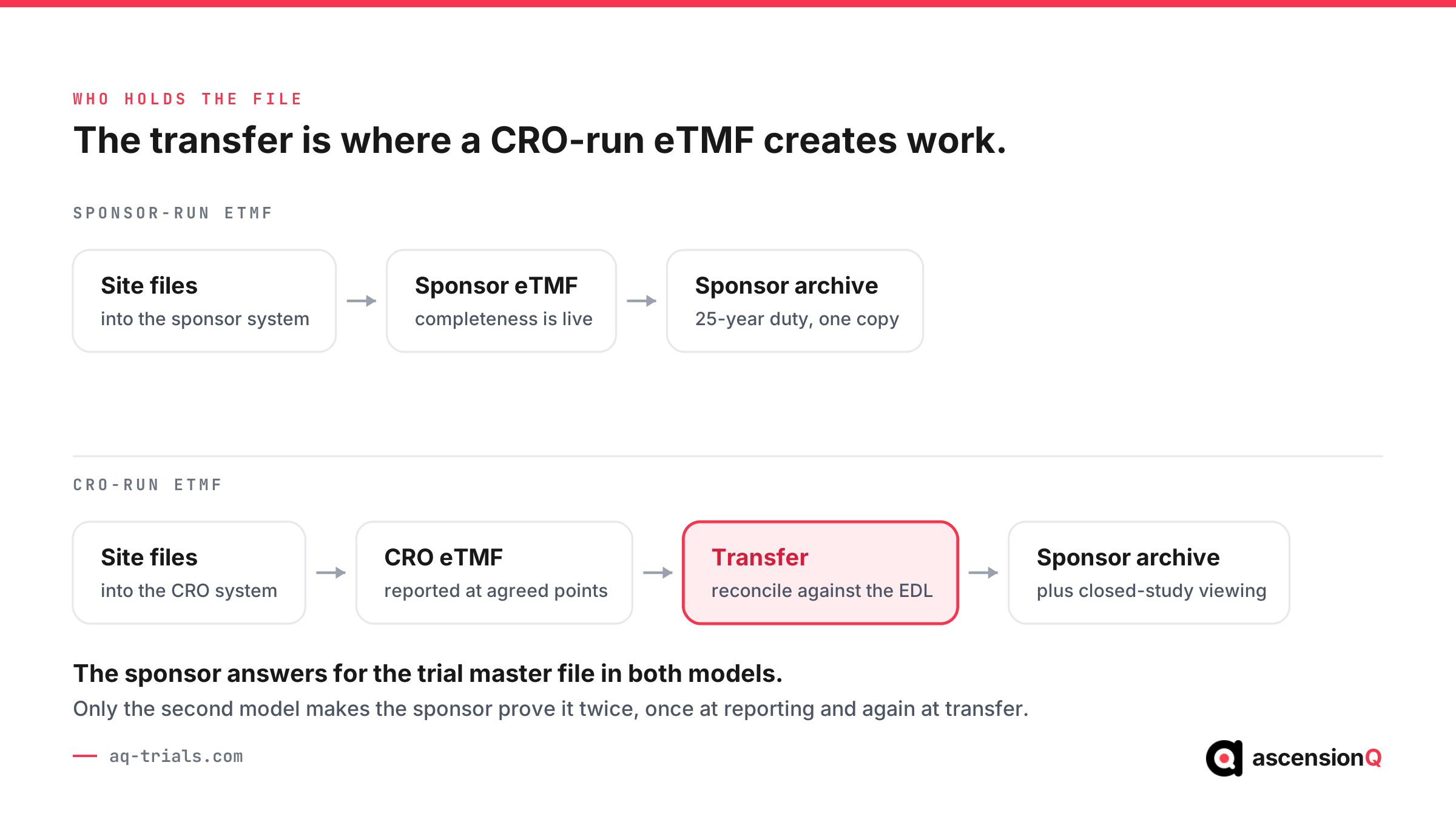
The same platform behaves differently depending on who holds the licence. A sponsor-run eTMF puts the sponsor in the system from day one. A CRO-run eTMF hands the sponsor a transfer at the end. Both are legitimate. They carry different risks, and the vendor set divides along that line.
| Aspect | Sponsor-run eTMF | CRO-run eTMF |
| Who holds the licence | The sponsor, for every study | The CRO, per study or per programme |
| When the sponsor sees completeness | Continuously, in the live file | At agreed reporting points, and at transfer |
| Main operational cost | Running the file, and training site and CRO users | Reconciling the transfer against the expected document list |
| Where the 25-year duty lands | On the sponsor’s own archive | On the sponsor after transfer, with a viewing arrangement for closed studies |
| Typical failure mode | Sites file late because the system is unfamiliar | Sponsor, CRO and site copies drift in version and location |
| What to confirm in the contract | Who holds the archive after the final study closes | The transfer format, the transfer date and the viewing arrangement for closed studies |
PhlexTMF publishes a separate product for viewing a closed-study eTMF transferred from a CRO, which is the clearest vendor acknowledgement of this split in the set. A UK clinical trials unit or an academic sponsor usually sits in the first column and lacks the staff of the second. That combination is where a connected record earns its place, because the reconciliation work disappears rather than moving to a different team.
Where AQ eTMF Fits
AQ eTMF files every document to the CDISC TMF Reference Model by zone, section and artifact, at study, country and site level, so a document has one correct place whether a sponsor, a CRO or a site files it. Completeness, timeliness and quality show as a status for every study, country, site and zone, which means the count is current on the day an auditor asks for it rather than the day a spreadsheet was last updated.
The mechanism that carries the UK criteria is the connected record:
- The trial master file sits on the same study record as the investigator site file, AQ Pharmacy and AQ CAPA, which removes the reconciliation step between a sponsor copy and a site copy.
- Every expected document carries a named owner and a due date, which routes a gap to a person instead of a report.
- Documents convert to PDF/A as they reach final, which keeps each record readable across a 25-year retention period.
- The platform and the study record are hosted in Microsoft Azure UK regions, and AQ meets the NHS Data Security and Protection Toolkit Standards for 2026 and holds Cyber Essentials certification.
- AQ is validated to GxP standards with every release, covering installation, operational and performance qualification and an assessment against 21 CFR Part 11 and EU Annex 11.
AQ Platform has been in continuous daily NHS use for six years, and runs 13 sites on one connected record. AQ eTMF fits a UK research site, clinical trials unit or NHS R&D office that answers for its own trial master file and wants the file, the site documentation and the quality record on one structure.
Documentation features compare faster against a live file than against a feature list. Book a live demo and ask to see a gap routed to a named owner, and an inspector view issued without an export.
Frequently Asked Questions
What is the best eTMF software for clinical research?
No single platform is best for every organisation. The best eTMF software for clinical research in a UK setting is the one that states a retention capability for at least 25 years, names an inspector access role, states where data is hosted, and names the CDISC TMF Reference Model version it ships. Of the nine platforms AI assistants name most often, none states all four.
What eTMF solutions work best for UK trials?
Platforms that publish UK-specific evidence work best for UK trials, because a UK buyer has to show that evidence to an inspector. Florence publishes a UK compliance page covering MHRA guidance, the Data Protection Act 2018 and a Data Security and Protection Toolkit self-assessment. Ennov publishes an MHRA TMF inspection finding checklist. AQ states UK hosting regions and Data Security and Protection Toolkit Standards Met for 2026.
Which trial platforms have the best documentation features?
Judge documentation features on three mechanics rather than a feature count: whether the expected document list is tracked by study, country and site; whether a gap carries a named owner and a due date; and whether the file and the investigator site file sit on one record. Veeva and Trial Interactive state automated document classification. Montrium and Medidata state rules-based auto-filing.
What should an eTMF do about the 25-year UK retention rule?
It has to keep records readily available, complete and legible for the whole period, restrict archived access to named individuals the sponsor appoints, and hold audit trails and metadata that stay readable. Regulation 31A requires at least 25 years for trials applied for from 28 April 2026. Ask what happens to the records when the contract ends.
Do eTMF vendors state where UK data is hosted?
None of the nine platforms compared here states a UK hosting region on its own website. Three name EU regions: Montrium, Trial Interactive and Veeva. Three name a cloud provider without a region. Two state nothing. A UK organisation that needs a hosting location in writing has to ask for it in procurement.
Which CDISC TMF Reference Model version should an eTMF support?
Version 3.3.1, released on 11 August 2023, is the current release of the model. Oracle names that version and attributes it to CDISC. Montrium names the version without the custodian. Medidata and Ennov still describe the model as the DIA TMF Reference Model, which is the older attribution.
Does a research site need its own eTMF?
A site maintains an investigator site file, and the sponsor maintains the trial master file. A site that also sponsors studies, such as a clinical trials unit or an NHS trust running its own research, carries both duties and needs both files. The two sets of records overlap, and the split between the two files decides which system owns which record.
Also Read: What Is Clinical Research Software and How to Choose the Right One