eSource and paper source worksheets differ at the site in four places: how errors arise, how a correction is recorded, where the record is stored, and how much work monitoring creates. The duty the site carries is identical in both formats. The difference lies in how much of the supporting evidence each format produces without human effort.
This guide is written for UK research sites weighing what actually changes on the ward when a paper worksheet becomes an electronic form. It covers the error types each format produces, the anatomy of a correction, storage and retrieval across the retention period, and the monitoring effort each one creates. The wider context sits in our complete guide to eSource in clinical trials.
The format decides how much of the record a person has to remember to write down.
What Changes When a Site Replaces a Paper Worksheet with eSource?
The record gains the metadata that a paper worksheet depends on a person to supply. A paper worksheet holds the value, a signature and a handwritten date. An electronic form holds the value and captures the author, the device, the timestamp and every later change as a by-product of the entry itself.
Both formats are source records. ICH E6(R3) defines source records as the original documents or data, including relevant metadata, or certified copies of them, in any media. A worksheet completed during the visit is source. An electronic form completed during the visit is source. Our guide to what counts as source data in a clinical trial sets out the underlying definitions.
| Aspect | Paper source worksheet | eSource form |
| What the record holds | The value, a signature and a handwritten date | The value plus author, timestamp and device metadata |
| Evidence of timing | The date the person wrote | The system timestamp on the entry |
| How an error surfaces | Review by a second person, usually at a monitoring visit | Edit checks at entry and audit trail review |
| What a correction shows | Whatever the person recorded beside the change | The prior value, the author, the time and the reason |
| Where the record sits | Physical files in the site file room | A controlled system with role-based access |
| What a monitor needs | Physical or scanned access to the sheet | Scoped access to the record and its audit trail |
The comparison with the sponsor’s data capture system is a separate question. Our guide to where source data ends and the CRF begins covers that boundary, and the forms site capture can take are set out in our guide to the types of eSource.
How Do Errors Differ Between Paper and Electronic Worksheets?
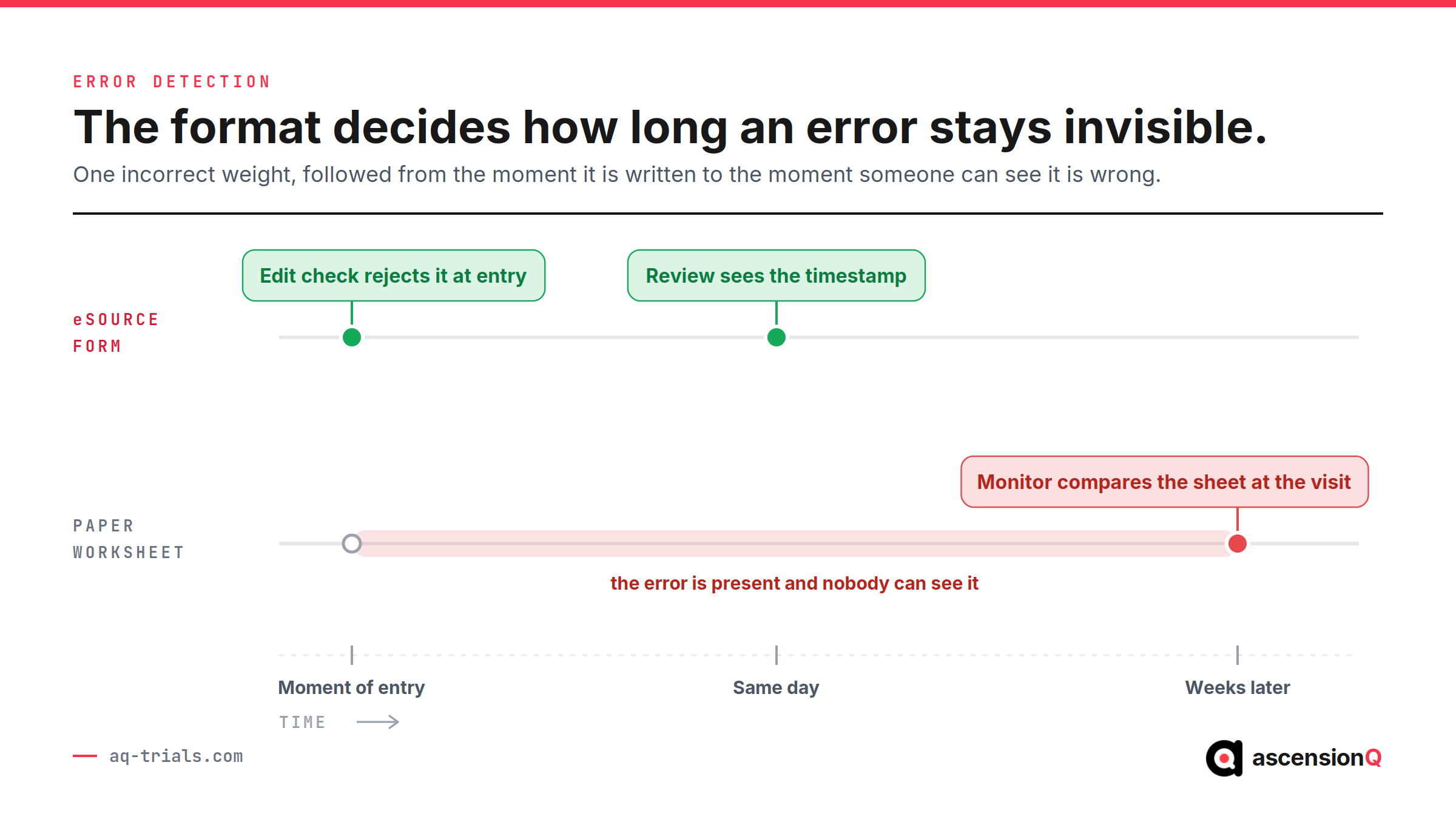
Paper worksheets produce errors of omission, legibility and design. Electronic forms produce errors of design and timing. The shift moves error detection from a person reading a sheet weeks later to a rule applied at the moment of entry.
The error types separate cleanly by format:
- Paper: a field left blank, because the sheet gives no signal that an answer is missing.
- Paper: a value that cannot be read with confidence, which forces a query to establish what was written.
- Paper: a unit or decimal place recorded inconsistently between visits, because nothing constrains the entry.
- Electronic: an entry made after the visit, which the timestamp records and the audit trail exposes.
- Electronic: a workaround forced by a form that does not fit the clinical reality, which moves the real record outside the system.
- Electronic: a value entered in the wrong participant record, which an edit check catches only where the rule exists.
A worksheet designed once carries its gaps for the life of the study. The MHRA GCP inspections metrics report describes a contract research organisation given a critical finding on record keeping, where there was a lack of source data available to verify the exact dose of investigational medicinal product provided to subjects during home visits, and the patient diaries produced for the trial did not capture the exact dose or volume administered. The design of the record decided what could be reconstructed afterwards.
A field that was never on the sheet cannot be recovered at the monitoring visit.
How Does a Correction Work on Paper and in an eSource System?
A correction has to leave the original entry readable and the change explained. ICH E6(R3) requires that changes to source records are traceable, do not obscure the original entry and are explained where necessary. The MHRA GXP data integrity guidance asks for the same outcome, requiring procedures that give visibility of the original record and traceability of the correction.
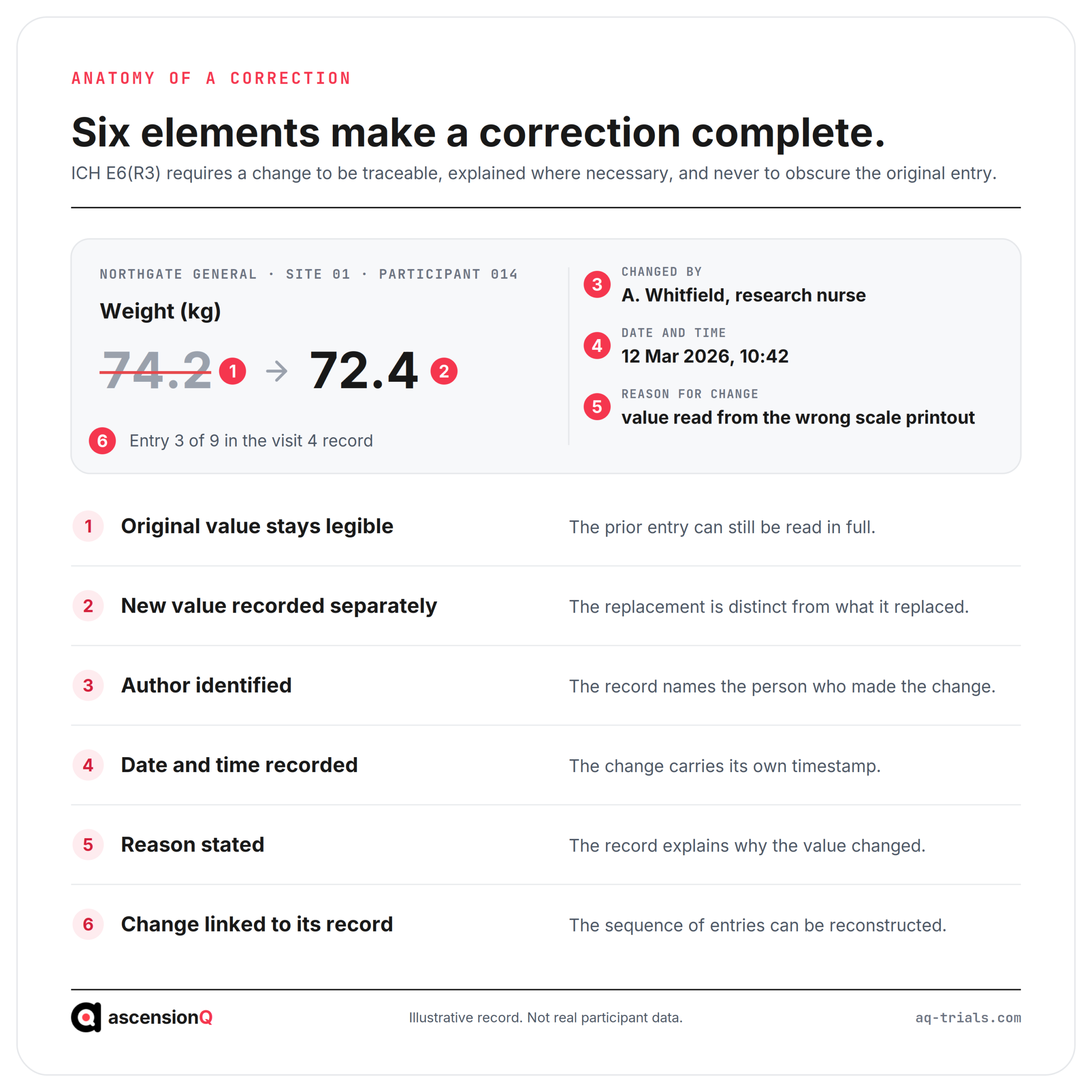
Six elements make a correction complete in either format:
- The original value stays legible, so the prior entry can still be read.
- The new value is recorded clearly and separately from the original.
- The person who made the change is identified.
- The date, and where relevant the time, of the change is recorded.
- The reason for the change is stated where the change is not self-explanatory.
- The change is linked to the record it belongs to, so the sequence can be reconstructed.
The formats differ in who guarantees each element. A paper correction relies on the person remembering to initial, date and explain beside a single struck-through line. An electronic correction records the author, the timestamp and the prior value by design, and it prompts for the reason. The remaining judgement in both formats is whether the reason given is meaningful.
Corrections are also where paper and electronic records diverge on originality. The EMA guideline on computerised systems and electronic data in clinical trials treats data collected on paper worksheets as data that needs transcription into an electronic system, either manually or through a validated entry tool, which creates a second record to keep consistent with the first.
Where Is Each Format Stored, and Who Can Retrieve It?
Paper worksheets are stored as physical objects in the site file room. Electronic records are stored in a controlled system that has to stay readable for as long as the paper would have lasted. The MHRA archiving and retention guidance requires trial master file and investigator records for trials applied for from 28 April 2026 to be retained for at least 25 years, and expects archived systems to keep audit trails and metadata readable throughout.
Each format carries its own retrieval risk:
- Paper depends on physical control, so fire, water, mislabelling and relocation are the failure modes.
- Paper retrieval scales with volume, so a request across several studies takes hours of staff time.
- Paper is readable without any dependency, which remains its clearest advantage across 25 years.
- Electronic records depend on the system, so vendor exit, format obsolescence and export quality decide what survives.
- Electronic retrieval is instant within the system, and it ends the moment access is withdrawn.
- Electronic archiving has to carry the metadata and the audit trail, because a flat extract will not reconstruct the trial.
A worked example makes the difference concrete. An inspector asks a site in year eleven for the visit four record of one participant on a closed study. The paper site sends a coordinator to the file room with a participant identifier and a visit date. The electronic site runs a query, and the answer depends entirely on whether the system, or its readable export, is still under the site’s control. Both answers are filed against the same investigator site file, which holds the source data plan and the location log that tell the inspector where to look.
How Much Monitoring Effort Does Each Format Create?
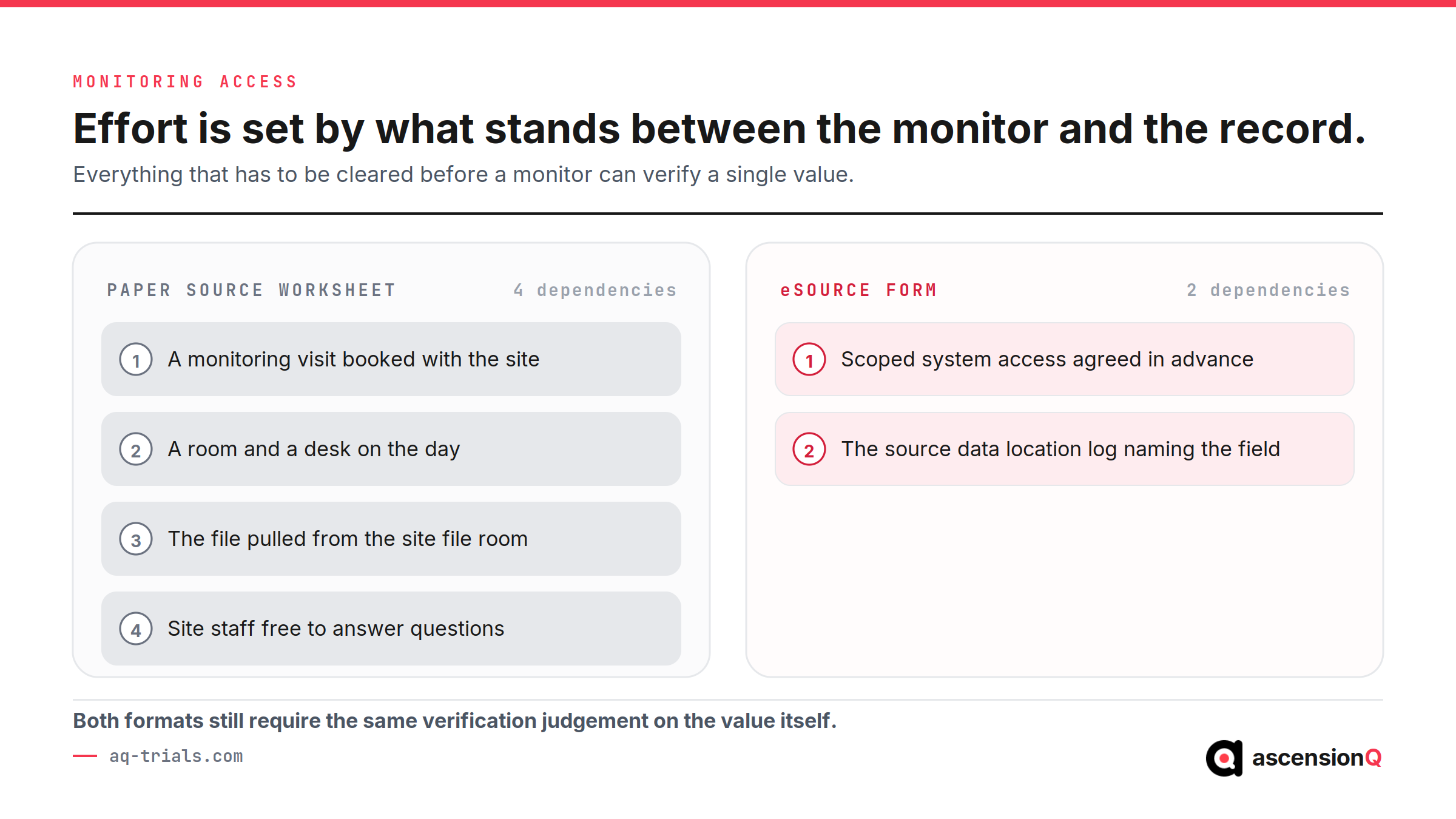
Monitoring effort is decided by where the monitor has to travel, how many records must be compared, and how long a query takes to close. Paper worksheets place all three on site. Electronic records move the first and shorten the third.
One monitoring cycle breaks into five stages, and the format changes four of them:
- Arrange access: paper requires a site visit and a room; electronic requires scoped access agreed with the trust in advance.
- Locate the record: paper depends on the filing system; electronic depends on the source data location log pointing at the right field.
- Compare the values: paper requires reading each field against the reported data; electronic allows the monitor to read the source directly.
- Read the change history: paper offers whatever was written beside a correction; electronic offers the audit trail.
- Resolve the query: paper waits for a scanned page or the next visit, and electronic can resolve once the site has answered in the system.
No regulator publishes a figure for the monitoring time either format consumes. Published evidence on source data verification effort varies by study design and by the mix of data sources at the site, so any efficiency figure a site relies on should come from peer-reviewed work rather than a vendor claim. Monitoring visit planning itself belongs to the site’s clinical trial management system.
What Stays the Same Whichever Format a Site Uses?
The obligations do not move with the medium. A site changing from paper to electronic forms changes the evidence its records produce, and it keeps every duty it had before.
- The source for each data point is declared in writing before the data is collected, and filed at the site.
- Records stay attributable, legible, contemporaneous, original, accurate and complete across the whole lifecycle.
- The investigator remains responsible for the data recorded under their oversight, whoever entered it.
- Entry rights follow the delegation log, so only delegated staff record or amend trial data.
- Retention runs for the full statutory period, in a format that stays readable.
- Computerised systems used for source capture are validated for their intended use before first patient in.
Those controls live in the site’s quality management system, which holds the procedures for correction, access review and system validation that apply to both formats.
The medium changed. The duty did not.
Frequently Asked Questions
What changes when a site replaces paper source worksheets with eSource?
The record gains its metadata automatically. A paper worksheet holds a value, a signature and a handwritten date. An electronic form also captures the author, the device, the timestamp and every later change.
How is a correction made in an eSource system?
The correction leaves the original entry readable and records who changed it, when and why. ICH E6(R3) requires changes to source records to be traceable, to leave the original entry visible and to be explained where necessary.
Do a site’s duties change when it moves from paper to eSource?
No. The format changes the evidence the records produce, and every duty stays the same, including declaring the source for each data point in writing before data is collected.
Sites weighing a move from paper worksheets usually start with the four questions above and work back to what their own records would show at inspection. Book a live demo to see the AQ platform today.