Over the past decade, I’ve watched organisations invest heavily in clinical research technology. CTMS, eTMF, eISF, QMS, pharmacy systems, training platforms, and countless spreadsheets have improved individual processes. Many organisations still struggle to connect those processes into one operational picture. Teams often spend more time finding information than using it.
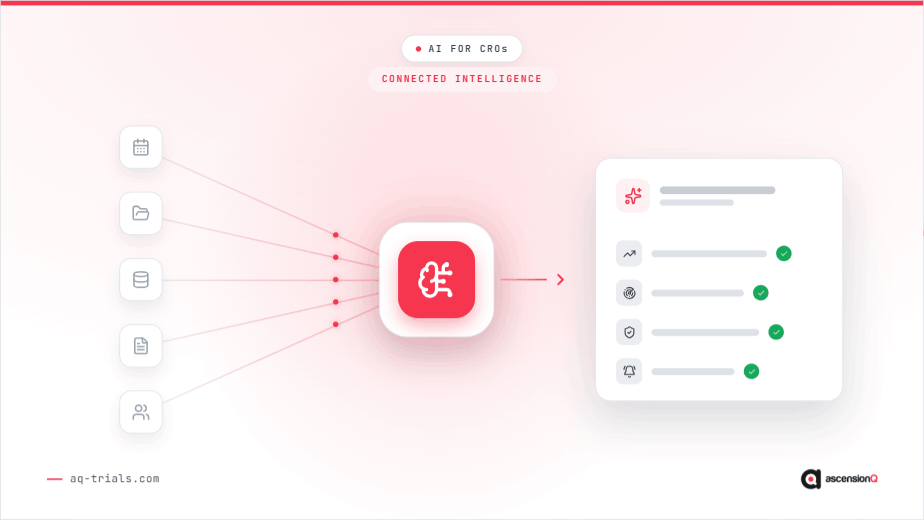
Artificial intelligence has accelerated the next stage of this evolution. However, its greatest value does not come from generating content or automating isolated tasks. Its real value comes from helping research teams understand relationships across studies, documentation, quality events, delegated responsibilities, training, and operational records. Intelligent assistance becomes significantly more valuable when it understands context rather than isolated data.
I believe the future of clinical research will not be defined by who adopts the most AI. It will be defined by who builds the most connected operational environment, where people, processes, quality, and information work together to support faster decisions, stronger governance, and continuous inspection readiness.
Clinical research does not need more disconnected intelligence. It needs connected intelligence built on trusted operational data.
AI is transforming CROs by:
- Improving study planning and protocol design
- Strengthening feasibility assessments
- Accelerating patient recruitment
- Optimising site selection
- Enhancing clinical data management
- Supporting risk-based monitoring
- Assisting medical writing and regulatory documentation
- Improving pharmacovigilance and safety surveillance
- Strengthening quality management and CAPA processes
- Automating operational reporting and analytics
- Optimising resource planning and portfolio management
- Supporting inspection readiness and regulatory compliance
- Enabling connected operational intelligence across clinical research
However, this article focuses specifically on the operational dimension of AI, where connected intelligence is helping CROs strengthen governance, improve operational visibility, and support better decision-making across the clinical trial lifecycle.
Artificial Intelligence Is Changing Clinical Research. Connected Data Determines Its Value.
Artificial intelligence has earned its place within modern clinical research. Research teams use it to accelerate study planning, strengthen patient recruitment, improve data review, support medical writing, and identify operational risks earlier than traditional manual processes.
All the capabilities continue to mature. However, the greater transformation lies in how AI works with clinical research data.
Every clinical trial generates thousands of interconnected records. Protocols evolve. Site files expand. Training records grow. Deviations trigger investigations. Corrective actions influence future audits. Delegated responsibilities change throughout the life of a study. Every activity contributes to a broader operational picture that extends far beyond a single document or workflow.
AI delivers its greatest value when it understands those relationships. For instance, a language model can summarise a document. And a connected clinical research platform can explain how that document relates to investigator responsibilities, outstanding CAPAs, protocol amendments, training requirements, quality events, and inspection readiness.
That difference matters.
Clinical research is not a collection of independent tasks. It is a connected operational system where every decision influences another.
Many organisations still operate across disconnected applications. Clinical operations, document management, quality management, pharmacy oversight, and site documentation often exist within separate platforms that require teams to manually reconcile information before making informed decisions.
- Artificial intelligence cannot fully compensate for fragmented data.
- Disconnected information produces disconnected intelligence.
- Connected information creates contextual intelligence.
The distinction becomes clear across every stage of the clinical trial lifecycle.
| Clinical Activity | Traditional Digital Workflow | Connected Intelligent Workflow |
| Study planning | Historical reports reviewed manually | Historical studies, operational metrics and quality insights support planning decisions |
| Site management | Multiple systems reviewed independently | Connected operational records reveal emerging risks earlier |
| Document review | Users search across repositories | Related documents, approvals and quality records appear within context |
| Quality management | Issues investigated module by module | Connected records reveal relationships across studies, documents, CAPAs and audits |
| Inspection readiness | Evidence assembled before inspections | Operational evidence remains connected and continuously maintained |
This shift changes the role of enterprise software.
Clinical research platforms no longer succeed simply because they store information securely. But infact, they create greater value when they help organisations understand operational context, identify relationships, and surface meaningful insights without requiring teams to navigate multiple disconnected systems.
Artificial intelligence strengthens that capability. Connected operational data makes it possible.
Also Read: What is AQ Platform?
Connected Intelligence Creates Better Decisions
Clinical research has never lacked data. It has lacked context.
Every study generates thousands of operational records across clinical operations, quality management, essential documentation, delegated responsibilities, pharmacy activities, training, and regulatory oversight. Each record tells part of the story. Research teams make better decisions only when those records are viewed together.
That is the difference between digitisation and connected intelligence.
Traditional software captures information within individual applications. Teams still move between systems to understand the complete operational picture. Every manual search, spreadsheet reconciliation, and disconnected workflow introduces delay, duplication, and unnecessary risk.
Connected intelligence removes those barriers.
Instead of asking users to assemble information manually, modern platforms should present the operational context surrounding every activity.
For instance:
- a protocol amendment should immediately reveal the documents affected by the change.
- a quality event should expose related CAPAs, previous investigations, and outstanding actions
- an investigator record should provide visibility into delegated responsibilities, completed training, site documentation, and ongoing study activities.
- an audit should begin with connected evidence rather than weeks of manual preparation.
The objective is not to help people find more information. The objective is to help them understand the information they already have.
That shift changes the way organisations manage research.
Operational reviews become faster because supporting evidence already exists within the same context. Quality investigations become more consistent because related records remain connected throughout the lifecycle. Inspection readiness becomes a continuous operational state instead of a project that begins a few weeks before an inspection.Research teams also spend less time asking operational questions that software should already answer.
Questions such as:
- Which SOP governs this activity?
- Has everyone completed the required training?
- Are there related quality events?
- Does an open CAPA already exist?
- Has this issue occurred before?
- Who remains accountable for the next action?
All those questions should not require searching across multiple systems. They should already be part of the operational record.
| Disconnected Operations | Connected Intelligence |
| Information exists in multiple systems | Information exists within one operational context |
| Users search for relationships | Relationships are already connected |
| Reports explain what happened | Operational intelligence helps explain why it happened |
| Inspection evidence is assembled manually | Inspection evidence develops continuously |
| Teams spend time locating information | Teams spend time making informed decisions |
Artificial intelligence strengthens this model because it works with connected operational context instead of isolated records.
Intelligent assistance becomes capable of identifying incomplete documentation, highlighting emerging quality risks, surfacing related operational records, and supporting informed decision-making across the entire research lifecycle.
Clinical research will always depend on experienced professionals. Connected intelligence ensures those professionals spend their expertise solving problems rather than searching for information.
Every minute spent connecting information manually is a minute taken away from improving research quality, protecting participants, and advancing clinical outcomes.
Also Read: How AQ eISF and ePSF Support Multi-Site Documentation Governance Across a CRDCs?
Building AQ Around Connected Intelligence
Everything I’ve described shaped how we built AQ.
I’ve spent over twenty years inside clinical research, working alongside NHS Trusts, CROs, sponsors, biotechnology companies, and academic research organisations. Every one of them runs differently. Every one of them hits the same structural problem.
Information sits everywhere. Operational context sits nowhere.
CTMS, quality systems, essential documents, pharmacy records, delegated responsibilities, training, and corrective actions run in separate applications. Each system controls its own task. Few connect those tasks into one operational record. Teams hold the connection themselves, across spreadsheets, email threads, and memory.
Fragmentation is where operational control breaks. It is also where AI fails quietly. A model pointed at one disconnected system answers one narrow question and misses the study around it. Research teams still lose hours answering questions the system should already answer:
- Which SOP governs this activity?
- Has the required training been completed and acknowledged?
- Is there an open CAPA linked to this issue?
- Has a similar deviation happened before?
- Which documents changed after the latest protocol amendment?
- Who owns the next action, and by when?
Every hour spent reconciling systems is an hour taken from study delivery, oversight, and patient safety.
We Built AQ Around One Connected Operational Record
AQ is control infrastructure for the whole study record. Every operational activity contributes to the same trusted account, so study teams work from one source instead of assembling one.
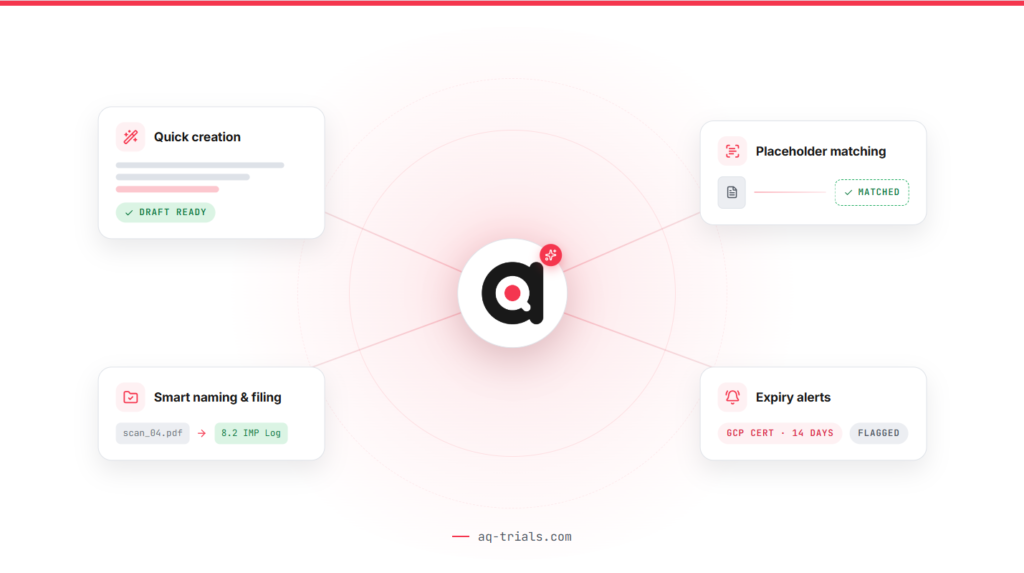
AQ clinical research modules operate as connected controls inside one environment.
| Module | Control |
| CTMS | Study execution control across planning, recruitment, participant flow, and milestones |
| eTMF | Trial Master File oversight with structured filing, completeness tracking, and version control |
| eISF | Investigator Site File control across documentation, delegation, and inspection readiness |
| ePSF | Pharmacy Site File control across IP accountability, dispensing, and storage oversight |
| QMS | Quality governance across SOPs, document control, training, competency, and audit readiness |
| CAPA | Issue resolution across findings, root cause, corrective and preventive actions, and closure |
| Digital DoA | Delegated authority with role assignment, effective dates, and traceable responsibility |
Each module owns its function and shares the same operational context. The control chain runs end to end: CTMS feeds clean operational state into eISF and ePSF; documentation and pharmacy accountability feed QMS and CAPA; Digital DoA governs who holds authority across all of them. Information stops living in functional silos.
AQ is built around the standards research already operates under: ICH-GCP E6(R3), MHRA inspection expectations, ALCOA+, and UK GDPR. Secure audit trails, role-based access, and attributable, controlled approvals sit inside the operational record itself.
Governed AI Works Better As the Study Record Is Connected
Connected data is what makes AI useful in regulated research. When every module shares one operational record, governed AI reads across the whole study instead of a single document, and its output carries the context an inspector would expect.
Inside AQ, that assistance works against the connected record:
- Document intelligence organises study records, highlights missing or superseded documents, and speeds retrieval across the eTMF and site files.
- Readiness monitoring surfaces documentation gaps and operational issues across CTMS, eISF, and ePSF as work happens.
- Workflow assistance prompts the next controlled action and shows who owns it through Digital DoA.
- Quality signal detection flags potential deviations, unresolved CAPAs, and overdue approvals before they escalate.
Governance holds the line around all of it. Every recommendation stays subject to human review. Every decision stays attributable. Every action stays traceable in the audit trail. AQ removes the administrative effort of finding and connecting information, so quality professionals spend their judgement on scientific decisions, governance, and patient safety.
AI does not replace the people running research. It works inside their operational record and gives them the complete picture before they decide.
Connected Records Create Connected Decisions
One operational change moves through the whole study. AQ keeps those relationships connected, so the consequences stay visible and the assistance stays accurate.
- A protocol amendment updates controlled documents.
- Updated documents trigger training and re-acknowledgement.
- Training records feed competency and delegation.
- Quality events open investigations and CAPAs.
- CAPAs shape future audits and risk assessments.
- Every action lands in one complete operational history.
That connected context gives research teams — and the governed AI supporting them — three answers at once: what happened, why it happened, and what needs attention next. Inspection readiness becomes a continuous operational state, maintained as work happens rather than rebuilt before every audit.
The objective is simple. Keep the operational record complete, connected, and ready to stand up to scrutiny, so experienced people, supported by governed AI, spend their judgement on research instead of reconciliation.
AI Makes Connected Platforms Even More Valuable
Artificial intelligence becomes far more useful when it works with connected operational data instead of isolated records.
Rather than analysing a single document or answering a single question, governed AI can understand relationships across the study.
It can help teams:
- Surface incomplete documentation.
- Identify related SOPs and study records.
- Highlight linked quality events and CAPAs.
- Detect overdue reviews and approvals.
- Support document reviews with operational context.
- Reveal emerging inspection and compliance risks.
Every recommendation remains subject to human review. Every decision remains attributable. Every action remains fully traceable.
I don’t believe AI replaces quality professionals. I believe it removes unnecessary administrative effort so experienced professionals can focus on scientific judgement, governance, and patient safety.
That philosophy continues to shape the evolution of AQ. We are embedding governed AI throughout the platform, not as a standalone feature, but as intelligent assistance that works within CTMS, eTMF, eISF, ePSF, QMS, CAPA, and Digital DoA.
The objective remains unchanged: connect information, strengthen oversight, and help research teams make informed decisions with greater confidence.
Connected intelligence isn’t about adding more technology. It’s about helping every decision begin with the complete operational picture.
Bottom Line
Artificial intelligence is reshaping the future of CROs, but technology alone will never define that future. Connected intelligence, built on trusted operational data and guided by human expertise, will enable the next generation of clinical research to operate with greater clarity, confidence, and purpose.