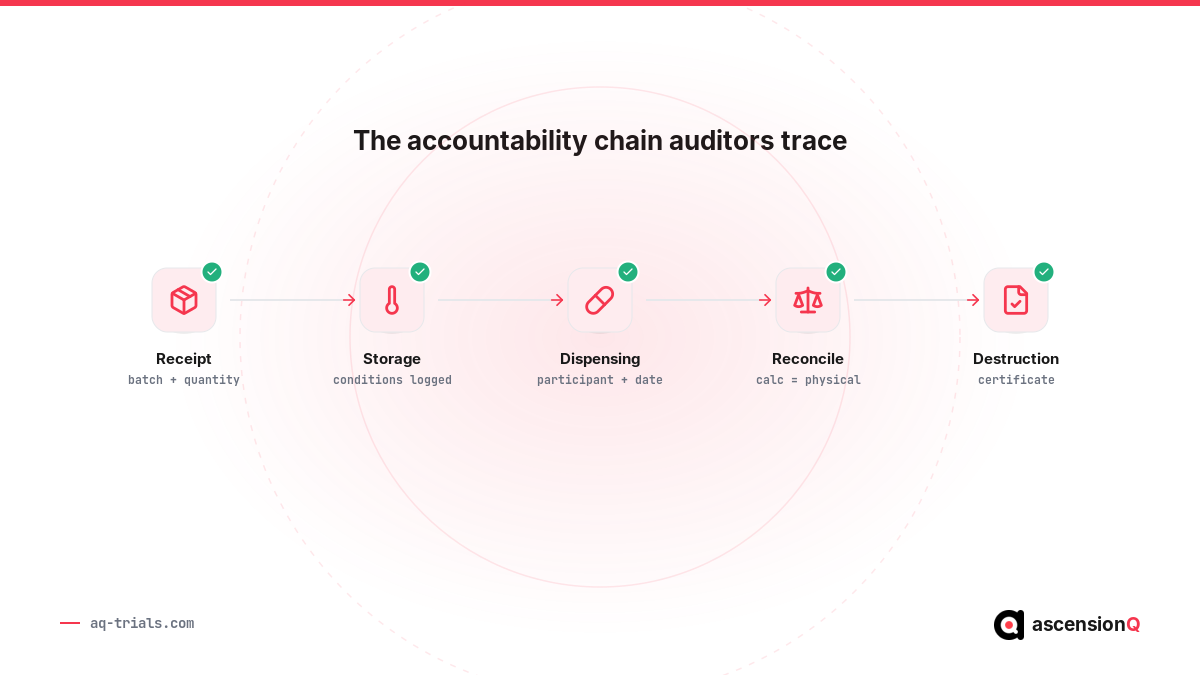
The drug accountability log is the record that proves the investigational medicinal product (IMP) was controlled at every point. It tracks each unit from receipt at the site, through storage and dispensing, to return and destruction, with a running balance at every step. An auditor or MHRA inspector reads it to answer one question: can this site account for every unit of drug it received? This guide sets out exactly what they check, the ALCOA+ rules the log must meet, and the common findings they write.
The log lives in the pharmacy record, held and maintained by the delegated research pharmacist. It sits in the electronic Pharmacy Site File (ePSF), separate from the investigator site file, because drug accountability is a distinct control with its own reviewer.
- The log traces every unit of IMP from receipt to destruction, with a running balance.
- Auditors check completeness, contemporaneous entries, and whether the balance reconciles to physical stock.
- The log must meet ALCOA+ (attributable, legible, contemporaneous, original, accurate, plus complete, consistent, enduring, available).
- Reconciliation confirms the calculated balance matches the physical count, at each monitoring visit and at study closure.
What is a drug accountability log?
A drug accountability log is the site record of every movement of investigational product. It captures receipt, storage conditions, dispensing to each participant, returns, and destruction. Each entry records the date, the quantity, the responsible person, and the resulting balance.
The running balance is the spine of the log. Every event updates it, so the calculated figure should always match the drug physically on the shelf. A balance that does not reconcile is the single fastest way to a finding.
What do auditors actually check?
An auditor reviews the log for four things. Each one maps to a specific control the pharmacy should already have in place.
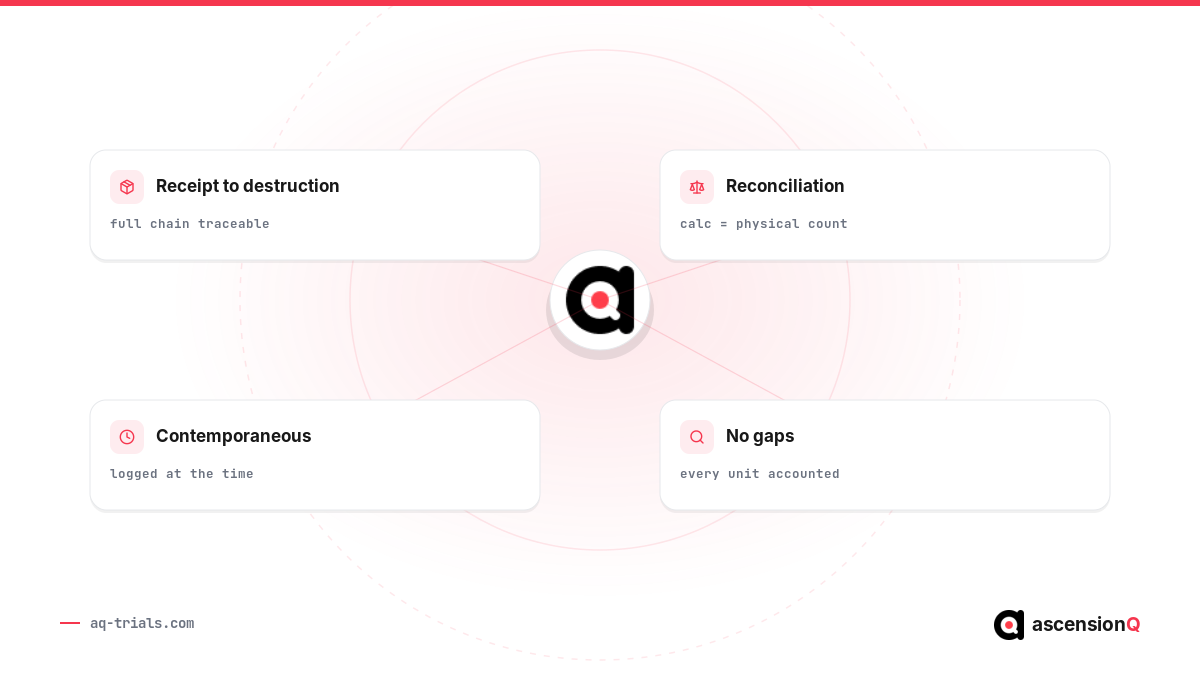
- The full chain is traceable. Every unit received links forward to a dispensing, a return, or a destruction record. Nothing disappears from the count.
- Entries are contemporaneous. Each dispensing was logged at the time it happened. A retrospective entry is a data-integrity issue, not a tidy-up.
- The balance reconciles. The calculated running balance matches the physical stock on the shelf and in the log.
- Discrepancies are resolved. Any difference has a documented explanation and a resolution, not an open question.
Which findings appear most often?
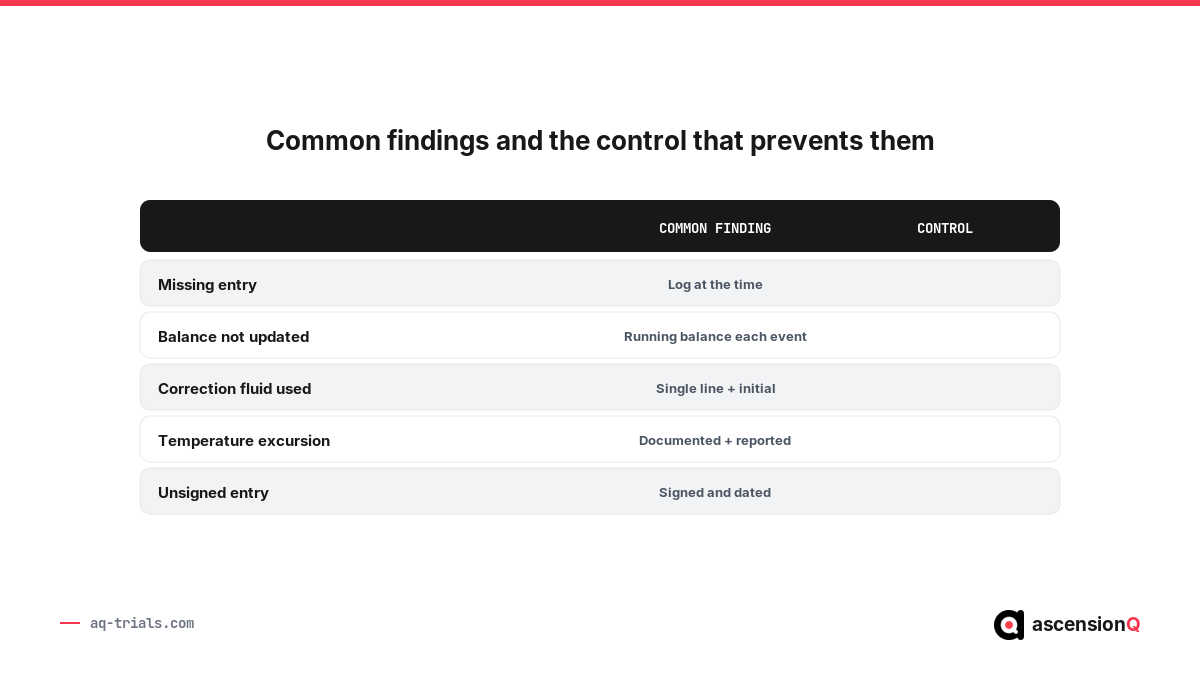
MHRA GCP inspections write the same accountability findings repeatedly. The table pairs each common finding with the control that prevents it.
| Common finding | Control that prevents it |
|---|---|
| Missing entry | Log every dispensing at the time it occurs, against the participant and visit. |
| Running balance not updated | Update the balance column on every receipt, dispensing, return, and destruction. |
| Incorrect quantity recorded | Second-person check on dispensing and reconciliation entries. |
| Unsigned entry | Each entry signed and dated by the authorised pharmacy person. |
| Correction fluid used | Single line through the error, correct value, initial and date. |
| Undocumented temperature excursion | Record the excursion, report it to the sponsor, and document the resolution. |
How does ALCOA+ apply to the log?
The accountability log is a data-integrity record, so it is judged against ALCOA+. Each attribute has a concrete meaning at the point of entry:
- Attributable: the entry names who made it.
- Legible and Original: the record is readable and is the first capture, not a copied-up version.
- Contemporaneous: the entry was made at the time of the activity.
- Accurate, Complete, Consistent: the quantities are correct, nothing is missing, and the log agrees with source.
- Enduring and Available: the record survives for the retention period and can be produced on request.
A gap in any attribute is a gap an inspector can write. The pharmacy site file exists to hold these records to that standard.
What is reconciliation, and when does it happen?
Reconciliation is the mathematical check that the calculated balance matches the physical inventory. The pharmacy performs it at each monitoring visit and again at study closure. A clean reconciliation confirms the chain held. A discrepancy triggers an investigation, and an unresolved discrepancy escalates into a CAPA.
Reconciliation is also where late filing shows. A log reconstructed the week before a monitoring visit rarely matches on the first pass, and the pattern of round-number corrections gives it away.
How does AQ ePSF keep accountability audit-ready?
The AQ electronic Pharmacy Site File holds IMP accountability in a structured, permission-controlled record. Dispensing and authorisation link to named pharmacy users, every action carries a timestamped audit trail, and completeness indicators show which records are filed, missing, or awaiting sign-off across each study. The result is a log that stays close to inspection-ready every day, rather than the week before a visit.
The boundary is clear. AQ does not reconcile the physical count for you. Physical stock still has to match the record, and a person confirms the count. AQ surfaces the discrepancy, holds the evidence, and makes contemporaneous recording easy to prove.
Read also: What is ePSF in Clinical Trial Data Management? and Clinical Research Audits: Types, Process, Checklist and Audit Readiness.
Book a live demo to see how AQ keeps investigational product accountability audit-ready.