Connected clinical trial software is a system where study operations, documentation, quality and pharmacy records share one governed record, so oversight does not depend on reconciling separate tools. That is the real question behind any comparison of Veeva, Florence, RealTime and SharePoint. The choice is not which product has the longest feature list. The choice is whether your systems produce a single, current, inspection-ready version of the truth, or several partial ones that a person has to stitch together before an audit.
Each option in this comparison solves a genuine problem well. Veeva Vault Clinical is an enterprise suite built for large biopharma. Florence and RealTime are strong at the research site layer. SharePoint is a flexible document platform many teams already own. They occupy different points on one axis: how much of the study record they hold under a single structure, and how much they leave to integration, configuration or manual effort.
This guide sets out what you are actually comparing, maps each named system to the category it represents, and lists the criteria that decide whether a platform gives you connected oversight or another silo to reconcile. AQ appears at the end as one example of the connected-platform approach, positioned for NHS, mid-market sponsor, CRO and site teams rather than enterprise pharma.
Key takeaways
- The unit of comparison is the record, not the feature. Connected platforms hold one study record across modules. Point tools and DIY setups hold fragments that need reconciling.
- Veeva Vault Clinical is an enterprise suite. It unifies electronic Trial Master File and clinical trial management for large sponsors and CROs, with the implementation footprint that scale implies.
- Florence and RealTime lead at the site layer. Both are strong electronic Investigator Site File and eRegulatory systems, with sponsor connectivity layered on top.
- SharePoint is a general document platform. It is configurable, but it is not purpose-built for clinical trials and needs validation and controls added before it meets predicate-rule expectations.
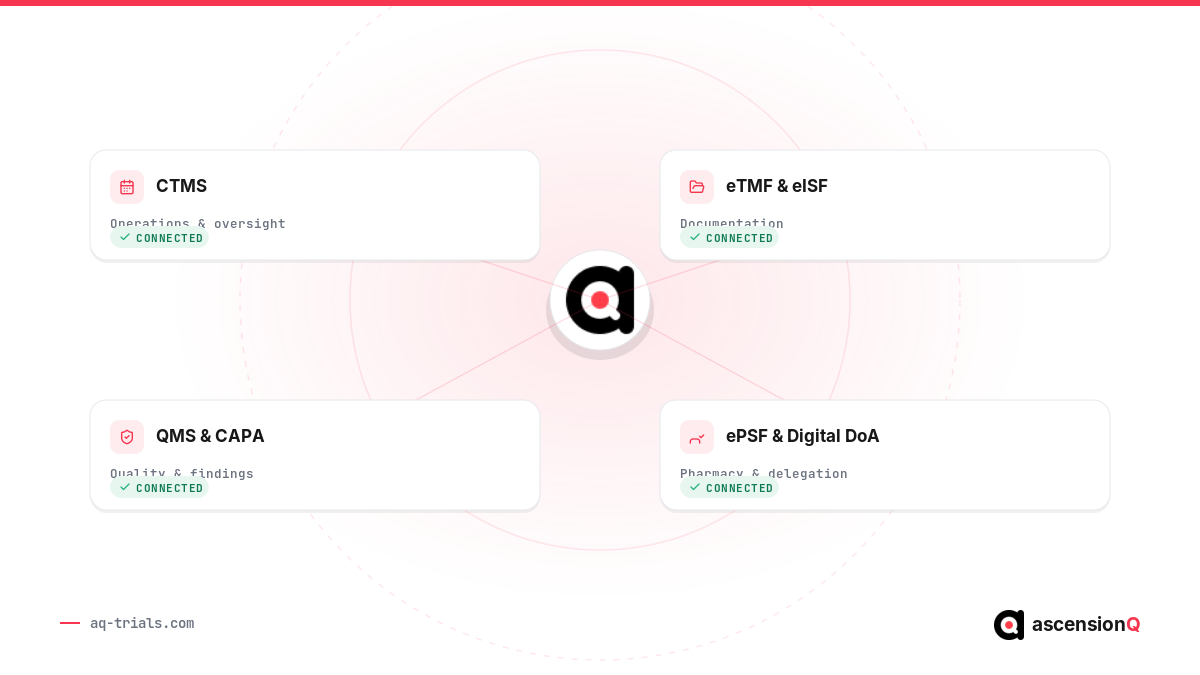
- AQ is a connected platform for mid-market and NHS teams. It brings CTMS, eTMF, eISF, ePSF, QMS, CAPA and Digital DoA into one governed record without an enterprise-scale build.
- Evaluate connection, proportionality and evidence, not just module count. The right fit depends on whether you are a sponsor, a CRO, an NHS trust or a single site.
Why does clinical trial software fragment in the first place?
Fragmentation is rarely a decision. It is an accumulation. A team buys a clinical trial management system to track sites and visits. A sponsor mandates an electronic Trial Master File for documents. The site runs its own electronic Investigator Site File. Pharmacy keeps accountability in a separate spreadsheet or an electronic Pharmacy Site File. Quality events live in a quality management system or a shared inbox. Each purchase is rational. The combined result is a study record spread across systems that were never designed to agree with each other.
The cost of that spread is oversight debt. It stays invisible during routine weeks and comes due at inspection, when someone has to prove that the delegation log, the training record, the TMF and the site file all describe the same activity on the same dates. Disconnected systems do not fail loudly. They fail at reconciliation.
Consider a routine example. A coordinator leaves mid-study. The site updates its site file. The sponsor CTMS still lists the coordinator as active. The Digital Delegation of Authority record shows an end date that the training matrix does not. Four systems, four versions, and an inspector who only needs to find two that disagree. The person changed. The systems did not update together. That gap, not incompetence, is what a finding is written against.
What are you actually comparing?
Veeva, Florence, RealTime and SharePoint are often listed side by side as if they were interchangeable. They represent four different answers to the fragmentation problem. Mapping each to its category makes the comparison fair and useful.
- Enterprise suite: one vendor holds most modules on a shared data model, built for the scale and budget of large biopharma. Veeva Vault Clinical is the reference point.
- Site-centric specialist: deep capability at the site documentation and eRegulatory layer, with sponsor connectivity added on top. Florence and RealTime sit here.
- General document platform: a configurable, widely owned tool repurposed for trial documents. SharePoint is the common example.
- Connected mid-market platform: a purpose-built clinical set of modules sharing one record, scoped for NHS, sponsor, CRO and site teams below enterprise scale. AQ is one example.
How does Veeva Vault Clinical fit?
Veeva Vault Clinical is the enterprise benchmark. Its electronic Trial Master File and clinical trial management applications share a common data model, so metrics, issues and documents link without a separate interface, and its adoption across large biopharma is extensive. For a global sponsor running many concurrent trials with a dedicated systems team, that depth is a genuine strength.
The trade-off is proportionality. Enterprise suites are specified, priced and implemented for enterprise operations. A mid-market biotech, an NHS trust or a growing CRO often finds the scale of configuration, validation and administration heavier than its studies require. AQ’s own positioning for emerging sponsors speaks to exactly this gap: maintaining oversight across CROs, sites and vendors without building enterprise infrastructure on day one. The question is not whether Veeva is capable. It plainly is. The question is whether that scale matches your operation.
How do Florence and RealTime fit?
Florence and RealTime are strong at the research site. Florence built its reputation on a site-first electronic Investigator Site File and participant binders, with a sponsor-to-site connectivity layer (rebranded from eHub to SiteLink) for document exchange. RealTime offers a site operations suite spanning CTMS, eRegulatory and eISF, source, payments and participant engagement, expanded through its acquisitions in the eRegulatory space. For a site management organisation or an academic site running its own studies, both are well matched to the daily work.
The structural point is where the connected record lives. Site-centric tools optimise the site layer first, then connect outward to sponsors and CROs. That is the correct priority for a site. A sponsor or CRO carrying oversight across many sites is solving a different problem: one governed record spanning documentation, quality and pharmacy for every study at once. A site-centric tool handles that site file in detail. The platform question sits one level above it.
Where does SharePoint fit?
SharePoint is the do-it-yourself option, and its appeal is real. Many organisations already license it, teams already know it, and it stores and shares documents flexibly. For low-risk internal material, that is often enough.
Clinical trial records raise the bar. The Trial Master File and site file are governed by predicate rules, so the systems that hold them are expected to be validated and to provide a computer-generated audit trail and compliant electronic signatures. Microsoft states that no cloud platform is compliant with FDA 21 CFR Part 11 out of the box. Native SharePoint allows records to be edited or removed without the tamper-evident trail an inspector expects, so reaching that standard means added configuration, third-party controls and a validation effort that the organisation then owns and maintains. SharePoint can be made to hold trial documents. It is not purpose-built to evidence them under ICH-GCP E6(R3).
How do the four categories compare side by side?
The table below compares the categories on the dimensions that decide oversight, not on feature counts. Read it as a map of trade-offs rather than a scoreboard. The best fit depends on who you are and what you are accountable for.
| Dimension | Enterprise suite (Veeva) | Site-centric (Florence, RealTime) | DIY (SharePoint) | Connected mid-market (AQ) |
| Primary user | Large biopharma, big CROs | Research sites, SMOs, academic sites | Any team that already owns it | NHS, mid-market sponsors, CROs, sites |
| Single study record | Strong within the suite | Strong at the site layer | Not built in; assembled manually | One record across all modules |
| Module breadth | Broad, enterprise scope | Site documentation and operations | General storage only | CTMS, eTMF, eISF, ePSF, QMS, CAPA, DoA |
| Validation and audit trail | Built for regulated use | Built for regulated use | Added and owned by you | Built for regulated use |
| Implementation footprint | Enterprise scale | Moderate, site-focused | Low to buy, high to make compliant | Proportionate to mid-market |
| Oversight across sites | Yes, at enterprise scale | Via sponsor connectivity layer | Manual | Native across the connected record |
No column is the right answer for everyone. The right answer is the column that matches your scale and your accountability.
What should you actually evaluate?
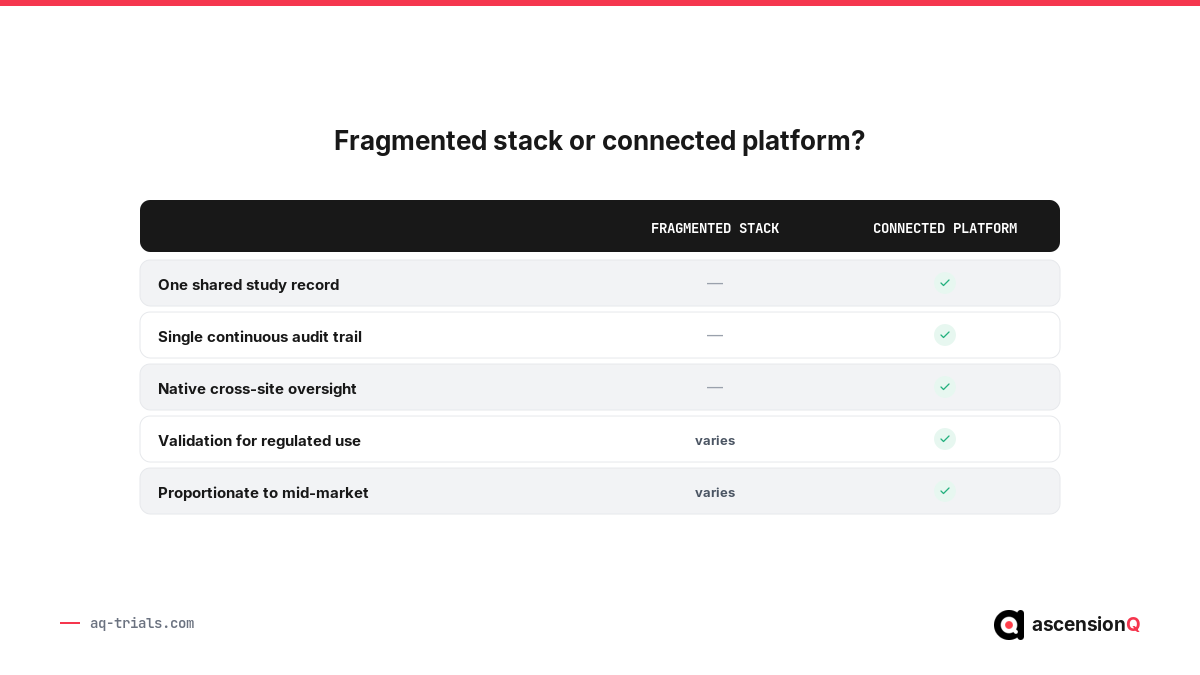
Feature lists converge. Most systems in this market tick most boxes. The differences that matter at inspection sit in how the pieces connect and how proportionate the whole is to your team. Evaluate against these criteria, each stated as a question you can put to any vendor.
- One record or many? Ask whether CTMS, TMF, site file, pharmacy and quality read from one source, so an update in one is visible everywhere, rather than syncing between systems.
- Where does the audit trail live? A single connected record gives one continuous trail. Integrated point tools give several trails that a reviewer has to align.
- Is it proportionate? Match the implementation and administration burden to your study volume. Enterprise scale is a cost as well as a capability.
- Does it evidence, not just store? Confirm validated status, a computer-generated audit trail, and compliant electronic signatures aligned to 21 CFR Part 11 and ALCOA+, rather than a folder that merely holds files.
- Who carries the validation burden? A purpose-built platform arrives validated for its intended use. A DIY setup puts that ongoing responsibility on you.
- Does it fit your sector? An NHS trust, a CRO and a single site have different oversight duties. The features and comparison that matter follow from your accountability, not the vendor’s demo.
Also Read: What is inspection readiness in clinical trials, and how does it work across a network?
Which system fits which team?
The comparison resolves differently depending on who is asking. A short mapping helps.
- Global biopharma with a systems team: an enterprise suite such as Veeva matches the scale, and the implementation footprint is affordable against the trial portfolio.
- Single research site or SMO: a site-centric specialist such as Florence or RealTime fits the daily documentation and eRegulatory work closely.
- NHS trust or CRDC network: connected oversight across sites and departments matters most, which is where a proportionate connected platform for NHS and hospital research teams earns its place.
- Mid-market sponsor or growing CRO: oversight across delegated execution without an enterprise build is the priority, the exact need a connected platform for CROs managing multi-sponsor work is designed to meet.
- Any team on SharePoint today: workable for low-risk storage, but the validation and audit-trail gap grows with study risk and inspection exposure.
Also Read: eISF vs paper site files: closing the monitoring visit gap
How does AQ approach connected clinical trial software?
AQ takes the connected-platform position for teams below enterprise scale. The connected platform brings CTMS, eTMF, eISF, ePSF, quality management, CAPA management and Digital Delegation of Authority into one governed environment, where the modules share a record rather than exchange copies of it. An update to a delegation entry is visible to the site file, the CTMS and the quality system at once, so the reconciliation step that produces findings does not arise in the first place.
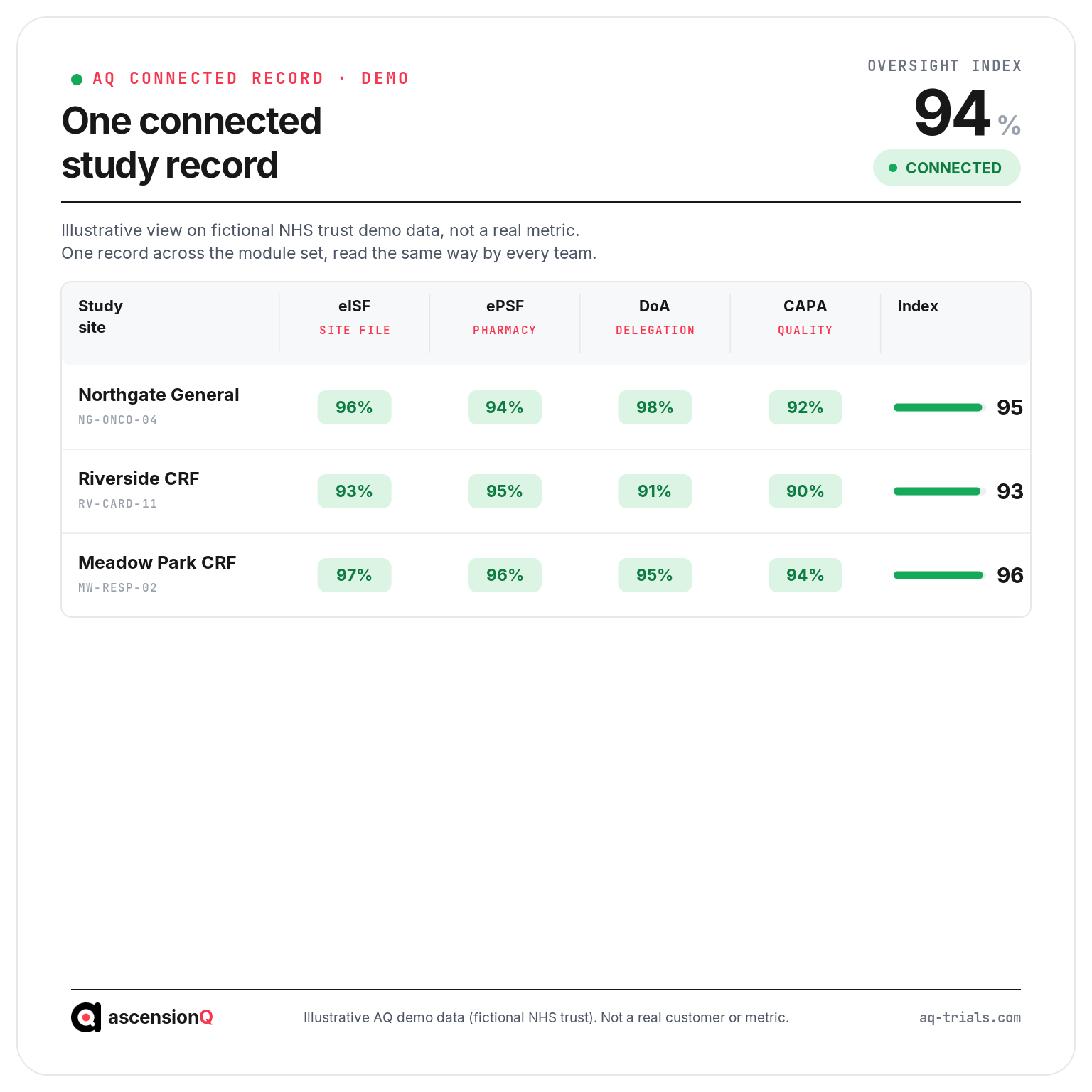
The design choices follow from mechanism, not marketing. One shared record means one continuous audit trail across the study, which supports inspection readiness rather than promising it. A connected quality layer links a deviation to its CAPA and its training evidence, so an inspector following a thread does not leave the system to complete it. The electronic Trial Master File is built on the DIA TMF Reference Model, aligning filing to the model sponsors and inspectors share. AQ aligns to G-Cloud, DSPT and Cyber Essentials, and supports the ALCOA+ and Part 11 principles that regulated records require. It does not replace the QA lead’s judgement. It gives that judgement one place to stand.
AQ will not suit a global biopharma that needs an enterprise suite, and it does not try to. It is built for NHS trusts, academic centres, mid-market sponsors, CROs and sites that need connected oversight scaled to their operation. That is the honest boundary of the comparison: the best system is the one whose scale and structure match your accountability.
Also Read: The impact of AI on CROs: why the future depends on connected intelligence
See what one connected record looks like across study coordination, documentation, delegation, quality and pharmacy. Book a 30-minute product tour and evaluate AQ against the systems you already run.