Academic research teams move from REDCap at the point where the unit of accountability changes from the project to the portfolio. REDCap holds the data a study collects. An institution that sponsors research has to answer for every study it has open, at once, on request. A clinical trial management system (CTMS) holds that second record.
The decision turns on scope. The software itself is not in question. REDCap describes itself as “a secure web application for building and managing online surveys and databases”, and it does that job for research teams in over one hundred countries. The difficulty arrives at the point where the organisation, rather than the individual project, becomes the thing being asked about.
This guide sets out what changes when a university or NHS organisation takes sponsorship, the signals that show a team has outgrown a project database, where the portfolio view breaks in practice, what a UKCRC Registered Clinical Trials Unit has to evidence, what the published inspection record shows for non-commercial organisations, and what the move costs in practice.
Key Takeaways
- The trigger for moving from REDCap is organisational rather than technical. Sponsorship makes the institution accountable for arrangements across a portfolio, and a project database is scoped to one project at a time.
- The UK Policy Framework for Health and Social Care Research places risk management, data management, reporting and monitoring arrangements on the sponsor organisation.
- REDCap’s consortium terms require the licensee institution to supply its own IT support and infrastructure, which places the operating burden inside the unit.
- UKCRC registration criteria for 2027 onwards ask for evidence of an appropriate data management system, a validation process for trial-specific database and treatment allocation systems, and sufficient systems staff.
- In the MHRA’s GCP inspection metrics for 2018 to 2019, 8 of the 11 non-commercial inspection reports (66.7%) carried at least one major or critical finding. All eight commercial sponsors inspected that year carried one.
- The cost of the move is largely institutional: validation evidence, standard operating procedure (SOP) rewriting, named system ownership and a budget line that sits outside any single grant.
What Changes When an Institution Becomes the Sponsor?
The Health Research Authority (HRA) defines the sponsor in section 9.10 of the UK Policy Framework for Health and Social Care Research as “the individual, organisation or partnership that takes on overall responsibility for proportionate, effective arrangements being in place to set up, run and report a research project”. The duty attaches to the organisation. Individual tasks move to other people and other bodies. Responsibility stays where it started.
The same framework sets out what those arrangements have to cover. Two sub-paragraphs of section 9.10 decide what a system has to be able to produce.
| Policy Framework duty | What it asks of the organisation | Evidence it has to be able to show |
| 9.10(h): arrangements for “adequate finance and management of the research project, including its competent risk management and data management” | Risk and data management are held as standing arrangements that stay current between protocols | A current view of where each study sits, what is unresolved, and who is accountable for resolving it |
| 9.10(i), reporting: “effective procedures and arrangements are kept in place and adhered to for reporting” | Reports fall due on a cadence set by others, across every study at once | Milestone, recruitment and safety reporting drawn from one record rather than assembled per study |
| 9.10(i), monitoring: arrangements “for monitoring the research, including its conduct” | Monitors examine conduct, which sits outside the dataset | Delegation, training, visit performance, deviations and their corrective actions |
| 9.13: “A sponsor may delegate any or all of these activities to a CRO, but the ultimate responsibility, for example for the quality and integrity of the research data, always resides with the sponsor” | Tasks distribute across sites, departments and service providers, and the duty stays with the sponsor | A record of who holds which task, from which date, that survives staff turnover |
Each of these duties is written in the continuous present. The organisation keeps arrangements in place, and it keeps them in place across everything it sponsors at the same time. That standard applies whether the institution sponsors three studies or eighty.
Also Read: The New UK Clinical Trials Regulations (2026): What Changes
Why Does a Project Database Stop Answering the Question?
REDCap’s unit of organisation is the project. Each project is designed, configured, populated and locked on its own terms, by the team that owns it. That design is the reason REDCap works so well for investigator-led research. A portfolio answer is therefore constructed across project instances instead of read out of one.
REDCap’s own consortium terms make the institutional position explicit. The consortium FAQ states that “All IT support and infrastructure must be provided by your own organization’s internal IT department”, and describes partner sites as independently maintained, so that “consortium partner sites truly do have total control”. The same answer directs any organisation that cannot meet those requirements internally to “contact redcap@vumc.org to explore our data hosting services”. Control of the instance sits with the institution either way. A portfolio-level record is not something a project database is scoped to hold.
A database answers for a project. A sponsor answers for a portfolio.
| Dimension | The project view | The sponsor’s portfolio view |
| What the record is about | One study’s participants and their data | Every study the organisation has open, and its current state |
| The question it answers | What did this participant report, and when | What is this organisation delivering, and where is it at risk |
| Who asks it | The chief investigator, the statistician, the data manager | The sponsor group, the funder, the CTU director, the inspector |
| What makes it complete | All fields entered for all participants | All studies represented, current, with an owner named against each |
| Effect of adding a study | A new project is designed and configured from the start | A new study joins an existing structure and inherits its controls |
| When the study closes | The database is locked and archived | The organisation continues to answer for a trial of a medicine for 25 years after it concludes |
| When a key person leaves | The project continues once access transfers | The portfolio picture survives only where it was never held by one person |
Which Signals Show It Is Time for Moving From REDCap?
The signals are organisational, and they accumulate. Six of them appear repeatedly in academic research settings.
- The institution has taken sponsorship rather than participation. The Policy Framework duty attaches to the organisation, which means arrangements have to be evidenced at organisational level across the whole portfolio.
- One person holds the portfolio picture. The list of open studies and their current state lives in a coordinator’s spreadsheet, which makes institutional oversight dependent on that person’s availability.
- Studies compete for the same staff, clinic slots and pharmacy capacity. Project-scoped systems cannot show contention, so recruitment commitments get made against capacity that is already allocated elsewhere.
- External reporting became recurring. Funders, sponsor groups and national systems ask for milestone and recruitment data on a fixed cadence, and each return is rebuilt by hand from separate project instances.
- Requests moved from data to conduct. The questions arriving are about delegation, training records, monitoring visits and deviations and corrective actions, none of which a data capture system was built to hold.
- A registration or re-registration review is due. UKCRC criteria ask for evidence at unit level, and evidence assembled study by study has to be reassembled every time it is requested.
Three or more of these signals together usually mean the constraint is the shape of the record rather than the capability of any one system.
Also Read: REDCap vs CTMS: Where Data Capture Ends and Study Management Begins
Where Does the Portfolio View Break in Practice?
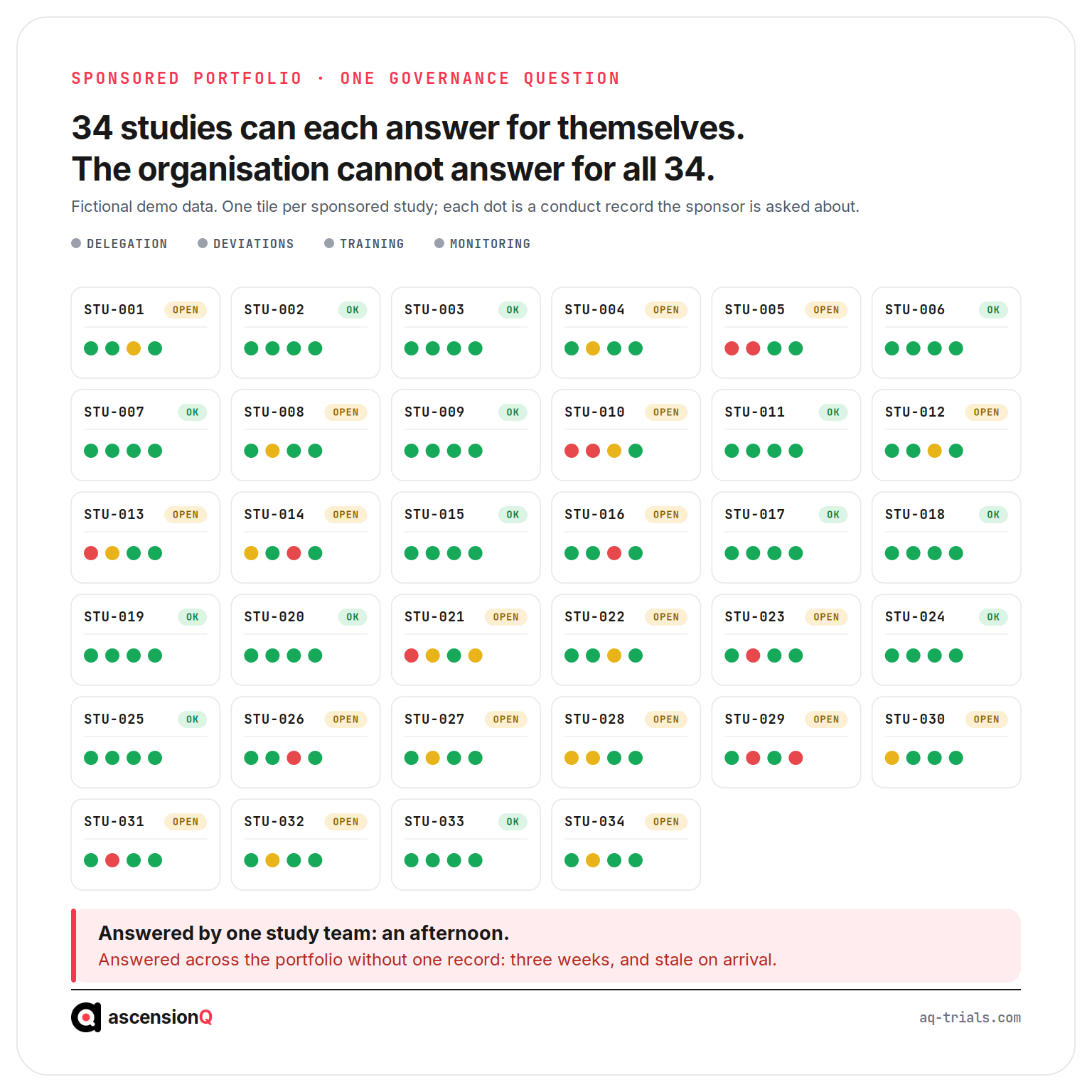
Consider a realistic scenario in a university that sponsors 34 studies. The research governance group prepares for a funder review and asks for one list: every sponsored study with a deviation open for more than 30 days, and the person currently delegated to close it.
Every individual team can answer for its own study within an afternoon. The organisation cannot answer at all without contacting every study team and waiting for replies. The first answers are three weeks old by the time the last one arrives, and two of the studies have changed hands in the interim. The governance group receives a document that was accurate at 34 different moments.
Every answer was correct. The question had changed.
The cost of this pattern shows up in four places.
- Latency becomes the limiting factor. Portfolio questions take weeks to answer, which pushes governance towards annual reviews and away from the continuous oversight the Policy Framework describes.
- Effort scales with the portfolio. Each additional study adds another manual return, so the reporting burden grows in step with research activity.
- The organisation cannot see contention. Two studies booking the same research nurse in the same week appear correct in both project records, which turns capacity planning into a recovery exercise.
- Evidence ages before it is used. A picture assembled over three weeks describes a portfolio that no longer exists, which weakens every decision taken from it.
What Does a Registered Clinical Trials Unit Have to Evidence?
UK Clinical Research Collaboration (UKCRC) registration is assessed against published criteria, and three of them speak directly to systems. The Key Competencies and Evaluation Criteria that apply to registration from 2027 onwards ask for evidence rather than for description, which is the distinction that decides how much work each review costs.
| Criterion | What it asks for | Assembled per project | Held at unit level |
| 1.12 “Evidence of an appropriate data management system. Evidence of a satisfactory validation process and infrastructure components for this system.” | A system, and proof that its validation was carried out | One validation position per instance, restated for each review | One validated system with documentation held once and referenced by every study |
| 1.13 “Evidence of robust validation process for trial specific database systems and treatment allocation systems.” | A repeatable process applied to each trial-specific build | Study teams evidence their own builds to differing standards | A single build-and-approval route that produces the same record every time |
| 1.14 “Evidence that the numbers and experience of systems staff are sufficient to support information system development, management, and validation.” | Named capability inside the unit, sized to the workload | Systems effort spread across project staff and hard to quantify | System ownership held as a defined role with a measurable workload |
Criterion 1.14 is the one most often underestimated. A self-hosted instance transfers development, management and validation to the institution, and the registration panel asks the unit to show that it has the people to carry that load.
What Does the Published Inspection Record Show for Non-Commercial Organisations?
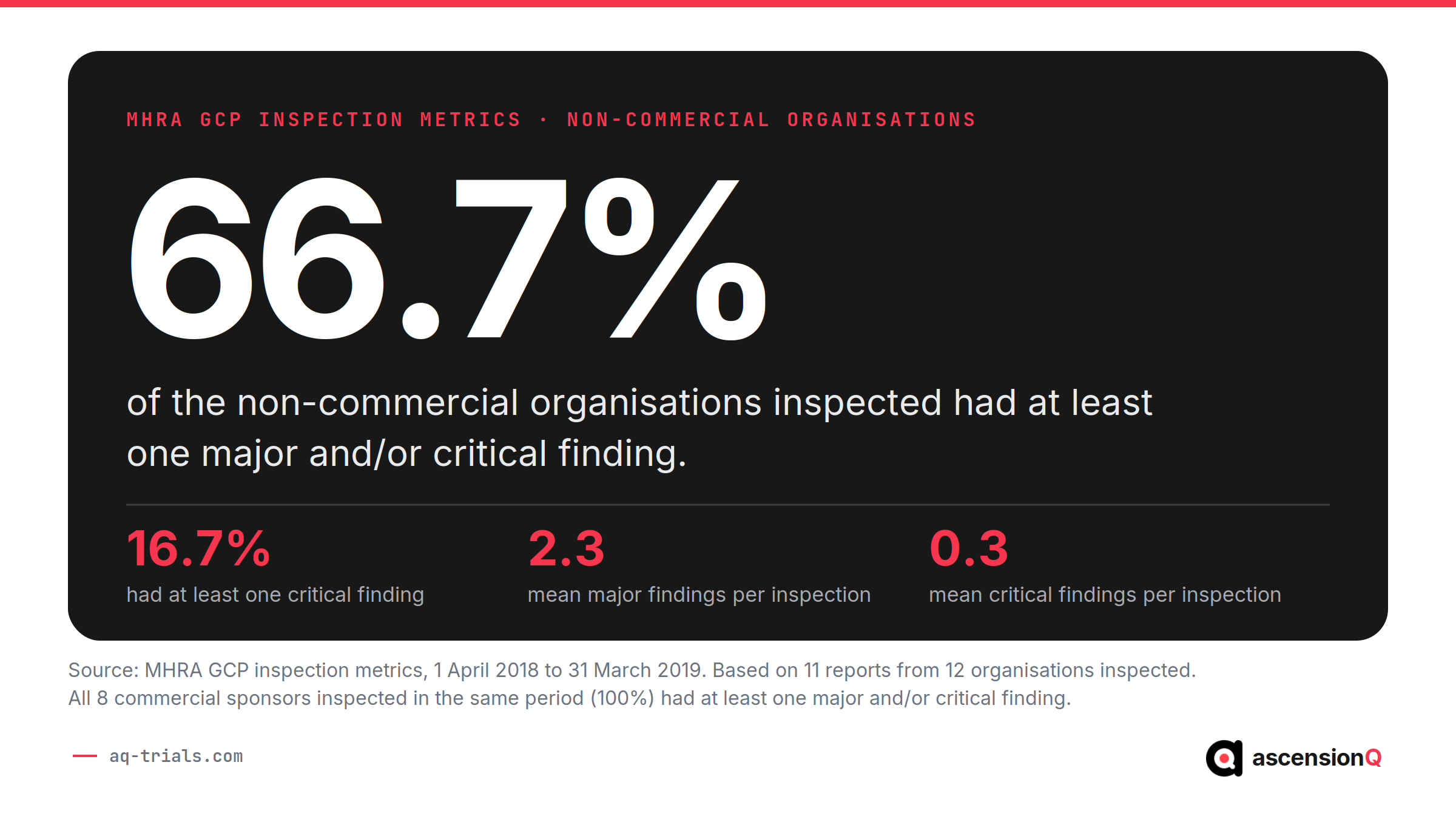
The Medicines and Healthcare products Regulatory Agency (MHRA) publishes metrics from its Good Clinical Practice inspections. In the metrics report covering 1 April 2018 to 31 March 2019, twelve non-commercial organisations were inspected. The report records that, “Of the 11 GCP inspection reports, 2 (16.7%) had at least one critical finding and 8 (66.7%) had at least one major and/or critical finding”. The mean number of critical findings per inspection was 0.3, and the mean number of major findings was 2.3.
The comparison matters as much as the headline. Commercial sponsors inspected in the same period recorded a higher rate on the same two measures. Four of the eight (50%) had at least one critical finding, and all eight (100%) had at least one major and/or critical finding. Non-commercial organisations were the stronger group in that reporting year. Two thirds of them still carried a major or critical finding, and a major finding attaches to the sponsor organisation rather than to any single project.
Both sets of figures rest on small numbers. The following year’s report covers four non-commercial organisations, of which three were reported, and two of those three (50.0%) had at least one major and/or critical finding. These are indicators of where inspection pressure falls, and they are not a measure of sector performance.
- Findings are organisational. An inspection examines the sponsor’s systems and procedures, so the response has to be an organisational change rather than a fix inside one study.
- Access is part of the assessment. Inspectors need to reach records directly, which makes the location and structure of the evidence part of the outcome.
- Corrective actions cross studies. A finding raised on one trial usually applies to every trial run the same way, which means the corrective action has to be applied and evidenced across the portfolio.
Also Read: Is REDCap Enough for GCP-Compliant Clinical Trials?
What Does the Move Actually Cost an Academic Team?
The honest answer starts with the incumbent. REDCap states that “There is no cost or fee of any kind” for a consortium licence, so the comparison is between a paid licence plus institutional work on one side, and unfunded institutional work on the other. The licence is the visible line. The work sits in validation, procedure and ownership, and a business case that ignores it will understate the effort by a wide margin.

One-off costs
- Validation evidence. Supplier documentation covers the product, and the institution still qualifies the system for its own intended use, which is effort the unit schedules into its own workload.
- Procedure rewriting. Standard operating procedures describe the current process, so a change of system means a controlled revision inside the quality management system and retraining against the new versions.
- A decision on closed studies. A completed trial of an investigational medicinal product carries a 25-year retention duty, and a read-only archive position is usually cheaper than migrating records that will never be edited again.
- Structure and permissions. The organisation’s studies, roles and access rules are configured once, and that configuration is what allows later studies to inherit controls instead of recreating them.
- Parallel running. One study runs in both places through a defined period, which converts the cut-over from an assumption into a tested change.
Recurring costs
- A budget line outside any single grant. Portfolio infrastructure serves studies that start and end on different clocks, so funding it from one project’s cost line creates a gap at that project’s close.
- Named system ownership. Someone in the unit owns configuration, access and change control, which is the same capability UKCRC criterion 1.14 asks the unit to evidence.
- Periodic access and delegation review. Accounts and delegated tasks are reviewed on a set cadence, which keeps the delegation record usable as evidence rather than as history.
- Change control on updates. Releases are assessed and recorded against the validated state, and that assessment recurs for the life of the system.
The comparison worth making is between the recurring cost of the system and the recurring cost of assembling the portfolio picture by hand. Most units have never measured the second figure, and it is usually the larger of the two.
Also Read: REDCap Alternatives for Clinical Trial Management in 2026
How Does AQ Support an Academic Research Portfolio?
AQ is built around the portfolio. Liverpool School of Tropical Medicine runs a portfolio of more than 65 studies from a single site on AQ CTMS, with recruitment, the visit diary, participant management and study communications held in one system instead of spreadsheets, Outlook and phone calls. That deployment is single-site and operational, so it demonstrates portfolio scale. For the oversight side, University Hospitals of Liverpool Group launched AQ eISF across a portfolio of more than 150 studies, and Royal Free London brought controlled documents, training and CAPA into one quality system used by more than 300 people.
- AQ CTMS holds every sponsored study in one operational record, which allows a portfolio question to be answered from the system rather than from 34 separate returns.
- Digital Delegation of Authority (Digital DoA) records delegated tasks with effective dates, which allows the organisation to show who was authorised to do what on any given day without reconstructing it afterwards.
- The electronic investigator site file (eISF) keeps essential documents against the study they belong to, which supports direct inspector access to the record instead of a request to a study team.
- Corrective and preventive action (CAPA) links a deviation to its investigation and corrective action, which allows a finding raised on one study to be applied and evidenced across every study run the same way.
- The electronic trial master file (eTMF) is built on the DIA TMF Reference Model, which gives the organisation a structure that an inspector already recognises.
- AQ is listed on G-Cloud and holds the Data Security and Protection Toolkit (DSPT) and Cyber Essentials, which supports the information governance review a university or NHS partner runs before go-live.
REDCap can continue to hold study data alongside it. The question this guide answers is where the record of conduct lives once an institution becomes accountable for a portfolio.
Bring your list of open studies and the last portfolio question your governance group asked. Book a live demo and we will work through how long that answer takes from one record.