Medidata alternatives are the trial management systems an organisation considers when the operating cost of an enterprise platform outgrows the portfolio it supports. Medidata describes its own product as a clinical trial management system that brings clinical and operational activity into one connected, AI-enabled solution, built to help teams plan, track and oversee studies. The capability is substantial and the platform is deployed at scale across sponsors and CROs. The question facing a mid-market sponsor, a growing CRO or an NHS research office sits alongside capability rather than inside it: how much of the system’s running does the organisation have to do itself.
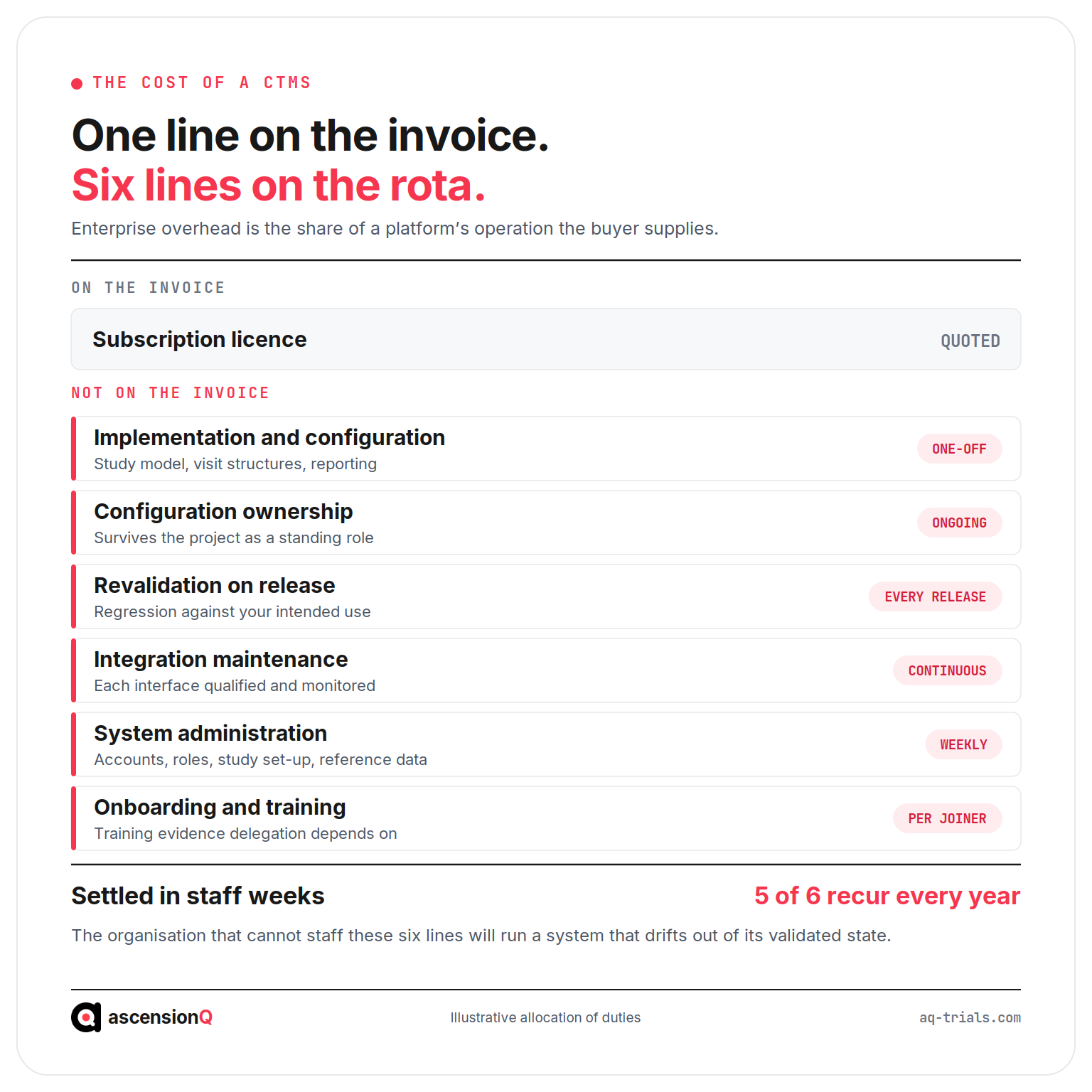
Enterprise overhead is the share of a platform’s operation that the buying organisation supplies. It covers implementation, configuration ownership, revalidation at each vendor release, integration maintenance, administrator time and study-team onboarding. None of it appears on a licence quote. All of it is paid in staff weeks by people who also deliver studies.
This guide sets out what Medidata publishes about its own clinical products, what enterprise overhead consists of line by line, the data-layer question that decides most of these evaluations, the alternative categories and where each places the operating load, and the proportionality test that replaces a feature comparison. Every product statement here is quoted from the vendor’s own public materials.
Key takeaways
- Overhead is a specification, not a defect. An enterprise platform assumes an enterprise operating model. The assumption holds at enterprise scale and breaks below it.
- Six lines carry the load. Implementation, configuration ownership, revalidation, integration maintenance, administration and onboarding. Five of the six recur every year.
- The data layer decides the shortlist. Medidata states that its CTMS populates from Rave EDC and files monitoring reports to Medidata eTMF, so a team whose EDC sits elsewhere is evaluating a different proposition.
- Categories differ by who operates the system. Enterprise suites, enterprise research platforms, connected mid-market platforms and assembled point tools each place the operating load in a different place.
- Revalidation is the recurring cost teams miss. Vendor releases arrive on the vendor’s calendar, and each one lands on the organisation that validated the configured instance.
- Proportionality is testable. Two numbers settle most of it: studies under your accountability, and named people who administer and validate the system.
What does Medidata’s clinical platform cover?
A fair comparison starts with the vendor’s own published scope. Medidata’s study experience pages name eight products, including the trial management application, each with a stated job.
- CTMS is published as the clinical trial management system, with Study Management, Site Monitoring, Issue Management, Oversight and Reporting, Document Submission and Tracking, and ICF Review named as capabilities.
- eTMF is the electronic trial master file, which the CTMS files monitoring reports and letters into automatically.
- Clinical Trial Financial Management is described as data-powered financial management.
- Grants Manager covers site budgeting, and Site Payments is published as a global payment solution.
- Study Feasibility is described as clinical trial analytics, and Protocol Optimization as smarter study design.
- Synthetic Control Arm is published as a smart external control arm.
The Rave CTMS fact sheet describes the product as a single sign-on cloud application that delivers centralized views of clinical trial activities and progress, and states that master data is entered once and used across all applications. Medidata positions Rave EDC as the cornerstone of the platform and cites the 2025 ISR Benchmarking Report naming Rave the number one preferred EDC. The stated buyer across these pages is sponsors and CROs.
Two things follow for anyone building a shortlist. The platform’s stated advantage is expressed through connections between its own applications, so the value compounds for a team that adopts several of them. Jobs outside that published list are placed elsewhere in the estate, which is a mapping exercise every buyer should complete before a demo rather than after one. The same exercise applies to any suite, and it is why a clinical trial management system comparison so often widens into a platform comparison.
What is enterprise overhead in a clinical trial management system?
Overhead is the work of keeping a validated system fit for its intended use. A vendor validates the product it ships. The organisation validates the configured instance for the way it actually runs studies, and repeats that work whenever either side changes. Six lines carry the load, and each one has an owner inside the buying organisation.
- Implementation and configuration. The build turns a generic platform into your study model, your visit structures and your reporting, which sets a start date measured in months rather than weeks.
- Configuration ownership. Someone holds the design decisions and revises them as protocols and sponsors change, which means the role survives the project and becomes a permanent post.
- Revalidation on release. Each vendor release triggers a regression and validation cycle against your intended use, which places a recurring deliverable on the same quality team that handles deviations.
- Integration maintenance. Every connection is an interface to qualify, monitor and revalidate, so integration count drives maintenance more reliably than module count does.
- Administration. User accounts, role matrices, study set-up and reference data all need a current owner, which turns access control into a weekly task rather than an annual one.
- Onboarding and training. Every coordinator, monitor and reviewer is trained to the configured system, and the training record itself becomes evidence an inspector can request.
The licence is the smaller bill.
Why do teams look for a Medidata alternative?
The search is usually about proportionality. An enterprise platform is specified, priced and implemented for enterprise operations, and the overhead it carries is appropriate to the portfolio it supports. Four conditions send teams looking, and each is a statement about the organisation rather than a criticism of the product.
- No dedicated systems function. Configuration, release testing and revalidation land on people who also run studies, which stretches the calendar for every upgrade and pushes quality work behind delivery work.
- A data layer outside the family. Sponsors, academic units and CROs frequently inherit the EDC from someone else, so the automatic population between applications is unavailable and has to be rebuilt as an integration the organisation owns.
- A portfolio below the priced scale. An organisation running a few dozen active studies funds administration capacity it never consumes, and the per-study cost rises as the portfolio shrinks.
- Site-facing evidence held separately. The delegation log, the investigator site file and the pharmacy file often sit outside the trial management system, which leaves a reconciliation step between the operational record and the regulatory record.
Each condition points at the same underlying variable. Capability arrives on the licence. Capacity to operate the capability comes from the organisation, and a shortfall there shows up as configuration drift, late revalidation and reconciliation by hand. Cost modelling for this is set out in the guide to what a clinical trial management system actually costs, which separates the subscription from the work around it.
Also Read: What is a CTMS? The complete guide to clinical trial management systems
Does your data layer stay in the same family?
This question decides more Medidata evaluations than any feature comparison. Medidata states that data is automatically populated from the EDC into the CTMS, and that monitoring reports and letters are automatically filed to the trial master file. The benefit described there is a benefit of adopting the family. A replacement decision therefore branches on where the data layer sits.
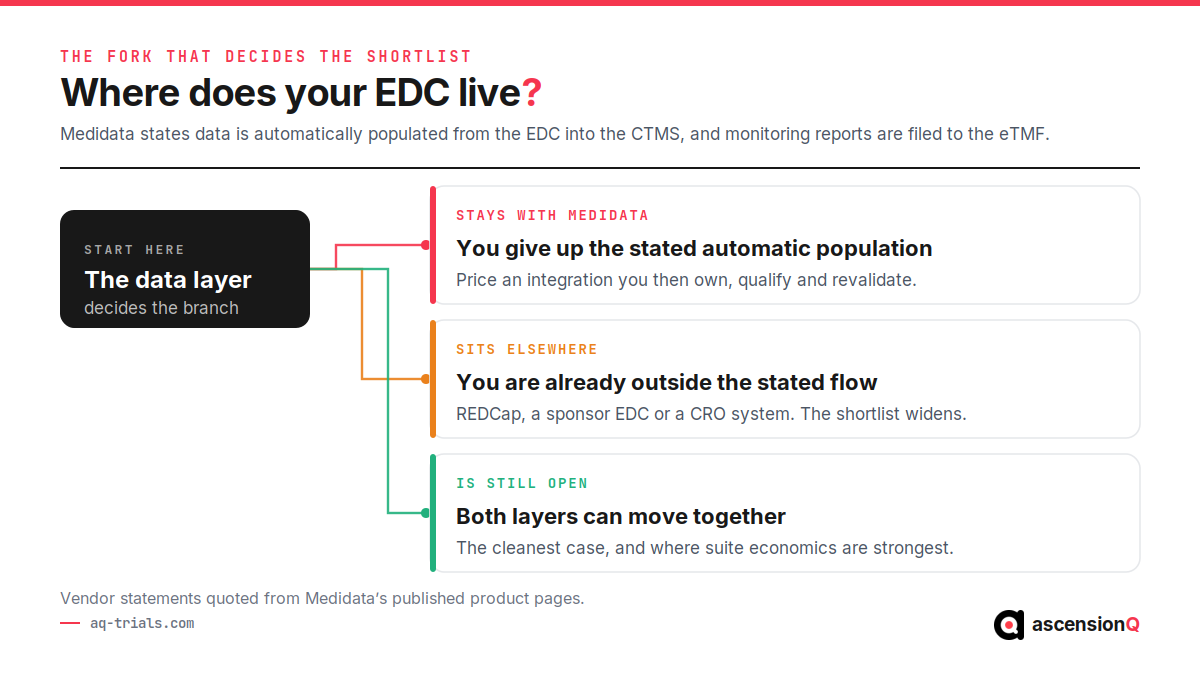
- The EDC stays with Medidata. A move that replaces only the trial management application gives up the stated automatic population, so the evaluation has to price an integration the organisation then owns, qualifies and revalidates.
- The EDC sits elsewhere. A team running REDCap, a sponsor-provided EDC or a CRO’s system already sits outside the stated flow, so the trial management decision is free-standing and the shortlist widens accordingly.
- The EDC decision is still open. Both layers move together, which is the cleanest case and the one where suite economics are strongest.
The boundary between the two layers matters for the evidence as much as for the integration. An EDC holds the values a study collects about its participants. A trial management system holds the conduct of the study that produced them, including visit windows, monitoring, deviations and delegation. Teams that blur the two end up with a record that two systems both partly own.
Also Read: CTMS vs EDC: what is the difference in clinical research?
What are the alternatives to Medidata CTMS?
Four categories make up a realistic shortlist. The useful axis between them is operational rather than functional, because feature lists converge and operating models do not. The table below sorts them by who runs the system once it is live.
| Category | Named examples | Who operates it day to day | What the organisation supplies |
| Enterprise suite | Veeva CTMS, Oracle Life Sciences CTMS | A dedicated internal systems and validation function | Configuration owners, a release testing cycle, integration maintenance |
| Enterprise research platform | Advarra OnCore, published for academic medical and cancer centres | A research informatics team inside the health system | EMR integration ownership and local billing or costing rules |
| Connected mid-market platform | AQ and comparable connected platforms | The research office, supported by the vendor | Study set-up decisions and local process alignment |
| Assembled point tools | EDC plus a document store plus trackers | Study coordinators, in the gaps between studies | Reconciliation between systems, and the audit trail that spans them |
Read the table as a map of operating models rather than a scoreboard. Each category is strong inside the brief its buyers write for it, and an organisation with a systems function is genuinely better served by an enterprise suite than by anything lighter. A comparison of the enterprise suites against each other, including the alternatives Veeva buyers shortlist, sits in the guide to Veeva Vault CTMS alternatives for mid-market and NHS teams. Teams weighing platform categories rather than single products will find the structural version of the same question in the AQ, Veeva, Florence, RealTime and SharePoint comparison.
The fourth row deserves a warning rather than a recommendation. Assembled point tools look inexpensive because the cost sits in coordinator hours rather than on an invoice, and the reconciliation between them is where inspection findings are written.
When does the overhead recur?
Implementation is the visible cost and the smaller one over a full ownership period. Five of the six overhead lines repeat, and they repeat on a calendar the vendor sets rather than the one the research office plans around.
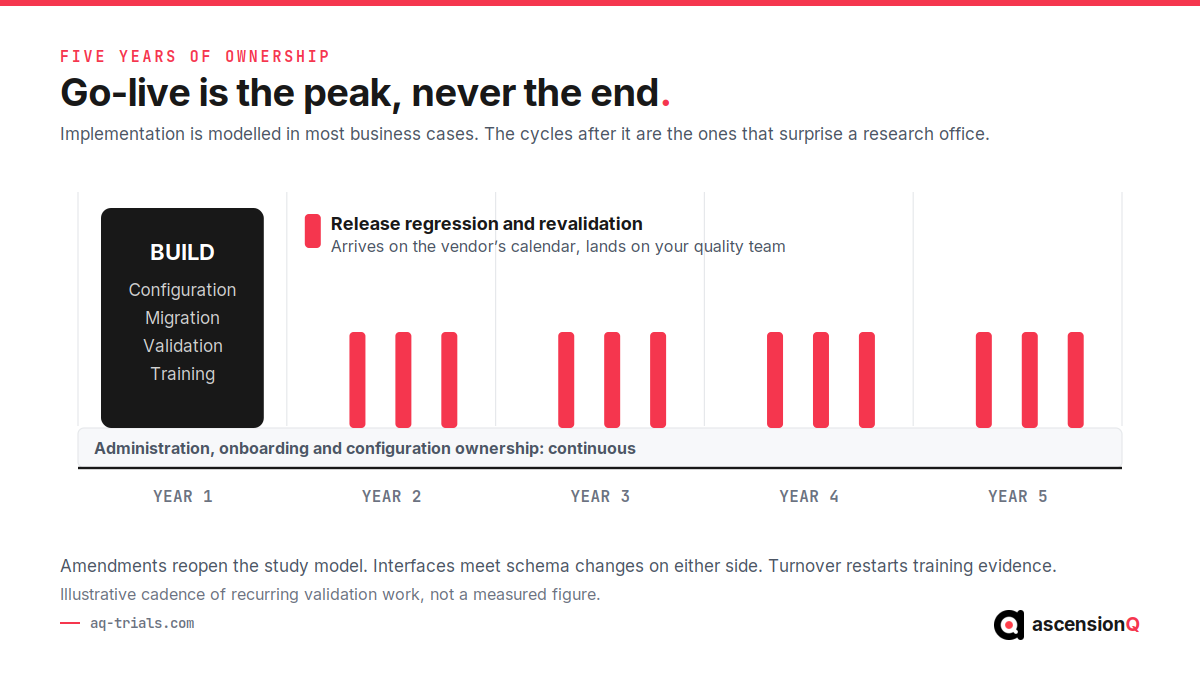
- Year one carries the build. Configuration, data migration, validation and training arrive together, which is the peak most business cases model correctly.
- Every release carries a regression cycle. Vendor releases land several times a year, and each one asks the organisation to confirm the configured instance still does what it was validated to do.
- Integrations drift. An interface that worked at go-live meets a schema change on either side, so qualification is a repeated exercise rather than a one-off deliverable.
- Protocol change reopens configuration. Amendments, new sponsors and new study types all revisit the study model, which returns work to the configuration owner every year.
- Staff turnover repeats onboarding. Coordinator and monitor turnover restarts training against the configured system, and the training evidence has to stay current for delegation to hold.
The validation share of this load has a published framework behind it. Risk-based validation planning under GAMP 5 is covered in the guide to GAMP 5 and computerised system validation, which sets out the deliverables an MHRA inspector expects to see and where the vendor’s evidence stops.
How should a mid-market team test proportionality?
Two numbers settle most of the question. Count the studies under your organisation’s accountability, then count the named people who would administer, configure and validate the system. A platform whose operating model assumes a team you do not have will drift, and configuration drift in a regulated system becomes a finding rather than an inconvenience.
A worked example makes the test concrete. The scenario below is hypothetical and typical rather than drawn from a customer.
- The trigger. A monitoring visit finds a coordinator listed as active on the delegation log for a study visit performed on 14 May, with a GCP certificate that expired on 30 April.
- The trace. A reviewer needs the delegation log entry, the training record behind it, the visit record, the monitoring visit report, the resulting protocol deviation and the CAPA that closes it.
- The count that matters. Ask how many systems hold those six artefacts, and how many people are needed to assemble them into one answer.
- The follow-up question. Ask whether the expiry itself raised anything at the moment it happened, or whether the monitoring visit was the first control that noticed.
Regulatory expectations sit behind that trace. ICH-GCP E6(R3) sets expectations for the computerised systems that hold trial records, and the amended UK Clinical Trials Regulations took full effect on 28 April 2026, with applications submitted on or after that date running under the new rules. The full UK picture is set out in the guide to the UK Clinical Trials Regulations in 2026.
A system you cannot keep validated is a system you do not really have.
Also Read: REDCap alternatives for clinical trial management in 2026
How does AQ approach trial management without enterprise overhead?
AQ takes the connected-platform position for organisations below enterprise scale. The connected platform holds trial management alongside the electronic Trial Master File, the electronic Investigator Site File, the electronic Pharmacy Site File, the quality management system, CAPA management and Digital Delegation of Authority. The modules share one record rather than exchange copies of it.
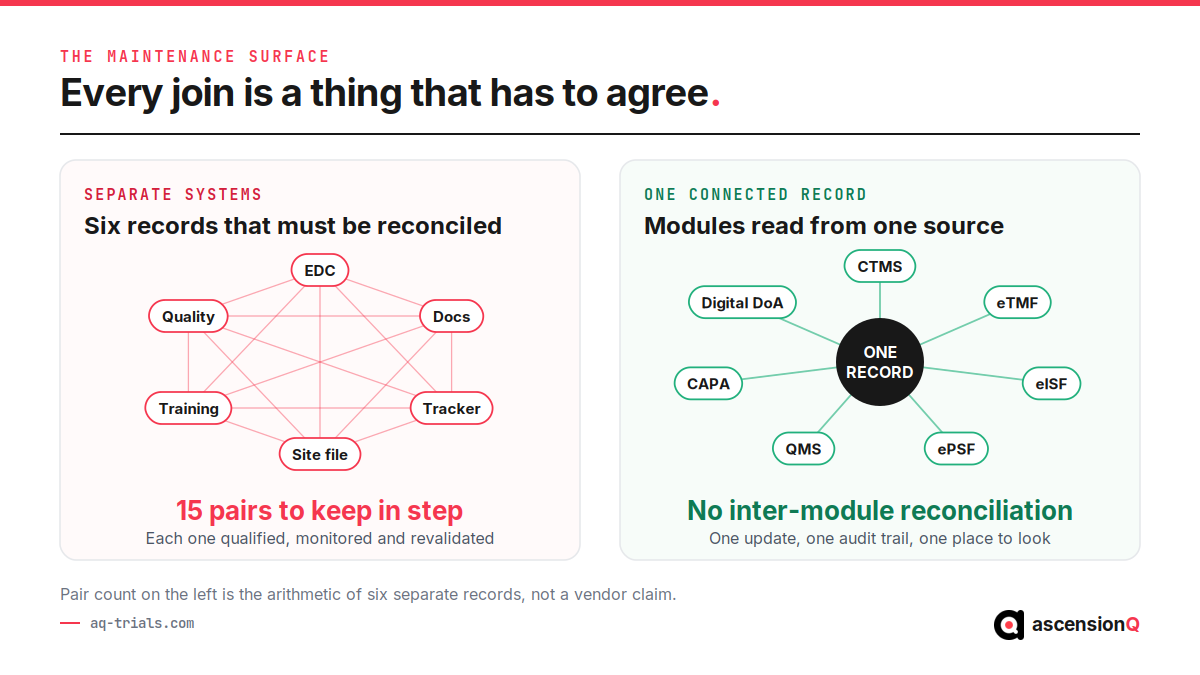
The design addresses overhead through mechanism rather than discount. Three effects follow from the shared record, and each maps to one of the six overhead lines.
- One record removes the reconciliation step. A delegation change is visible to the site file, the study record and the quality system at the moment it is made, which retires the manual cross-check between them.
- Fewer interfaces reduce the maintenance surface. Modules that read from one source create fewer connections to qualify and revalidate, which lowers the recurring integration line.
- One continuous audit trail supports inspection readiness. A reviewer following the delegation, training, deviation and CAPA thread stays inside the system to finish it.
AQ aligns to G-Cloud, DSPT and Cyber Essentials, and supports the ALCOA+ and 21 CFR Part 11 principles that regulated records require. The trial master file is built on the DIA TMF Reference Model, aligning filing to the model sponsors and inspectors share. The platform suits an NHS research office, an academic unit, a mid-market sponsor, a CRO or a site that needs connected oversight scaled to its operation. A global biopharma running an enterprise systems function is better served by an enterprise suite, and that is the honest boundary of this comparison.
See what one connected record looks like across study coordination, documentation, delegation, quality and pharmacy. Book a live demo and evaluate AQ against the systems on your shortlist.