A UK model clinical trial agreement is a standard-form contract between a study sponsor and a participating NHS organisation, published nationally so that the legal terms are settled before any single study reaches a site. Two templates carry most UK research. The model Clinical Trial Agreement (mCTA) covers commercially sponsored trials of investigational medicinal products. The model Agreement for Non-Commercial Research (mNCA) covers interventional studies sponsored by NHS bodies, universities, charities and research councils.
Both moved to April 2026 versions on 28 April 2026, the day the amended UK Clinical Trials Regulations came into force. The Health Research Authority states that new studies submitted in the Integrated Research Application System (IRAS) on or after that date must use the April 2026 versions, and that agreements already in place do not need to be updated or replaced.
A model agreement saves time only for as long as it arrives unaltered.
That single condition governs everything else in this guide. The templates carry pre-agreed indemnity, liability, data protection and publication terms so that an NHS site can sign without legal review. A tracked change in the body returns the study to site-by-site negotiation at each participating organisation.
What This Guide Covers
The sections below work through the templates in the order a study meets them, from selection to signature to the obligations that follow.
- Where the model agreements came from and who maintains them.
- The full suite of UK templates and which study characteristics select each one.
- Who signs an mCTA, and why the Principal Investigator is absent from the signature block.
- The nine appendices of the mCTA and the seven schedules of the mNCA, appendix by appendix.
- The legal status of unmodified use in each UK nation, and the waiver route.
- What the April 2026 versions changed.
What Is a UK Model Clinical Trial Agreement?
The mCTA is a template contract for industry-sponsored trials of investigational medicinal products at NHS trial sites across the UK. The Department of Health and the Association of the British Pharmaceutical Industry developed the first version in 2003. The mNCA followed in 2008, after consultation with the UK Clinical Research Collaboration, the Medical Schools Council, the NHS R&D Forum and the Medical Research Council. Both templates are now maintained by the UK Four Nations Contracting Leads Group, which meets to consider updates and holds the waiver decision described later in this guide.
A model agreement fixes three things in advance, and each removes a specific delay from study set-up:
- The liability and indemnity position. The ABPI Clinical Trial Compensation Guidelines and the ABPI Form of Indemnity sit inside the mCTA as fixed appendices, which means a trust’s legal team has no compensation position to negotiate.
- The data protection, publication and intellectual property terms. These are drafted once nationally, which removes the clauses that historically consumed the longest review cycles at each site.
- The commercial structure of the price. The financial appendix is generated by the NIHR interactive Costing Tool, which ties the contract to a nationally reviewed cost rather than a local one.
The Health Research Authority sets out the policy plainly on its model agreements guidance: “the National Directive on Commercial Contract Research sets a policy mandate that only the appropriate and unmodified UK template agreements are used.” The templates are an instrument of national delivery policy, and unmodified use is the mechanism by which they work.
Which Model Agreement Does a Study Take?
The April 2026 update covered the commercial suite and the non-commercial suite together. Four study characteristics select between them: who sponsors the study, what is being investigated, where the site sits in the NHS, and whether a contract research organisation holds site management responsibility.
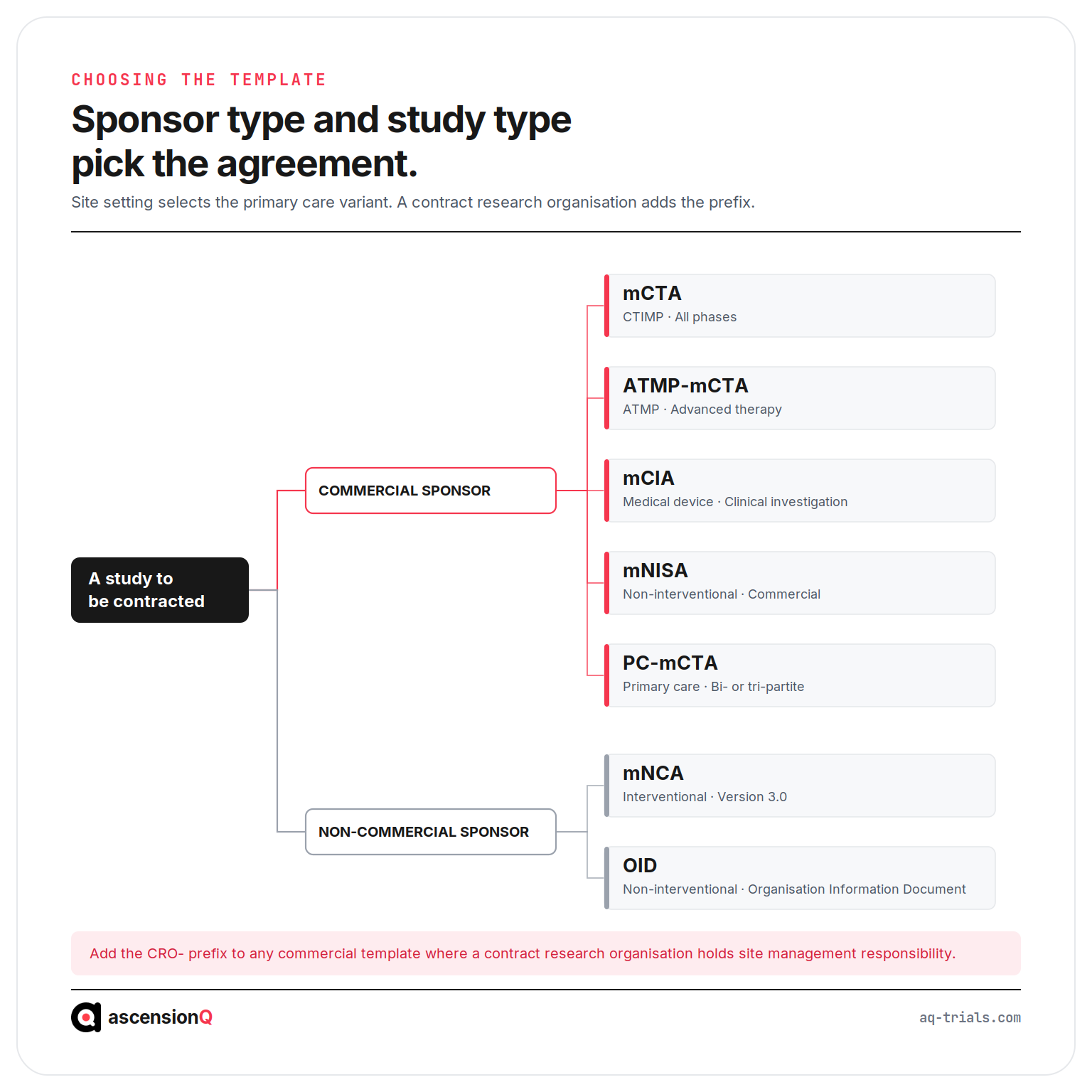
| Template | Study it covers | Parties |
| mCTA | Commercially sponsored CTIMP, all phases, at an NHS trial site | UK Sponsor and Trial Site |
| CRO-mCTA | The same trial where a CRO holds site management responsibility | Sponsor, CRO and Trial Site |
| ATMP-mCTA and CRO-ATMP-mCTA | Trials of advanced therapy medicinal products | As above, with ATMP-specific provisions |
| PC-mCTA (bipartite and tripartite) | Commercial trials in primary care with independent contractors | Sponsor, practice and, in the tripartite form, a third party |
| mCIA and CRO-mCIA | Clinical investigations of medical devices | Sponsor, Trial Site, and CRO where applicable |
| mNISA and CRO-mNISA | Non-interventional studies | Sponsor, Site, and CRO where applicable |
| mCCIA and CRO-mCCIA | Chief Investigator services on a commercial study | Sponsor, Chief Investigator or employing organisation |
| Model Commercial Hub and Spoke Agreement | A lead site subcontracting delivery to other legal entities | Lead Trial Site and Other Trial Sites |
| mNCA | Non-commercial interventional research, including CTIMPs, device studies and surgical trials | Sponsor and Trial Site |
| Organisation Information Document | Non-commercial studies that are non-interventional | Issued by the sponsor to the participating organisation |
| Model Non-Commercial Hub and Spoke Agreement | Non-commercial lead-site subcontracting | Lead Trial Site and Other Trial Sites |
The mNCA guidance is explicit about its own limits. The template should not be used for non-interventional research, for commercial studies, or where the trial site is a joint or co-sponsor. The mCTA guidance draws the equivalent boundaries, and adds that investigator-initiated trials fall outside it.
A separate template, the model Industry Collaborative Research Agreement (mICRA), was launched in February 2011 for collaborations between industry, academia and NHS organisations. A published decision tree helps a team establish whether a study is collaborative and therefore takes mICRA rather than a site agreement.
Also Read: MHRA Clinical Trial Approval Timelines Explained (2026)
Who Signs an mCTA, and Who Does Not?
The mCTA is signed by the UK Sponsor and the NHS Trial Site. The UK Sponsor may differ from the global sponsor, and the guidance allows another organisation to sign on the sponsor’s behalf where authority has been legally delegated. Evidence of that delegation is attached as Appendix 8. The CRO-mCTA adds the contract research organisation as a third party, forming a tripartite agreement.
The Principal Investigator is not a signatory to either template. The Trial Site procures the Principal Investigator’s performance instead, and the guidance places a direct obligation on the site to carry those terms forward: “It is important that the Trial Site incorporates the obligations of the Principal Investigator and other investigators set out in the mCTAs, into a separate agreement (in a form that is at the discretion of the Trial Site).” The mNCA takes the same position, and the Principal Investigator is explicitly not a party.
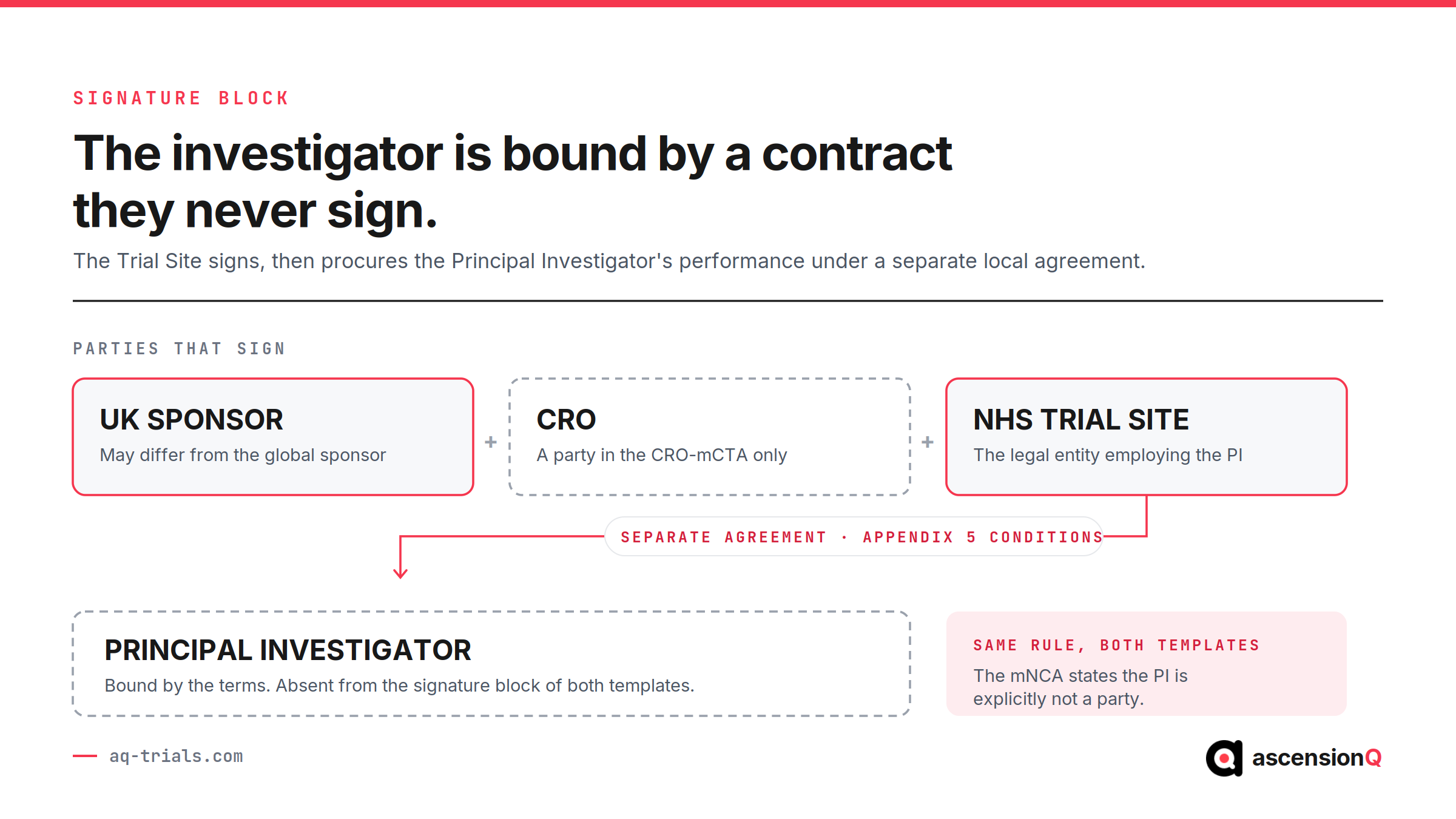
That structure creates a real operational duty for an R&D office. A worked example makes it concrete. A trust signs an mCTA for a Phase III trial in October. Appendix 5 sets the conditions applicable to the Principal Investigator, covering compliance with the protocol, the handling of confidential information and publication restraint. The trust holds no separate instrument binding the investigator to those conditions. The contractual obligation still sits with the trust, and the trust now carries a term it has not passed on to the person performing the work. The gap surfaces at monitoring, when a sponsor asks how investigator obligations are evidenced locally.
Three further relationships stay outside the template entirely, and the guidance names each:
- Academic partners. “The mCTAs should not be altered to form a tripartite agreement with an academic institution as a third party.” University relationships run through a separate partnership agreement.
- Sponsor-funded NHS staff time. Payment for staff time to support delivery generally is handled through an overarching agreement that is not specific to one clinical trial.
- Chief Investigator services. These are contracted through a model Commercial Chief Investigator Agreement, personally or via the employing organisation.
What Is Inside the mCTA?
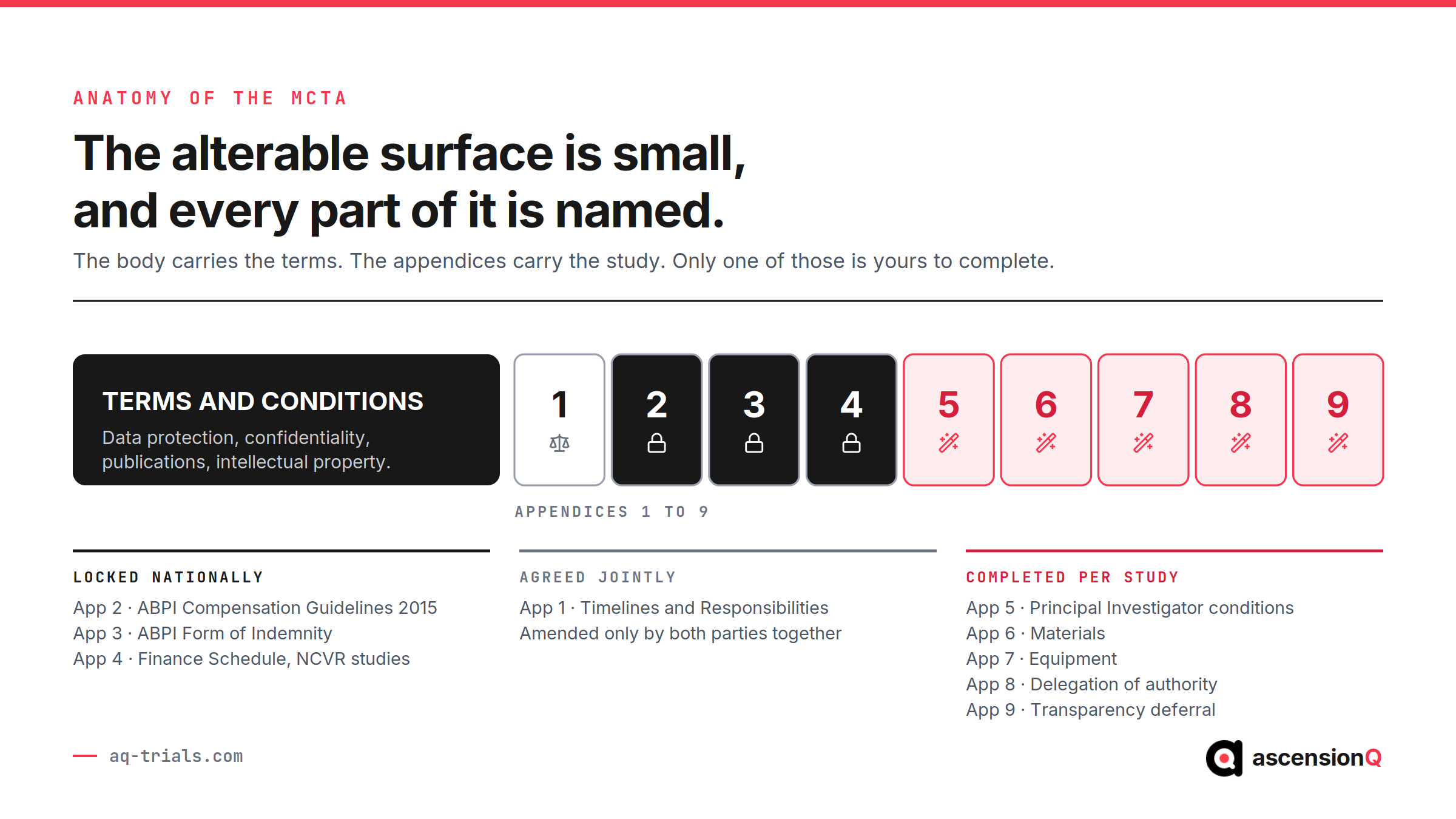
The body of the mCTA holds the terms and conditions. The appendices hold everything specific to the trial and the site. The split matters at set-up, because the appendices are where a site legitimately supplies information and the body is where alteration triggers the consequences set out below.
| Appendix | Contents | Status |
| 1 | Timelines and Responsibilities, with example milestones | Parties may amend jointly |
| 2 | ABPI Clinical Trial Compensation Guidelines 2015 | Unalterable |
| 3 | ABPI Form of Indemnity | Unalterable |
| 4 | Financial Arrangements, including the Finance Schedule generated by the NIHR interactive Costing Tool | Fixed for NCVR studies |
| 5 | Conditions Applicable to the Principal Investigator | Trial-specific |
| 6 | Material Transfer Provisions for clinical biological samples | Trial-specific |
| 7 | Equipment and Resources | Trial-specific |
| 8 (mCTA) / 9 (CRO-mCTA) | Formal Delegation of Authority for sponsor signature | Used where applicable |
| 9 (mCTA) / 10 (CRO-mCTA) | Authority to Defer Transparency Requirements | Used where applicable |
Appendix 4 carries the commercial detail that an R&D office and a finance team both rely on. It sets a payment term of forty-five calendar days, and covers invoicing, VAT, screen failures, unscheduled visits, archiving costs and pass-through costs. Its relationship with the National Contract Value Review is the tightest constraint in the whole template. The April 2026 mCTA guidance states that for studies within NCVR scope, “alteration of the iCT-generated Finance Schedule is prohibited.” The guidance permits three changes: reordering items for readability, removal of items not relevant to that site, and adjustment of decimal places to match a trust’s finance system. None of the three counts as an alteration. Studies outside NCVR scope treat the Finance Schedule as a guideline for discussion.
What Is Inside the mNCA?
The mNCA reached version 3.0 in April 2026, after revisions in 2018, 2021 and 2022. It runs on seven schedules rather than nine appendices, and two of them are optional.
| Schedule | Contents |
| 1 | Study support arrangements, participant numbers and contact details |
| 2 | Division of responsibilities and delegation of activities |
| 3 | Financial arrangements, costs and equipment provision |
| 4 | Material transfer provisions (optional) |
| 5 | Principal Investigator Declaration (optional) |
| 6 | Delegation of authority for sponsor signature |
| 7 | Transparency requirement deferrals |
Schedule 2 deserves attention from any R&D office running a non-commercial portfolio. It records the division of responsibilities and the delegation of activities between sponsor and site. That is a contractual statement about who performs what, and it has to stay consistent with the delegation log the site maintains under Good Clinical Practice. Two documents describing the same allocation of duties are two documents an inspector can compare.
Why Is Unmodified Use a Condition of Approval?
The strength of the obligation varies by sponsor type and by nation, and the published wording is precise in each case.
| Route | Published position | Practical effect |
| Commercial, England and Wales | “NHS organisations are required to use only an unaltered mCTA or CRO-mCTA (as appropriate and applicable).” | A requirement, waivable only in the HRA and HCRW Approval letter |
| Commercial, UK-wide | Strongly recommended by all the UK Health Departments that the mCTAs are used without alteration | The default expectation on every commercial study |
| Commercial policy mandate | The National Directive on Commercial Contract Research mandates use of appropriate and unmodified UK template agreements | HRA and HCRW Approval is usually issued conditionally on that use |
| Non-commercial | A policy expectation that the appropriate UK template will be used without modification | Modification “may result in prolonged central and participating NHS organisation review” |
Three alterations are refused outright in the commercial templates. Changes to the anti-bribery clauses to reference foreign law will not be accepted. Alterations to Clause 6.3, which governs data export, will not be accepted. Appendices 2 and 3 are ABPI documents and stay as published.
Also Read: Capacity and Capability Confirmation: Timelines and Delays
The Cost of an Altered Agreement
The waiver route exists, and it is deliberately slow. A sponsor proposing alterations must disclose them in the IRAS submission with tracked changes and a detailed justification. The UK Four Nations Contracting Leads Group considers the request. The guidance then states the consequence directly. A proposal to alter a template agreement “is likely to result in significant delay and does not oblige NHS organisations to agree the altered agreement.” A site may read the justification, decline it, and be entirely within policy.
The operational cost lands on the set-up clock. Consider a commercial Phase III study opening at eleven trusts. The sponsor’s global legal team amends the publication clause in the body of the mCTA. Each participating organisation now has a contract its legal team must read, because the national assurance that the text is pre-agreed no longer holds. The consequences accumulate in a specific order:
- Eleven separate legal reviews replace eleven counter-signatures, and each runs at the pace of a different contracts team.
- Sites reach different conclusions on the same clause, which produces eleven versions of one study’s contract for the sponsor to maintain.
- The Date Site Confirmed moves out for every site, since that date is defined as the last contract signature across all organisations at the site.
- The study’s position against the 150-day set-up target degrades on a measure the R&D office does not control, since the amendment originated with the sponsor.
The tracked change is what creates the delay.
What Changed in the April 2026 Versions?
The April 2026 updates follow the Medicines for Human Use (Clinical Trials) (Amendment) Regulations 2024, and the HRA published the updated suite for use from 28 April 2026. Five changes matter to a site or an R&D office:
- Terminology alignment with the regulations. “Amendments” became “modifications” and “modifications” became “variations”. A document still using the old terms follows the previous regulatory vocabulary.
- New defined terms. Authority, Public Registry and Transparency Requirements are now defined, which ties the contract to the registration and results-publication duties in the amended regulations.
- Updated retention and archiving provisions. These sit alongside the statutory retention duty and govern who holds what, and for how long, after the trial ends.
- Home healthcare visit providers. New provisions cover trial activity delivered at a participant’s home by a third-party provider.
- AI tool governance clauses. The templates now address the use of artificial intelligence tools in trial delivery.
The liability position is unchanged in structure and worth restating, because it is the part most often misread locally. The mCTA sets two caps on the Trial Site’s liability. The first covers wilful or deliberate breaches together with any breach of Clauses 6, 7, 8, 10 and 11, and limits liability to twice the value of the agreement. The second covers all other breaches and limits liability to the maximum value of the contract. Sponsors are separately required to hold clinical trials insurance or indemnity, and the guidance states the expectation that sponsors conducting trials in the UK will not self-insure unless a separate and adequate fund can be demonstrated.
One administrative point removes a common piece of unnecessary work. The HRA confirms there is no need to submit a modification to use an updated agreement, provided the agreement is used unaltered.
Where the Signed Agreement Has to Land
A signed model agreement generates obligations that outlive the signature. Appendix 1 sets timelines and the responsibilities of the parties. Appendix 4 sets a forty-five day payment term and the activities that may be invoiced. Schedule 2 of the mNCA sets the division of responsibilities. Each of those is a commitment the site is measured against for the life of the study, and each is held in a document that a contracts team files and a delivery team rarely reopens.
The AQ clinical trial management system holds the study record that those commitments run against, which changes what an R&D office can see:
- Contract and approval dates are recorded against the study record, which allows an NHS R&D office to report set-up performance from the same record the site works in.
- Recruitment is tracked against the target the agreement states, which can surface a shortfall against a contractual commitment while the study is still running.
- Delegated activities are held against the study delegation record, which helps keep the contractual division of responsibilities and the operational one aligned.
- The executed agreement is filed in the electronic investigator site file as an essential document, which places it in the same governed structure as the rest of the site’s essential documents and the sponsor’s trial master file.
Model agreements settle the terms nationally. The record of what a site then committed to, and whether it delivered, stays a local responsibility. Book a live demo to see how AQ holds study set-up dates, delegation and site file evidence in one connected record.
Also Read: CPMS and LPMS: What Sites Must Enter and When and What Is a SoECAT? Schedule of Events Cost Attribution Tool