A site moves from paper source to eSource mid-study by agreeing the change with the sponsor, fixing a single cut-over date, re-signing the source declaration on that date, and leaving every paper record already collected exactly as it stands. The study runs on one source medium before that date and the other after it.
This guide is written for research managers, QA leads and principal investigators at UK research sites part-way through a study. It covers who approves the change, what happens to the documents on the cut-over date, how the paper already collected is treated, why dual running is the risk that matters, and the order of the steps. The wider context sits in our complete guide to eSource in clinical trials.
A transition has one date. Everything follows from it.
Can a Site Move from Paper Source to eSource in the Middle of a Study?
Yes, and the guidance anticipates it in the wording of the source declaration itself. ICH E6(R3) section 2.12.2 states that the investigator should define what is considered to be a source record, the methods of data capture and their location prior to starting the trial, and should update this definition when needed. That final clause is what permits a mid-study change.
The EMA guideline on computerised systems and electronic data in clinical trials says the same at section 6.1, requiring that the location of all source data should be specified prior to the start of the trial and updated during the conduct of the trial where applicable. Both treat the declaration as a living record rather than a statement made once at set-up.
Three conditions have to hold for the change to be defensible:
- The sponsor has agreed the change, because the sponsor owns the trial data and the protocol describing how it is collected.
- The electronic system is validated for its intended use before any participant data is entered into it.
- The source declaration states which record is the original for each data point, and from which date.
The third condition is the one sites underestimate. A declaration that names the electronic form as source, with no effective date, tells an inspector nothing about the visits recorded on paper eight months earlier. Our guide to what counts as source data in a clinical trial covers the underlying definitions.
Who Approves a Mid-Study Move to eSource?
The sponsor approves the change and decides whether it needs to go further. HRA guidance states that it is the sponsor’s responsibility to decide whether a modification is substantial, a modification of an important detail or a minor modification. A site cannot make that judgement for itself.
The MHRA treats a modification as substantial where it affects to a significant degree the safety or physical or mental integrity of the subjects, the scientific value of the trial, the conduct or management of the trial, or the quality or safety of any investigational medicinal product. A change of source medium is tested against the third of those four.
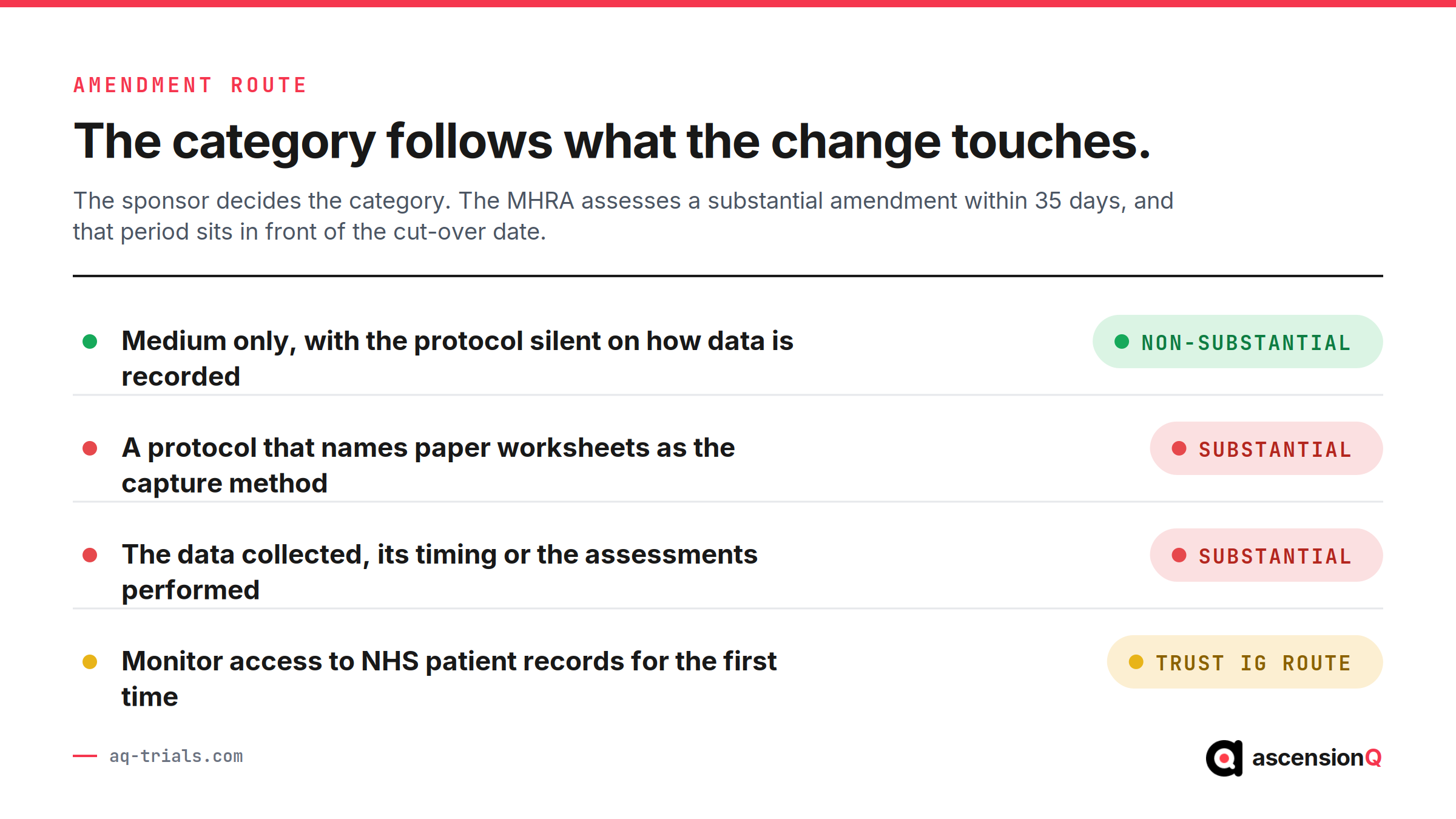
| What the change touches | Where the decision usually lands |
| The medium the site records data in, with the protocol silent on medium | Non-substantial, documented through site change control and sponsor oversight |
| A protocol that names paper worksheets as the method of data capture | Substantial, because the protocol itself has to be amended |
| The data collected, its timing or the assessments performed | Substantial, because the scientific value of the trial is engaged |
| Monitor access to NHS patient records for the first time | Separate trust information governance approval, whatever the category |
A substantial modification carries a clock. The MHRA assesses a substantial amendment application within 35 days, and that period sits in front of any cut-over date the site has in mind. Sites that fix the date first and ask the question second end up waiting.
Monitor access is the approval most often missed, because it runs on a separate track from the amendment. Our guide to how NHS sites give monitors EPR access without breaching UK GDPR covers the lawful basis and the trust approval chain.
What Changes on the Cut-Over Date?
The cut-over date is a single declared day on which the original record stops being the paper worksheet and starts being the electronic entry. One date applied to every data point is simpler to evidence than a staggered move, and an inspector can test it in a single question.
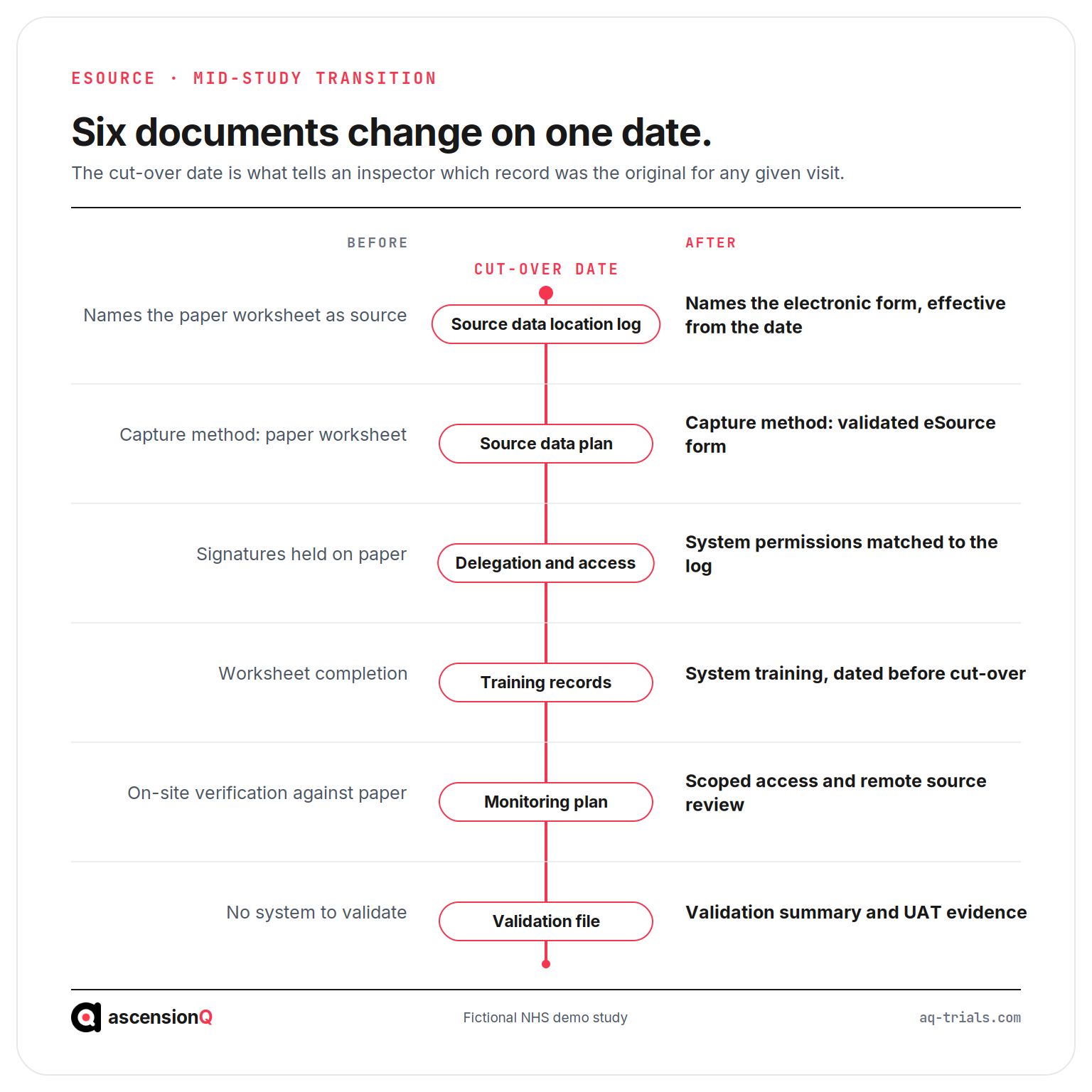
Six documents change on that date, and each one carries the date itself:
| Document | What changes | Who signs |
| Source data location log | A new version naming the electronic form as source, effective from cut-over | Principal investigator, with sponsor agreement |
| Source data plan | The capture method and location for each affected data point | Site and sponsor |
| Delegation log and user access list | System permissions granted to delegated staff, matched to the log | Principal investigator |
| Training records | Evidence that each user was trained before the date | Site, per user |
| Monitoring plan | How source data verification is performed after the change | Sponsor |
| Validation file | Validation summary and user acceptance testing, dated before cut-over | Site, with vendor evidence |
Version control on the first of these carries most of the weight. A superseded log stays in the file, because it is the only record that explains why visit four was captured on paper and visit five was not. Our guide to what a source data location log contains and who signs it off covers the columns and the version control the change depends on, and our guide to how to build a source data plan covers the decisions the plan settles.
All six are filed in the investigator site file, which is where an inspector establishes what the site was doing on any given date. Validation dated after the cut-over is a finding on its own, and our guide to how to validate an eSource system before first patient in covers the evidence that has to exist first.
Also Read: eSource vs Paper Source Worksheets: What Changes at the Site
What Happens to the Paper Records Already Collected?
The paper records already collected remain the source for the period they cover, and they stay in the site file for the full retention period. The transition changes what happens next and nothing about what has already happened.
Four rules govern the historical paper:
- The paper worksheet stays the original for every visit recorded before cut-over, which keeps the source declaration accurate for that period.
- Historical values are left where they are, because re-entering them creates a copy that is neither original nor contemporaneous.
- Historical values loaded in for continuity are labelled as transcribed data with their own date, which keeps them distinguishable from source.
- Paper replaced by a scan follows the certified copy route, which requires the copy to be verified as holding the same information as the original.
The second rule is where good intentions cause the most damage. A site that back-fills six months of paper observations into the electronic system, to give staff a complete view, has produced a second record of every one of those values. The MHRA GXP data integrity guidance requires that where hybrid systems are used, it should be clearly documented what constitutes the whole data set, and a back-filled system without that documentation makes the data set ambiguous.
A scan that replaces the original is a separate decision with its own test. Our guide to certified copies and when a scanned record can replace the original source covers the verification routes and who certifies at the site.
Why Is Dual Running the Biggest Risk in a Transition?
Dual running creates two live records of the same data point with no declared winner. The risk is specific to the transition period, and it comes from the old habit outlasting the date the new process started.
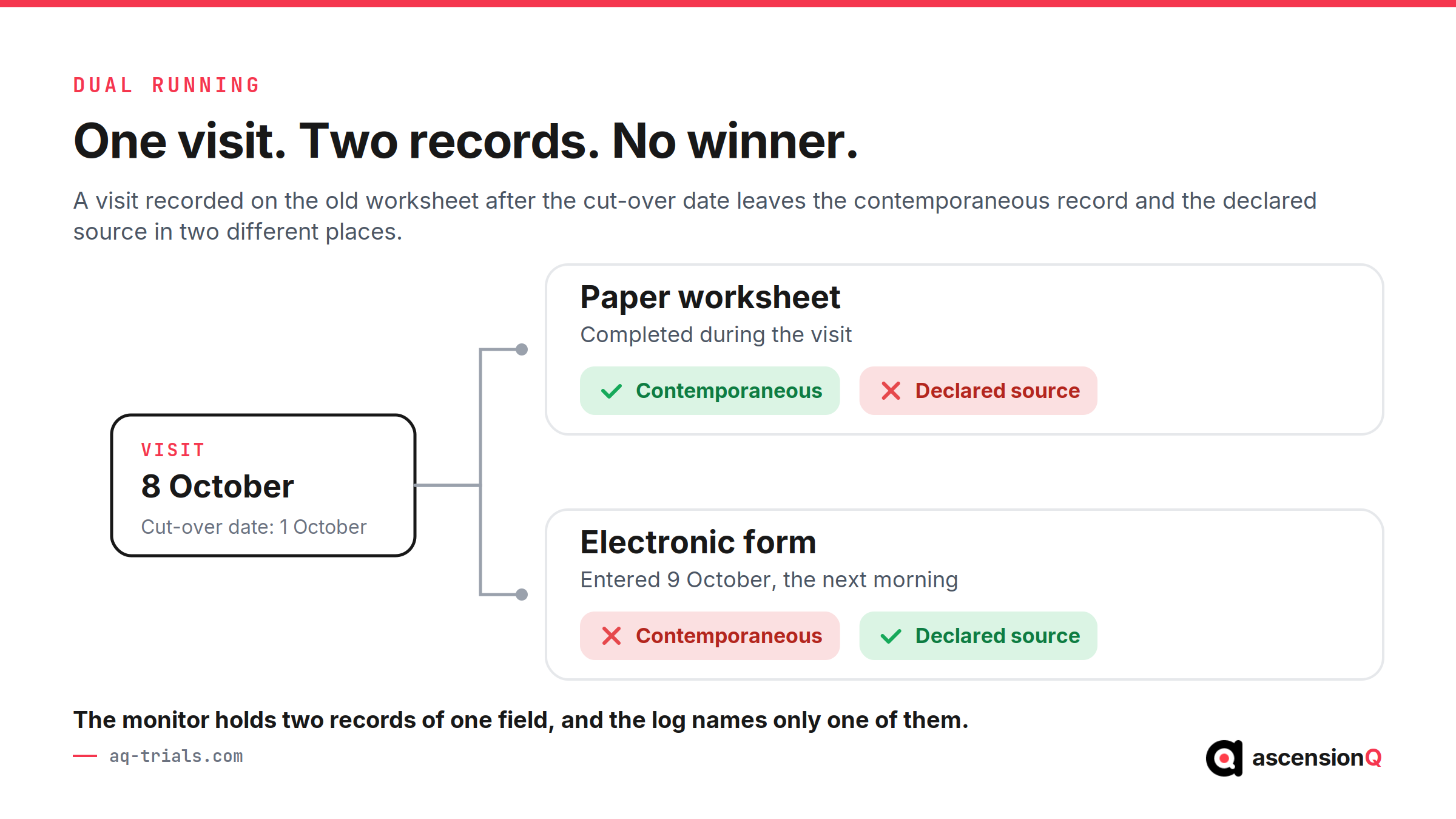
Consider a hypothetical respiratory study at an NHS trust with a cut-over date of 1 October. A research nurse covering a clinic on 8 October reaches for the printed worksheet pack on the desk, records the visit on it, and types the values into the electronic form the following morning.
- The source data location log names the electronic form as source from 1 October, so the electronic entry is the declared original.
- The electronic entry carries a timestamp of 9 October, which is not contemporaneous with the visit.
- The worksheet holds a value recorded during the visit and is no longer the declared source.
- The monitor now has two records, one contemporaneous and one declared, disagreeing on one field.
Each failure here is a system condition. The worksheet pack was still on the desk, the form allowed a late entry without challenge, and nobody had been told what to do with a visit recorded in the old format. Three controls close the gap: removal of blank worksheets on the cut-over date, a form that flags an entry date later than the visit date, and a written instruction covering the first month.
The date on the log is a decision. The pack of blank worksheets is a habit.
A transition error that breaches the protocol, or that repeats across visits, moves into the deviation and corrective and preventive action records rather than a data query.
How Should a Site Sequence the Change?
The sequence runs backwards from the cut-over date, because several steps have to be complete and dated before it. The order below keeps every document in the right chronological relationship to the first electronic entry.
- Raise the change with the sponsor, and ask the sponsor to categorise the modification.
- Submit the amendment where the sponsor categorises it as substantial, allowing the 35 day assessment period.
- Secure trust information governance approval for any new access to patient records.
- Validate the system and complete user acceptance testing, filing the evidence with a date before cut-over.
- Train every user who will enter data, and match system permissions to the delegation log.
- Agree the cut-over date with the sponsor, and issue a written instruction to the site team.
- Re-sign the source data location log and the source data plan, effective from that date.
- Remove blank paper worksheets from circulation on the date itself.
- Review the audit trail after the first month, checking entry dates against visit dates.
Step nine is the one that proves the transition worked. An audit trail review across the first month shows whether entries are being made during visits or the next morning, and it catches the habit before it becomes the record for the rest of the study. Those procedures belong in the site’s quality management system, alongside the change control the transition runs under.
Sites planning a mid-study move usually find the documents take longer than the software. AQ is launching eSource soon as part of the AQ platform. Book a live demo to see the AQ platform today.