What is agentic AI in clinical trials? It is software that takes a goal rather than an instruction, plans the steps itself, and acts across systems until the goal is met. An assistant answers one request. An agent runs a sequence. At a UK research site the sequence has to stop where a person decides.
This guide separates an agent from an assistant and from rules-based automation, sets out the task boundary a UK site can defend, and states what is actually being built today on the sponsor side and on the site side. The wider map of AI across a trial is in How is AI used in clinical trials?, and what to test a platform’s AI claims against is in AI for compliance and inspection readiness.
What Is Agentic AI in Clinical Trials?
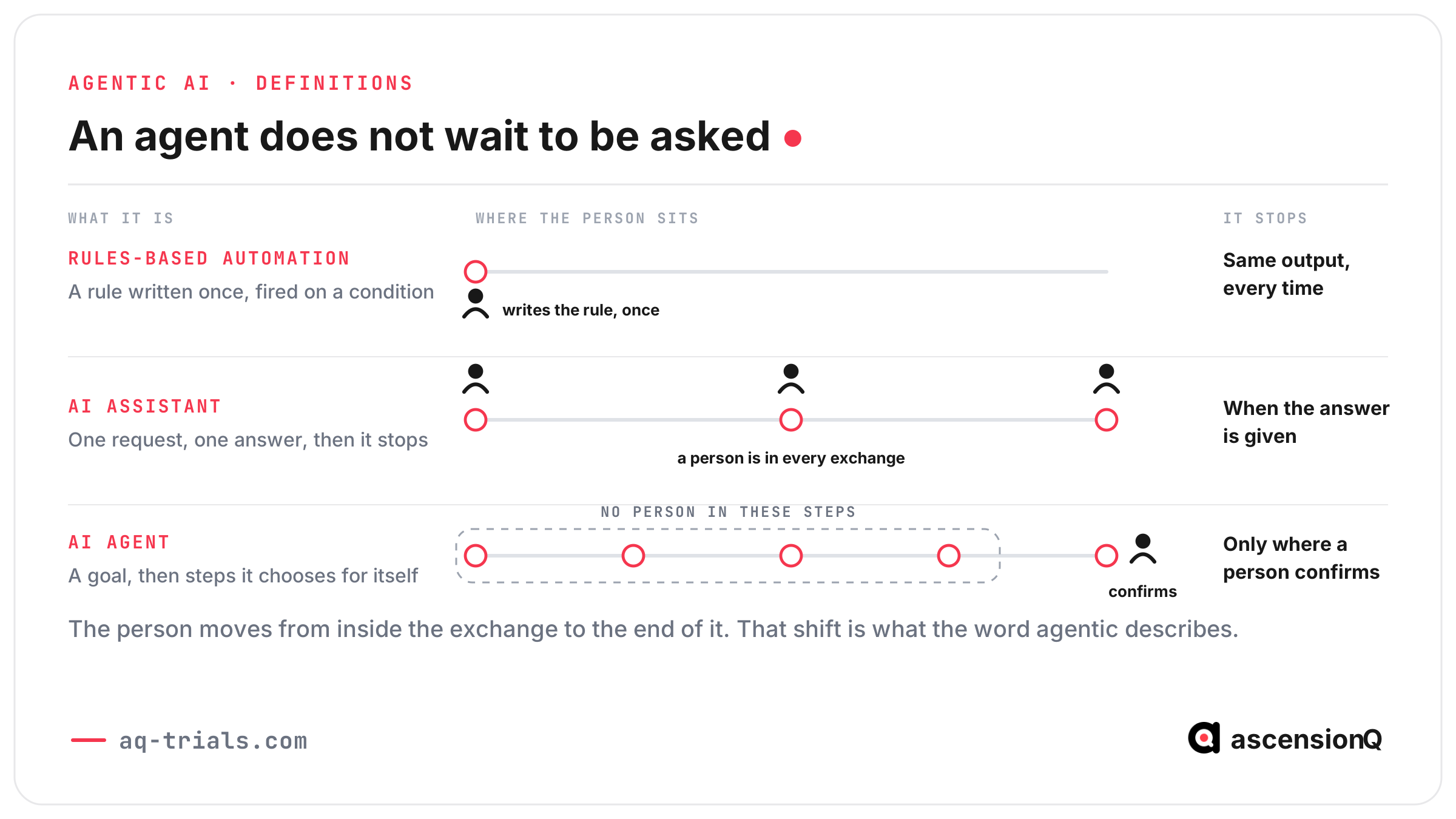
Agentic AI is a model given a goal, a set of tools and permission to use them in an order it works out for itself. The word describes an operating pattern rather than a new kind of model. The same model powers an assistant and an agent. The difference is how much of the sequence runs without a person in it.
Three things get called AI inside a trial platform, and a buyer has to tell them apart.
- Rules-based automation. A predetermined rule fires and returns the same output every time, which is why it is tested rather than reviewed. The full classification sits in automation versus AI in a trial platform.
- An assistant. A person asks, the model answers, and the exchange ends. The person holds the next move, and nothing reaches a record until they put it there.
- An agent. A person states an outcome, and the model decides the steps, calls the systems it needs, reads what comes back and continues. The person sees the result rather than each step.
An assistant waits to be asked. An agent carries on.
That line carries the whole regulatory question. What a UK site must settle follows from how far the carrying on is allowed to go, and from which step a named person has to stand in.
What Makes a System Agentic Rather Than Assistive?
Four properties move a feature from assistive to agentic, and each adds a question a research office answers before the feature goes live.
| Property | What changes at the site | The evidence it demands |
| It takes a goal, not an instruction | The person states an outcome and stops specifying the method | A written statement of what the feature is for, specific enough to test |
| It plans its own steps | The sequence varies between two runs of one request | An acceptance criterion set as a rate across a scripted set |
| It acts in systems rather than returning text | Output lands in a register, a file or a queue instead of on screen | An audit trail entry naming the model version, the proposal and the person who confirmed it |
| It persists between prompts | Work continues after the person has closed the screen | A record of what ran unattended, when, and under whose delegated authority |
The third property carries most of the regulatory weight. A feature that returns text to a screen leaves the record untouched. A feature that writes, files or routes has entered the trial record, and the method for proving it behaves is set out in validating an AI feature in a regulated clinical trial system. The fourth property is the one vendors describe least clearly. A system that runs overnight produces entries nobody watched being made, and the delegation record still names people who were asleep.
What May an Agent Prepare, and What Must Pass to a Named Person?
The useful boundary is drawn by task rather than by technology. An agent may do the assembly work that precedes a decision. The decision itself passes to a person the delegation log already authorises. The table sets the line out for eight tasks a UK site runs weekly.
| Site task | What an agent may prepare | What a named person must decide | Where the decision is recorded |
| Site file completeness | The documents expected but absent, each with the record compared against | Whether the absence is a gap, a filing error or a document that never applied | The site file and the deviation log |
| Document filing | The classification, the proposed destination and the index fields | That the document is what the proposal says it is, and that it belongs there | The eTMF or investigator site file audit trail |
| Deviation triage | A draft category, a summary and the related entries on the log | The category, the severity and whether the event is reportable | The deviation log and the quality management system |
| Quality signals | A trend across the deviation log, the training file and the document register | Whether the pattern is a risk worth opening a corrective action for | The CAPA record |
| Investigational medicinal product (IMP) reconciliation | The arithmetic, the unmatched units and the dates that fail to align | The explanation for each discrepancy and the disposition of the stock | The accountability log and the pharmacy site file |
| Monitoring preparation | The document pack, the open queries and the visit agenda | What the site commits to, and what it disputes | The monitoring visit follow-up letter |
| Training currency | Staff with lapsed records against delegated activity | Whether a person may continue performing the activity today | The delegation log and the training file |
| Participant-facing care | Nothing that reaches a participant | Every clinical judgement, without exception | The medical notes and the source record |
One row has no agent column worth filling. Clinical judgement about a participant is reserved to a qualified person. The other seven rows share a shape. The agent closes the distance to the decision and hands over. The person supplies the judgement and takes the consequence, which is the structure covered in who is accountable when AI gets it wrong at a trial site?.
Also Read: What AI may and may not file in an eTMF or eISF takes the filing row apart in full, including which document types a reading check can place and which always need a person.
Where Must a Person Decide?
Two instruments settle this for a UK site from different directions. One governs who answers for trial conduct. The other governs decisions made about people by machines.
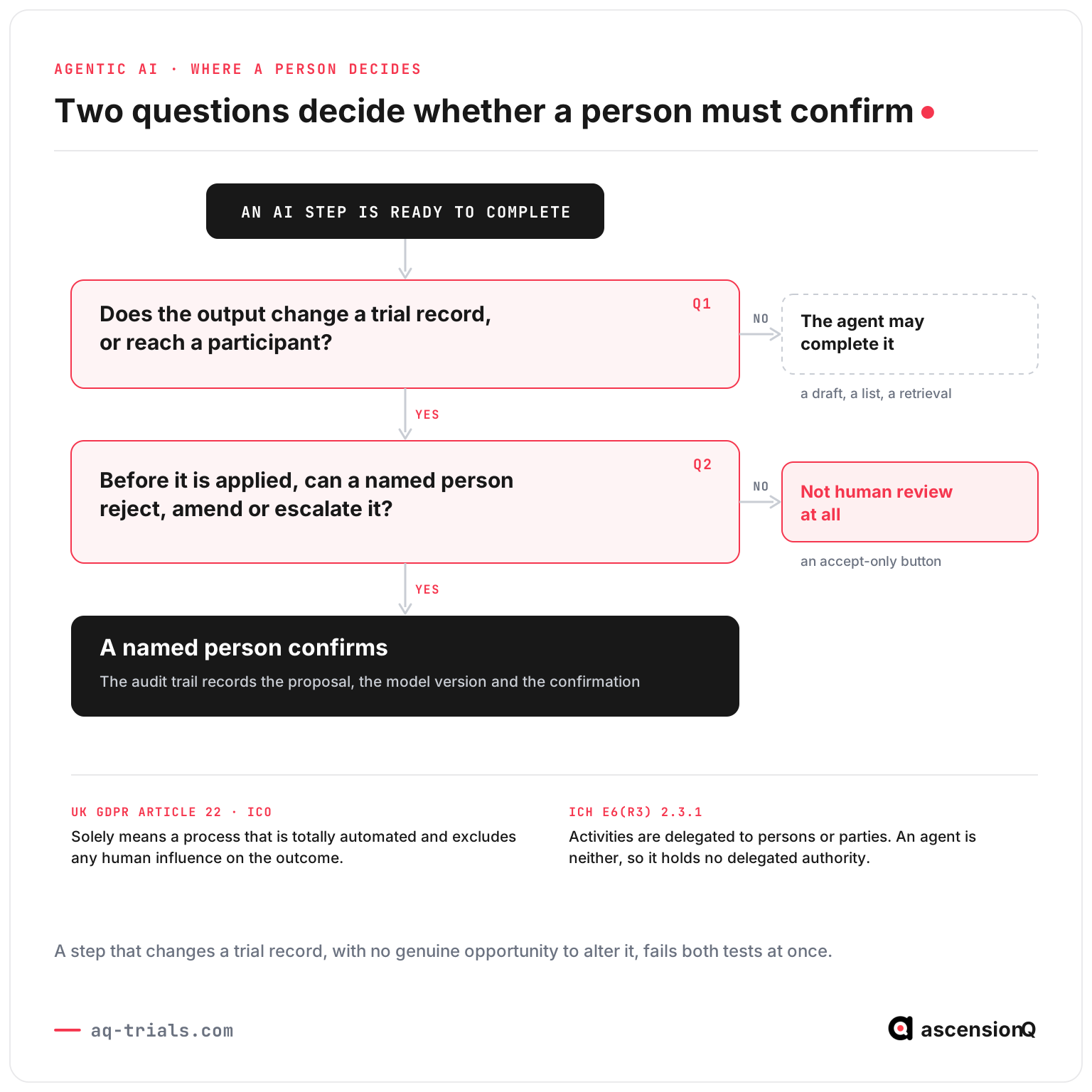
ICH E6(R3), adopted at Step 4 on 16 June 2026 in its consolidated form, places trial-related medical care and decisions with the investigator or sub-investigator at section 2.7.1(a). Section 2.3.1 permits delegation of trial-related activities to other persons or parties and states that the investigator “retains the ultimate responsibility”. Section 2.3.3 requires documentation of that delegation, proportionate to the significance of the activity. Delegation in the guideline runs to persons and parties. An agent is neither, so it holds no delegated authority and appears nowhere on the log.
The Information Commissioner’s Office guidance on automated decision-making and profiling supplies the second test. Article 22 of the UK GDPR gives a person the right not to be subject to a decision based solely on automated processing where it produces legal effects or similarly significant effects. The ICO defines the threshold plainly: “Solely means a decision-making process that is totally automated and excludes any human influence on the outcome.” A human who inputs data does not break that. A human who weighs up and interprets the result before it is applied does.
The ICO sets one question at the centre of it. The test is “whether a human reviews the decision before it is applied and has discretion to alter it”. A person who only passes the system’s output along has not reviewed it. Three conditions follow from that test, and a site can hold itself to all three.
- Review before application. The proposal waits until someone acts on it, which means an agent that writes first and notifies second has already failed the test.
- Discretion to alter. The reviewer can reject, amend or escalate, which means an accept-only button records agreement that was never available to withhold.
- Competence to judge. The reviewer understands the task well enough to disagree, which means the delegation log and the training record decide who sits at that gate.
The ICO notes that its guidance is under review following the Data (Use and Access) Act, which came into law on 19 June 2025. The controller and processor position for a research site sits in UK GDPR for clinical trial sites.
What Is Being Built Right Now, and Who Is It For?
Most of the agentic work announced in clinical research sits on the sponsor side. A site reading those announcements finds little it buys and runs itself, and the distinction is worth holding when a vendor arrives with an agent story.
The clearest public example is American. The US Advanced Research Projects Agency for Health announced SURPASS, Simulation-augmented, Real-time Platform Adaptive Seamless Trials, on 30 September 2026. It aims to evaluate drugs and biologics “faster, at lower cost, and with fewer participants” through perpetual adaptive platform trials, and names an “agentic operations layer” and a “continuous inference engine” among the capabilities it seeks. Solution summaries are due on 30 November 2026. SURPASS is a funding programme at proposal stage rather than a product.
| Where the work sits | What is being attempted | What a UK research site buys today |
| Sponsor and regulator programmes | Adaptive design, simulation-augmented control arms, continuous analysis | Nothing. The site contributes data and follows the protocol |
| Sponsor-side vendors | Protocol drafting, feasibility modelling, site selection, monitoring analytics | Nothing. These are sponsor jobs a site never procures |
| Site-side platforms | Drafting, document classification, cross-record flagging, natural-language retrieval | Assistive features with a confirmation step, inside a system already in service |
Agentic AI is a direction of travel for a UK site in 2026 rather than a category on a purchase order. What a site actually uses, role by role, sits in what AI a UK research site actually uses. The regulators have moved faster than the products. The MHRA Inspectorate published its expectations for AI-drafted inspection responses on 29 June 2026, requiring submissions to be “factually accurate and verifiable”, “technically reviewed by appropriately experienced people” and “signed off by someone with authority and accountability”. What the MHRA expects of AI inside a GxP system more generally is in is it safe to use AI in GxP clinical trial systems?.
Also Read: The EMA and FDA good AI practice principles covers the ten joint principles of 14 January 2026 and splits each one into what it asks of a site and what it asks of a sponsor.
What Goes Wrong When an Agent Runs Unattended at a Site?
The failure is quiet and visible only in the audit trail. Consider a site that switches on an overnight filing agent across two studies.
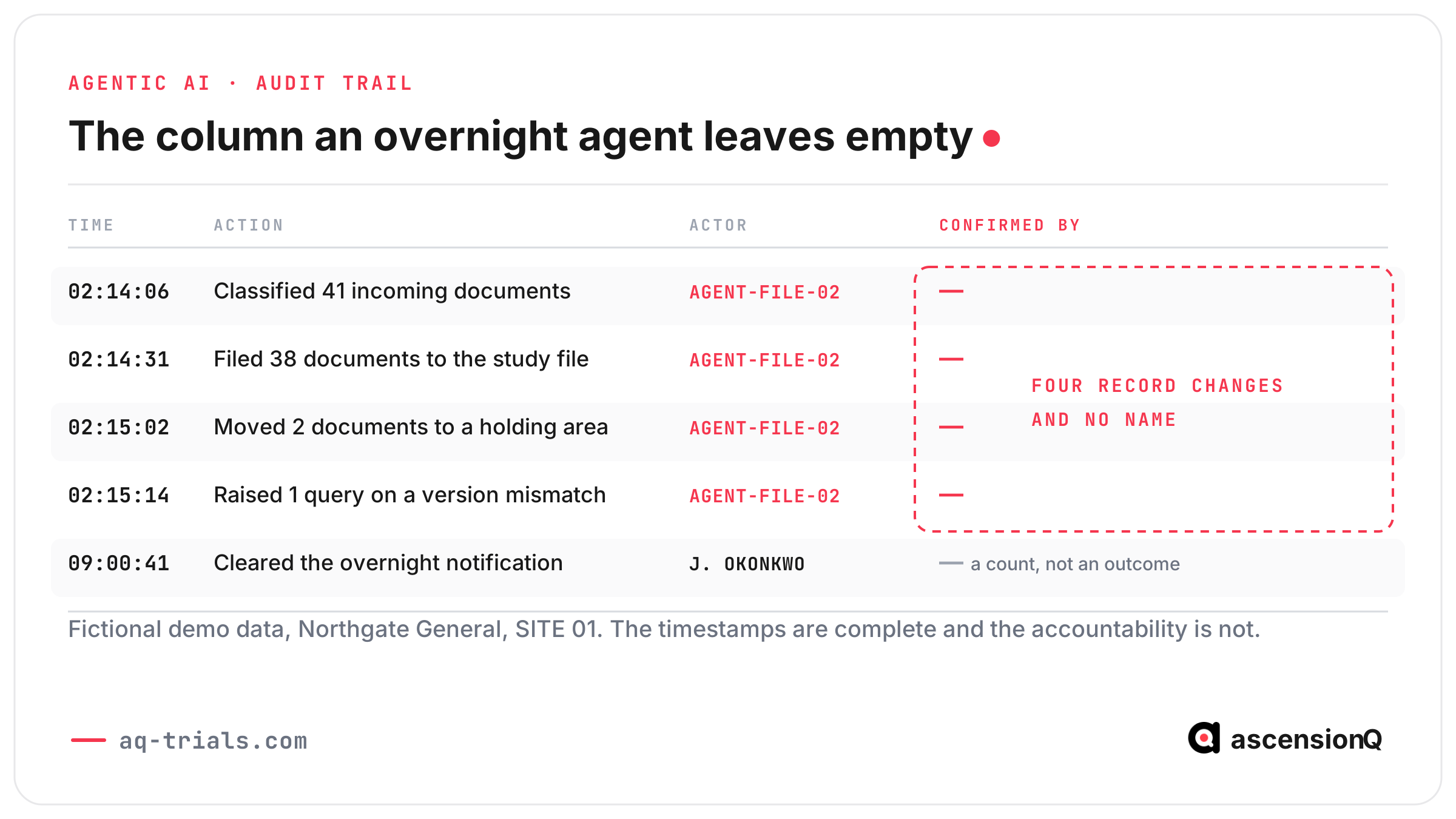
At 02:14 the agent classifies forty-one documents, files thirty-eight, moves two into a holding area and raises one query. Every action carries a timestamp and a system identity. None carries the name of a person who looked. At 09:00 a trial coordinator opens a dashboard reporting thirty-eight documents filed and clears the notification.
Eleven months later a monitor asks who confirmed that a signed protocol amendment was filed against the correct version. The audit trail names the agent. The delegation log names the coordinator, who was at home. Three records contradict each other, and the site cannot close the distance between them.
- The audit trail holds an actor with no authority. ICH E6(R3) delegates to persons and parties, so the entry records an action nobody was authorised to take.
- The delegation log holds authority with no action. The coordinator is authorised and performed nothing, so the log evidences a capability rather than a decision.
- The dashboard acknowledgement proves attention. Clearing a count is not weighing up an outcome, so it fails the ICO test and cannot be offered as human review.
The fix is structural rather than cultural. The confirmation step belongs in the system, before the write, with the reviewer’s name attached to the record it changes. A site relying on staff to remember has built the failure in and labelled it training. The written procedure covering scope, approval, monitoring and review for every AI use sits in how should a research site govern the use of AI?.
An agent can hold a timestamp. It cannot hold a responsibility.
Agentic AI and the AQ Platform
Connected Intelligence is the AI capability across the AQ Platform, and AQ Assist is the in-platform assistant a user works with directly. The design answer to the boundary question above is a property of the record rather than a setting a site has to remember to switch on.
- AQ’s AI proposes, flags and drafts, and a named person reviews and confirms, which keeps the decision with the individual the delegation record authorises on that date.
- Every AI action is written to the audit trail, so the proposal and the confirmation are both retrievable, and neither stands alone.
- Quality and corrective action records sit in the quality management system and CAPA on one connected record, which allows a cross-record signal to be raised and then traced to the person who acted on it.
- Every AQ release goes through validated release and change control, with installation and operational qualification evidence and a 21 CFR Part 11 and EU Annex 11 assessment, so an AI feature ships inside the same release evidence as the version a site runs. Performance qualification stays with the site, against its own configuration and intended use.
- The platform is UK-hosted, holds NHS DSPT Standards Met for 2026, is Cyber Essentials certified and runs ISO 27001-aligned controls.
AQ was built by Phase 1 trial doctors and has been in continuous daily NHS use for six years, with 13 sites on one connected record and 70 concurrent studies. It supports MHRA compliance and is built for MHRA GCP inspection. Book a live demo to see where a proposal becomes a confirmed record.
Frequently Asked Questions
What is agentic AI in clinical trials?
Agentic AI is software given a goal rather than an instruction, which then plans its own steps, calls the systems it needs and continues until the goal is met. An assistant answers one request and stops. An agent runs a sequence across several stages. The pattern matters in a trial because the sequence can reach a trial record, so a UK site decides which step a named person stands in.
What is the difference between an AI agent and an AI assistant?
Scope and persistence. An assistant handles one request inside one exchange, and the person holds every next move. An agent takes an outcome, decides the order of the work, acts in other systems and keeps going between prompts. Rules-based automation differs from both, because it fires a predetermined rule and returns the same output every time.
Can an AI agent file documents or sign records at a trial site?
It can prepare the filing. It cannot commit it. ICH E6(R3) permits the investigator to delegate trial-related activities to other persons or parties, and an agent is neither, so it holds no delegated authority and appears on no delegation log. An agent may classify a document, propose a destination and populate the index fields. A named person confirms the document is what the proposal says it is.
Does UK law allow an automated decision in a clinical trial?
Article 22 of the UK GDPR restricts decisions based solely on automated processing where they produce legal or similarly significant effects. The ICO states that solely “means a decision-making process that is totally automated and excludes any human influence on the outcome”, and sets the test as whether a human reviews the decision before it is applied and has discretion to alter it. A person who only passes the output along has not reviewed it.
Is agentic AI being used in UK clinical trials today?
Not at the site. The announced agentic work sits on the sponsor and funder side, such as the ARPA-H SURPASS programme announced on 30 September 2026, which names an agentic operations layer among the capabilities it seeks at proposal stage. What a UK site buys today is assistive: drafting, document classification, cross-record flagging and natural-language retrieval, each with a confirmation step.
What should a site ask a vendor that claims agentic AI?
Four questions. Which steps run without a person, and where exactly does the sequence stop? What does the audit trail record when the agent acts unattended overnight? Can the reviewer reject and amend, or only accept? Which model version was running on a given date, and under what change control? A vendor that cannot answer the first question in one sentence is selling a word rather than a feature.