Standalone AI in clinical trials works on one document, dataset or system at a time. Connected AI reads across the linked operational record of a study (delegation, training, documents, pharmacy, deviations and CAPA) and returns its output into a controlled workflow with an audit trail. The difference decides whether AI can see the risks that sit between records.
Most AI conversations in clinical research focus on the model. The model is rarely the constraint at a research site. The constraint is context: what the AI is allowed to read, how current that information is, and where its output goes once a person accepts it.
What This Guide Covers
- Precise definitions of standalone, integrated and connected AI, with examples of each.
- Why most site-level risk sits between records, and what single-record AI misses.
- A side-by-side comparison across twelve operational dimensions.
- The failure modes of each approach, including the ones connected AI introduces.
- A worked example of one protocol amendment handled by both kinds of AI.
- Eight adoption strategies for a UK research site, and the regulatory expectations behind them.
For the wider picture of AI across the trial lifecycle, start with the guide to how AI is used in clinical trials.
What Is the Difference Between AI and Connected AI in Clinical Trials?
The useful distinction is architectural. It describes what the AI can see and where its output lands. Three forms exist in practice.
| Form | What it reads | Where the output goes | Typical example |
| Standalone AI | One document, upload or dataset supplied by the user | Back to the user, outside the controlled record | A general chatbot summarising a protocol PDF; a translation tool for a participant information sheet |
| Integrated AI | Data copied between separate systems by a scheduled sync or export | Into the system that hosts the AI, often with a delay | A classifier in one eTMF that receives site data from a separate CTMS overnight |
| Connected AI | The live, linked record across modules that share one data model, one set of identities and one permission scheme | Into the workflow as a proposal that a named person confirms, with the action in the audit trail | AI that checks an approved amendment against delegation, training, consent versions and scheduled visits in one pass |
Connected AI therefore depends on three properties of the underlying system:
- Shared identifiers. A participant, a staff member, a protocol version and an IMP kit carry the same identity in every module, which allows the AI to join records without guessing.
- Inherited permissions. The AI reads only what the requesting user may read, which keeps role-based access intact under ICH E6(R3) and UK GDPR.
- Provenance. Every output cites the records it used, which allows the reviewer to verify it at source.
AI is only as useful as the record it can read.
The line between AI and rules-based automation is a separate question, covered in automation vs AI in a trial platform.
Why Does Site Risk Sit Between Records?
Inspection findings at UK sites rarely concern a single missing document. They concern two records that disagree. A delegation log, a training record and a visit schedule can each look complete in isolation. The finding appears only when an inspector reads them together.
The table below shows common cross-record events. Each scenario is a hypothetical but realistic pattern.
| Event | Records involved | What single-record AI sees | What connected AI sees |
| Protocol amendment approved | Protocol, consent form versions, training log, visit schedule | A well-formed amendment document | Participants due to visit before reconsent; staff without training on version 4 |
| Staff member added to the delegation log | Delegation log, GCP certificate, protocol training | A correctly completed log entry | A GCP certificate that expires before the next scheduled dosing visit |
| Temperature excursion recorded | Pharmacy temperature log, IMP kit register, dispensing record | An excursion entry | Kits from the affected fridge already dispensed to two participants |
| SOP revised | QMS document, training matrix, open CAPAs | A new SOP version | Three open CAPAs whose actions reference the superseded version |
| Deviation logged | Deviation record, CAPA history, monitoring reports | One deviation | The third deviation in six weeks with the same root cause at the same site |
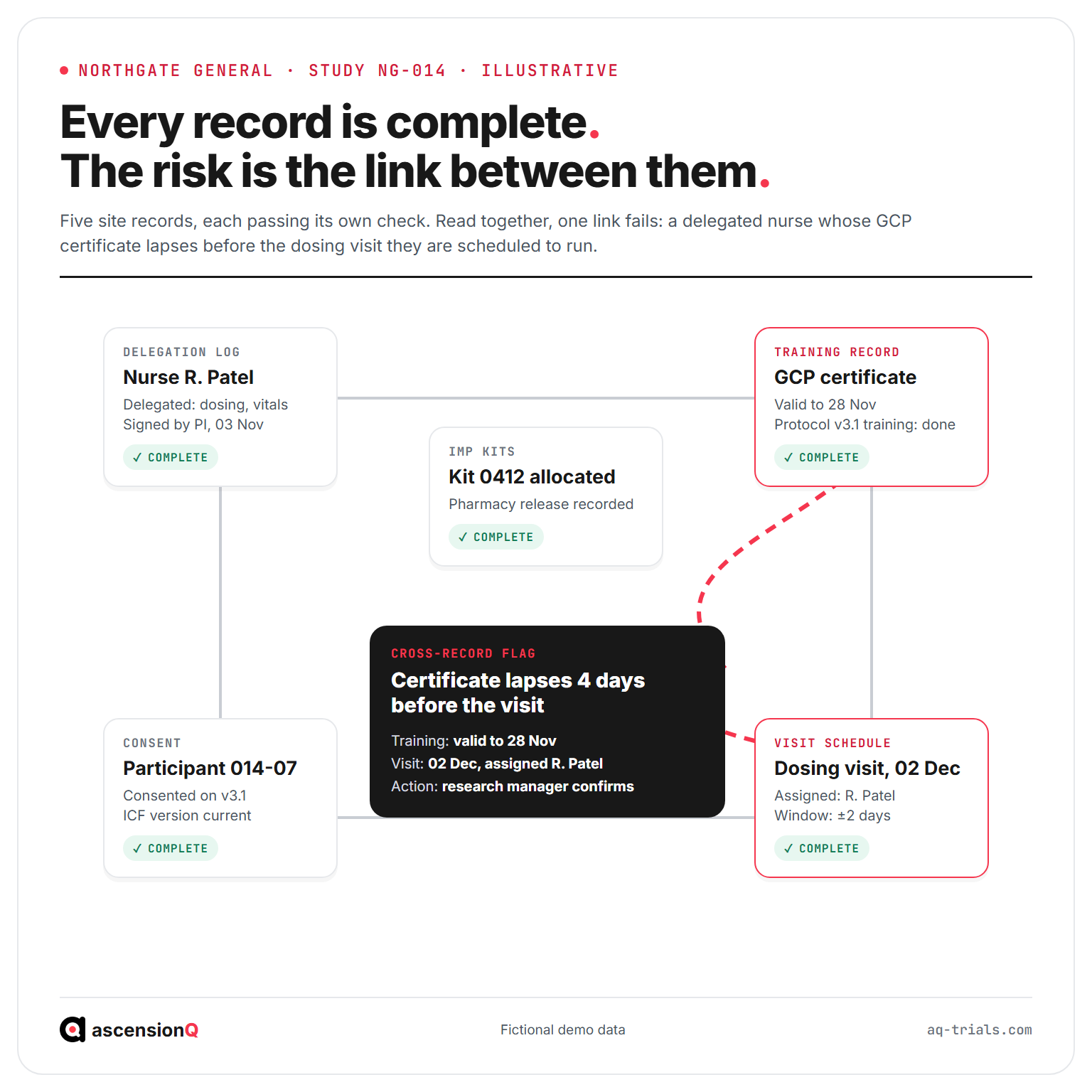
The pattern holds across every row. The individual record is correct. The risk lives in the relationship between records, and standalone AI has no view of that relationship.
The person changed. The record did not follow.
Also Read: AI-assisted quality risk detection for UK research sites
Standalone AI vs Connected AI: Side-by-Side Comparison
| Aspect | Standalone AI | Connected AI |
| Scope of reading | One document or upload | The linked study record across modules |
| Freshness | As current as the file the user supplied | As current as the live record |
| Identity of people and items | Inferred from text | Resolved from shared identifiers |
| Access control | Whatever the user pasted in | Inherits the requesting user’s permissions |
| Grounding | Model knowledge plus the upload | Cited records the reviewer can open |
| Where output lands | A chat window, an email, a copied paragraph | A proposal inside the workflow |
| Human confirmation | Informal, unrecorded | A named person accepts, edits or rejects |
| Audit trail | None inside the trial system | Every AI action and decision recorded |
| ALCOA+ position | Output is unattributable once copied | Output is attributable, contemporaneous and traceable |
| Data protection | Personal data may leave the controlled environment | Data stays inside the validated system |
| Validation | Outside the site’s validated systems | Within the vendor’s validation and change control |
| Best suited to | Bounded drafting, translation, literature tasks | Oversight, readiness, quality and impact questions |
Where Does Standalone AI Still Fit?
Standalone AI has a legitimate place at a research site. The test is whether the task depends on the study record. A task with no record dependency, no personal data and a human author who takes ownership of the result is a reasonable fit.
- Literature and background reading. A general model summarises published papers for a feasibility discussion, which saves reading time without touching trial data.
- Lay language drafting. A model proposes plain-English wording for a participant information sheet, which the author then edits, versions and approves through the normal document process.
- Training material. A model drafts quiz questions on a published guideline, which a trainer reviews before use.
Each case keeps participant data out of the tool and keeps the approval inside the site’s own process. The rules for AI-drafted documents are set out in can AI write clinical trial documents?
What Can Go Wrong With Standalone AI at a Research Site?
The main risks come from the gap between the AI and the controlled record.
- Data leaves the controlled environment. A coordinator pastes a screening log into a public chatbot, which places pseudonymised participant data with a third party and outside the site’s DPIA.
- Outputs become unattributable. A summary copied into an email has no record of its source, its author or its review, which breaks the attributable and traceable elements of ALCOA+.
- Answers rest on stale extracts. A user uploads last month’s delegation log, which produces a confident answer about a team that has since changed.
- Grounding is weak. The model fills gaps with plausible text, and the reviewer has no linked record to check it against.
- Shadow use grows. Staff adopt personal tools to save time, which leaves the research office with no inventory of AI use to govern.
Each of these is a system condition. Staff use the tools in good faith because the controlled system offers nothing comparable.
Also Read: how should a research site govern the use of AI?
What Can Go Wrong With Connected AI?
Connected AI removes the gap, and it introduces risks of its own. A balanced assessment names them.
| Risk | Cause | Control |
| Poor data amplified | AI reads every linked record, including incomplete ones | Fix data quality at source before switching on cross-record features |
| Broader reach | One question can touch many modules | Inherit role-based permissions; log every query |
| Over-reliance | Fluent outputs invite acceptance without checking | Require a named person to confirm; show cited records beside each proposal |
| Model change | Vendor updates alter output behaviour | Change control, regression testing and release notes per update |
| Unclear accountability | The AI appears to decide | Keep decisions with the delegated person; record the confirmation |
The accountability chain is covered in who is accountable when AI gets it wrong at a trial site?, and validation of a probabilistic feature in validating an AI feature in a regulated clinical trial system.
A Worked Example: One Protocol Amendment, Two Kinds of AI
The scenario is hypothetical. A sponsor issues protocol version 4.0, which adds a safety blood test at week 12 and requires reconsent. The site R&D office confirms the amendment on Monday.
| Step | Standalone AI | Connected AI |
| Input | The research nurse uploads the v4.0 PDF and asks for a summary of changes | The approved amendment is recorded against the study |
| Analysis | A clear summary of the new week 12 test | The same summary, plus a check against linked records |
| Consent | No visibility of who has signed which version | Six participants consented on v3.1; two have visits before reconsent is scheduled |
| Training | No visibility of the training log | Two delegated staff have no v4.0 training record |
| Schedule | No visibility of visits | Four week 12 visits fall in the next fortnight without the new test slot |
| Lab | No visibility of sample kits | Sample records show no kit type set up for the new test |
| Output | A paragraph pasted into an email | A set of proposed actions, each linked to its record, for the research manager to confirm |
| Evidence | None in the trial system | The proposals, the confirmation and the resulting tasks sit in the audit trail |
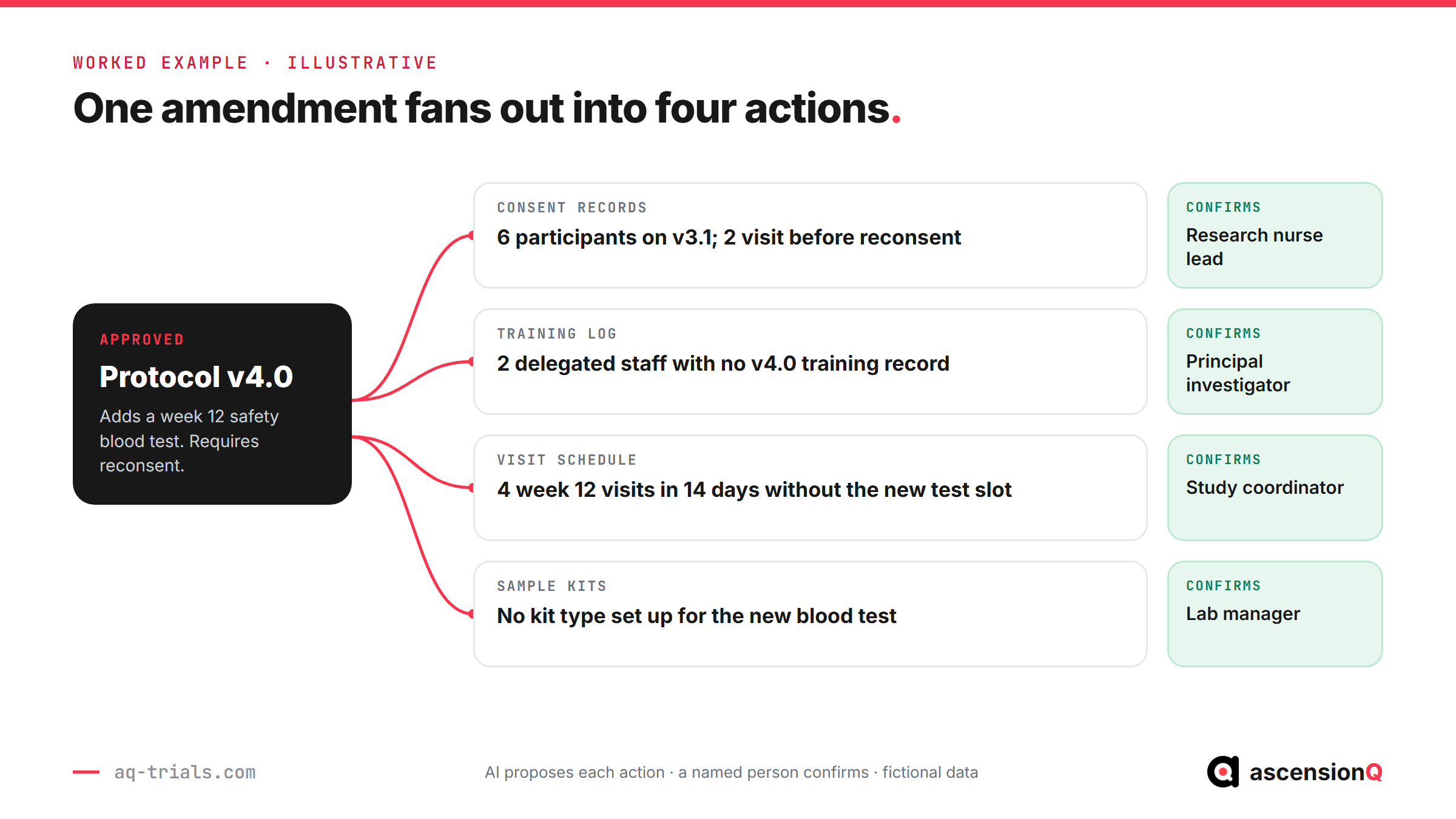
The standalone summary is accurate. It answers the question asked. The connected output answers the questions the site needed to ask, and leaves evidence an inspector can follow.
Accuracy on one document is a narrower thing than oversight of a study.
Strategies for Adopting Connected AI at a UK Research Site
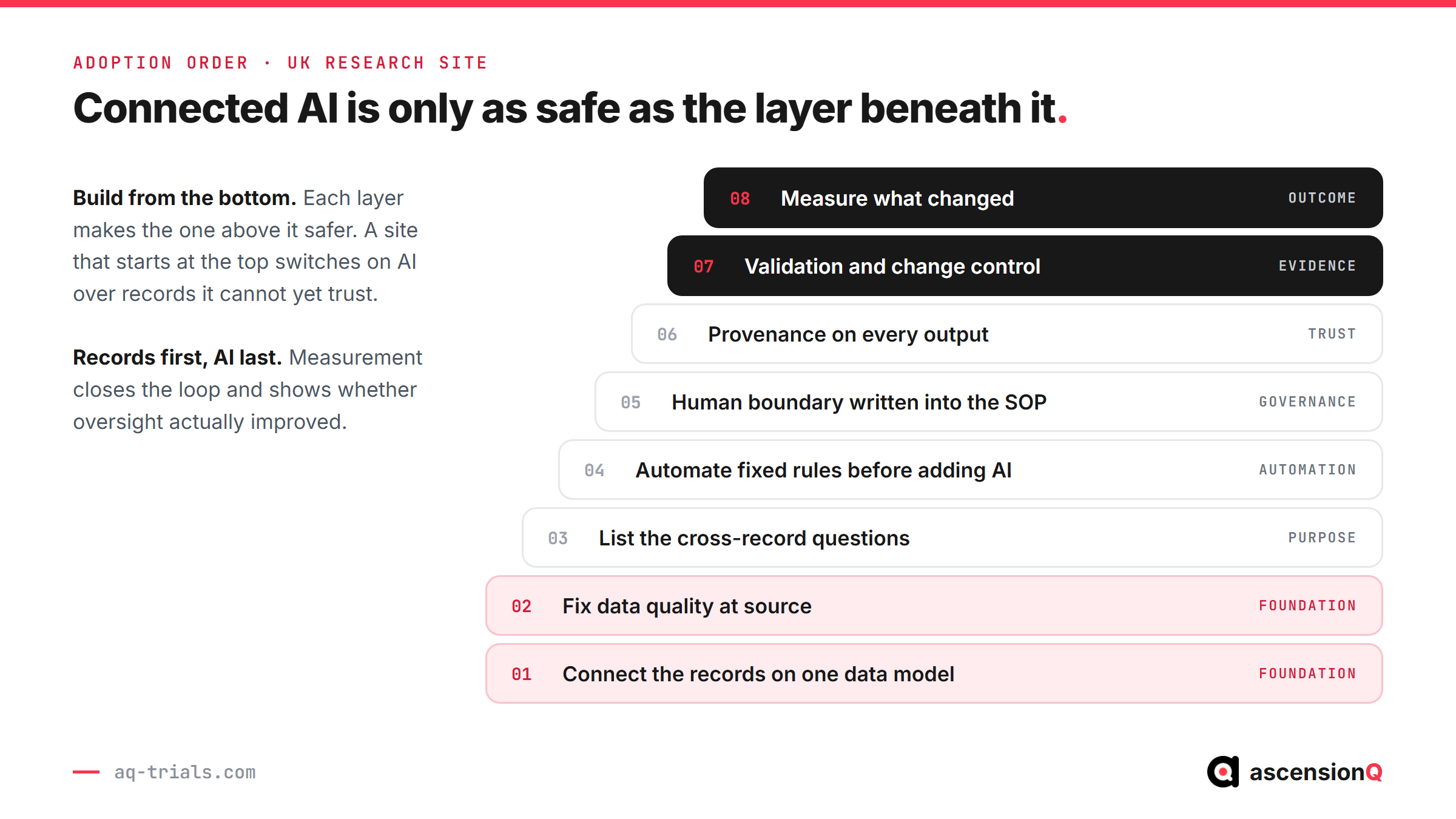
The order matters. Each strategy below makes the next one safer.
- Connect the records first. Delegation, training, documents, pharmacy and quality records on one data model give the AI a reliable base, which makes every later feature more accurate. The AI readiness checklist for research sites scores this dimension.
- Fix data quality at source. Consistent document naming, complete training records and current delegation logs reduce false signals, which keeps staff trust in the outputs.
- List the cross-record questions. The research office writes down the five questions it answers by hand most often (for example, “who is delegated and trained for this visit?”), which gives each AI feature a measurable purpose.
- Automate the deterministic tasks before adding AI. Expiry reminders and version checks follow fixed rules, which belong to automation rather than a model.
- Set the human boundary in writing. AI proposes, flags and drafts; a named, delegated person reviews and confirms. Writing this into the governance SOP makes the boundary auditable.
- Require provenance on every output. Each proposal links to the records it used, which allows the reviewer to verify at source in seconds.
- Bring AI into validation and change control. Intended use, test cases and regression checks on model updates keep the feature inside the site’s validated system boundary.
- Measure what changed. Track time to close readiness gaps, repeat deviations by root cause and findings at monitoring visits, which shows whether the AI improves oversight or only adds activity.
Role-by-role use at a site is mapped in what AI a UK research site actually uses.
What Should a Site Ask a Vendor About Connected AI?
The full evaluation, scorecard and demo script sit in the guide to AI compliance and inspection readiness. Four questions test whether a product is genuinely connected:
- Which records does the AI read for this feature? A connected answer names the modules and fields.
- Are people, versions and items the same entity in every module? Shared identifiers are the difference between a join and a guess.
- Does the AI respect the requesting user’s permissions? A connected product inherits them, so the AI reaches only what the user may see.
- Where does the output go, and what does the audit trail record? A connected answer shows the proposal, the reviewer, the decision and the timestamp.
What Does Regulation Expect of AI That Reads Across Records?
Regulation describes outcomes rather than architecture. Several rules describe outcomes that connected architecture makes easier to evidence.
| Framework | What it asks | Implication for connected AI |
| ICH E6(R3) (adopted 6 January 2025) | Risk-proportionate quality management; Annex 1 section 4 on data governance, with section 4.3 on computerised systems | AI outputs inside the validated system, with audit trail and access control, fit the data governance expectations |
| EMA and FDA guiding principles of good AI practice (14 January 2026) | Ten principles, including a human-centric design, a risk-based approach, a clear context of use, data governance and life cycle management | Provenance, a defined context of use and change control on model updates map directly to the principles |
| MHRA GxP data integrity guidance | ALCOA+ records, audit trails and data governance across GxP computerised systems | An AI proposal and its confirmation become part of the attributable record |
| UK GDPR, with HRA data protection guidance for research | Lawful basis, data minimisation and a DPIA for high-risk processing | Inherited permissions and in-system processing reduce the data that leaves the controlled environment |
| UK clinical trials regulations, as amended (GCP compliance in the UK) | ICH E6 GCP principles as a legal requirement from 28 April 2026; sponsor and investigator duties for oversight and record keeping | Cross-record checks support oversight duties; accountability stays with the delegated person |
ALCOA+ underpins all five. An AI output that is attributable, contemporaneous and traceable to source is easier to defend than one copied into an email. The MHRA has already set out its expectations for AI-drafted material in its inspectorate blog on AI in GxP inspection responses (29 June 2026), and the site-level position is covered in is it safe to use AI in GxP clinical trial systems? and UK GDPR for clinical trial sites.
Sources and Further Reading
Primary sources, checked 21 November 2026:
- ICH. Guideline for Good Clinical Practice E6(R3), final version adopted 6 January 2025.
- EMA. EMA and FDA set common principles for AI in medicine development, 14 January 2026, with the guiding principles of good AI practice in drug development (PDF).
- MHRA. Guidance on GxP data integrity.
- MHRA. Clinical trials for medicines: compliance with ICH E6 GCP in the United Kingdom.
- MHRA Inspectorate. Use of AI for GxP inspection responses, 29 June 2026.
- HRA. Data protection and information governance.
Key Takeaways
- Standalone AI reads one item; connected AI reads the linked study record.
- Most site-level risk sits in the relationship between records.
- Standalone AI suits bounded tasks with no record dependency and no personal data.
- Connected AI amplifies data quality, good or bad, so the records come first.
- A named person confirms every AI proposal, and the audit trail records it.
- Regulation rewards evidence of oversight, which connected AI makes easier to produce.
How AQ Platform Applies Connected Intelligence
Connected Intelligence is the AI in AQ Platform. It reads across nine modules on one connected record: CTMS, eTMF, eISF, QMS, CAPA, Digital DoA, AQ Labs, AQ Pharmacy and eSource.
- Amendment impact checks an approved protocol change against consent versions, delegation, training and scheduled visits, which allows the research manager to act before the first affected visit.
- Quality signal detection reads deviations, CAPAs and SOP versions together, which surfaces repeat root causes across a site.
- Readiness monitoring tracks essential documents and training against study phase, which helps the site keep its file inspection-ready between monitoring visits.
- AQ Assist answers portfolio questions and drafts corrective actions with links to the records it used.
AQ Assist is the in-platform assistant within Connected Intelligence. A research nurse, PI or QA lead asks a question about a study in plain English, and AQ Assist answers from the connected record with links to the records it used. The short film below shows it in use.
AQ’s AI proposes, flags and drafts. A named person reviews and confirms, and every AI action is in the audit trail. AQ Platform has supported six years of continuous daily NHS use and runs 13 sites on one connected record.
Book a live demo to see Connected Intelligence work across a study record.
Frequently Asked Questions
What is connected AI in clinical trials?
Connected AI is AI that reads across the linked operational records of a study, such as delegation, training, documents, pharmacy and quality records, using shared identifiers and the user’s own permissions. Its outputs return to the workflow as proposals that a named person confirms, with each action recorded in the audit trail.
Is a general chatbot safe to use at a research site?
A general chatbot suits bounded tasks with no participant data, such as background reading or drafting lay language that an author then reviews. Participant data and study records belong inside the site’s validated systems, under its DPIA and governance SOP.
Is integrated AI the same as connected AI?
Integrated AI receives data copied between separate systems, often on a schedule. Connected AI reads one live record with shared identities across modules. Integration can approximate connection, with delays and mapping loss at each sync.
Does connected AI make decisions?
Connected AI proposes, flags and drafts. The delegated person reviews the cited records and confirms, edits or rejects the proposal, and accountability stays with that person.
What should a site fix before adopting connected AI?
The records come first: connected delegation, training and document records, consistent data at source, a named governance owner and a written human-confirmation boundary. The AI readiness checklist scores each of these.