Clinical trial sample management is how a research site plans, collects, processes, stores, ships, reconciles and disposes of the biological samples a study requires, following the sponsor’s lab manual and UK regulation. It runs from the first kit delivery at study set-up to the final status of the last sample at close-out.
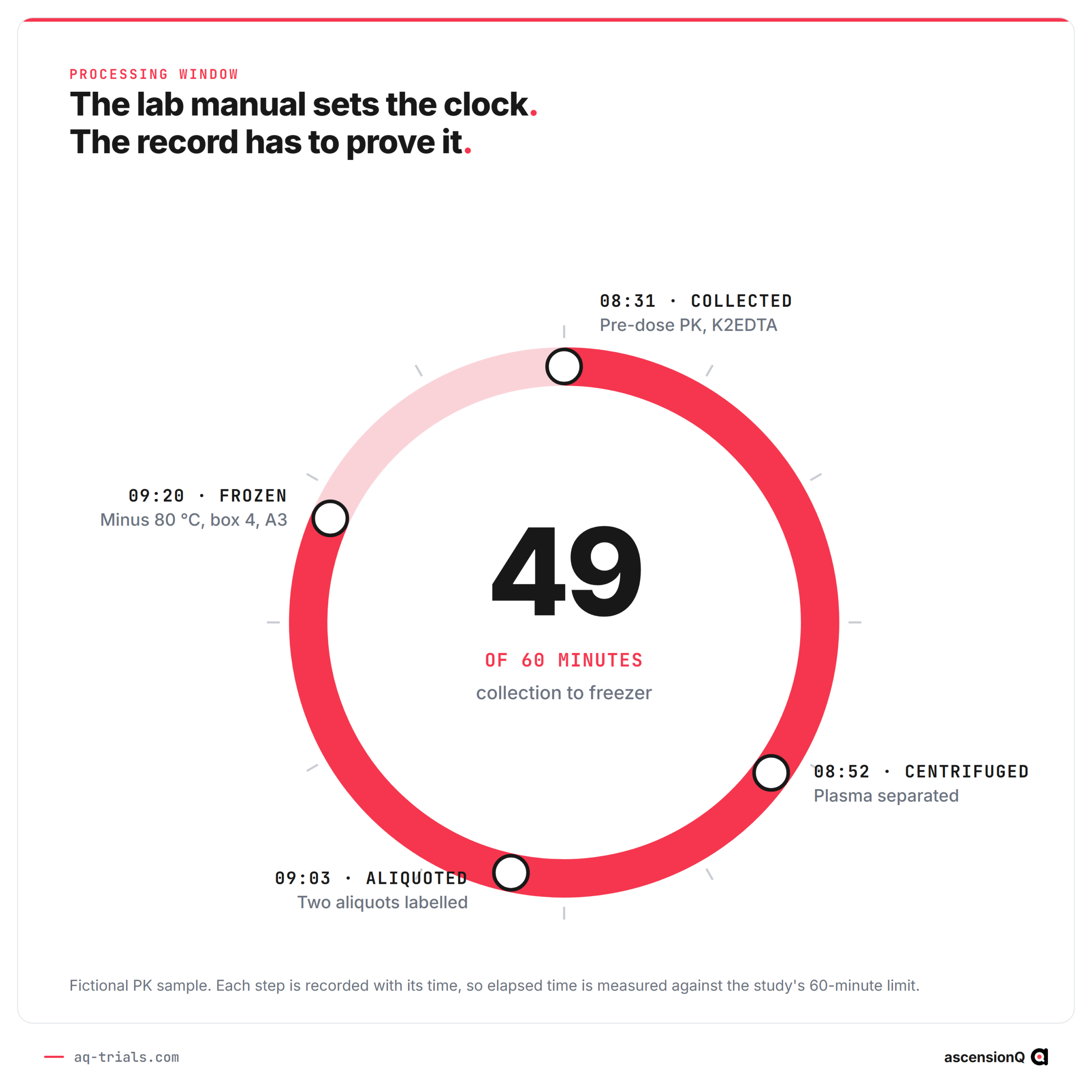
Samples are among the most time-critical records a site produces. A pharmacokinetic (PK) sample may have a 30-minute collection window, a 60-minute freezing limit and a single chance to be taken. Most of the evidence that it was handled correctly lives in logs, spreadsheets and portals that nobody reviews until a laboratory raises a query or a monitor asks to see it.
This guide covers the full sample lifecycle at a UK research site: what it includes, who is involved, which samples a site manages, where it goes wrong, which regulations apply, how needs differ by setting, and how to measure it. Each stage links to a detailed guide.
What Does Clinical Trial Sample Management Include?
Sample management covers nine workflows across three stages. The sponsor’s lab manual defines the requirements for each one, and the site turns them into steps at the bench.
| Stage | Workflow | What the site controls |
| Before the visit | Lab set-up | The sample schedule per visit, taken from the current lab manual version |
| Before the visit | Collection supplies | Kits and tubes received, in date and reserved against booked visits. See lab kit management in clinical trials. |
| Before the visit | Visit readiness | Supplies, a trained collector and a courier confirmed for each visit |
| At the bench | Collection and processing | Order of draw, collection time, centrifuge settings and time against the study limit |
| At the bench | Storage | Freezer, box and position, time placed and temperature record |
| At the bench | Shipments | Packaging category, refrigerant, manifest and courier handover |
| After the laboratory | Laboratory queries | Every query answered from the sample record and closed |
| After the laboratory | Result review | Investigator assessment of out-of-range safety results, where the protocol requires it |
| After the laboratory | Reconciliation | The final status of every sample: analysed, stored, returned or destroyed |
One thread runs through all nine workflows: the chain of custody, an unbroken record of who handled each sample, when, where and under which condition. Our guide to clinical trial sample tracking sets out what that record needs at every step.
Who Is Involved in Sample Management at a Research Site?
Sample handling crosses several roles, and each one sees a different part of the record. The principal investigator remains responsible for the site’s trial records and delegates the tasks below.
| Role | Typical sample tasks |
| Research nurse | Collects samples at the visit in order of draw and records collection times |
| Laboratory technician | Processes, aliquots, stores and packs samples within the study’s limits |
| Study coordinator | Manages kits, books couriers, answers laboratory queries and keeps the lab manual current |
| Principal investigator | Reviews safety results and records clinical significance; oversees delegated tasks |
| R&D and quality assurance | Check processes, deviations and inspection readiness across studies |
| Sponsor monitor | Verifies sample records against source and the laboratory’s data |
Each delegated task needs training on the current lab manual and an entry on the delegation log. A sample record signed by someone who was never delegated the task fails at inspection, however well the sample was handled.
Which Samples Does a Research Site Manage?
A single study often sends samples to more than one laboratory under different rules. The site’s record needs to hold all of them in one place.
| Sample type | Destination | What makes it demanding |
| Pharmacokinetic (PK) samples | Central or bioanalytical laboratory | Tight timing against the dose; processing and freezing limits |
| Biomarker and exploratory samples | Central or specialist laboratory | Multiple aliquots; long-term storage; consent for future use |
| Safety bloods | Local NHS laboratory or central laboratory | Hospital request process; investigator review of results |
| Genetic samples | Specialist laboratory | Separate consent; restricted access to identifiable data |
| Archival tissue | Pathology, then central laboratory | Retrieval from the hospital archive; return or retention decisions |
Central laboratories keep their own portals for ordering and results. Local NHS laboratories use the hospital’s systems. The site still needs its own complete view of sample activity across every study and laboratory.
Where Does Clinical Trial Sample Management Go Wrong?
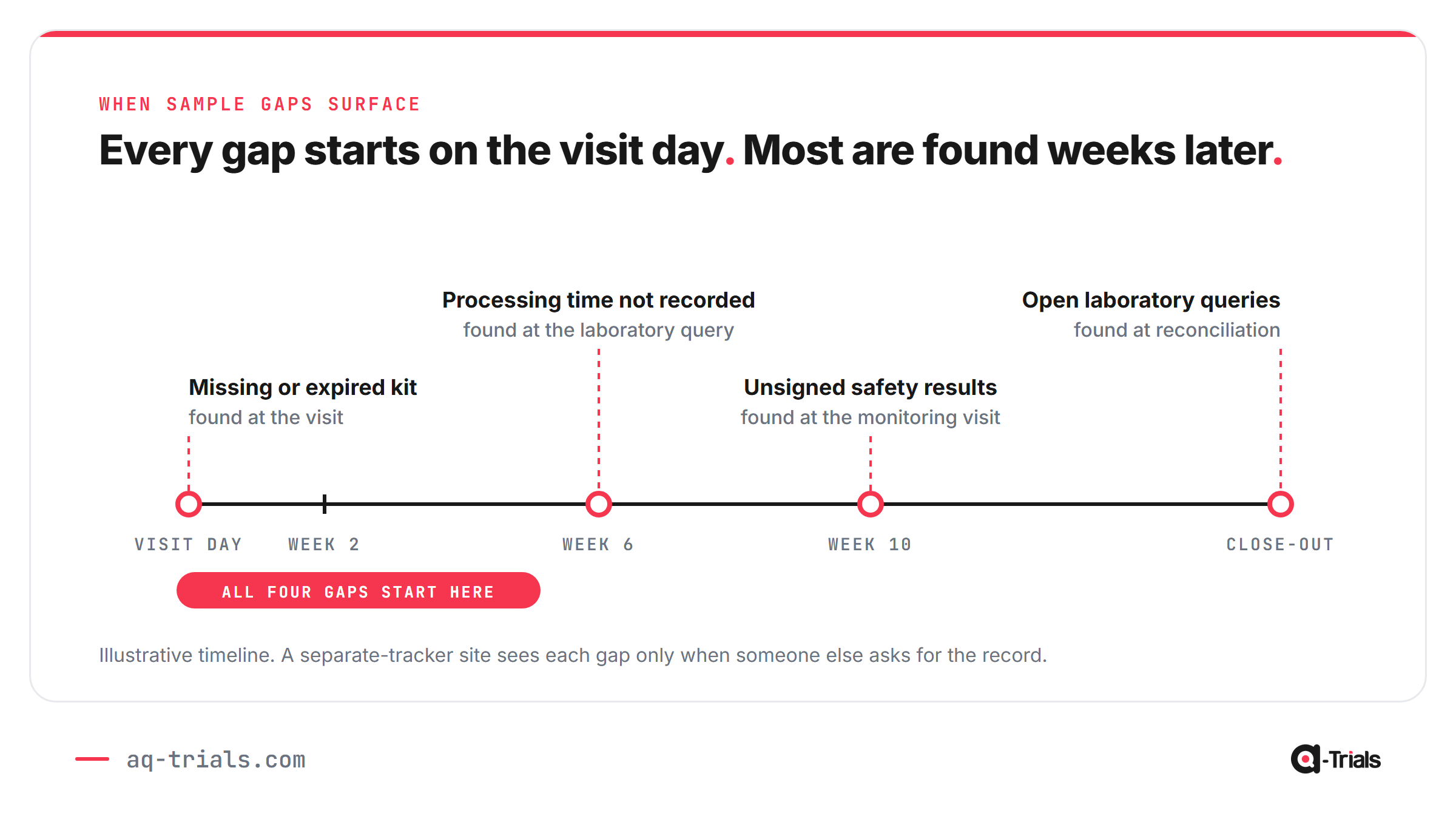
Each study brings its own collection schedule, processing limits and laboratory requirements. Separate supply logs, handling records and laboratory portals make outstanding work hard to see and handling hard to evidence. Four gaps recur, and each is found late.
| Gap | What happens | When it is usually found |
| Supply availability and expiry | A kit is missing or expired for a planned collection | On the day of the visit |
| Incomplete processing records | A processing or freezing time was never written down | When the laboratory raises a query |
| Outstanding laboratory queries | Queries sit unanswered across several studies | At reconciliation |
| Delayed result review | Safety results wait for an investigator signature | At the monitoring visit |
Every one of these gaps exists on the day it starts. The record shows it weeks later.
Also Read: MHRA GCP Inspection Common Findings
Separate Trackers Compared With One Sample Record
The central choice in sample management is where the record lives. Many sites run each study on its own trackers. A controlled site keeps one record of every sample across every study and laboratory.
| Aspect | Separate trackers per study | One sample record for the site |
| Daily view | Each coordinator checks their own spreadsheets | Visits, samples due, shipments and reviews in one worklist |
| Supplies | Cupboard counts and expiry checked on the day | Kits reserved against booked visits; expiry visible in advance |
| Processing evidence | Times written on paper logs, sometimes later | Times recorded at the step, against the study limit |
| Storage | Freezer maps kept apart from processing records | Storage position held on the sample record |
| Queries | Answered by searching several records | Answered from the sample’s own history |
| Oversight | R&D sees problems at monitoring visits | Open actions visible across all studies at any time |
What Regulations Apply to Sample Management in the UK?
UK sites work to the frameworks that govern every trial record, plus rules specific to human tissue and to transport.
| Framework | What it asks of the site’s sample records |
| ICH E6(R3) Good Clinical Practice | Complete, attributable and retrievable records; investigator oversight of delegated tasks |
| ALCOA+ data integrity | Sample records kept as source data: attributable, contemporaneous, original, accurate and complete. See what source data is. |
| MHRA GCP inspections | Sample handling reviewed as part of the site’s essential records and data integrity |
| Human Tissue Act 2004 and the HTA codes of practice | Consent, storage, retention and disposal of relevant material in England, Wales and Northern Ireland; Scotland has separate legislation |
| IATA Dangerous Goods Regulations | Packaging and labelling for UN3373 Biological Substance, Category B, and for dry ice |
| UK GDPR | Restricted access to identifiable participant information on requests and labels |
Laboratory documents belong in the site file too: laboratory certificates, reference ranges, lab manual versions and shipment manifests. See the ISF essential documents checklist.
How Do Sample Management Needs Differ by Research Setting?
The lifecycle is the same everywhere. The pressure points differ by setting.
- NHS trust R&D departments run many studies with different central laboratories alongside the hospital’s own laboratory, which makes a single site-wide view of samples the main need. See AQ for NHS hospital research.
- Phase 1 units handle dense PK schedules, often dozens of timed samples per participant per day, which makes processing timers and missed-limit flags essential. See clinical trial software for Phase 1 units.
- Clinical research delivery centres (CRDCs) collect at spoke sites and process at a hub, which puts the chain of custody under strain at every transfer. See what a CRDC is.
- Early-phase oncology teams combine PK, biomarker and archival tissue samples with long follow-up, which makes retention and consent decisions frequent.
- CROs and site networks need the same standard at every site, which makes one shared sample process more valuable than local trackers. See AQ for site management organisations and AQ for CROs.
How Should a Site Measure Sample Management?
A handful of measures show whether sample management is under control. Each one turns a late-found gap into an early signal.
| Measure | What it shows |
| Samples processed within the study limit (%) | Whether bench workflows match the lab manual |
| Booked visits with a reserved, in-date kit (%) | Whether supply problems will reach the bedside |
| Laboratory queries open for more than 30 days | Whether the site can answer from its own record |
| Safety results awaiting investigator review for more than 5 working days | Whether oversight keeps pace with results |
| Kits expired unused per quarter | Whether stock is rotated and ordered to demand |
| Samples with a final status at study close (%) | Whether reconciliation is complete |
Missed limits and storage excursions that recur belong in the quality system as deviations with root-cause analysis. See managing deviations in clinical research.
What Should a Site Look for in Sample Management Software?
Software helps when it records the work as it happens and connects samples to the rest of the study record. Useful questions for any system:
- Does it build the sample schedule from the lab manual and the booked visit, so staff see what is due without a separate worklist?
- Does it record each handling step with the person, time, location and condition, so the chain of custody is complete?
- Does it track samples for every laboratory the site works with, including the local NHS laboratory?
- Does it link sample records to delegation, training and the investigator site file?
- Does it support UK requirements such as the Human Tissue Act, UK hosting and the NHS Data Security and Protection Toolkit?
How Does AQ Labs Support Clinical Trial Sample Management?
AQ Labs is the lab sample management software within AQ Platform, built for UK and NHS research sites. It turns each sponsor’s lab manual into defined steps at the bench and keeps one record of every sample until it is analysed, stored or destroyed, across all nine workflows.
- A visit booked in the study calendar creates the participant’s sample list, which sets the schedule before the visit opens. See AQ CTMS.
- Collection supplies are scanned in with lot and expiry and reserved against booked visits, which keeps expired kits away from the bedside.
- Processing timers show the time remaining against the study’s limit, which flags a missed limit for assessment and documented follow-up.
- Local NHS laboratory samples are tracked alongside central-laboratory samples, which gives the site one view of its own sample activity.
- Consent withdrawal, retention and destruction decisions are recorded per sample, with destruction under two-person control and a certificate.
Laboratory certificates, reference ranges, manifests and signed result reviews link to the AQ eISF site file as work is completed, and deviations reach AQ QMS. AQ Labs is priced and deployed as its own module. Book a live demo to see one sample followed from the booked visit to the laboratory result.
Frequently Asked Questions
What is clinical trial sample management?
Clinical trial sample management is how a research site plans, collects, processes, stores, ships, reconciles and disposes of the biological samples a study requires, following the sponsor’s lab manual and UK regulation.
What is a lab manual in a clinical trial?
A lab manual is the sponsor’s or central laboratory’s instruction document for a study’s samples. It sets which samples are taken at each visit, in which tubes, how quickly they are processed, at what temperature they are stored and how they are shipped.
What is the difference between a central laboratory and a local laboratory?
A central laboratory analyses samples from every site in a study to one standard, under the sponsor’s contract. A local laboratory, usually the hospital’s own NHS laboratory, analyses samples such as safety bloods under the hospital’s request process.
Does the Human Tissue Act apply to clinical trial samples?
The Human Tissue Act 2004 governs consent for, and storage of, relevant material in England, Wales and Northern Ireland, including many trial samples. Licensing exemptions can apply to material held for a specific research project with recognised ethics approval. Scotland has separate legislation.
Who is responsible for trial samples at a research site?
The principal investigator is responsible for the site’s trial records and delegates sample tasks to trained staff, usually research nurses, laboratory technicians and study coordinators, each recorded on the delegation log.