Clinical trial sample tracking is the record of every biological sample a study requires, from the sponsor’s lab manual through collection, processing, storage, shipment and laboratory receipt, until the sample is analysed, stored long term or destroyed. A complete record answers four questions at every step: who handled the sample, when, where, and under which condition.
The test of that record usually arrives weeks after the visit. A central laboratory asks whether sample 301-014-W12-PK1 reached minus 80 °C within the 60 minutes the lab manual allows. The research nurse remembers the visit. The processing log shows the centrifuge time. The freezer map shows the box position. None of them shows the time the tube went into the freezer, so the site can describe what probably happened and cannot evidence it.
This guide sets out what sample tracking covers, what chain of custody means for a trial sample, where tracking breaks down at research sites, what UK regulation and good clinical practice expect, and what a sound process records at each step. It forms part of our guide to clinical trial sample management.
What Does Clinical Trial Sample Tracking Cover?
Sample tracking covers the full life of a sample at the site, and each stage produces evidence that a monitor, a laboratory or an inspector may ask to see. The sponsor’s lab manual defines the requirements: which samples, at which timepoints, in which tubes, processed how quickly, stored at which temperature and shipped to which laboratory.
| Stage | What the site records | Evidence it produces |
| Set-up | Sample schedule per visit, taken from the current lab manual version | A defined list of samples and limits for every timepoint |
| Collection supplies | Kit and tube lot numbers and expiry dates, reserved against booked visits | Proof that in-date supplies were used |
| Collection | Participant, timepoint, tube, collector and collection time | The start of the chain of custody |
| Processing | Centrifuge settings, aliquot count, processor and time against the study limit | Proof that the sample met the processing window |
| Storage | Freezer or fridge, box and position, time placed, temperature record | A location for every aliquot at every point in time |
| Shipment | Manifest, packaging category, refrigerant, courier handover time | A matched list of what left the site and what the laboratory received |
| Laboratory queries | Query, response, person responding and supporting record | A closed loop for every discrepancy |
| Result review | Investigator assessment of out-of-range safety results, where the protocol requires it | Signed evidence of investigator oversight |
| Reconciliation and disposal | Final status of every sample: analysed, stored, returned or destroyed | A closed account at study close-out |
Two sample types usually run side by side. Research samples such as pharmacokinetic (PK) plasma or biomarker aliquots go to a central laboratory named in the lab manual. Safety samples such as full blood counts often go to the local NHS laboratory under the hospital’s own request process. Both belong in the site’s tracking record.
What Is Chain of Custody for a Clinical Trial Sample?
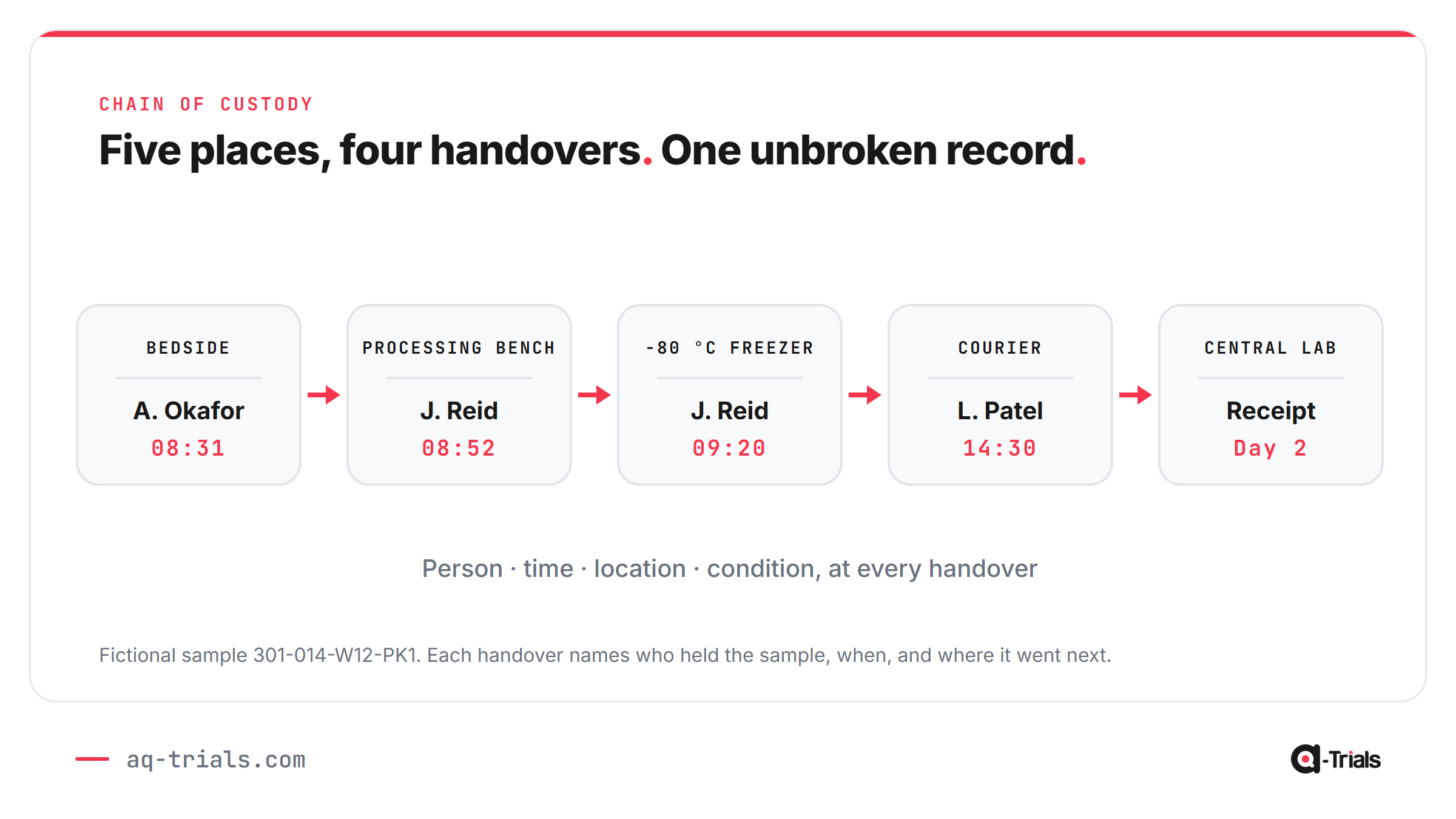
Chain of custody is the unbroken, attributable record of every handover and every change of state a sample goes through. Each entry names a person, a time, a location and a condition. A gap anywhere in the chain means the site cannot show that the sample analysed is the sample collected, handled as the protocol required.
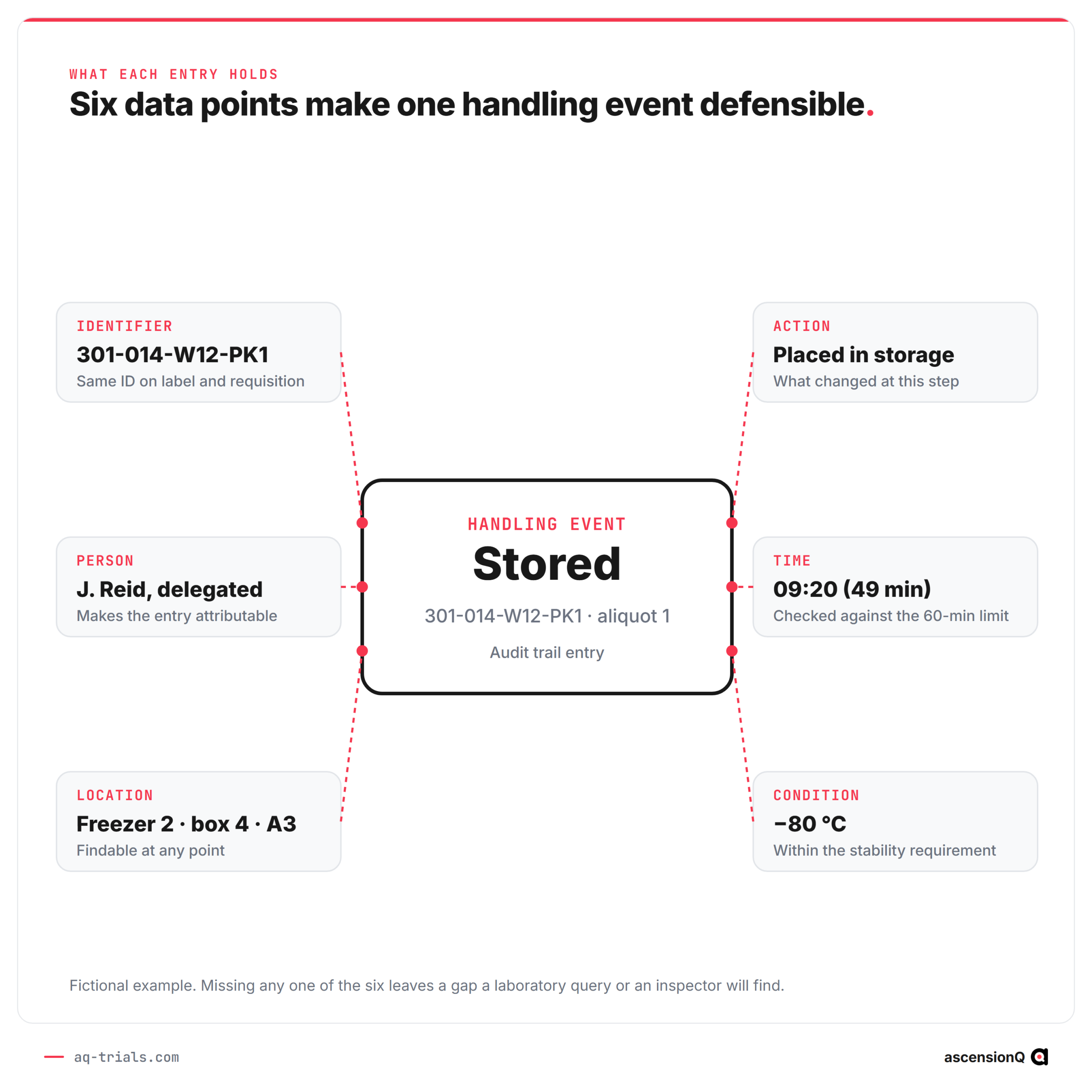
Each handling event in the chain should carry six data points:
- Sample identifier, matching the label and the requisition, which allows the laboratory and the site to refer to the same tube without ambiguity.
- Action (collected, processed, aliquoted, stored, moved, packed, handed to the courier, received), which shows what changed at that point.
- Person, a named and delegated member of staff, which makes the entry attributable under ALCOA+.
- Time, recorded as the event happened, which allows elapsed time to be checked against the processing and storage limits.
- Location (bedside, processing bench, freezer and position, courier), which shows where the sample was at every point.
- Condition (ambient, 2 to 8 °C, minus 20 °C, minus 80 °C, dry ice), which shows the sample stayed within its stability requirement.
The same principles apply to every original record at the site. Sample handling records are source data in their own right.
Also Read: What Is Source Data in a Clinical Trial?
Where Does Sample Tracking Break Down at Research Sites?
Sample tracking fails between records. A typical site holds the same sample across five places: a paper processing log at the bench, a spreadsheet of aliquots, a freezer map, a courier email and the central laboratory’s portal. Each record is accurate for its own step. None of them holds the whole chain.
The worked example below is fictional. It follows one PK sample through a site that tracks by separate records.
| Time | Step | Where it was recorded | What is missing |
| 08:31 | Collected, pre-dose | Paper processing log | Nothing at this step |
| 08:52 | Centrifuged and aliquoted | Aliquot spreadsheet | Who processed it |
| Not recorded | Placed in the minus 80 °C freezer | Freezer map (position only) | The time it was frozen |
| 14:30 | Collected by courier | Email to the study coordinator | Which aliquots were in the box |
| Day 2 | Received by the central laboratory | Laboratory portal | Link back to the site record |
Six weeks later the laboratory asks whether the sample met its 60-minute freezing limit. The site holds four records, and the one fact that matters sits in none of them.
The sample was probably handled correctly. Probably is the one answer a laboratory query cannot accept.
The same pattern produces four recurring gaps, each found late:
- Supply availability and expiry, often found on the day of the visit, when a kit turns out to be expired or missing.
- Incomplete processing records, found when the laboratory raises a query.
- Outstanding laboratory queries, found at reconciliation, often months after the visit.
- Delayed result review, found at the monitoring visit, when unsigned safety results surface.
Reconstructed Records Compared With Records Made at the Bench
The central difference is timing. A reconstructed record is assembled after the event from memory and partial logs. A bench record is made as the work happens, by the person doing it, against limits the record already knows.
| Aspect | Reconstructed from separate logs | Recorded at the bench on one record |
| Timing | Times written up later or estimated | Event time captured as the step is completed |
| Processing limits | Checked by the processor against a printed lab manual | Elapsed time shown against the study limit, with a missed limit flagged |
| Storage | Freezer map updated separately from the processing log | Storage position recorded as part of the same sample record |
| Shipment | Manifest typed from the spreadsheet, handover noted by email | Manifest built from the samples scanned into the box |
| Laboratory queries | Answered by searching several records | Answered from the sample’s own history |
| Monitoring and inspection | Reconciliation before every monitoring visit | Status visible at any time, with an audit trail |
What Do UK Regulations and GCP Expect From Sample Records?
The expectation for site sample records comes from the frameworks that govern every trial record, plus specific rules for human tissue and for transport.
- ICH E6(R3) Good Clinical Practice requires records that are attributable, complete and retrievable, and investigator oversight of tasks delegated to the site team. The guideline is published on the ICH efficacy guidelines page.
- ALCOA+ data integrity applies to sample records as source data: attributable, legible, contemporaneous, original and accurate, plus complete, consistent, enduring and available.
- MHRA GCP inspections look at laboratory sample handling as part of the site’s essential records. The MHRA sets out its approach in its good clinical practice guidance.
- The Human Tissue Act 2004 governs consent for, and storage of, relevant material in England, Wales and Northern Ireland, with separate legislation in Scotland. The Act and the Human Tissue Authority’s codes of practice set the rules for consent, retention and disposal.
- Transport rules classify most trial samples as UN3373, Biological Substance, Category B, and dry ice as a dangerous good in its own right. Couriers apply the IATA Dangerous Goods Regulations for air transport.
Inspectors tend to test the same thing in different ways. They pick a sample from the laboratory’s data and ask the site to show its journey. A site that can do that in minutes demonstrates control.
Also Read: MHRA GCP Inspection Common Findings
What Should a Sample Tracking Process Record at Each Step?
A sound process turns the lab manual into defined steps and records each one as it happens. The checklist below sets the minimum a site should be able to show for any sample.
Before the visit
- The sample schedule for each timepoint comes from the current lab manual version, which keeps the bench instructions aligned with the sponsor’s requirements after every amendment.
- In-date collection supplies are reserved against the booked visit, which removes the risk of discovering an expired kit at the bedside. See lab kit management in clinical trials.
- The collector and processor are trained on the current lab manual and delegated the task on the delegation log, which makes every later entry attributable to an authorised person.
At the bench
- Collection time, tube and collector are recorded at the bedside, which starts the chain of custody at the true event time.
- The processing record holds the centrifuge settings, aliquot count and elapsed time against the limit, which shows compliance or flags a deviation at once.
- Storage records the unit, box, position and time placed, which gives every aliquot a findable location.
- A temperature excursion in a storage unit identifies every sample stored there and holds them until the sponsor’s decision is recorded, which stops affected samples being shipped by mistake.
After the laboratory
- The shipment manifest is built from the samples packed, and the courier handover time is recorded, which gives the laboratory and the site the same list.
- Laboratory queries are answered from the sample’s own history and closed with the response recorded, which leaves no open query at reconciliation.
- Out-of-range safety results reach the investigator for a recorded assessment of clinical significance, which evidences oversight.
- Consent withdrawal, retention and destruction decisions are recorded against each affected sample, in line with the consent given, the protocol and the Human Tissue Act where it applies.
Also Read: Temperature Excursion SOP for Clinical Trials
How Does Sample Tracking Connect to the Rest of the Study Record?
Sample handling depends on records held elsewhere at the site. The visit date, the staff authorisation and the site file all shape whether a sample record holds up.
| Record | What it contributes to sample tracking |
| Study calendar and visit schedule | The booked visit and its window, which set the sample timepoints. See clinical trial management software. |
| Delegation log and training records | Proof that the collector, processor and reviewer were trained and authorised on the current lab manual |
| Investigator site file | Laboratory certificates, reference ranges, lab manual versions and shipment manifests. See the electronic investigator site file and the ISF essential documents checklist. |
| Source documents | Collection and processing times recorded at the visit. See ALCOA+ for eSource. |
| Deviation and quality records | Missed processing limits and excursions, assessed and closed. See managing deviations in clinical research. |
What Are the Risks of Incomplete Sample Records?
The risks fall on the data, the participant and the site’s standing with the sponsor.
- A sample that cannot be shown to meet its processing or storage limit may be excluded from analysis, and the participant’s contribution at that timepoint is lost.
- Repeated laboratory queries consume coordinator and nurse time that the study budget rarely covers.
- Unsigned safety results point to a gap in investigator oversight at the next monitoring visit or inspection.
- Samples held after consent withdrawal, or beyond their approved retention, create a legal exposure under human tissue legislation.
- A sponsor that sees frequent sample queries may weigh them in feasibility for the next study.
Phase 1 units and early-phase oncology teams feel these risks most, because dense PK schedules put many timed samples into a single day. See clinical trial software for Phase 1 units.
How Does AQ Labs Support Clinical Trial Sample Tracking?
AQ Labs is the lab sample management module of AQ Platform. It records every sample from the sponsor’s lab manual through collection supplies, collection, processing, storage, shipment and laboratory queries to result review where the study requires it, on the same record as the site file.
- A visit booked in the study calendar creates the participant’s sample list for that timepoint, which sets the schedule from the lab manual before the visit opens.
- Staff see the samples due in order of draw, and processing timers show the time remaining against the study’s limit, which flags a missed limit for assessment and documented follow-up.
- Each handling step records the person, event time and location, which keeps the chain of custody complete from collection to laboratory receipt.
- Shipments are built by scan and the manifest is linked to the site file at courier handover, which gives the site and the laboratory the same list.
- A storage excursion identifies every sample in the affected unit and places them on hold until the sponsor’s decision is recorded per sample.
AQ Labs works alongside central-laboratory portals, hospital laboratory systems, couriers and temperature monitoring systems. It gives the site one record of its own sample activity across all of them, and it can be adopted on its own or with the rest of AQ Platform. Book a live demo to see a sample followed from the scheduled visit to the laboratory result.
Frequently Asked Questions
What is clinical trial sample tracking?
Clinical trial sample tracking is the record of every biological sample a study requires, from the lab manual through collection, processing, storage, shipment and laboratory receipt, until the sample is analysed, stored long term or destroyed. It shows who handled each sample, when, where and under which condition.
What does chain of custody mean for a trial sample?
Chain of custody is the unbroken record of every handover and change of state, each entry naming a person, a time, a location and a condition. It allows the site to show that the sample analysed is the sample collected, handled as the protocol required.
Who is responsible for sample tracking at a research site?
The principal investigator holds overall responsibility for the site’s trial records. Day-to-day entries are made by delegated staff, usually research nurses, laboratory technicians and study coordinators, each trained on the current lab manual.
Are sample handling records source data?
Yes. Collection times, processing times and storage records are original records of trial activity, so they are source data and follow ALCOA+ principles like any other source record.
What happens to stored samples when a participant withdraws consent?
The site records the withdrawal and its scope, identifies every affected sample wherever it is held, and stops further collection. Decisions on stored samples follow the consent given, the protocol and the Human Tissue Act where it applies. Samples already analysed cannot be withdrawn.