A temperature excursion puts the affected investigational medicinal product (IMP) into quarantine at once. The site then reconstructs the full excursion window from the monitoring record and reports it to the sponsor, who decides whether the stock stays usable. What should a site do after an IMP temperature excursion? The sequence below, in order.
The pharmacy owns the first forty minutes. The sponsor owns the disposition decision. Most of the inspection risk sits in the gap between the two, where stock keeps moving while nobody has written anything down.
What Counts as a Temperature Excursion?
A temperature excursion is a confirmed departure from the storage condition the sponsor specified for that product. The condition itself travels with the product on three surfaces. The label carries “any special storage precautions” under regulation 46(1)(g)(iv) of the Medicines for Human Use (Clinical Trials) Regulations 2004, in the Part 7 text substituted on 28 April 2026 by S.I. 2025/538. The sponsor sets the numbers. ICH E6(R3), adopted on 6 January 2025, states at section 3.15.2(b) that the sponsor “should determine acceptable storage temperatures, storage conditions” and should inform all involved parties, including pharmacists. Section 2.10.5 puts the matching duty on the site: the investigational product “should be stored as specified by the sponsor”.
Four events get called an excursion in daily use, and they attract different first actions. The procedure keeps the response proportionate by separating them at the point of detection.
| Event | What it is | First action at the site |
| Alarm | A monitoring device reports a reading outside its set limit | Read the device and confirm the reading against the minimum and maximum record |
| Excursion | A confirmed departure from the specified storage condition | Quarantine the affected stock and open the excursion record |
| Protocol deviation | An excursion that affects product issued to a participant or a protocol requirement | Record it in the deviation log and assess it against regulation 29A |
| Serious breach | A breach likely to affect participant safety or the scientific value of the trial to a significant degree | Report to the sponsor at once, who then has seven days to notify the licensing authority |
An alarm is evidence of a reading, not yet evidence of an excursion. The MHRA Inspectorate addressed the transient case directly in its guidance on refrigerated medicinal products, published on 26 January 2016, advising that “best practice would be to take a further reading later the same day” to confirm that conditions have returned within parameters. The confirmation step belongs in the procedure. The quarantine step runs first regardless, because an unconfirmed reading and a real excursion look identical for the first few minutes.
Two adjacent cases sit outside this guide. An excursion found on arrival belongs to the receipt check, covered in receipt and quarantine at UK sites. The content of the storage record itself, including how ALCOA+ applies to temperature data, is set out in the investigational product storage records checklist.
The Eight Steps After an Excursion Is Found
The sequence below is the operational core of the procedure. Each step leaves one record, and each record is the thing an inspector asks for later. Steps one to five belong to the site alone and run before any contact with the sponsor.
| Step | Who | Action | Record left behind |
| 1. Stop the stock | Whoever finds it | Move the affected units out of the usable balance and label them as quarantined | Quarantine entry with date, time and kit numbers |
| 2. Read the device | Whoever finds it | Capture the current, minimum and maximum readings before resetting anything | Device reading with the time it was taken |
| 3. Bound the window | Delegated pharmacy staff | Establish the start time, the end time, the duration and the extreme reading | Excursion window with its source data |
| 4. Identify the stock | Delegated pharmacy staff | List every kit held in that location during the window, across all studies affected | Affected stock list by kit number |
| 5. Check what left | Delegated pharmacy staff | Identify any unit dispensed or administered during the window | Dispensing record cross-check |
| 6. Report | Named reporter in the SOP | Send the window, the readings and the stock list to the sponsor contact | Dated report with its attachments |
| 7. Hold | Pharmacy | Keep the stock quarantined until the sponsor’s written decision arrives | Sponsor decision in writing, filed |
| 8. Close the loop | Quality lead | Complete the deviation record, open a CAPA where the cause is systemic, file everything | Deviation and CAPA references on the excursion record |
Step five is the step sites skip. An excursion that touched only stock still on the shelf is a stock problem. An excursion that touched a unit already given to a participant is a safety question, and it changes who needs to know and how fast. The dispensing cross-check is what separates the two, and it takes minutes while the records are fresh.
Step seven has one rule with no exceptions. Stock stays out of the usable balance until a written decision arrives. A verbal release on a phone call is not a decision a site can evidence twelve months later.
The excursion is an event. The finding is stock that kept moving while the question was still open.
Also Read: IMP Accountability in Clinical Trials: A Complete Guide for UK Pharmacy Teams
Where Does the Decision Branch?
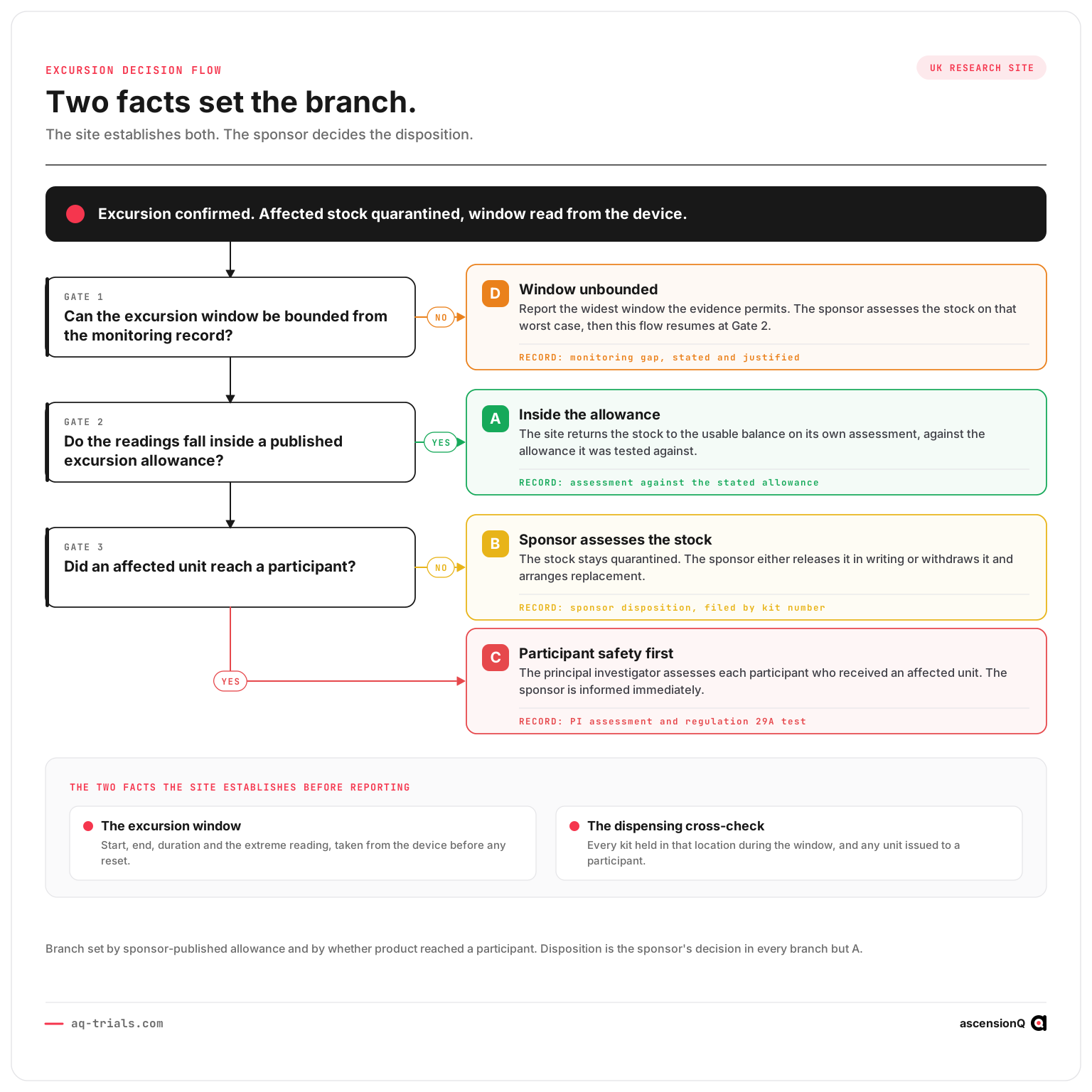
The eight steps run the same way every time. The outcome then splits four ways, and the branch is set by two facts: whether the readings fall inside an allowance the sponsor has already published, and whether any affected unit reached a participant. The site determines both facts. The sponsor decides the disposition, as set out in the storage records guide.
- Branch A, inside a published allowance. Some protocols carry a permitted excursion allowance, stated as a cumulative time above or below the range. Readings inside that allowance return the stock to the usable balance on the site’s own assessment, recorded against the allowance it was tested against.
- Branch B, outside the allowance, nothing dispensed. The stock stays quarantined and the sponsor assesses it. Two outcomes follow: the sponsor releases the stock in writing, or the sponsor withdraws it and arranges replacement. The site records whichever arrives.
- Branch C, outside the allowance, product already given. Participant safety runs first. The principal investigator assesses the clinical implication for each participant who received an affected unit, and the sponsor is informed immediately rather than within the routine reporting window. The regulation 29A test applies here.
- Branch D, the window cannot be bounded. A monitoring gap, a flat battery or a device reset leaves a period with no data. The site reports the widest window the evidence permits, and the sponsor assesses on that worst case. A site that reports only the observed portion of an unbounded window has reported a window it cannot defend.
Branch D produces most of the avoidable product loss. A fridge with continuous monitoring and an intact download gives a window of a few hours. The same fridge with a monitoring gap over a weekend gives a window of sixty hours, and the sponsor has to assess the stock against sixty hours of unknown conditions. The difference lies entirely in the monitoring record, and it is decided long before the excursion happens.
What Does the Site SOP Need to Contain?
ICH E6(R3) Principle 11.6 expects “appropriate processes” for the handling, shipping, storage, dispensing, returning and destroying of investigational product. The procedure below turns that expectation into eight sections a UK research pharmacy can write and an inspector can test.
| SOP section | The decision it fixes in advance | Evidence it generates |
| 1. Scope | Which products and which storage locations the procedure covers | Location list, reviewed at each study set-up |
| 2. Roles | Who monitors, who quarantines, who reports and who signs the disposition | Named roles reconciled to the delegation log |
| 3. Conditions and alarm settings | The specified range per study and the alarm thresholds set against it | Per-study condition record and device settings |
| 4. Detection and first actions | The stop-the-stock rule and the order of the first three steps | Quarantine entry and the initial device reading |
| 5. Reporting route and timing | The sponsor contact and the deadline the protocol sets | Dated report with a delivery confirmation |
| 6. Quarantine and segregation | Where quarantined stock physically sits and how the system blocks it | Segregation record and a blocked system balance |
| 7. Disposition | What the site may act on, and that written authority is required | Sponsor decision filed against the kit numbers |
| 8. Deviation, CAPA and review | When an excursion escalates and how often the procedure is reviewed | Deviation reference, CAPA reference, review record |
Section 2 carries the most weight. The person who finds an excursion at seven in the morning is often not the person named in the procedure, and the SOP has to say what that person does in the meantime. Quarantine is the safe default, available to anyone on the delegation log for IMP handling. Every other action waits for the named role.
Section 3 is where multi-study pharmacies lose control. One fridge holds stock for several studies with different specified ranges, so a single reading can be an excursion for one product and within range for another. The per-study condition record is what lets the pharmacy answer that in one pass. The wider documentation set is covered in what belongs in a clinical trial pharmacy site file.
When Does a Temperature Excursion Become a Serious Breach?
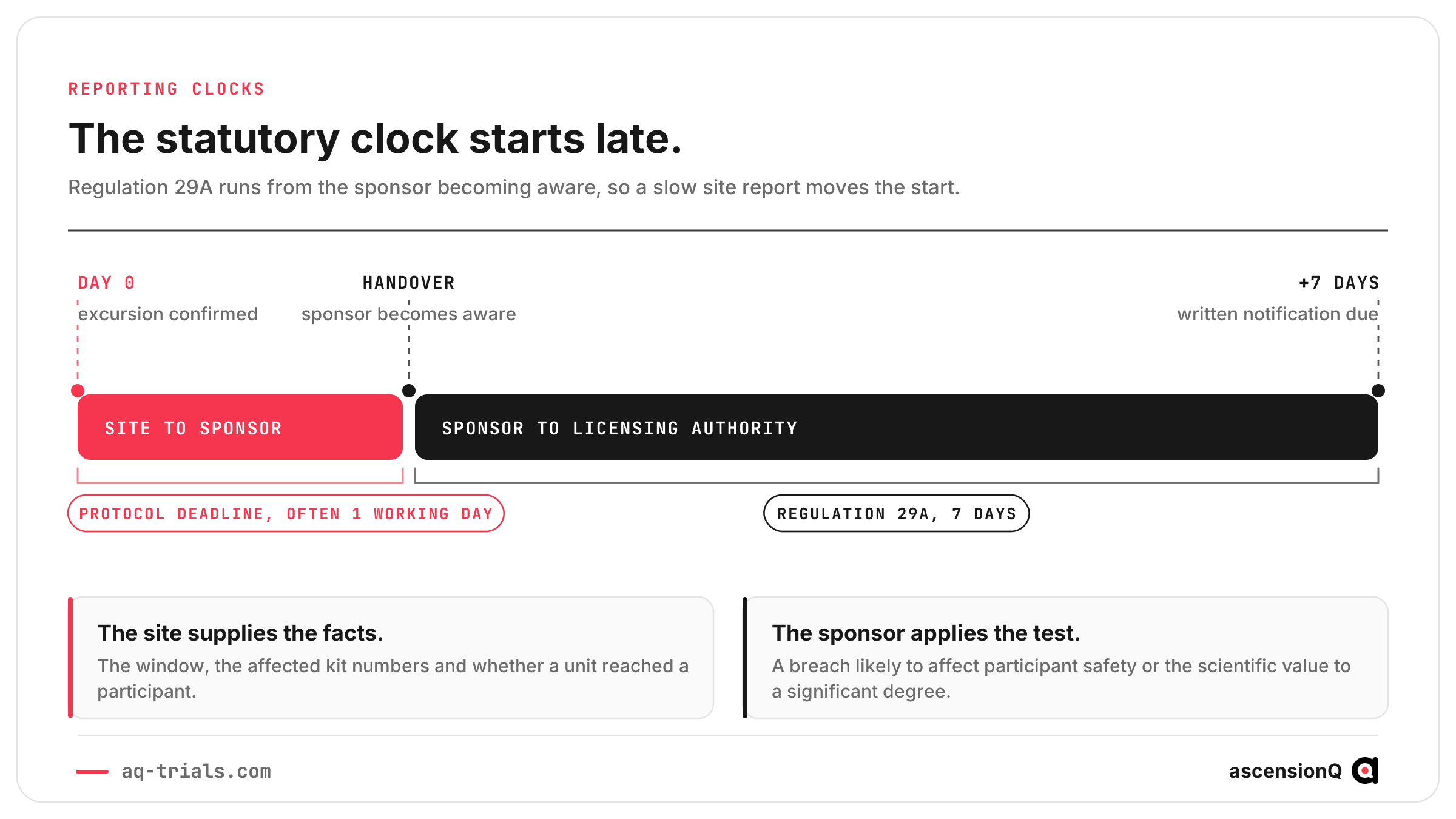
Most excursions are deviations and stay deviations. A minority meet the statutory test. Regulation 29A requires the sponsor to notify the licensing authority in writing of any serious breach of the conditions and principles of good clinical practice or of the protocol, “within 7 days of becoming aware of that breach”. Regulation 29A(2) defines a serious breach as one “likely to effect to a significant degree” either the safety or physical or mental integrity of the participants, or the scientific value of the trial. The regulation was amended on 28 April 2026 by S.I. 2025/538.
Three facts move an excursion towards that test.
- An affected unit reached a participant. The question becomes one about a dose of uncertain quality rather than about stock on a shelf.
- The excursion is one of a repeating set. A fourth excursion in the same fridge in a quarter speaks to the control system rather than to one event.
- The affected stock covers a material share of the study’s participants at that site. Scientific value enters the assessment once the quantity is large enough.
The seven-day clock belongs to the sponsor and starts when the sponsor becomes aware of the breach. The site’s own reporting deadline runs before it and is set by the protocol, commonly within one working day. A site that reports late delays the start of the statutory clock and leaves the sponsor assessing an event that is already old, which is the practical reason the reporting timing belongs in the SOP rather than in someone’s judgement. Repeat excursions and their corrective actions are handled through the quality system, covered in CAPA software for NHS research.
Also Read: MHRA GCP Inspection: The Most Common Findings
Where Does the Excursion Record Break?
The procedure fails in five recognisable places. Each one is visible in the records a clinical trial pharmacy site file inspection requests.
- The window has one timestamp. The record shows when the alarm was noticed and nothing about when the excursion started, so the sponsor assesses against an unknown duration and withdraws stock that was probably fine.
- The release is verbal. A monitor confirms by phone that the stock is fine, the pharmacy returns it to the balance, and the file holds no written authority. The stock is usable and the record cannot show why.
- The quarantine is physical only. Affected kits move to a marked shelf while the system balance still counts them as available, so a second member of staff dispenses from a quarantined batch in good faith.
- The dispensing cross-check is missing. Nobody establishes whether an affected unit reached a participant, so a potential safety question is handled as a stock question and the regulation 29A assessment never happens.
- The excursion and the CAPA sit apart. The excursion closes in the pharmacy record and the recurring root cause closes in the quality system, with no reference linking them, so the fourth excursion in the same fridge still reads as a first.
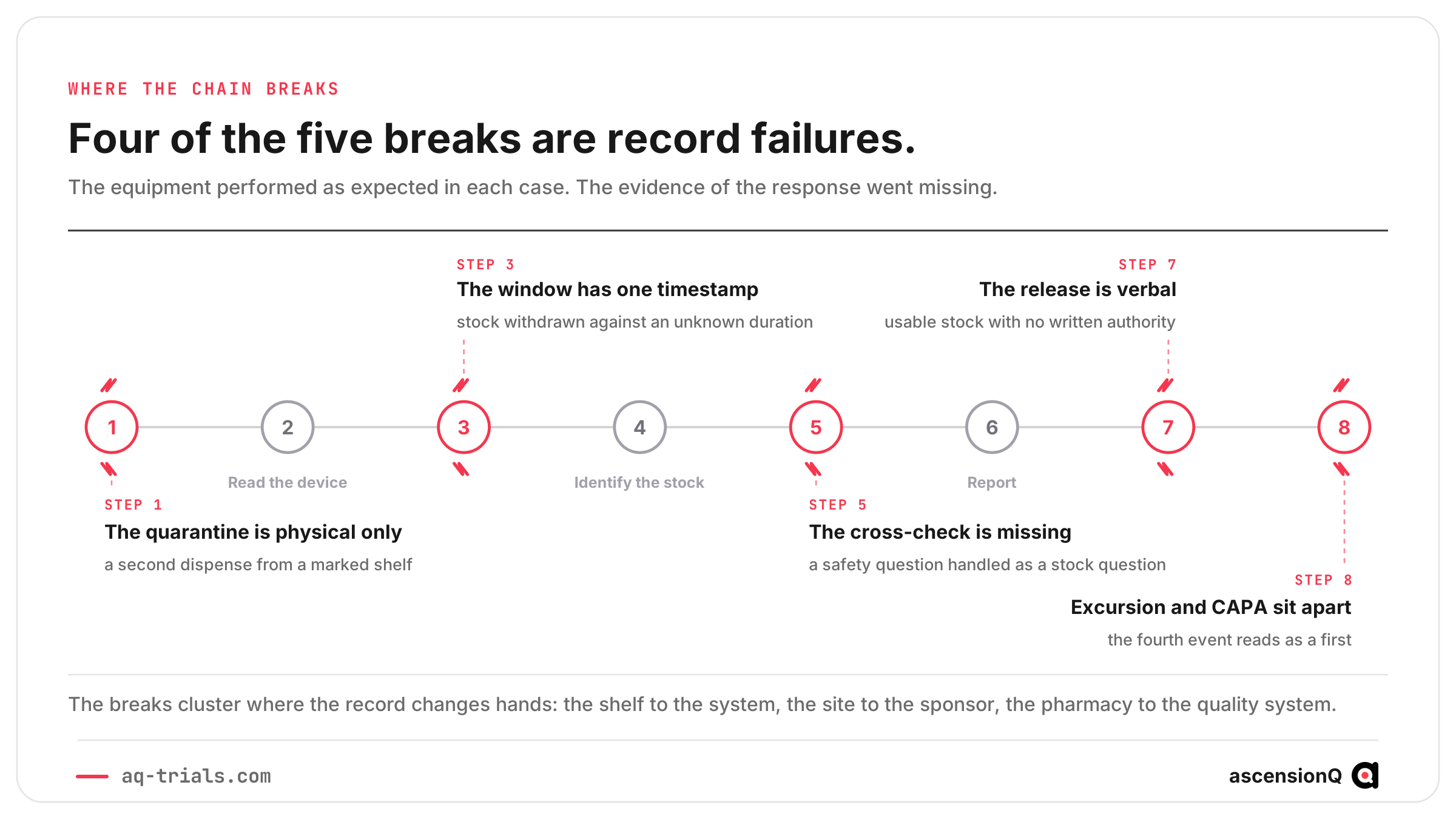
Four of the five are record-keeping failures rather than cold-chain failures. The equipment performed as expected in each case. The evidence that the site responded correctly is what went missing.
How Does AQ Pharmacy Support the Excursion Decision Flow?
AQ Pharmacy holds the site’s IMP record at kit level, so quarantining a storage location moves every affected kit out of the usable balance in the same action and blocks dispensing against it until a named person records the disposition. The dispensing cross-check runs against the same record, which returns the list of units issued during the excursion window rather than requiring a manual search across the accountability log.
The excursion record, the deviation and the corrective action stay linked across AQ QMS and AQ CAPA, so a repeating root cause in one storage location is visible as a pattern rather than as four unrelated events. Every entry is attributed to a named person in the audit trail, and AQ’s AI proposes and flags while a named person reviews and confirms each decision.
AQ is built for UK research sites and is validated to GxP standards with every release, covering IQ, OQ and PQ with a 21 CFR Part 11 and EU Annex 11 assessment. The platform is UK-hosted, holds NHS DSPT Standards Met (2026) and Cyber Essentials certification, and applies ISO 27001-aligned controls.
- A quarantine action on a storage location returns every affected kit number across every study held there, in one pass.
- The dispensing cross-check returns the participants who received an affected unit inside the excursion window, which sets the branch the response follows.
- The sponsor’s written disposition files against the kit numbers it covers, so the accountability balance and the excursion record reconcile without a manual step.
A live walkthrough shows a quarantine action moving a batch out of the usable balance, the dispensing cross-check returning the affected participants, and the disposition filed against the kit numbers. Book a live demo to see the excursion flow inside the connected pharmacy record.
Frequently Asked Questions
What should a site do after an IMP temperature excursion?
Quarantine the affected stock before anything else, then read the device and capture the current, minimum and maximum values. Establish the start and end of the excursion window, list every kit held in that location during it, and check whether any unit was dispensed. Report all of this to the sponsor and hold the stock until a written decision arrives.
How long does a site have to report a temperature excursion to the sponsor?
The protocol sets the deadline, and one working day is common. The site deadline runs before the sponsor’s statutory seven-day clock, which starts when the sponsor becomes aware of a serious breach under regulation 29A. Late site reporting delays the start of that clock, so the timing belongs in the SOP as a fixed figure.
Does every temperature excursion have to be reported to the MHRA?
No. Most excursions are deviations recorded in the site’s own quality system. The sponsor notifies the licensing authority only where the event meets the regulation 29A(2) test of a breach likely to affect participant safety or the scientific value of the trial to a significant degree. The sponsor makes that assessment, and the site supplies the facts it rests on.
What does a site do when the excursion window cannot be bounded?
Report the widest window the evidence permits. A monitoring gap, a flat battery or a device reset leaves a period with no data, and the sponsor has to assess the stock against that whole period. A report covering only the observed portion understates the exposure and leaves the site with a window it cannot defend at inspection.
Can a site keep dispensing from a fridge that has alarmed?
The pharmacy stops dispensing the affected stock until the reading is confirmed or the sponsor’s decision arrives. An unconfirmed alarm and a real excursion are indistinguishable at the moment of detection, so quarantine is the safe default. Stock in other locations, under confirmed conditions, continues as normal.
Where is the temperature excursion record filed?
The excursion record is filed in the clinical trial pharmacy site file for the study, with the deviation record in the site’s quality system and a cross-reference between them. The sponsor’s written disposition is filed against the affected kit numbers so the accountability record and the excursion record reconcile.