An MHRA inspector looks in a pharmacy site file for evidence that the site can rebuild the history of any unit of investigational medicinal product on demand, from the delivery that brought it into the building to the signature that released it. The file is read as proof rather than as folders. An inspector selects a study, a participant and a kit, then asks for every record that unit touched, in the version of the procedure in force when each entry was made.
This guide covers how a pharmacy learns an inspection is coming, what an inspector requests and in what order, the walkthrough, the thread an inspector pulls through the file, how findings are graded, and what makes a file ready. The pharmacy record sits inside the wider duty set out in the complete guide to IMP accountability in clinical trials.
- The MHRA notifies an organisation before a planned inspection and requests a GCP inspection dossier, returned within 30 days.
- An inspector works from the system level down to a single unit, so the file is tested by its weakest entry.
- Findings are graded critical, major or other, and a critical finding is referred to the GCP Inspection Action Group.
- Retrieval speed is part of the evidence, because a record produced slowly reads as a record that was reconstructed.
How Does a Pharmacy Learn an Inspection Is Coming?
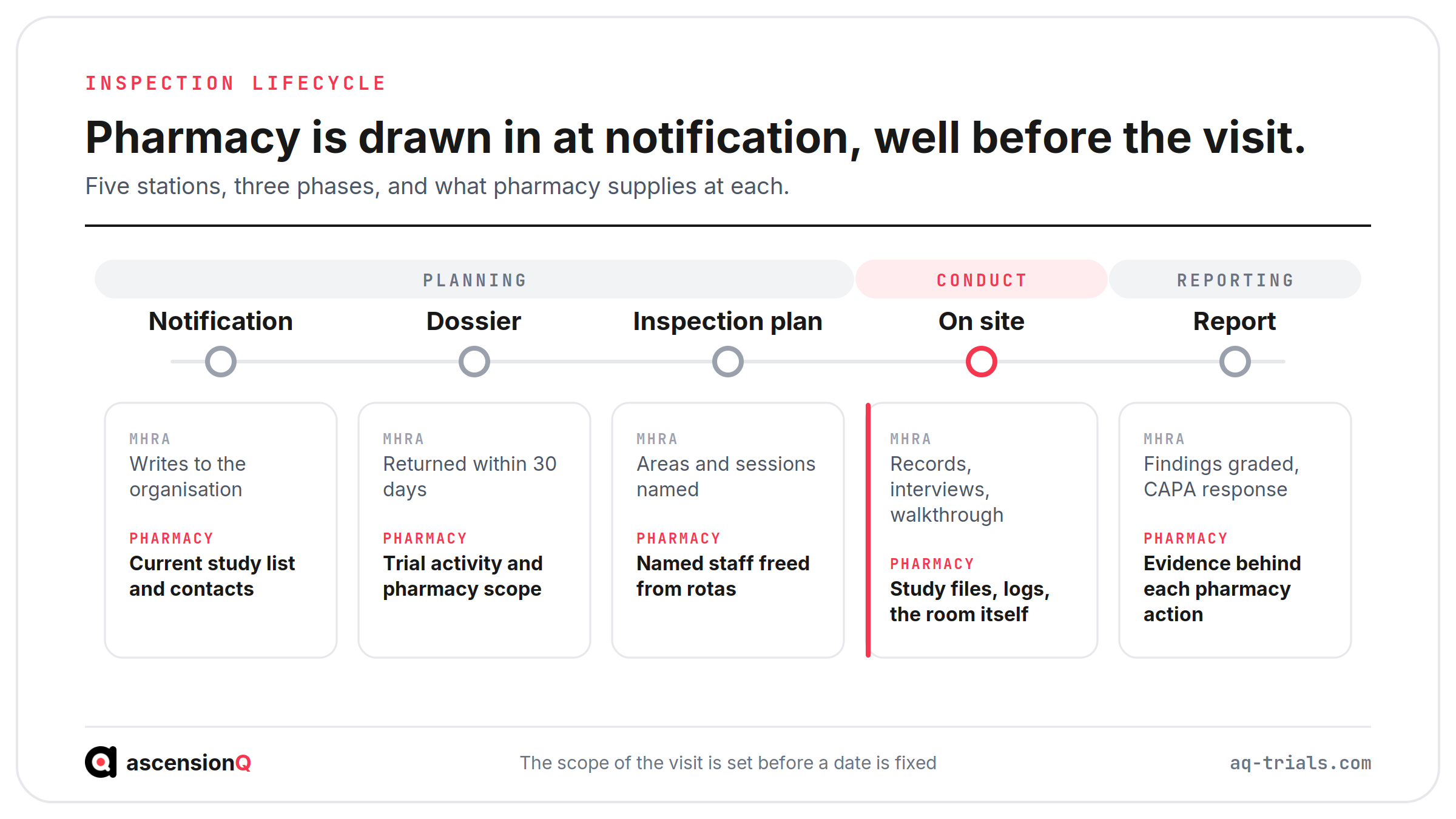
A pharmacy learns an inspection is coming through the organisation that holds the notification, usually the research and development office, and the trial pharmacy is drawn in during the planning phase. The MHRA states that it will notify an organisation being considered for inspection “unless the inspection is to be conducted without notice”. The notification carries a request for a GCP inspection dossier and a clinical trials spreadsheet, which the organisation returns within 30 days.
The MHRA uses that return to decide whether an inspection is required and which areas to examine, so pharmacy activity shapes the scope before any date is fixed. The lead inspector then issues an inspection plan in advance, except for short-notice and no-notice inspections, where the state of the file on an ordinary Tuesday becomes the state of the file at inspection.
- The dossier fixes the scope. It lists the organisation’s trial activity, which lets the inspector choose studies with features they want to test, such as blinded supply or a cold-chain product.
- The inspection plan names the sessions. It sets out the areas to be examined, which lets pharmacy identify who must be available for interview and free them from clinical rotas.
Preparation changes what is found. It does not change what happened.
What Does an Inspector Request from Pharmacy, and in What Order?
An inspector requests pharmacy records in descending order of scale, from the systems that govern all studies, to the file for one study, to the records behind one unit of product. A strong system with a broken unit-level entry still produces a finding, because the entry is the evidence and the system is only the explanation.
| Level | What is requested | What it has to prove |
|---|---|---|
| 1. The pharmacy and its people | Department structure, trial pharmacy SOPs with version history, staff acknowledgements, training records, the delegation log and the signature sample | That a current written procedure governed the work, and that each signatory was authorised and trained at the time |
| 2. The study | The pharmacy site file for the selected studies, with protocol and amendment versions, the pharmacy manual, the label sample and the technical agreement | That pharmacy held the study’s instructions in the version applicable on each date |
| 3. The product | Receipt records against packing lists, the accountability log, prescriptions, dispensing entries, returns counts and destruction certificates | That every unit received is accounted for in one place |
| 4. The environment | Temperature records for storage and transit, calibration certificates, and the decisions taken after any excursion | That stock stayed within its conditions, or that the departure was investigated |
| 5. The exceptions | Pharmacy protocol deviations, the deviation log, and corrective actions from a previous inspection or audit | That the site detects its own problems and closes them |
Level 1 is answered from standing records that serve every study. Levels 2 to 5 come from the study file itself, and the twelve-section structure holding them is set out in what belongs in a pharmacy site file. The conditions behind a single signature are covered in delegation and training records for pharmacy.
Also Read: What Belongs in a Pharmacy Site File?
What Happens on the Pharmacy Walkthrough?
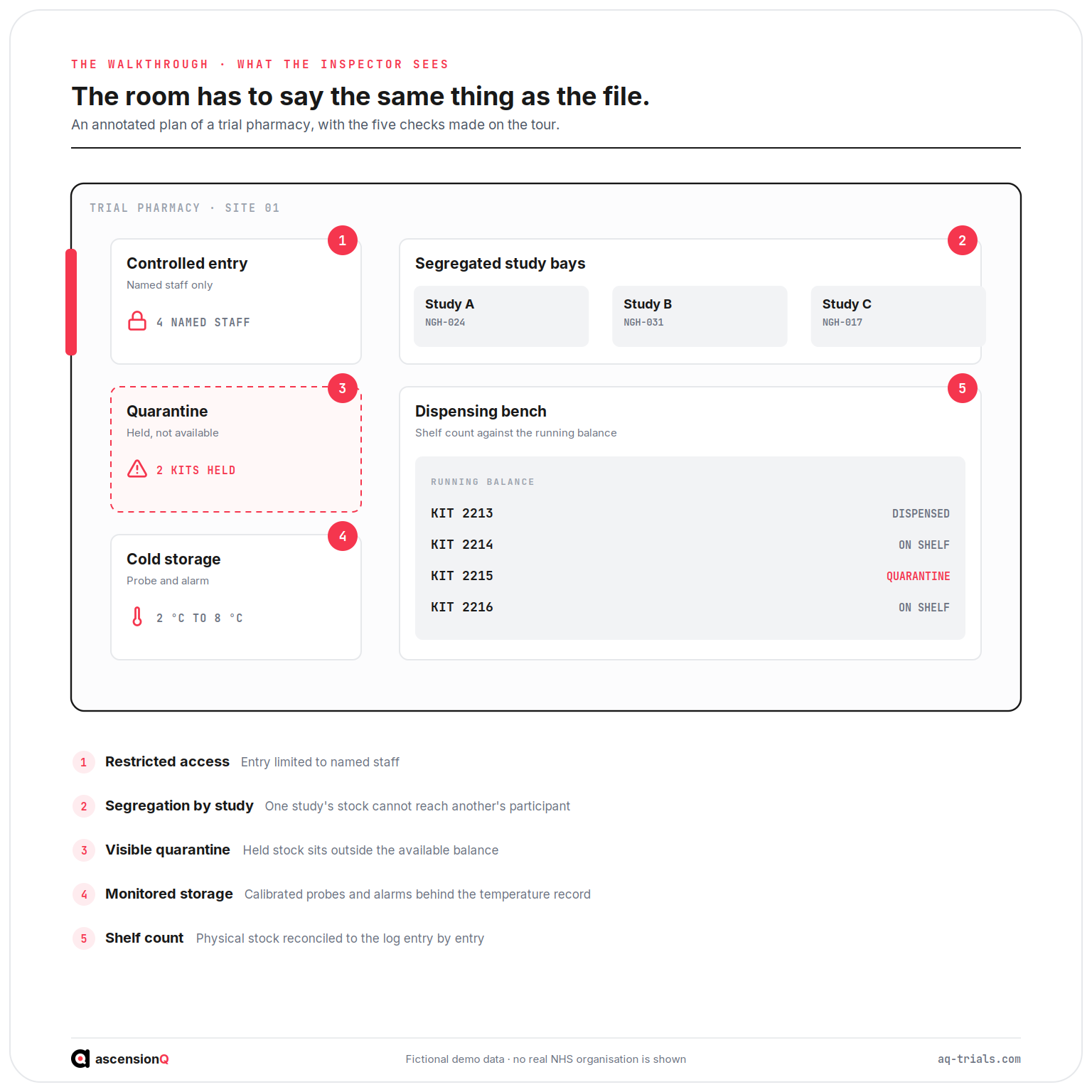
The pharmacy walkthrough tests whether the room agrees with the file. An inspector compares the written procedure against what is physically in front of them, so a tidy file beside an untidy shelf produces the same finding as a wrong entry. Five things are usually covered.
- Restricted access. Trial stock sits behind a control limiting entry to named staff, which supports the claim that only authorised people handled it.
- Segregation by study. Each study’s stock is held separately and labelled, which stops one study’s kit reaching another study’s participant. Storage areas carry calibrated probes and alarms.
- A visible quarantine area. Stock awaiting release, or held after an excursion, sits apart, which keeps the available balance honest.
- The code break arrangement. The emergency unblinding route is available and testable in the pharmacy, which shows the site can unblind without delay.
- The shelf count. Physical stock is counted against the running balance in the log, which closes the loop between the record and the room.
Storage carries the heaviest record set of the five, and those records, their integrity and the excursion workflow sit in the investigational product storage records checklist. The code break route and the record each unblinding leaves are covered in blinding and unblinding in the pharmacy.
Which Thread Does an Inspector Pull Through the File?
An inspector pulls one unit of product through the whole file and watches where the thread breaks. The request is narrow and the answer has to be wide, because one kit touches the receipt record, the prescription, the dispensing entry, the delegation log, the training file, the returns count and the final disposition. A complete file and a reconstructable record are different things, and the gap between them is where pharmacy findings live.
| Aspect | A file that satisfies a monitoring visit | A record that satisfies an inspection |
|---|---|---|
| Scope of the question | One study, reviewed section by section | One unit, traced across every section at once |
| Version control | The current procedure is filed | The procedure in force on each entry date can be produced |
| Timing | The balance is correct today | Each entry was made when the action happened |
| Attribution | Entries are signed | Each signatory was delegated and trained on that date |
| Retrieval | Records are found within the visit window | Records are produced while the inspector waits |
A hypothetical trace shows the shape of it. At Riverside CRF, an inspector takes study NGH-024 and asks for kit 2213, dispensed to participant 024-007. The accountability log produces the entry in under a minute, and the prescription comes back from the clinic within the hour. The signatory appears on the delegation log, and the training record for the dispensing SOP is dated three weeks after the dispense. Every number reconciles, and the finding stands, because the authority behind the entry arrived after it.
The count was right. The authority arrived late.
The log format decides how fast that trace runs, and the comparison of paper accountability logs against an electronic pharmacy record sets out the retrieval and correction differences. Why pharmacy documentation is held apart from the investigator site file is covered in why pharmacy documentation needs its own file.
How Are MHRA Inspection Findings Graded?
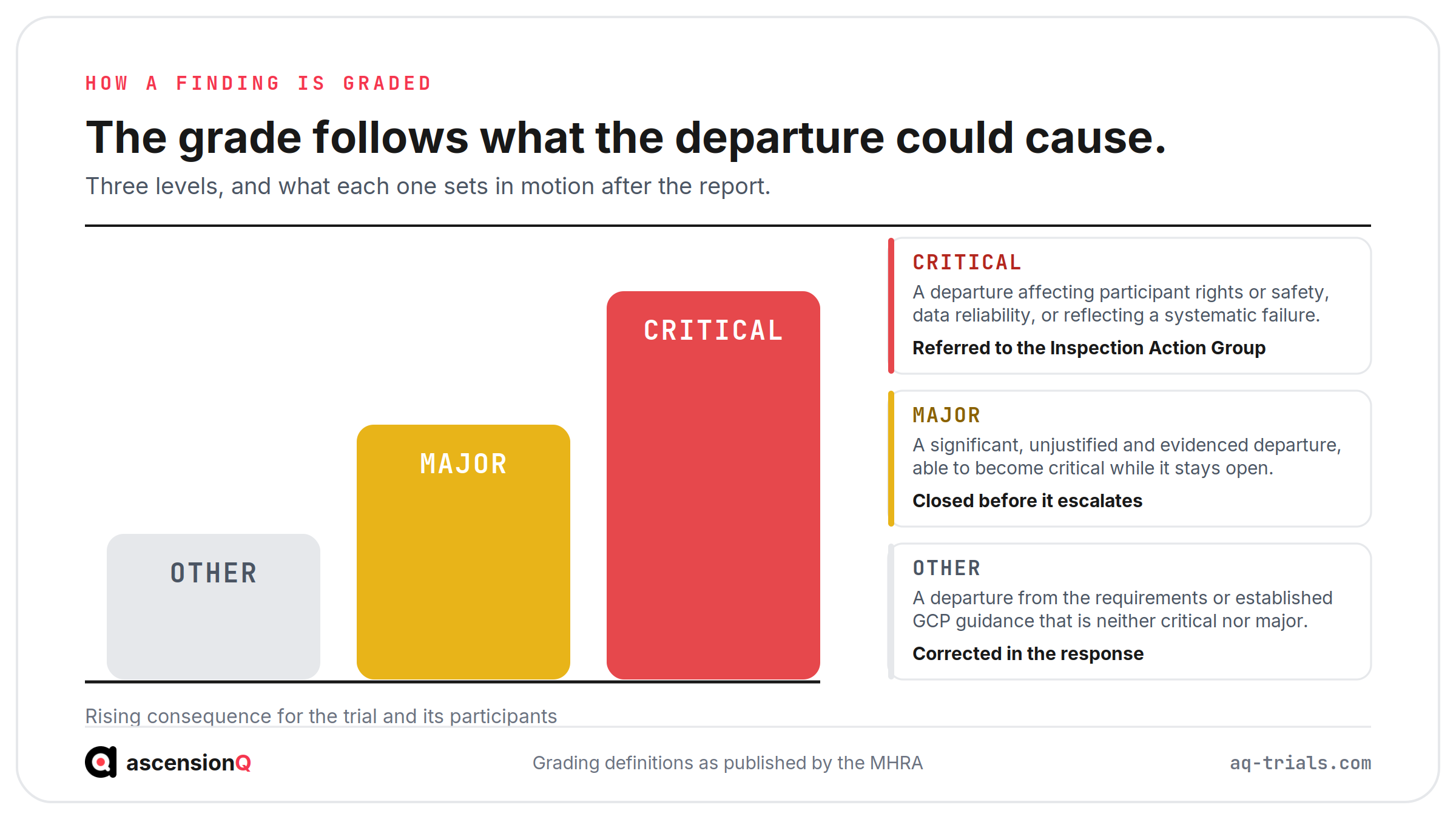
MHRA inspection findings are graded at three levels, and the grade follows the consequence of the departure rather than the number of records involved. The inspector gives a verbal summary at the end of the inspection, the written report follows, and the organisation responds with a corrective and preventive action plan. It is usually given one opportunity to provide additional information or clarification.
- Critical. A significant and unjustified departure from the legislative requirements that affects the rights, safety or wellbeing of participants, affects the reliability of the trial data, or reflects a systematic quality failure across multiple major findings. Critical findings are referred to the GCP Inspection Action Group.
- Major. A non-critical finding where evidence shows a significant and unjustified departure has occurred, with the potential to become critical while it stays open.
- Other. A departure from the legislative requirements or from established GCP guidelines that is neither critical nor major.
One weak pharmacy entry rarely reaches critical on its own. The same weakness repeated across studies reaches it more easily, because the grade responds to the systemic reading. The findings the MHRA publishes across all inspected areas sit in the guide to the most common MHRA GCP inspection findings.
Also Read: The Most Common MHRA GCP Inspection Findings
What Makes a Pharmacy File Inspection-Ready?
A pharmacy file is inspection-ready when any single unit can be traced through it in minutes, by someone who did not make the entries. Readiness is a property of the record, built during the study rather than before the visit. Six habits produce it.
- Make the log entry part of the action. The entry is written at the point of dispensing, which keeps the record contemporaneous under the MHRA GXP data integrity guidance.
- Keep a dated version history for every procedure. The file can then say which SOP governed an entry made eighteen months ago.
- Date the delegation and the training together. Authority and competence are then provable for the day of the entry.
- Document the investigation behind every difference. A closed discrepancy with a written reason reads as control, and a corrected number with no explanation reads as a gap.
- Index the file by kit and by participant. A request is then answered from the index rather than from memory.
- Route systemic weaknesses into the quality system. A repeated failure handled through the site’s quality management system produces the self-detection evidence an inspector asks for.
The ICH E6(R3) section 2.10 duties the file has to evidence are taken clause by clause in what E6(R3) requires of IMP management at the site, and the national pharmacy review completed before approval is covered in HRA Technical Assurance for pharmacy and radiation. The MHRA does not approve site systems. It inspects the records those systems produce.
Frequently Asked Questions
What does an MHRA inspector look for in a pharmacy site file?
Evidence that the site can rebuild the history of any unit of IMP on demand, from the delivery that brought it into the building to the signature that released it.
How are MHRA inspection findings graded?
At three levels, and the grade follows the consequence of the departure rather than the number of records involved.
What makes a pharmacy file inspection-ready?
Any single unit can be traced through it in minutes by someone who did not make the entries. Readiness is built during the study rather than before the inspection.
An inspection reads pharmacy records as one strand of a site’s evidence, alongside the investigator site file and the study record. AQ’s electronic pharmacy site file page sets out where pharmacy documentation sits in that picture, and a live demo walks through how AQ holds site evidence today.