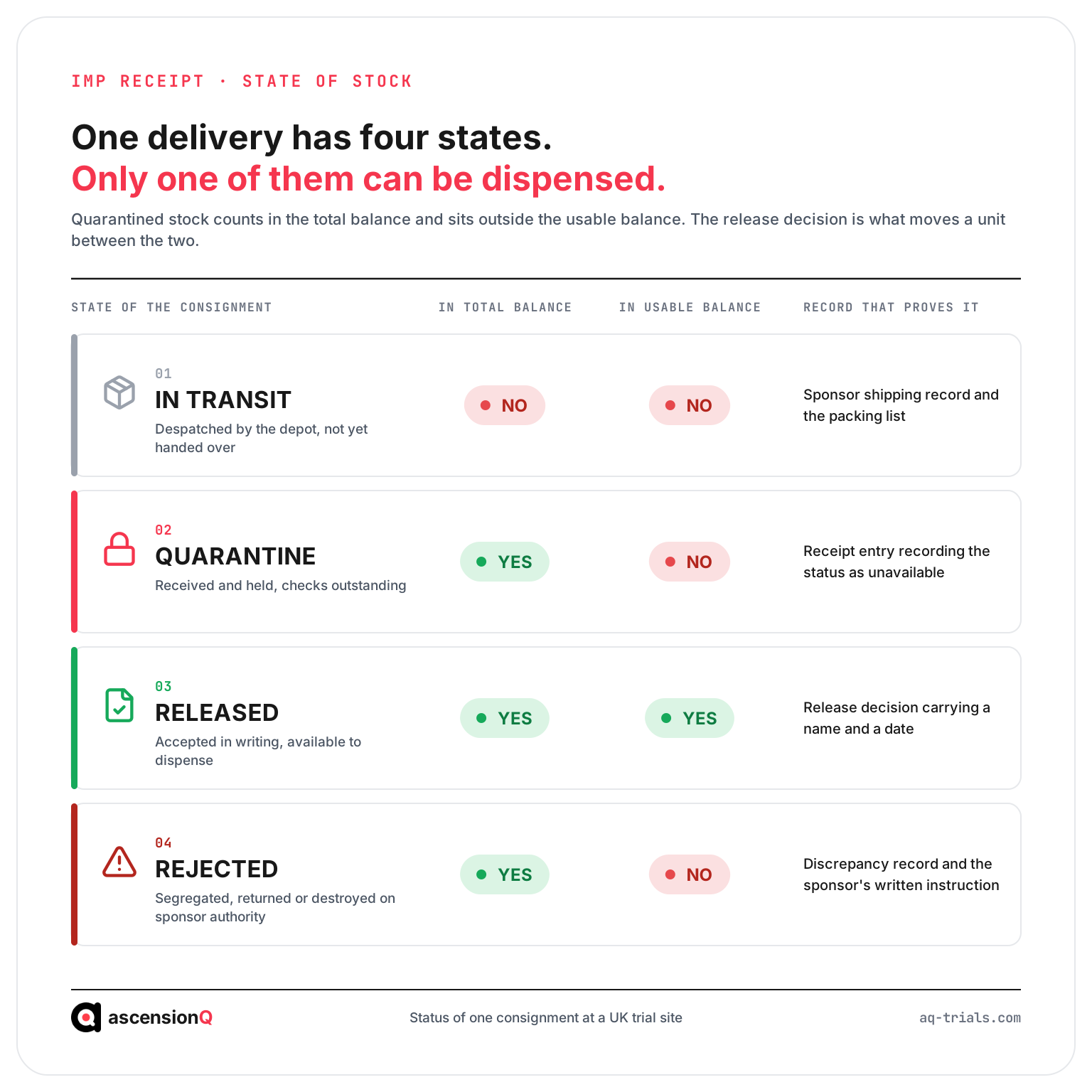
Every delivery of investigational medicinal product is locked on arrival and stays locked until a named member of pharmacy staff completes the receipt check and records a release decision. The lock is quarantine. Quarantine is a documented status rather than a physical place, and it holds the stock outside the usable balance until an authorised person accepts it in writing.
This guide covers the receipt sequence, the check against the packing list, the batch and expiry data captured per unit, the transit temperature record, quarantine, the named release decision and the grounds for rejection. It sits under the guide to IMP accountability in clinical trials.
- Quarantined stock counts in the total balance and sits outside the usable balance.
- ICH E6(R3) section 2.10.4 requires the delivery record to carry dates, quantities, batch or serial numbers and expiry dates.
- The release decision is a personal act by a delegated and trained individual, and an unresolved discrepancy keeps the stock in quarantine until the sponsor instructs the site in writing.
- The MHRA GCP Inspectorate has recorded a critical finding where medication was dispensed despite quarantine.
What Happens When an IMP Delivery Arrives?
An IMP delivery moves through six steps between the courier handover and the stock becoming available. Each step leaves its own entry in the pharmacy record. Responsibility for all six rests with the investigator or institution under ICH E6(R3) section 2.10, and the work is delegated to the trial pharmacy.
- Acceptance of custody. A named person signs for the consignment, which fixes when the site becomes responsible for it.
- Transfer to the specified conditions. Cold chain stock goes into the study fridge before any paperwork is opened.
- Assignment of quarantine status. The consignment is recorded as received and unavailable, which keeps it out of the dispensable balance.
- The receipt check. The contents are counted against the packing list, where a shortfall or a wrong kit surfaces.
- The transit temperature read. The logger establishes whether the stock met its conditions in transit.
- The release decision. A delegated individual accepts the delivery in writing, which moves it into usable stock.
Custody starts at the signature. Availability starts at the release decision.
The gap between those two moments is often days, and the record must show the stock was held unavailable throughout. The handovers either side of receipt are set out in the twelve steps a trial medicine takes from depot to patient.
What Does the Receipt Check Count Against the Packing List?
The receipt check counts the physical contents of the consignment against the packing list the sponsor shipped with it, unit by unit. The packing list states what left the depot, and the receipt entry states what arrived. ICH E6(R3) section 2.10.4 requires records of “dates, quantities, batch/serial numbers, expiration dates (if applicable)”. Five fields carry that requirement at receipt, alongside the date of receipt itself.
| Field captured at receipt | Where it is read from | What a mismatch tells the site |
|---|---|---|
| Kit or pack numbers | The label on each unit, listed on the packing list | A unit never shipped, or a shipped unit missing |
| Quantity received | A physical count of the contents | A shortfall or an overage against the depot’s record |
| Batch number | The unit label | A batch the site holds no release evidence for |
| Expiry date | The unit label | Stock expiring before the visits it was sent for |
| Condition of the packaging | Visual inspection of outer and inner packaging | Damage or a broken seal, putting the contents in doubt |
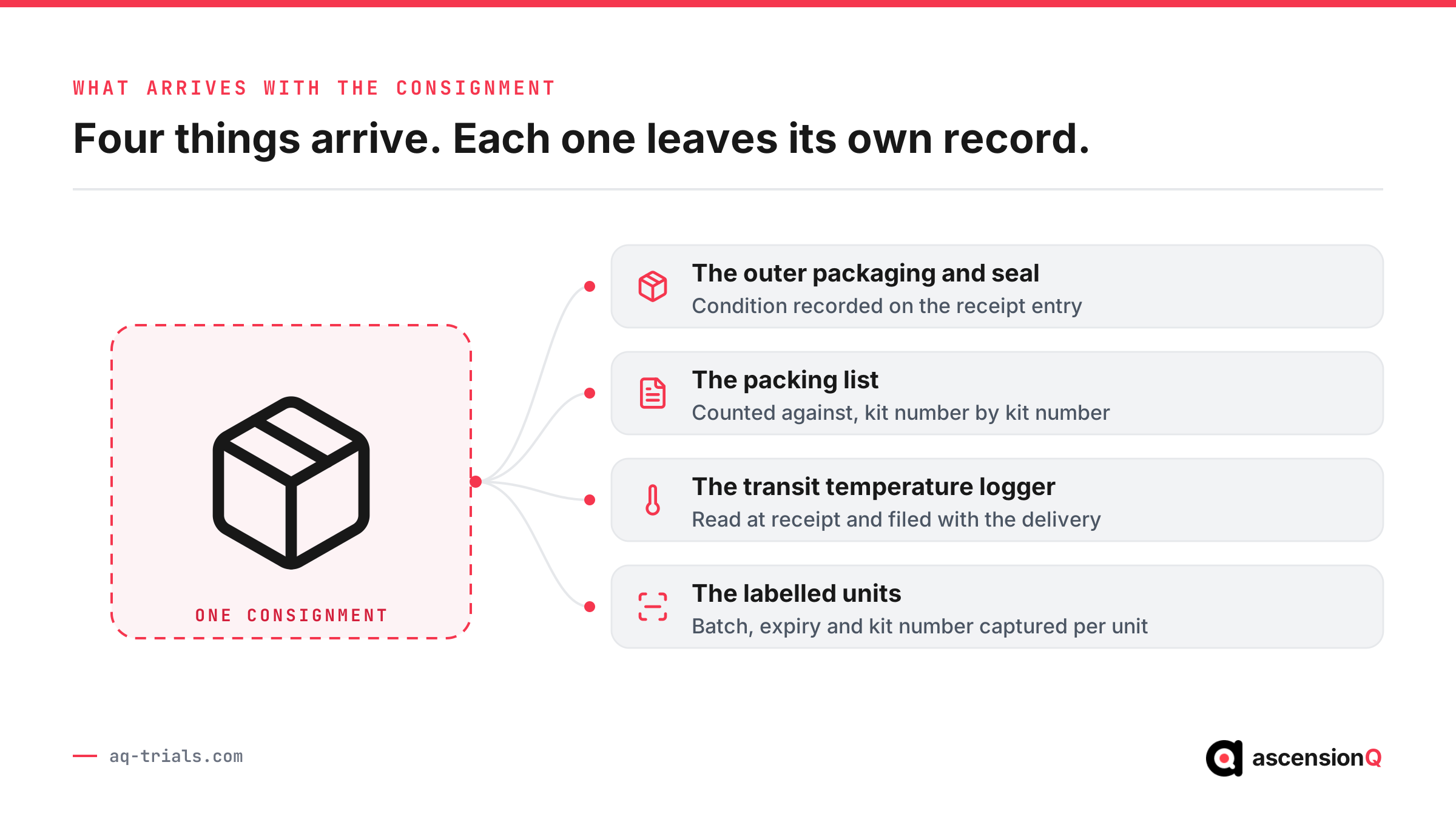
Kit numbers do the heaviest work in the check. A kit number links one pack to the sponsor’s allocation system, so an uncounted kit number is a unit that cannot be traced to a participant. Who assigns those numbers is covered in what an investigational medicinal product is, and the label particulars are covered in IMP labelling requirements for UK trials. The site also confirms receipt in the sponsor’s interactive response technology, and RTSM and IRT against the pharmacy record sets out why both records exist.
Also Read: Who Releases IMP to a UK Site, and What Is QP Release?
What Does the Transit Temperature Record Show?
The transit temperature record shows whether the consignment stayed inside its labelled conditions between the depot and the pharmacy. Most temperature-sensitive shipments travel with a logger in the box. ICH E6(R3) section 2.10.5 requires investigational product to be stored as the sponsor specifies, and the transit read is the first evidence that the condition was met. Three outcomes follow.
- A clean transit profile. The logger shows no excursion, so the release decision turns on the physical check alone.
- A recorded excursion. The stock stays in quarantine, and the sponsor decides whether it may be used.
- No readable transit data. An absent or failed logger leaves the condition unproven, which is treated as an excursion until the sponsor says otherwise.
The storage record set this joins, the data integrity expectations for temperature data and the excursion workflow are covered in the investigational product storage records checklist.
Why Is Every Delivery Quarantined on Arrival?
Every delivery is quarantined on arrival because the site holds no evidence that the stock is usable until the checks are done. Quarantine makes that absence visible in the record.
| Aspect | Delivery accepted straight to the shelf | Delivery held in quarantine |
|---|---|---|
| Risk of an early dispense | A unit can be picked before its transit data is read | A unit cannot be picked until a release decision exists |
| Effect of a shortfall | The balance is already wrong when the count happens | The count happens before the balance claims anything |
| Effect of a transit excursion | Affected stock has to be recalled from the shelf | Affected stock has never left segregation |
| What the record shows a monitor | One date for receipt and availability | A receipt date, a decision date and the name behind the decision |
Quarantine is the site saying so far we have checked nothing.
Segregation supports the status without replacing it. A quarantine bay, a labelled box or a separate fridge shelf keeps units physically apart, and the record proves the status held. The physical arrangement is one of the things an inspector walks through, as what an MHRA inspector looks for in a pharmacy site file sets out.
Quarantined stock still belongs in the total balance. A reconciliation that counts the shelf and ignores the quarantine bay reaches the wrong number. Paper accountability logs against an electronic pharmacy record compares the two formats on how visible that status stays.
Who Makes the Release Decision, and What Does It Record?
A delegated and trained member of pharmacy staff makes the release decision, and the record carries that person’s name, the date and the basis of it. The decision is local and specific to one consignment. It sits after the two sponsor-side decisions covered in who releases IMP to a UK site. The entry answers five questions about one delivery.
- Which units. The kit numbers released, which lets a dispensing entry point back to an accepted unit.
- On what date. The date availability began, which makes an earlier dispense visible immediately.
- By whom. The name and signature of the individual, which makes the decision attributable.
- On what basis. Confirmation that the count, the labels and the transit record were found acceptable.
- With what exceptions. Any units held back, which keeps a partial release honest about what stays in quarantine.
The authority behind the signature is part of the evidence. A release signed by someone absent from the study delegation log, or whose training has lapsed, fails even where every check was correct. That condition is set out in delegation and training records for pharmacy, and the roles that may hold the decision in who is accountable for IMP at a trial site.
When Is a Delivery Rejected?
A delivery is rejected when the receipt check finds a condition the site cannot resolve locally and the sponsor confirms the stock may not be used. Rejection is a sponsor decision carried out by the site. Six grounds recur.
- Damaged or breached packaging. Identity and quality are both in doubt.
- A transit excursion outside the labelled range. Only the sponsor can judge the effect.
- Stock expiring inside its intended use period. The units cannot serve the visits they were sent for.
- Kit numbers absent from the packing list. The site holds units the sponsor’s record does not place at the site.
- An incorrect or missing label. The pack fails the particulars UK law requires.
- Delivery ahead of a current sponsor release. The stock arrived before the site had permission to dispense it.
Rejected stock keeps its accountability line. The units were received, so they appear in the total received and then move to a returned or destroyed category on the sponsor’s written authority. A rejected delivery that disappears from the log leaves a permanent gap between the depot and site records.
Also Read: What Belongs in a Pharmacy Site File?
Where Does the Receipt Record Break?
The receipt record breaks where the physical handling and the documented status drift apart. Five failures recur.
- Dispensing from quarantined stock. A unit is picked before its release decision exists, which is the failure the MHRA GCP Inspectorate recorded as a critical finding where medication was still dispensed to subjects despite quarantine.
- A release decision with no name. The delivery is marked received and checked, and no individual is identifiable behind it.
- Quarantined stock left out of the balance. The usable count and the total count are treated as one number, so a held unit reads as a missing unit.
- A receipt entry written days later. The record then fails the contemporaneous expectation in the MHRA GXP data integrity guidance.
- A discrepancy closed without the sponsor. A shortfall is corrected to match the packing list with no investigation record.
A worked example shows the pattern. Study NGH-017 at Northgate General (SITE 01) receives thirty kits of batch B-3104. Two packs are visibly crushed, and the technician sets them aside correctly. The release entry records thirty kits accepted. Six weeks later the shelf holds twenty-two usable kits against a log balance of twenty-four, and the two crushed packs sit in the quarantine bay with no entry of their own.
Nothing in that example was handled badly, and the units never reached a participant. The record failed because the release entry described a decision broader than the one actually made. A discrepancy with a systemic cause moves into the site’s corrective and preventive action process.
Frequently Asked Questions
Why is every IMP delivery quarantined on arrival?
Because the site holds no evidence that the stock is usable until the receipt checks are done. Quarantine is a documented status that makes that absence visible in the record.
Who releases a delivery from quarantine?
A delegated and trained member of pharmacy staff, who records their name, the date and the basis of the release decision for that consignment.
When is a delivery rejected?
When the receipt check finds a condition the site cannot resolve locally and the sponsor confirms the stock may not be used. Rejection is a sponsor decision carried out by the site.
Receipt entries, quarantine status and release decisions belong to one pharmacy record. AQ’s electronic pharmacy site file page sets out how AQ approaches pharmacy documentation as part of one connected site file. Book a live demo to talk through how your receipt and release evidence holds together.