Lab kit management in clinical trials is the control of the collection supplies a sponsor or central laboratory provides to a research site: visit kits, tubes, labels, requisition forms and shipping materials. It covers receipt, storage, expiry, reservation against booked visits, reordering, and the return or disposal of unused kits at study close.
Most sites discover a kit problem at the worst moment. A participant arrives for a Week 12 visit, the nurse opens the cupboard, and the only Week 12 kit expired last Friday. The sample window is 30 minutes before the dose. The visit goes ahead without the PK sample, a deviation is raised, and the timepoint is lost for good.
This guide explains what a lab kit contains, where kit management breaks down, how to run kits through the full study, how to estimate stock, and what monitors check. It forms part of our guide to clinical trial sample management.
What Is in a Clinical Trial Lab Kit?
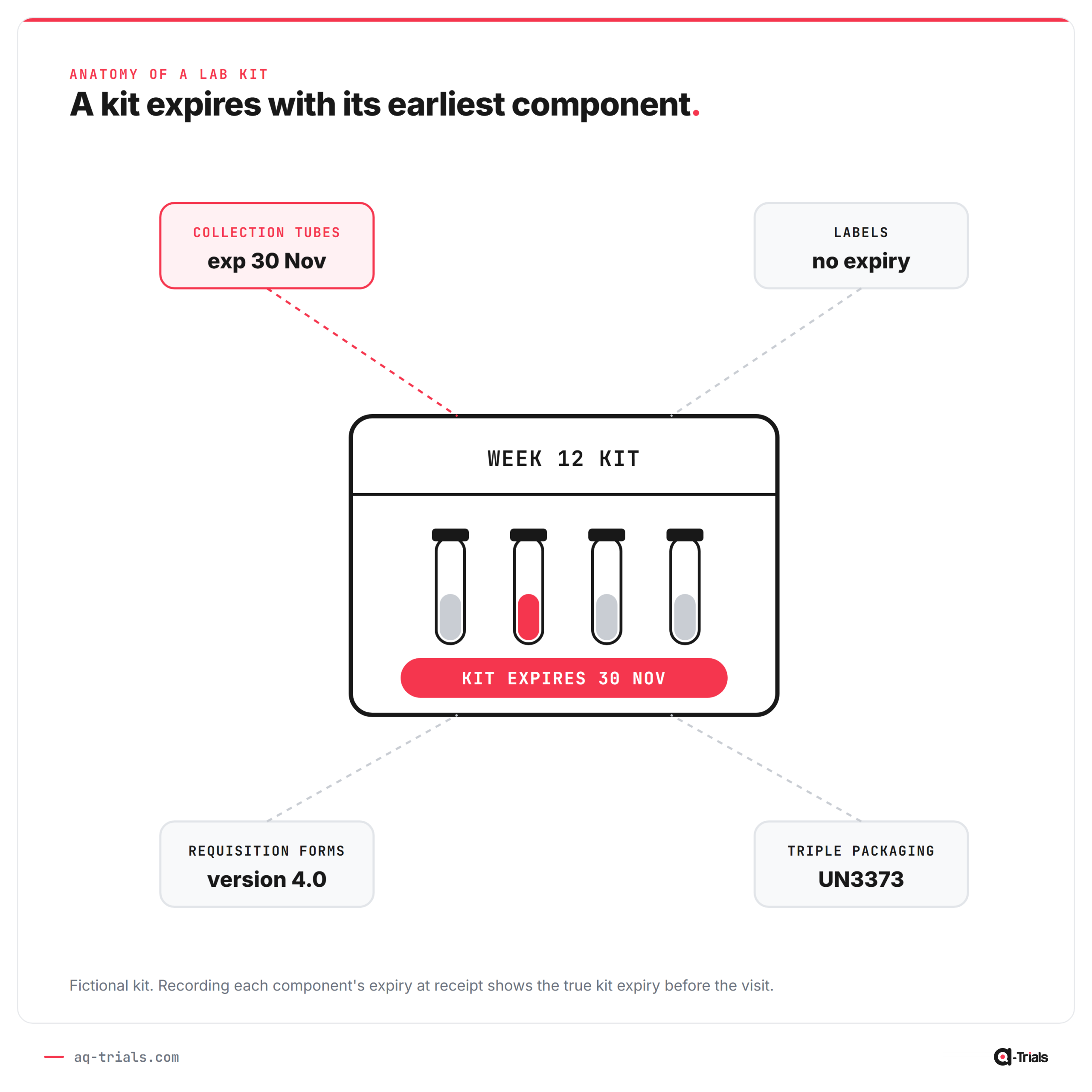
A lab kit holds everything the site needs to collect and send one visit’s samples. Central laboratories usually build kits per visit type, so a screening kit, a Week 12 kit and an end-of-study kit carry different contents. Each component has its own expiry, and the kit expires with its earliest component.
| Component | Purpose | What the site checks |
| Collection tubes | Hold the sample in the right additive (for example K2EDTA, serum or citrate) | Tube type and volume against the lab manual; tube expiry date |
| Pre-printed labels | Identify the sample by study, participant and timepoint | Label format matches the current lab manual version |
| Requisition form | Tells the laboratory what was collected and when | Form version; fields completed at collection |
| Aliquot and transfer tubes | Hold processed plasma or serum | Number of aliquots required; tube expiry |
| Packaging | Triple packaging for UN3373 Category B biological substances | Correct size for the shipment; absorbent material present |
| Temperature materials | Cold packs or dry ice instructions for the shipment condition | Shipment condition and courier booking |
Lab kits sit outside the accountability rules for investigational medicinal product (IMP). Sponsors and central laboratories set inventory, reorder and return instructions in the lab manual, and monitors check the site against them.
Also Read: Investigational Product Storage Compliance
Where Does Lab Kit Management Break Down?
Kits arrive in bulk at study start and sit in a cupboard or storeroom. The stock list is a spreadsheet updated when someone remembers, and expiry is checked by eye on the day of the visit. Five failures follow from that arrangement.
- Expired kit at the visit. The only kit for the timepoint is out of date, and the sample is missed or collected into the wrong tube.
- Superseded kit version. A lab manual amendment changes the tubes or labels, and old-version kits stay on the shelf beside new ones.
- Stock-out for a busy week. A cohort of participants reaches the same visit together and the site holds fewer kits than visits.
- Expired stock building up. Kits expire unused because nobody used the oldest first, which wastes supplies and shelf space.
- Kit lot missing from the sample record. The site cannot show which lot a sample was collected with, so a later tube recall cannot be traced to participants.
The fictional week below shows how quickly a bulk-stock arrangement runs short in a dose-escalation cohort.
| Day | Visits booked | Week 12 kits on the shelf | In date for that day |
| Monday | 2 | 6 | 6 |
| Tuesday | 3 | 4 | 4 |
| Wednesday | 2 | 1 | 1 |
| Thursday | 1 | 0 | 0 |
The reorder lead time from the central laboratory is five working days. The shortage was visible on Monday morning to anyone who compared booked visits with kits in date. Nobody compared them.
Kit stock is a forecast problem. A cupboard count answers the wrong question.
Bulk Stock Checked on the Day Compared With Kits Reserved Against Booked Visits
The central contrast is when the check happens. A bulk-stock site checks kits at the visit. A controlled site checks kits when the visit is booked, so a shortage or an expiry surfaces while there is still time to reorder.
| Aspect | Bulk stock, checked on the day | Kits reserved against booked visits |
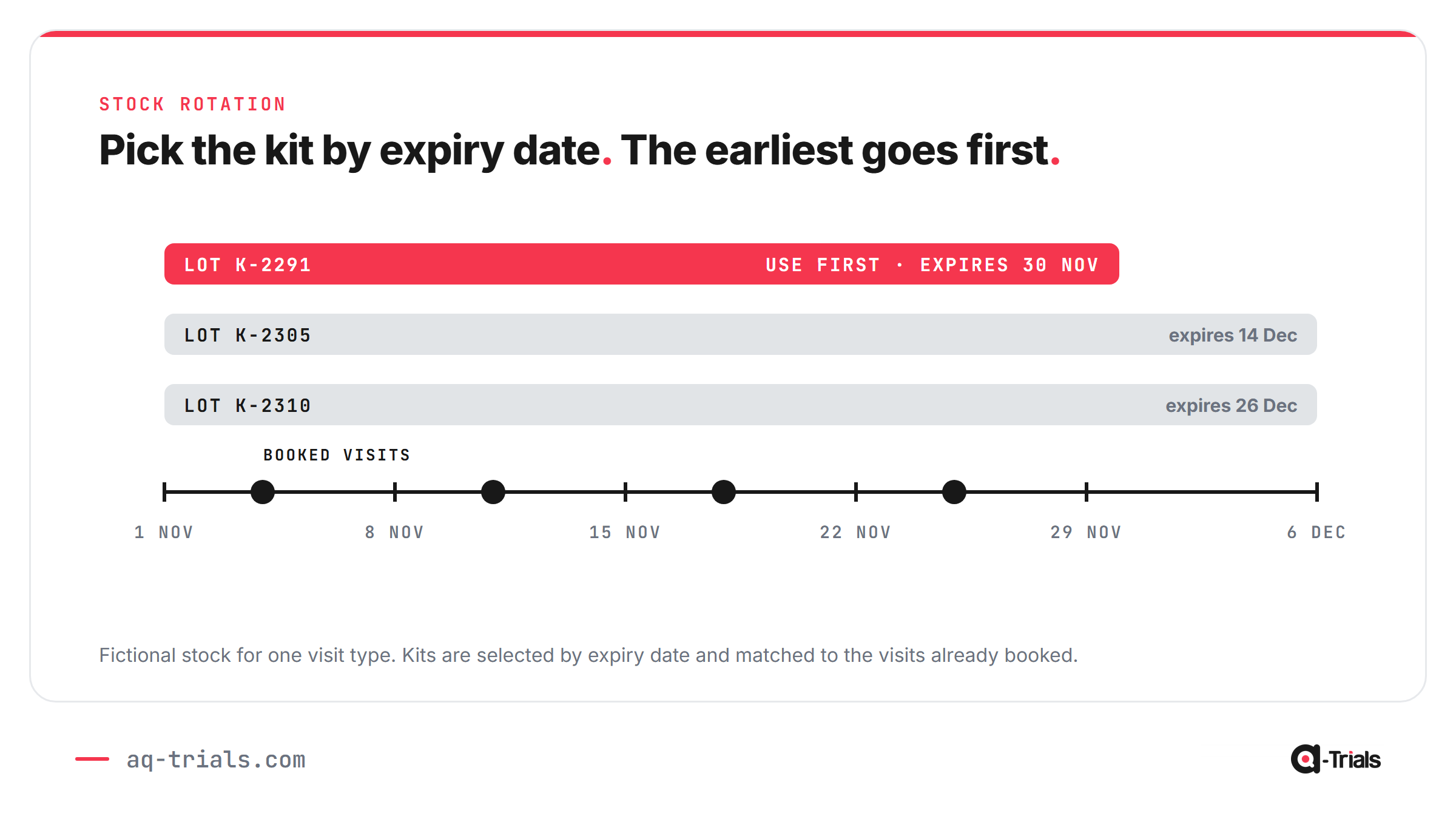
| Expiry | Checked by eye when the kit is opened | Recorded at receipt; kits near expiry used first; expired kits blocked |
| Availability | Cupboard count, if anyone counts | Each booked visit holds a reserved, in-date kit |
| Reordering | Triggered when stock looks low | Suggested from the visits booked and the supplier lead time |
| Version control | Old and new kits mixed on the shelf | Superseded versions withdrawn when the lab manual changes |
| Traceability | Kit lot rarely linked to the sample | Kit lot recorded against every sample collected |
| Waste | Expired kits found during clear-outs | Expiry visible weeks ahead, so stock is rotated |
How Should a Site Manage Lab Kits Through the Study?
Lab kits follow a lifecycle from delivery to close-out. Each step below states what the site does and what it gains.
- Receive. Record the kit type, quantity, lot number, expiry date and lab manual version at delivery, which gives every kit a known expiry from day one.
- Store. Record the storage location and any temperature requirement, which keeps kits findable and within their own storage conditions.
- Reserve. Allocate an in-date kit to each booked visit, which turns a shortage into a warning days before the participant arrives.
- Use the earliest expiry first. Select kits by expiry date rather than shelf position, which reduces expired stock.
- Reorder from the forecast. Order against the visits booked within the supplier’s lead time, which keeps stock matched to demand.
- Withdraw superseded versions. Remove old-version kits when the lab manual changes, which stops samples being collected into the wrong tubes.
- Record the kit lot at collection. Link the lot number to each sample, which allows any tube recall to be traced to participants.
- Close out. Reconcile remaining kits and return or dispose of them under the sponsor’s instructions, which leaves no unexplained stock at study close.
Also Read: Visit Scheduling in a CTMS
How Many Lab Kits Should a Site Hold?
The right stock level comes from the visit schedule. A practical rule is to hold enough in-date kits to cover every booked visit within the supplier’s lead time, plus a small buffer for unscheduled and repeat visits. The fictional calculation below shows the method for one visit type.
| Input | Example value |
| Week 12 visits booked in the next 10 working days | 7 |
| Supplier lead time | 5 working days |
| Buffer for unscheduled or repeat visits | 2 |
| Kits needed in date over the period | 9 |
| Kits in stock that stay in date over the period | 5 |
| Order now | 4 |
The same calculation works across every visit type and study. Run weekly, it replaces the cupboard count with a reorder list, and it links kit stock to the study calendar held in clinical trial management software.
What Do Monitors and Inspectors Check About Lab Kits?
Kit checks usually sit inside a wider review of sample handling and essential records. The questions are practical.
- Were any samples collected with expired tubes or kits, and if so, were they recorded as deviations?
- Does the kit version in use match the current lab manual held in the investigator site file?
- Are kits stored in the conditions the lab manual sets, and is the storage area controlled?
- Can the site show the kit lot used for a given sample?
- Were missed samples caused by supply problems, and were they assessed under the site’s deviation process?
Inspectors look at the same evidence from the other direction. A missed timepoint in the data leads them to the site’s supply record. The MHRA describes its approach in its good clinical practice guidance, and ICH E6(R3) sets the expectation for complete, attributable records.
Also Read: MHRA GCP Inspection Common Findings
How Does Kit Management Connect to Sample Tracking?
Kit management is the first link in the sample’s chain of custody. The kit lot recorded at collection connects the supply record to the sample record, and the shipping materials in the kit determine how the sample travels.
- The reserved kit sets the tubes the collector uses, which ties the sample to the current lab manual version.
- The kit lot on the sample record allows a recall or a tube defect to be traced to the participants affected.
- The packaging and temperature materials in the kit set the shipment condition, which the manifest then records. Couriers apply the IATA Dangerous Goods Regulations to UN3373 samples and to dry ice.
Also Read: Clinical Trial Sample Tracking: Chain of Custody From Collection to the Laboratory
What Are the Risks of Poor Lab Kit Management?
Each risk lands on a different part of the study.
- A missed PK or biomarker timepoint is permanent, and dense early-phase schedules leave no room to repeat it. See clinical trial software for Phase 1 units.
- A participant asked to return for a repeat sample carries the burden of the site’s supply gap.
- Samples collected into expired or superseded tubes may be rejected by the laboratory or excluded from analysis.
- Expired stock adds cost for the sponsor and clutter for the site.
- Repeated supply deviations shape a sponsor’s view of the site in feasibility for the next study.
How Does AQ Labs Support Lab Kit Management?
AQ Labs manages collection supplies as part of the same record that tracks every sample, so supply checks happen when the visit is booked rather than when the cupboard is opened.
- Collection supplies are scanned in with lot and expiry date, which gives every kit a known expiry from receipt.
- Supplies are reserved against booked visits, which shows a shortage days before the participant arrives.
- Supplies close to expiry are flagged for use first and expired supplies are blocked from selection, which reduces waste and stops expired kits reaching the bedside.
- Reorder suggestions are based on the visits booked, and AQ Assist can prepare a supply forecast for staff to review, with every suggestion recorded in the audit trail.
AQ Labs is priced and deployed as its own module and connects to visit scheduling, delegation records and the site file when used with the rest of AQ Platform. Book a live demo to see supplies reserved against a week of booked visits.
Frequently Asked Questions
What is a lab kit in a clinical trial?
A lab kit is the set of collection supplies a sponsor or central laboratory provides for one visit’s samples: tubes, labels, requisition forms, aliquot tubes and shipping materials. Kits are usually built per visit type and carry an expiry date set by their earliest-expiring component.
Can a site use an expired lab kit?
Sites should treat expired kits as unusable unless the sponsor or central laboratory gives written instructions otherwise. A sample collected with an expired kit is normally recorded as a deviation and may be rejected by the laboratory.
How far ahead should a site reorder lab kits?
Reorder far enough ahead to cover every booked visit within the supplier’s lead time, plus a buffer for unscheduled visits. A weekly check of booked visits against in-date stock keeps the order matched to demand.
Do lab kits need accountability records like IMP?
Lab kits fall outside IMP accountability rules. Sponsors and central laboratories still set inventory, reorder and return instructions in the lab manual, and monitors check the site against them.
What happens to unused lab kits at the end of a study?
The site reconciles remaining kits and returns or disposes of them under the sponsor’s instructions, recording what happened to each, so no unexplained stock remains at close-out.