EHR-to-EDC integration suits an NHS trust that needs the same structured fields across many studies, holds a stable electronic patient record (EPR), and has digital capacity to build and maintain an interface. Site eSource suits every data point the interface cannot reach. Most trusts run both, and the route is chosen per data point rather than per organisation.
This guide compares the two routes on the four questions that settle the decision inside a trust: how much of a protocol each one covers, who has to approve it, what the EPR supplier controls, and where the cost falls. It sits under our complete guide to eSource in clinical trials for UK research sites. The four forms eSource takes are defined in our guide to the types of eSource, from direct data capture to ePRO.
The interface carries the fields it was built to carry. A person carries the rest.
What Does Each Route Change About the Same Visit?
Both routes leave the EPR as the original record for routine care data. They differ in what replaces the retyping step, and in what covers the rest of the protocol. The table below sets the two side by side on the six practical differences a research team feels.
| Aspect | EHR-to-EDC integration | Site eSource forms |
| Where the original sits | The trust EPR, as routine care | The site’s trial system, entered during the visit |
| Data originator | The clinical team recording care | Delegated research staff |
| Route to the sponsor | A validated interface sends mapped fields | The site enters once and the value passes to EDC |
| Investigator judgements | Recorded on another record | Recorded on the form itself |
| Who builds it | The trust digital team with the EPR supplier | The research team with its own vendor |
| Who changes it at an amendment | The supplier work queue | The research team, inside its own system |
The boundary between source data and the case report form holds in both cases, and our guide to where source data ends and the CRF begins sets it out in full. The choice here is narrower. It settles which route carries each value to the sponsor.
How Much of a Protocol Can an EHR-to-EDC Interface Carry?
An EHR-to-EDC interface carries the structured, coded fields the EPR already holds in a mapped form. Its reach stops at data the EPR records as free text, and at data the EPR never records.
The prize is substantial. The i~HD Task Force on eSource scale-up in oncology trials reports that more than half of all trial data comes from manual transcription of EHR sources. The same review names unstructured clinical content, including clinical notes, imaging reports and pathology narrative, as material that still needs manual interpretation.
Two lists divide most protocols. Fields an interface usually maps:
- Laboratory results filed from the hospital pathology system.
- Vital signs and observations recorded on the ward or in clinic.
- Demographics, including date of birth and sex registered at birth.
- Prescribed and administered medications held on the prescribing record.
Fields that stay with a site form:
- Eligibility confirmations made against the protocol’s criteria.
- Adverse event severity, causality and expectedness as the investigator assesses them.
- Protocol-specific assessments the EPR has no field for.
- Consent version and the date the participant signed it.
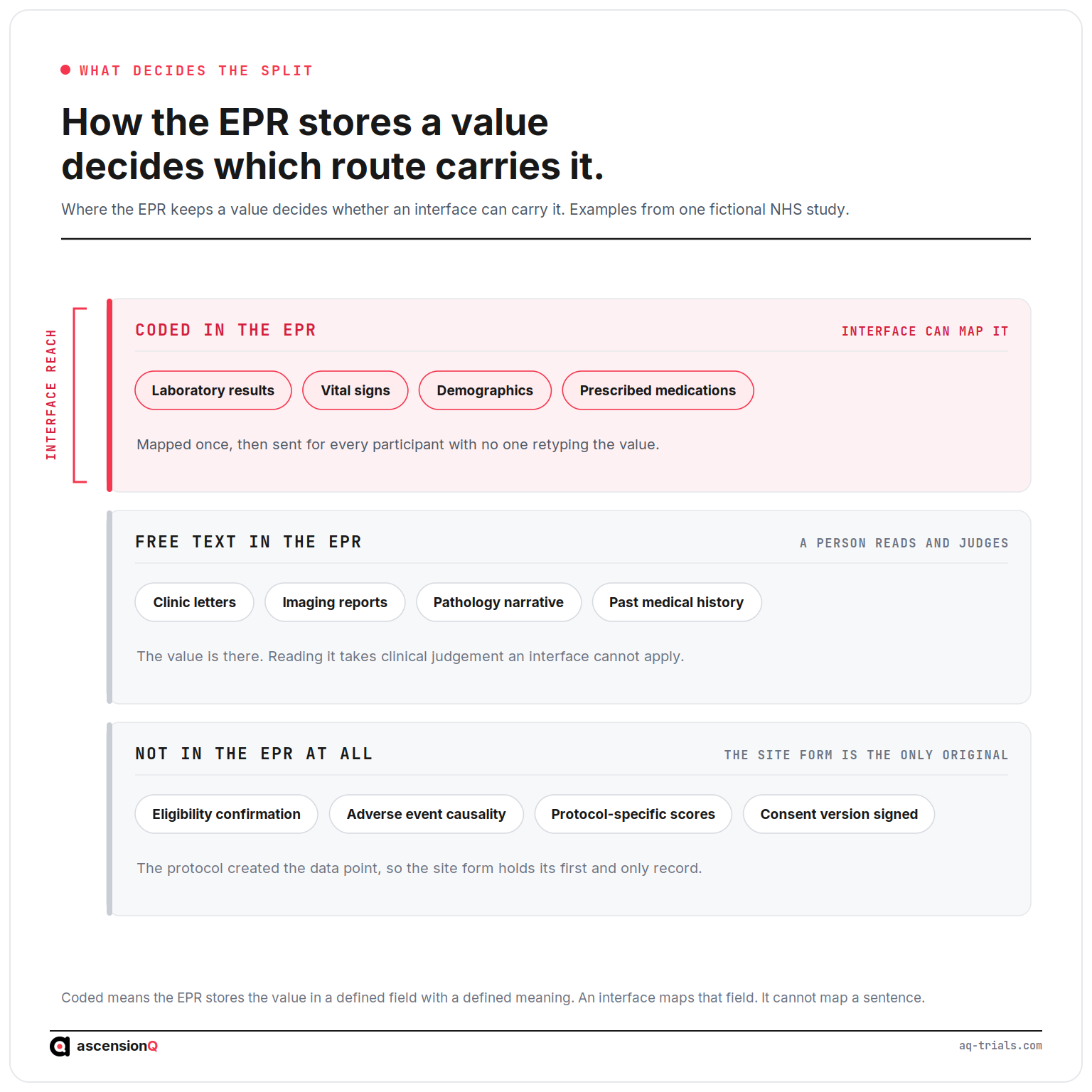
The split is settled per data point before the study opens, and recorded in the source data location log. Our guides to building a source data plan before the site initiation visit and to which record is the source when data sits in both the EPR and the trial system cover that decision and the documents it produces.
Who Has to Approve an Integration Inside an NHS Trust?
An integration passes through the trust’s digital and clinical safety governance, because the change reaches the clinical system estate rather than a research application alone. The approvals run in sequence, and each one has a separate owner inside the organisation.
- Sponsor agreement that the interface is the declared route for those data points.
- A data protection impact assessment covering a new flow of identifiable data out of the EPR.
- Clinical safety assurance under DCB0160, the standard published under section 250 of the Health and Social Care Act 2012 for the deployment and use of health IT systems.
- A change record with the trust digital team, and a work order with the EPR supplier.
- Supplier assurance covering the system that receives the data.
- Validation evidence for the interface itself, filed in the investigator site file.
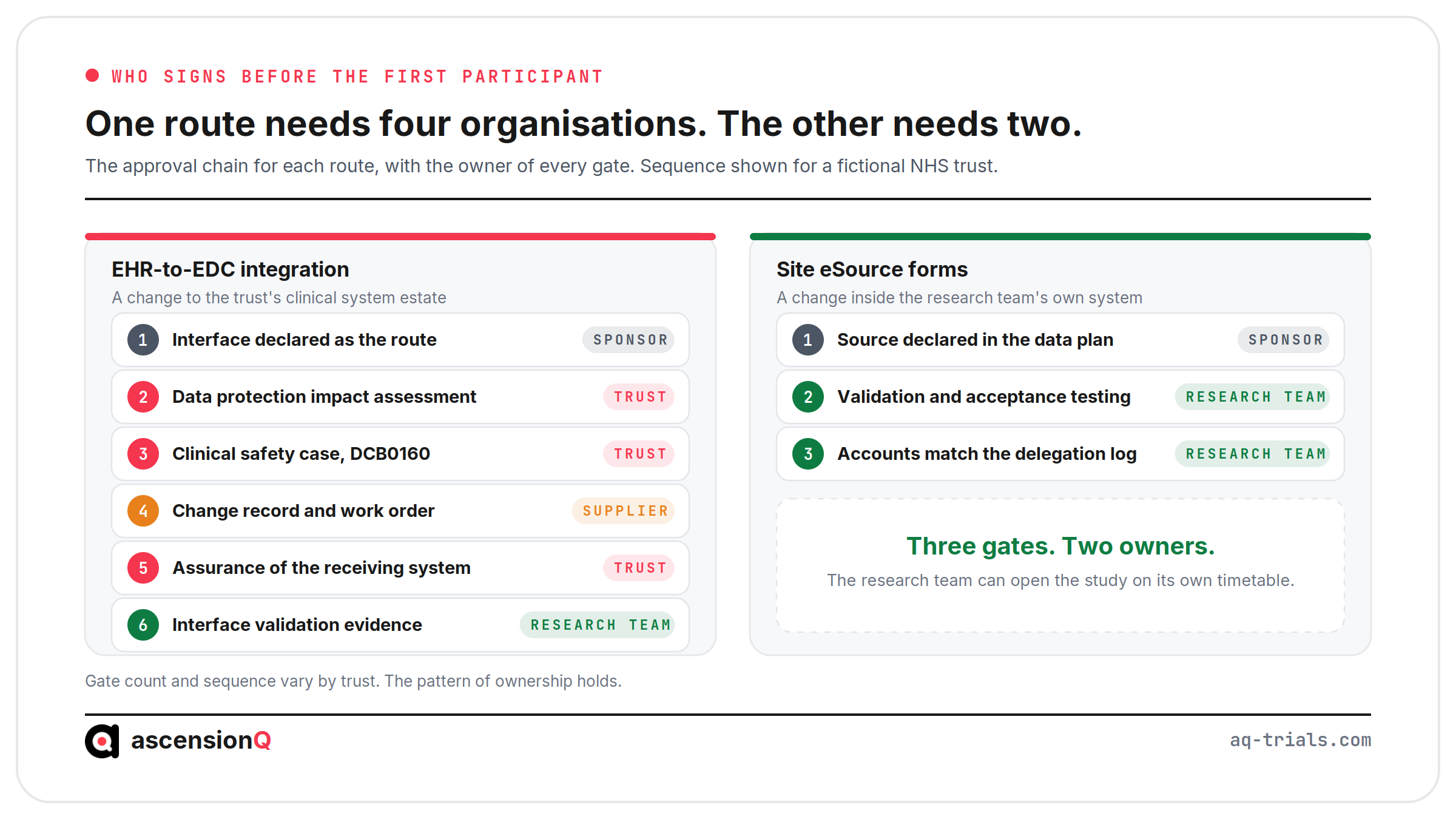
The site eSource route is shorter by design. It needs the sponsor’s agreement, validation and user acceptance testing evidence, and user accounts matched to the delegation log. Our guide to how to validate an eSource system before first patient in covers the evidence a site files for either route. Access for the sponsor’s monitor is a separate approval again, and our guide to how NHS sites give monitors EPR access without breaching UK GDPR covers the lawful basis, participant consent and trust approval chain behind it.
What Does the Trust’s EPR Supplier Decide?
The EPR supplier decides which interfaces exist, how the data is shaped on the way out, and when the work reaches the front of a queue. The trust owns the decision to ask for it. The supplier owns the timetable.
Nearly every acute trust now has an EPR to integrate with. NHS England’s frontline digitisation programme set a target that 95% of trusts would have implemented or upgraded an EPR by March 2026. The question at a trust has moved on from whether an EPR exists to what that EPR exposes, and on what terms.
Standards narrow the gap without closing it. NHS England’s DAPB4020 information standard introduces the governance process for UK Core FHIR Release 4, the resource set used for sharing data across health and care in England. Implementation of it still varies by supplier and by local deployment. Suppliers also publish their own research capability. Epic describes a life sciences platform it calls Discovery, and states that its research tools let teams “explore study feasibility, organize studies, recruit participants, collect consents, track patient-reported outcomes, and more”.
Deployment time is the honest variable. A 2025 study in JAMIA Open of REDCap’s EHR integration module found that 77 of 7,202 institutions, or 1.1%, had implemented it by May 2024. Implementation took a median of eight months, with a range from under one month to more than four years. The highest-rated barrier was competition for health IT resource, ahead of regulatory restriction. Three questions put to the supplier early save most of that uncertainty:
- Which trial-relevant resources does the current deployment expose, and under which version of UK Core FHIR?
- What is the lead time and the charge for an interface change, and who signs the work order?
- What happens to the interface at an EPR upgrade, and at a change of supplier?
Where Does the Cost of Each Route Fall?
Integration cost falls once on the trust, then thins across every study that reuses the interface. Site eSource cost falls on the research team each time a study opens, and it scales with the number of studies rather than the number of mapped fields.
| Cost line | EHR-to-EDC integration | Site eSource forms |
| First build | Trust digital team and a supplier work order, before any study benefits | Vendor configuration for the first study |
| Each additional study | Mapping for fields the deployment already exposes | A new set of forms built from the protocol |
| Protocol amendment | A change request into the supplier queue | A form change inside the research team’s system |
| Staff time at the visit | Removed for mapped fields only | Removed for every field on the form |
| Who holds the budget | The trust’s digital programme | The study’s own costing |
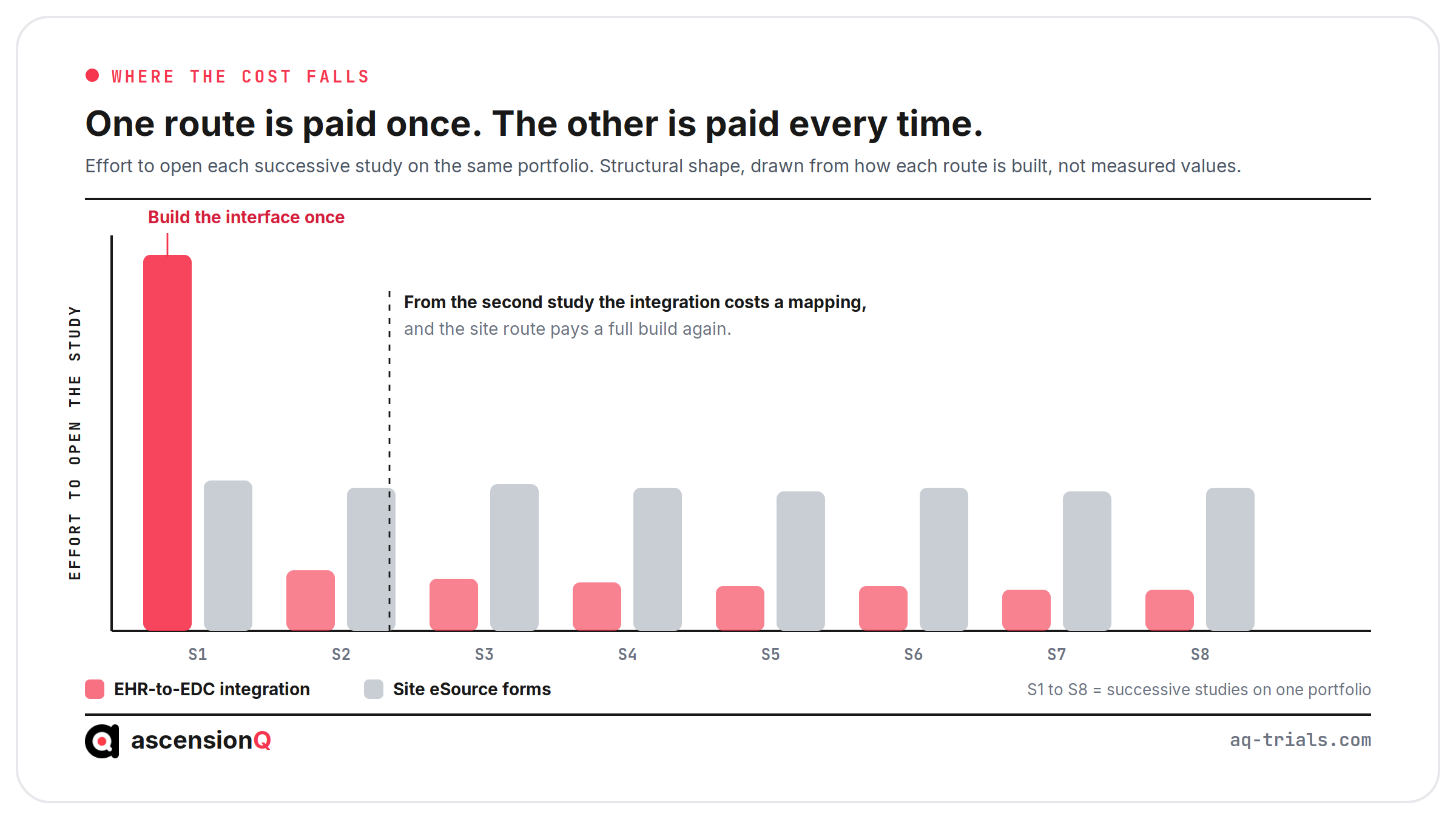
Study costing gives the second route a natural home. An activity carried out for one study alone is attributed in that study’s costing template, through National Contract Value Review for a commercial contract study, or a Schedule of Events Cost Attribution Tool for non-commercial research. A shared interface built once for the whole trust sits outside any single study’s costing, which is why it waits on a digital programme rather than a study budget.
Which Route Suits Which NHS Trust?
The answer follows the shape of the research portfolio rather than the size of the trust. An integration earns its place under four conditions:
- The same structured fields recur across many studies on the portfolio.
- The EPR deployment is stable, and the supplier roadmap for it is known.
- The trust digital team holds capacity beyond its committed clinical priorities.
- The portfolio is large enough that one interface serves several years of studies.
Site eSource earns its place under four different conditions:
- Studies are few in number, varied in design, or short in duration.
- The protocol data sits mostly outside the EPR’s structured fields.
- The research team needs to open a study on its own timetable.
- The trust digital queue is measured in quarters rather than weeks.
Most trusts land on both. A site running a mixed portfolio commonly takes laboratory values and observations through whichever route the trust already supports, and records eligibility, adverse event assessments and protocol-specific measures on its own forms. Our page on NHS and hospital research covers the wider operating picture around that split.
Frequently Asked Questions
When does EHR-to-EDC integration suit an NHS trust?
When the trust needs the same structured fields across many studies, holds a stable electronic patient record, and has digital capacity to build and maintain an interface.
How much of a protocol can an EHR-to-EDC interface carry?
The structured, coded fields the EPR already holds. Its reach stops at data the EPR records as free text, and at data the EPR never records, which site eSource covers instead.
Where does the cost of each route fall?
Integration cost falls once on the trust, then spreads across every study that reuses the interface. Site eSource cost falls on the research team each time a study opens and scales with the number of studies.
The route a trust chooses decides how much of its own trial record it controls directly. Book a live demo to see the AQ platform today.