The record that is the source is the one that held the observation first, and the site declares that record, per data point, before the first participant is enrolled. A weight measured in clinic and saved to the electronic patient record (EPR) is source in the EPR. The same weight typed into a trial form afterwards is a copy of it, whatever the trial form is called.
This guide is written for UK research sites running studies where routine care and trial procedures produce the same values. It covers the test that separates an original from a copy, the order in which to settle a duplicate, how a site declares the source for each data point, which record usually holds the original for common NHS data types, and what an inspector asks when two records carry the same number. The wider context sits in our complete guide to eSource in clinical trials.
A value held in two records is routine. A value held in two records with no declared original is a finding.
What Makes One Record the Source and the Other a Copy?
The first permanent capture of an observation is the source. Every record written from it afterwards is a copy, however official the second system looks. The EMA guideline on computerised systems and electronic data in clinical trials puts it in one line: the first obtainable permanent data from an electronic data generation or capture should be considered and defined as the electronic source data.
Three tests settle the question for any single field:
- Order: which record received the value first, in a form that persists after the visit.
- Authorship: whether the person who made the observation, or a delegate acting at the time, put it there.
- Metadata: whether that record carries its own author, date, time and change history.
The same electronic health record (EHR) can be the source for some fields in a study and a copy for others. The EMA guideline allows for this directly, stating that data at different processing stages can be considered source depending on the preceding processing steps. Our guide to what counts as source data in a clinical trial sets out the underlying ICH definitions, and our guide to the types of eSource covers the routes by which each form of data reaches the trial record.
Which Record Wins When the EPR and the Trial System Hold the Same Value?
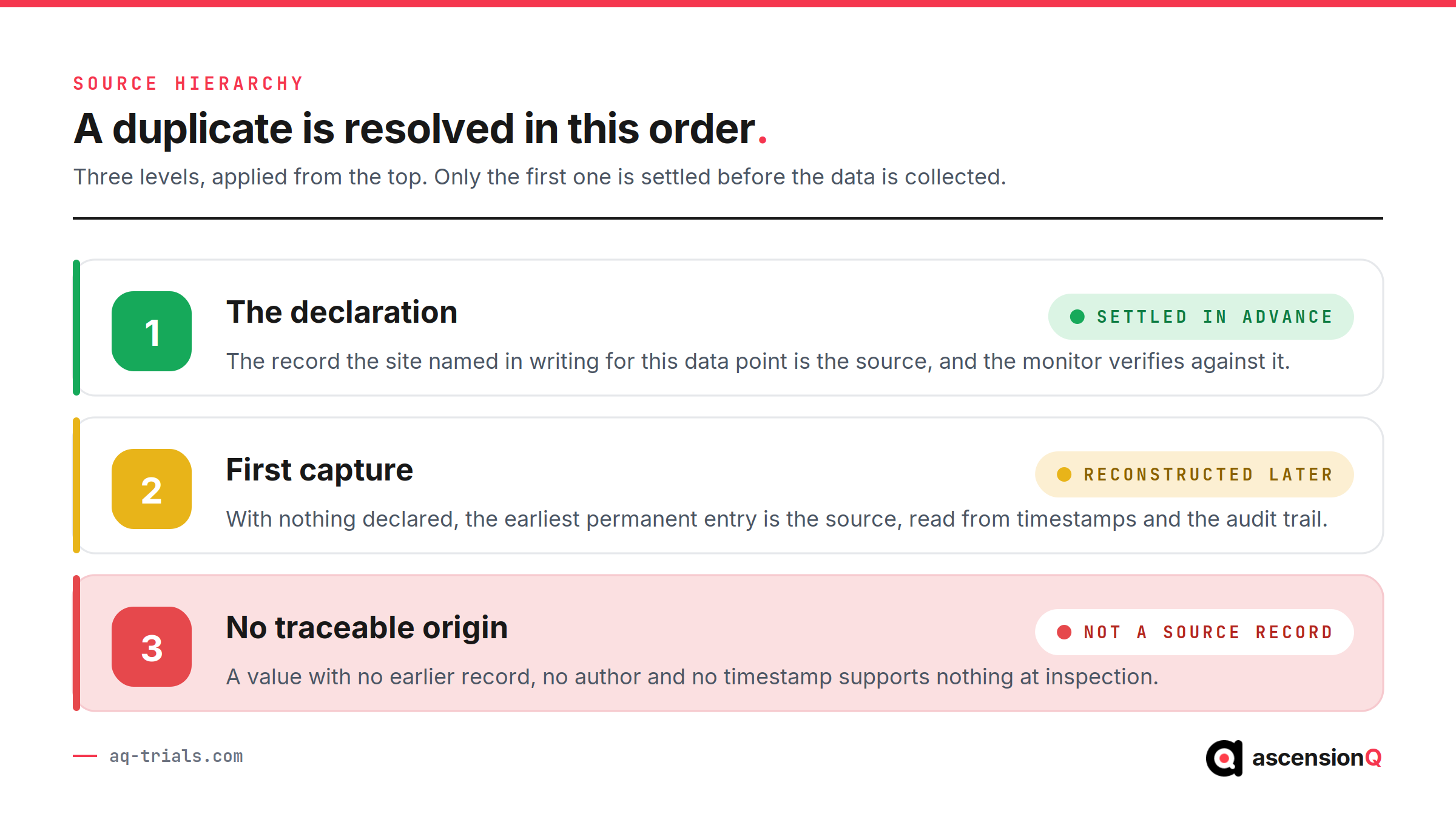
The declared record wins. A site that has named the source for that data point has already settled the question, and the second record is a copy to be kept consistent with the first. Three levels resolve every duplicate, applied in order:
- The declaration. The record named in the site’s written source declaration is the source for that field, and the monitor verifies against it.
- First capture. The record holding the earliest permanent entry is the source where no declaration exists, judged from timestamps and the audit trail rather than from which system looks more official.
- Traceability. A value that appears in the trial system with no earlier record, no author and no timestamp is not a source record at all, and it supports nothing at inspection.
A difference between the two records is a query against the copy. The correction is made in the source record, through that system’s own audit trail and with a reason for change, and the copy is then brought back into line. The alternative, editing whichever record is easier to reach, leaves two records that each claim to be right. Scheduling and tracking the monitoring visit that finds the difference belongs to the site’s clinical trial management system, and the boundary between the site’s record and the sponsor’s is covered in our guide to where source data ends and the CRF begins.
How Does a Site Declare the Source for Each Data Point?
The declaration is an investigator duty under ICH E6(R3), which states at section 2.12.2 that the investigator should define what is considered to be a source record, the methods of data capture and their location prior to starting the trial, and should update this definition when needed. The EMA guideline sets the same expectation, requiring that the location of all source data is specified before the trial starts and updated during its conduct where applicable.
A workable declaration fixes five things for every data point:
- The data point, named as it appears on the protocol schedule of events.
- The system or document that holds the original, identified specifically enough to open it.
- The person, role or device authorised to create that original.
- Any second record that will hold a copy, and which record it is reconciled against.
- The date the arrangement takes effect.
The unit of declaration is the data point. One visit form can hold three kinds of field at once: values entered directly, values transcribed from the EPR, and values transferred from a laboratory or a device. FDA guidance on electronic source data approaches the same problem from the other side, asking sponsors to maintain a list of authorised data originators and to attach a data element identifier to each element as it enters the case report form. The site records its decisions in a source data location log, agreed with the sponsor and filed in the investigator site file.
Which Record Usually Holds the Original at an NHS Site?
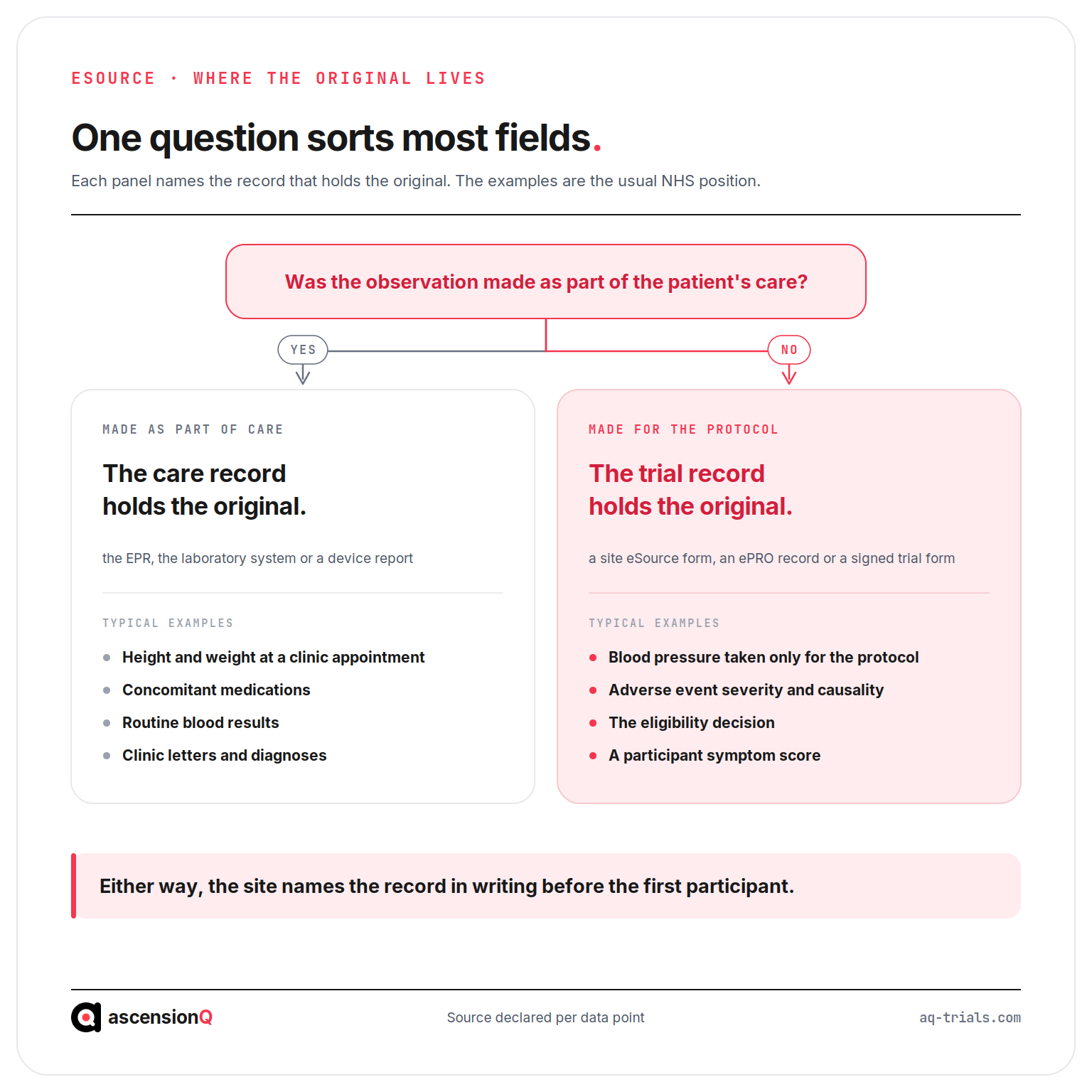
One question decides most fields at an NHS trust: was the observation made as part of the patient’s care, or only because the protocol asks for it. Care generates a record in the EPR first. A trial-only procedure generates its first record in the trial system.
| Data point | Usual source at an NHS site | Why that record holds the original |
| Height and weight at a clinic appointment | The EPR clinic record | Measured as part of care and written there first |
| Blood pressure taken only for the protocol | The trial visit form | No earlier record of the reading exists |
| Full blood count | The hospital laboratory system report | The laboratory system generates and reports the result |
| ECG | The device output and its signed report | The trace and the interpretation are created outside both systems |
| Concomitant medications | The EPR prescribing and clinic record | Prescribing and review happen as care |
| Adverse event term, severity and causality | The investigator’s trial assessment record | The judgement is made for the trial and recorded there |
| Eligibility decision | The signed eligibility record | The decision is a trial act, even where its inputs sit in the EPR |
| Investigational product dispensing | The pharmacy record | Pharmacy creates it under the prescription |
| Participant symptom score | The ePRO record | The participant is the originator of the entry |
Local practice moves several of these rows. A trust that performs research ECGs on a machine feeding the EPR has a different answer from one using a standalone trial device. The table gives the usual position, and the declaration made at the site is what counts.
What Does an Inspector Ask When Two Records Hold the Same Value?
Three questions cover it. Which record is the source for this field, where is that written down, and does that record’s audit trail support the value reported to the sponsor. The site answers the first two from the source declaration and the third from the system itself.
Five failure modes account for most of the trouble:
- The source was never declared, so two members of staff give the inspector different answers about the same field.
- A declaration exists and daily practice contradicts it, so the monitor has verified reported data against a copy.
- The EPR entry was corrected and the trial form copy was left alone, so the two records disagree at close-out.
- The declaration was written before first patient in and never revisited after the site changed how a value is captured.
- A trial form field holds a value with no earlier record and no evidence of who entered it or when.
Each of these is a system condition rather than a personal failing. The MHRA GXP data integrity guidance expects data to satisfy the ALCOA+ attributes across its whole lifecycle, and a duplicated value with no declared original fails the original attribute before anyone looks at the number itself. The procedures that prevent it, covering corrections, access review and periodic checks of practice against the declaration, sit in the site’s quality management system. The evidence each record format produces is compared in our guide to eSource versus paper source worksheets.
When Does the Declared Source Change During a Study?
The declaration changes whenever the way a value is captured changes, and the change is recorded against the date it took effect. Four triggers account for most updates:
- A trust moves a data type into a new EPR module or a new laboratory information system.
- A study adds a device or an ePRO instrument after recruitment has started.
- A site replaces a paper worksheet with an electronic form for a group of fields.
- A protocol amendment adds an assessment that no existing record covers.
Every version of the declaration stays retrievable for the life of the study. A visit conducted in March is judged against the arrangement in force in March, so a single current version with no history leaves the earlier data unexplained.
The site decides where the original lives. The declaration is how anyone else finds out.
Frequently Asked Questions
When data sits in both the EPR and the trial system, which is the source?
The record that held the observation first, as the site declares it per data point before the first participant is enrolled. A clinic weight saved to the EPR is source in the EPR, and the same weight typed into a trial form is a copy.
Who declares which record is the source?
The investigator. ICH E6(R3) section 2.12.2 states that the investigator should define what is considered a source record, the methods of data capture and their location before the trial starts, and update that definition when needed.
When does the declared source change during a study?
Whenever the way a value is captured changes, for example when a trust moves a data type into a new EPR module or a study adds a device. The change is recorded against the date it took effect.
Sites working through these questions usually find the effort sits in the declaration rather than in the software. Book a live demo to see the AQ platform today.