The Human Tissue Act 2004 governs the storage and use of relevant material for research in England, Wales and Northern Ireland, and many clinical trial samples are relevant material. For a research site, the Act turns into three records for each sample: the consent that covers it, the approval or licence it is stored under, and what happened to it at the end.
Gaps in those records surface late. In the fictional study NEURO-412, participant 412-019 tells the research nurse at month 14 that she no longer wants her samples used for future research. The nurse records it in the medical notes. Six serum aliquots and two whole blood samples for DNA stay in the site freezer, labelled for transfer to the sponsor’s biobank at study close. Nobody links the note to the freezer.
This guide covers Human Tissue Authority (HTA) licensing, consent scope, withdrawal, retention and destruction records. It forms part of our guide to clinical trial sample management and summarises published guidance. Each study’s protocol, consent form and sponsor instructions govern the detail.
What Does the Human Tissue Act Cover for Clinical Trial Samples?
The Human Tissue Act 2004 defines relevant material as material, other than gametes, which consists of or includes human cells. The HTA regulates storage for research through licensing and publishes codes of practice. Its research code, Code E, states that a sample known to contain even a single human cell should be classed as relevant material.
| Trial sample | Relevant material? | Basis |
| Whole blood | Yes | Contains human cells |
| Peripheral blood mononuclear cells (PBMCs), tissue biopsies, archival tissue blocks | Yes | Cellular by nature |
| Serum separated from cells | Treated as acellular in Code E’s examples | Code E examples treat retained serum as material that is not relevant material |
| Extracted DNA or RNA | No | Code E describes subcellular components as material that is not relevant material |
| Other sample types | Check each one | The HTA publishes guidance on relevant material, and the sponsor should state its classification |
Three boundaries matter. The Act covers storage and use, and Code E notes that consent to remove tissue from a living person falls under common law and mental capacity legislation. Scotland has its own law, the Human Tissue (Scotland) Act 2006, and the HTA does not license research storage there. The offence of DNA analysis without qualifying consent applies across the whole UK, Scotland included.
Does a Site Need an HTA Licence to Store Trial Samples?
It depends on the approval behind the storage. Code E states that storage of human tissue as part of a clinical trial must take place on HTA-licensed premises, subject to listed exceptions. The broadest exception comes from regulations made under the Act: tissue held for a specific research project approved by a recognised research ethics committee (REC), or where that approval is pending, can be stored without a licence. Recognised RECs include committees recognised to review clinical trials of investigational medicinal products.
| Situation at the site | Licence position under Code E |
| Samples held for an ethically approved trial, within its approval | Exempt from licensing for that project |
| Samples held briefly while awaiting a courier | Exempt as incidental to transportation, which the HTA reads as hours or days and no longer than a week |
| Whole blood held for a few days only to separate acellular serum | Exempt, provided processing takes hours or days and no longer than a week |
| Samples kept after the trial for research outside its approval | Licensed premises required, unless a new exception applies |
| A research tissue bank storing samples for future studies | Licensed, often with generic ethics approval for the bank |
The HTA licenses premises for storage, and Code E states that it neither licenses the use of tissue nor approves individual projects. A trust’s research office, and its HTA Designated Individual where the trust holds a licence, should confirm the position before a study opens.
What Should Sample Consent Cover?
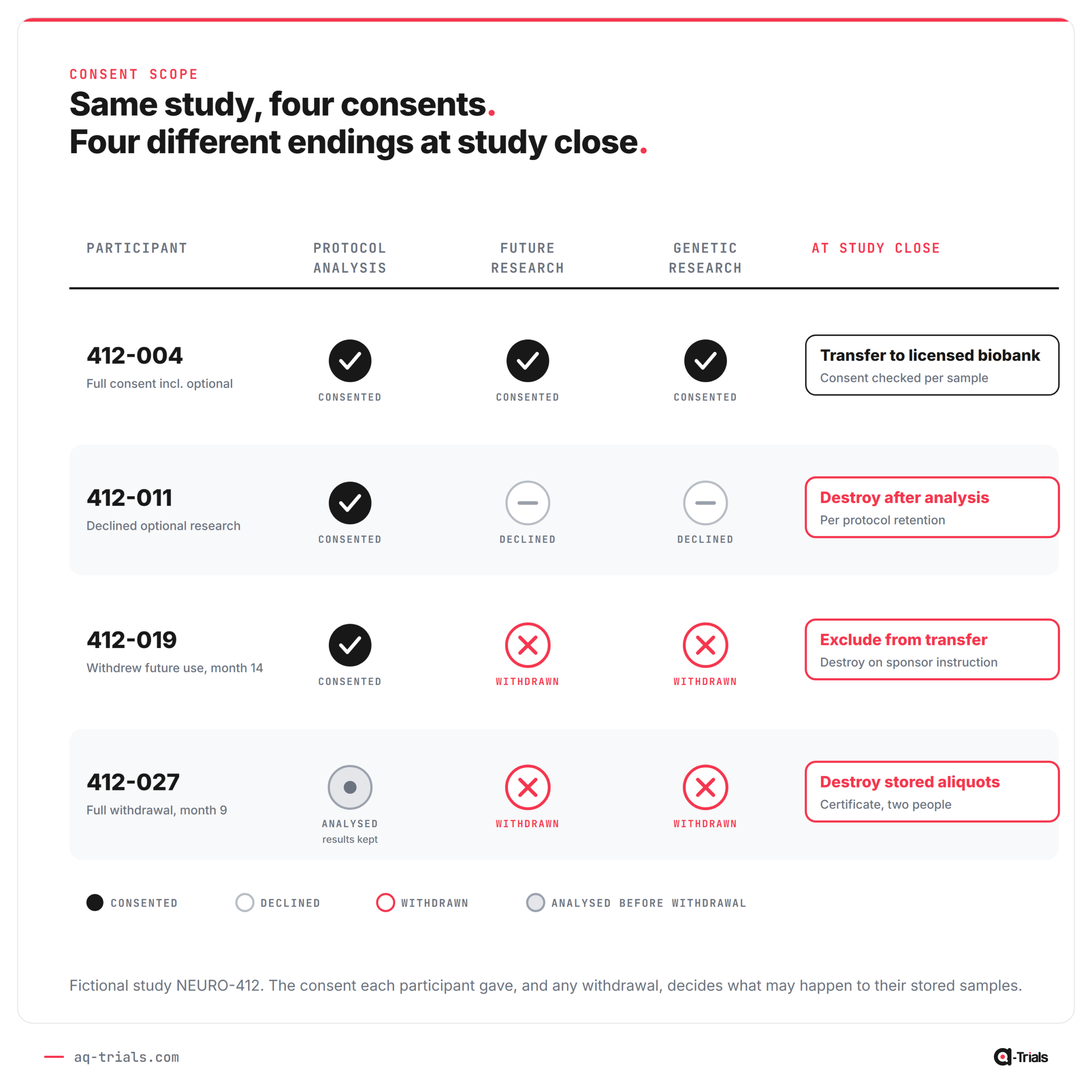
Consent sets what the site may do with each sample, and it is often layered. Core protocol samples come with consent to take part. Optional elements, such as future research, sit on separate tick boxes or initials. Code E advises that donors be told the value of generic consent for future research, the types of research involved, and the circumstances under which tissue will be disposed of. A complete site record captures these items for each participant:
- Consent form version and date, which ties the participant’s choices to the approved wording.
- Core protocol samples, covered by consent to take part, which allows analysis set out in the protocol.
- Optional future research, recorded as agreed or declined, which decides whether samples can outlive the study.
- Genetic research, where the form asks separately, which matters for DNA samples.
- Transfer, export or commercial use, where the form mentions them, which Code E treats as matters for transparency at consent.
- Later changes: re-consent to a new version and any withdrawal, each dated, which keeps the current scope clear.
Samples carry personal data as well as tissue. Code E reminds researchers that UK GDPR and the common law duty of confidentiality apply alongside the Act. See UK GDPR for clinical trial sites for the data side.
What Happens to Samples When a Participant Withdraws Consent?
Code E states that consent may be withdrawn at any time, whether generic or specific, and that withdrawal cannot be effective where tissue has already been used. It adds that withdrawal from one purpose does not necessarily mean samples must be destroyed, and that withdrawal from future projects does not require data to be removed from existing ones. The practical outcome depends on the scope of the withdrawal.
| Scope of withdrawal | Further collection | Stored samples | Samples already analysed |
| From study treatment only | Continues as the protocol allows for follow-up | Kept and used as consented | Results kept |
| From optional future research | Core samples continue | Excluded from future research; retained or destroyed per protocol and sponsor | Results kept |
| From further participation | Stops | Handled as the consent form and protocol state | Results kept, as the information sheet usually explains |
| Full withdrawal with a request to destroy | Stops | Identified wherever held and destroyed on sponsor instruction | Cannot be withdrawn, since the tissue is used |
The site’s part is to record the withdrawal exactly and act on every sample. Seven steps cover it:
- Record the withdrawal with date, scope in the participant’s words, and who received it.
- Stop further collection where the scope requires it, and cancel any booked sample timepoints.
- Identify every affected sample: in site freezers, in transit, at the central laboratory and at any biobank.
- Notify the sponsor and the laboratories holding samples, within the timeline the protocol sets.
- Record the decision for each sample: retain for consented use, exclude from future research, or destroy.
- Complete destruction where decided, with a destruction record for each sample.
- Update the consent record so later shipments and transfers read the current scope.
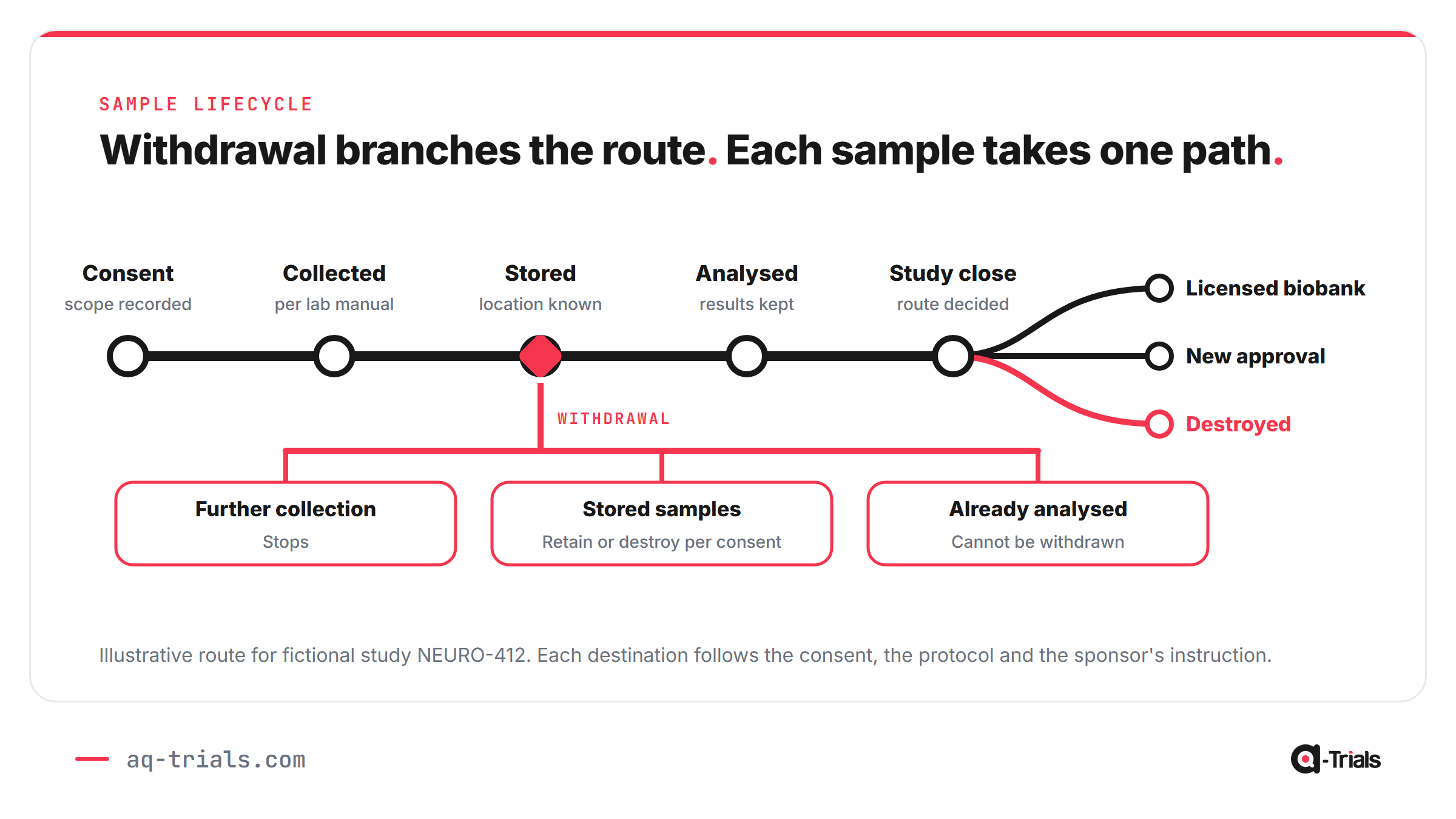
A withdrawal in the notes describes the participant. A withdrawal linked to each sample protects her.
How Long Are Clinical Trial Samples Retained?
Code E notes that the Human Tissue Act gives no minimum or maximum term for storage of tissue for research. The retention period comes from the protocol, the consent form, the lab manual and the sponsor’s agreement with the site. Sample retention also differs from record retention: the destruction certificate outlives the sample, and records follow the trial’s own archiving rules, as our guide to archiving and retention of trial records explains.
The end of the study is the point of decision. Code E states that once tissue is no longer stored for a project with recognised REC approval, it must be held on licensed premises if it is intended for a further scheduled purpose, and further research must sit within the original consent or new consent. The usual routes are these:
| End-of-study route | Applies where | Site record |
| Ship to the central laboratory or sponsor biobank | Future-use consent given, receiving premises licensed | Manifest, consent check per sample, receipt confirmation |
| Hold under a new ethics approval | A follow-on project with its own approval | Approval reference linked to each retained sample |
| Hold on the trust’s licensed premises | The trust holds an HTA licence and consent allows retention | Transfer into the licensed collection, with the Designated Individual’s agreement |
| Destroy | Analysis complete, consent limited to the study, or withdrawal | Destruction record per sample |
Retained samples travel under the same packaging rules as any other shipment, covered in our guide to shipping clinical trial samples. The final count belongs in sample reconciliation at study close.
What Should a Sample Destruction Record Hold?
Code E says donors should be told how their tissue will be disposed of, and that the Act permits disposal of surplus tissue as waste. It describes separate bagging from clinical waste as good practice, and asks for disposal details to be documented. A destruction record for trial samples typically holds nine fields:
- Study, participant and sample identifiers, one line per aliquot.
- Last storage location: unit, rack, box and position.
- Reason: end of retention, withdrawal, excursion discard or sponsor instruction.
- Authority: the sponsor’s written instruction or the protocol clause.
- Method, in line with the trust’s waste policy.
- Date and time of destruction.
- The person who destroyed the samples, delegated for the task.
- A second person who witnessed or verified the destruction.
- Reconciliation against the inventory, so the sample shows as destroyed everywhere it was listed.
The same discipline applies to investigational medicinal product. See IMP returns, reconciliation and destruction for the pharmacy equivalent.
Consent Held in the Notes Compared With Consent Linked to Each Sample
The central difference is where the consent decision travels. Consent held in the notes describes the participant. Consent linked to each sample travels with the aliquot to every freezer, shipment and destruction log.
| Aspect | Consent held in the notes | Consent linked to each sample |
| Optional future use | Ticked on the form, unknown at the freezer | Visible on every aliquot record |
| Withdrawal | Recorded in medical notes | Affected samples identified wherever held |
| End-of-study transfer | Shipping list built from the freezer | Transfer limited to samples whose consent allows it |
| Destruction | Paper log, often unsigned by a second person | Record per sample, with two people named |
What Do Monitors and Inspectors Check About Sample Retention?
Monitors trace each stored sample back to its consent, and the MHRA describes its approach in its good clinical practice inspection guidance. The HTA inspects the establishments it licenses against its licensing standards and codes of practice, including Code E on research. These questions recur:
- Does every stored sample have a signed consent on the approved version that covers its current use?
- Are samples from participants who declined future research excluded from transfers to a biobank?
- Was each withdrawal acted on for every sample, including those at the central laboratory?
- Is any sample held beyond its retention period or outside its ethics approval?
- Does each destruction have a record with reason, authority and two named people?
- Were the people who destroyed samples on the delegation log for that task?
Consent forms, sponsor destruction instructions and certificates belong in the investigator site file. Freezer records that support them are covered in our guide to clinical trial sample storage.
Also Read: MHRA GCP Inspections: What to Expect and the Most Common Findings
How Does AQ Labs Support Consent Withdrawal, Retention and Destruction?
AQ Labs is the lab sample management module of AQ Platform, built for UK and NHS research sites. It keeps one record of every sample until it is analysed, stored or destroyed.
- A withdrawal and its scope are recorded, and every affected sample is identified wherever it is held, which closes the gap between the notes and the freezer.
- Further collection stops, and decisions on stored samples are recorded in line with the consent given, the protocol and the Human Tissue Act where it applies.
- Consent and retention decisions are recorded with reference to the Human Tissue Act, which keeps the basis for each retained sample visible.
- Destruction requires two different people and re-authentication, and produces a certificate.
- Records link to delegation, training and the site file, on UK-hosted AQ Platform, which meets the NHS DSPT standard.
Samples already analysed cannot be withdrawn. AQ Labs is priced and deployed as its own module. Book a live demo to see a withdrawal traced from the consent record to every affected aliquot.
Frequently Asked Questions
Does the Human Tissue Act apply to clinical trial samples?
It applies to relevant material, meaning material other than gametes that consists of or includes human cells, stored or used for research in England, Wales and Northern Ireland. Whole blood, cells and tissue are relevant material. Scotland has the Human Tissue (Scotland) Act 2006.
Do research sites need an HTA licence to store trial samples?
Storage for research generally needs an HTA licence. Material held for a specific project approved by a recognised research ethics committee, including an approved clinical trial, is exempt for that project. Storage after the approved project ends needs licensed premises if the material is kept for further research.
What happens to samples when a participant withdraws consent?
Further collection stops where the withdrawal covers it, and stored samples are handled as the consent form, protocol and sponsor instruct, which may mean destruction. HTA Code E states that withdrawal cannot be effective for tissue already used, so results from analysed samples remain.
How long can clinical trial samples be kept?
The Human Tissue Act sets no minimum or maximum storage term. The protocol, consent form and sponsor agreement set the retention period, and samples kept after the study need consent for the further use and suitable approval or licensed storage.
What should a sample destruction certificate include?
Sample and participant identifiers, last location, reason, the sponsor or protocol authority, method, date, the delegated person who destroyed the samples, a second verifying person, and reconciliation against the inventory.