Sample reconciliation in a clinical trial is the comparison of the samples a study expected with the samples the site collected, shipped, and the laboratory received and analysed, with a recorded reason for every difference. A reconciled study can explain each missing number, and every laboratory query behind those numbers is closed with its answer on file.
The gap usually surfaces at close-out. In the fictional study RESP-307, the central laboratory’s final listing shows 337 analysed samples against 360 expected. The monitor asks for the reason behind each of the 23. The site finds missed visits in the visit log, two discarded samples in an excursion email, three haemolysis queries in a shared inbox, and one sample with no record after collection.
This guide covers the four counts behind reconciliation, where they diverge, how to answer central laboratory queries, how to handle missing, haemolysed and unlabelled samples, and what monitors check at study close. It forms part of our guide to clinical trial sample management.
What Is Sample Reconciliation in a Clinical Trial?
Reconciliation lines up four counts for each participant, visit and sample type. Each count comes from a different record, and each step between them needs an explanation.
| Count | What it means | Where the number comes from |
| Expected | Samples the protocol and lab manual require for the visits that should have happened | Sample schedule against the visit schedule |
| Collected | Samples actually drawn and processed at the site | Collection and processing records |
| Shipped | Samples packed and handed to the courier | Shipment manifests and courier records |
| Received and analysed | Samples the laboratory logged on arrival and reported a result for | Laboratory receipt reports and data listings |
Samples sent to the local NHS laboratory follow the same logic with a shorter chain. Samples that stay in storage at close add a fifth state: retained, returned or destroyed. The handling steps behind each count are set out in our guide to clinical trial sample tracking.
Where Do the Sample Counts Diverge?
Some differences are expected and need only a reason. Others point to a lost sample or a broken record and need action. The fictional RESP-307 listing shows both kinds.
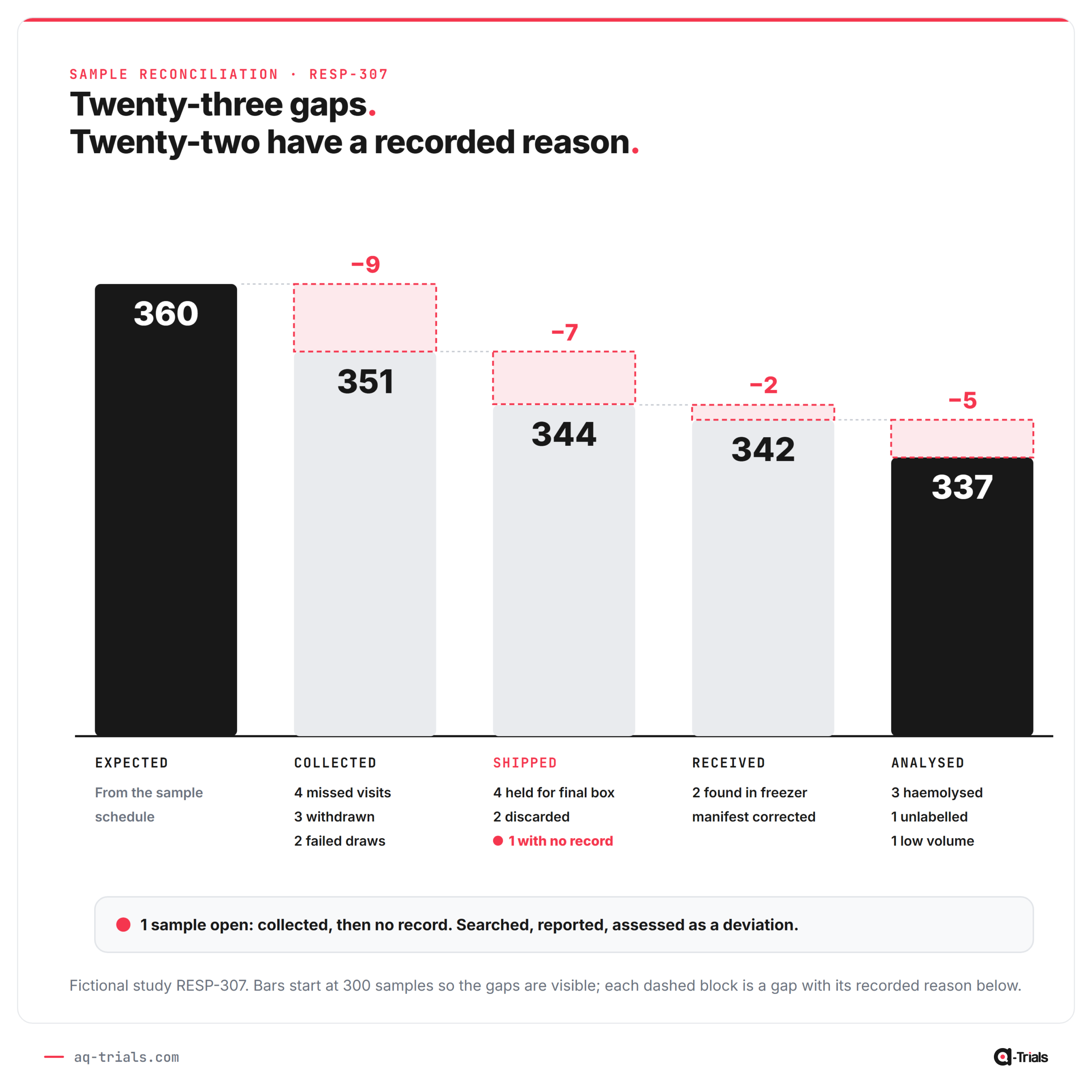
| Step | Gap (fictional) | Reasons found | Status |
| Expected to collected | 9 | 4 missed visits, 3 participants withdrawn before the visit, 2 failed draws | Explained |
| Collected to shipped | 7 | 4 held for the final batch shipment, 2 discarded on sponsor instruction after a freezer excursion, 1 with no record after collection | 1 open |
| Shipped to received | 2 | 2 tubes listed on a typed manifest and later found in the site freezer | Explained, manifest corrected |
| Received to analysed | 5 | 3 haemolysed, 1 unlabelled, 1 insufficient volume | Explained, queries closed |
Twenty-two of the gaps had a reason. The twenty-third is the one the monitor will remember.
What Is a Laboratory Query?
A laboratory query is a request from the central laboratory, or from the sponsor’s data team, to confirm or correct information about a sample. Queries arrive through the laboratory’s portal or by email, often weeks after the visit. Most fall into six types.
- Missing data: no collection time, no requisition form, or a blank field on the requisition.
- Identity mismatch: the tube label, the requisition and the manifest disagree on participant, visit or timepoint.
- Manifest difference: a sample on the manifest and absent from the box, or the reverse.
- Sample quality: haemolysed, clotted, insufficient volume or thawed on arrival.
- Handling limit: a processing or freezing time outside the lab manual limit, or one the site cannot evidence.
- Unexpected sample: a sample for a timepoint the laboratory did not expect, or for a participant it has not registered.
Each open query is a reconciliation line waiting for a reason. The answer to most of them sits in the sample’s own handling history.
How Should a Site Answer a Central Laboratory Query?
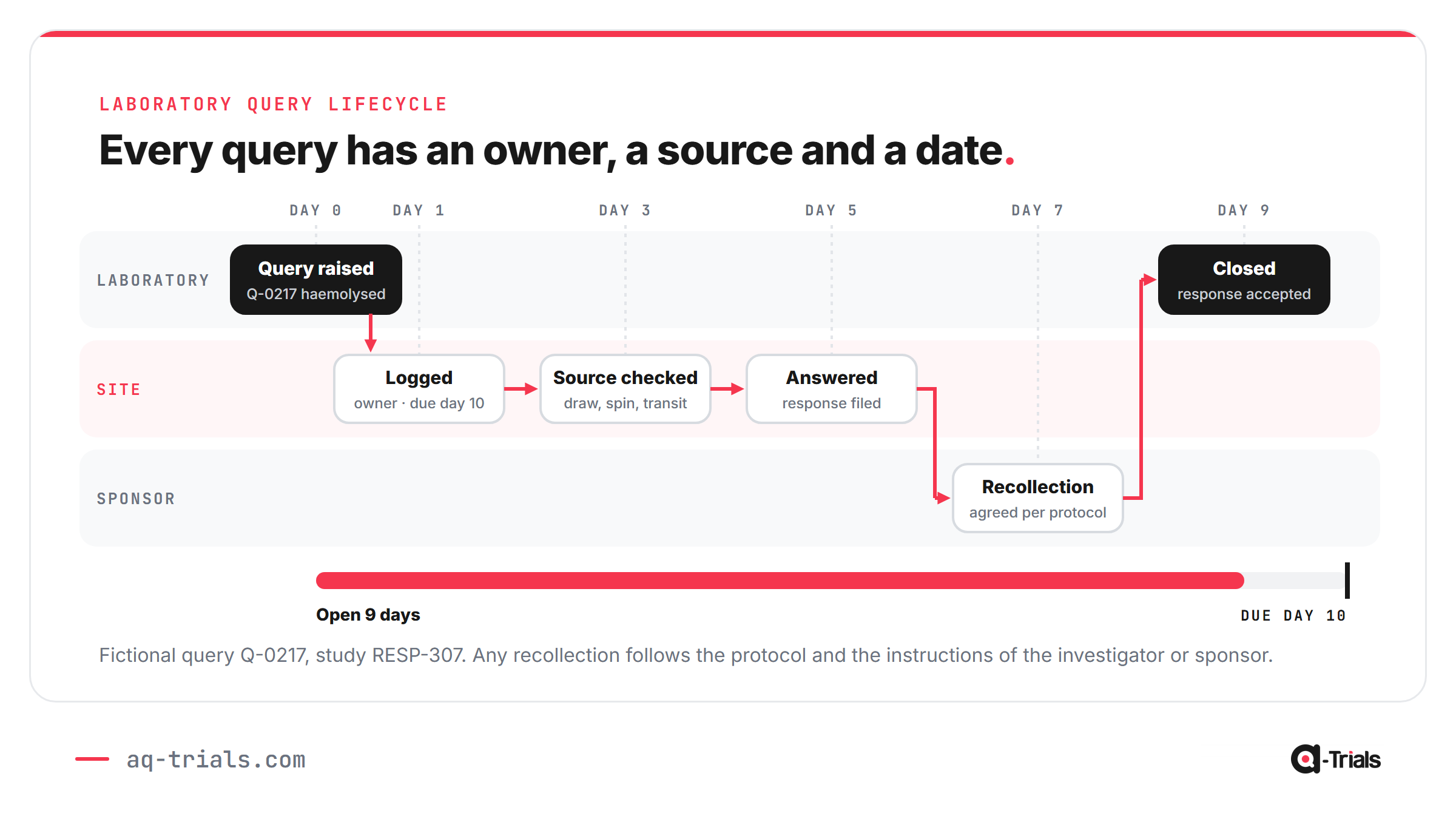
A query answer is a record in its own right. It must come from source, name the person who gave it, and be retrievable at close. Six steps keep each answer defensible.
- Log the query against the sample it concerns, with the date received, an owner and a due date.
- Check source: the collection record, processing times, storage location, manifest and courier handover for that sample.
- Answer from the record, and state plainly where the record holds no answer. A time reconstructed from memory is a new problem.
- Agree any correction with the laboratory or sponsor. The site corrects its own records with a dated, attributed change, and the laboratory corrects its database.
- Arrange any recollection in line with the protocol and the instructions of the investigator or sponsor.
- Close the query with the response filed, and assess whether the cause is a deviation.
Sites with source data held across several systems take longest to answer. See what counts as source data in a clinical trial for the records a query answer can rely on.
How Should a Site Handle Missing, Haemolysed and Unlabelled Samples?
Three sample problems drive most rejected results. Each has a typical cause at the bench and a fixed set of facts the site records. The lab manual and the sponsor set the response for each study.
| Problem | Typical causes | Site response | What the site records |
| Missing sample | Missed visit, failed draw, sample left in storage, sample packed into another shipment | Search storage and other manifests, then confirm the outcome with the laboratory | Search result and the reason, or a lost-sample report |
| Haemolysed sample | Difficult draw, narrow needle, vigorous mixing, delay before the spin, rough transport | Recollection where the protocol allows, and a review of draw and processing practice | Query response, recollection outcome and any trend across staff or visits |
| Unlabelled or mislabelled sample | Labels printed for the wrong visit, labels applied away from the participant, labels lost to frost | The laboratory and sponsor decide; the site never relabels a sample from memory | Facts known from the manifest and records, and the sponsor’s decision |
| Insufficient volume | Short draw, wrong tube, aliquot volume changed in a new lab manual version | Check the volume against the current lab manual, and retrain where the version changed | Query response and any training record |
Many of these causes start at the bench, in the processing step the lab manual sets. See from lab manual to bench: processing trial samples within study limits. Samples lost or damaged in transit are covered in our guide to shipping clinical trial samples.
Reconciliation at Close Compared With Continuous Reconciliation
The central difference is when the reason is recorded. A site that reconciles at close reconstructs reasons months after the event. A site that reconciles continuously records each reason as the difference appears.
| Aspect | Reconciliation at close | Continuous reconciliation |
| Timing | A single pass at the laboratory’s final listing | At every visit, shipment and laboratory receipt |
| Reasons | Rebuilt from inboxes, visit logs and memory | Recorded on the sample when the difference appears |
| Lost samples | Found months later, when a search is no longer useful | Found within days, while storage and courier records are fresh |
| Queries | Open queries counted at the close-out visit | Each query tracked with an owner and a due date |
| Close-out visit | Spent on finding answers | Spent on confirming answers |
What Happens to Sample Reconciliation at Study Close?
Close-out turns a running reconciliation into a final one. Every sample reaches a final state, and every supporting record reaches the site file. Seven tasks make up the sample side of close-out.
- Final shipment of samples held for batching, with a manifest and a laboratory receipt.
- Final listing from each laboratory, compared line by line with the site’s own counts.
- Open queries closed, each with a response on file.
- Stored samples left at close shipped, destroyed under sponsor instruction with a destruction certificate, or retained under consent and the approved protocol.
- Collection supplies reconciled and returned or disposed of under sponsor instruction.
- Storage records closed, with the study’s boxes cleared from shared freezers.
- Site file complete: manifests, receipts, query responses, laboratory certificates, reference ranges and the signed reconciliation.
Retention and destruction carry their own legal conditions under the Human Tissue Act 2004. See consent withdrawal, retention and destruction of trial samples. Unused kits follow the close-out steps in lab kit management in clinical trials, and freezer clearance follows clinical trial sample storage.
Also Read: How Should a Site Manage IMP Returns, Reconciliation and Destruction?
What Do Monitors Check About Sample Reconciliation at Close-Out?
Monitors test reconciliation by sampling. They pick participants and timepoints and follow each sample from schedule to result. Seven questions come up repeatedly.
- Does every expected sample have a final state: analysed, retained, destroyed or explained as never collected?
- Is there a recorded reason for every difference between the four counts?
- Are all laboratory queries closed, with responses traceable to source?
- Were safety results reviewed and signed by the investigator where the study requires it?
- Were deviations raised for missed limits and lost samples, and assessed in the quality system?
- Is there a destruction certificate for every destroyed sample?
- Are manifests, receipts and laboratory certificates filed in the investigator site file?
ICH E6(R3) expects trial records that are attributable, complete and retrievable, and the MHRA describes its approach in its good clinical practice inspection guidance. Investigator review of safety results is covered in investigator review of safety lab results, and the documents the site file must hold are listed in the ISF essential documents checklist.
Also Read: What Is Inspection Readiness in Clinical Trials?
When Should a Sample Discrepancy Become a Deviation or CAPA?
A single explained gap, such as a missed visit, is usually recorded in reconciliation alone. A discrepancy that breaks the protocol, the lab manual or the site’s procedures is assessed as a deviation. A pattern needs a corrective and preventive action (CAPA). The site’s SOP and the sponsor’s definitions set the threshold, and four signals are common.
- A sample with no record after collection, which is a chain of custody failure.
- A processing or freezing limit missed, which breaks the lab manual.
- Repeated haemolysis or labelling errors across visits or staff, which points to a training or process cause.
- Samples retained after consent withdrawal or past their approved retention, which carries a legal exposure.
See managing deviations in clinical research, a CAPA example walked through step by step, and CAPA effectiveness verification for proof that a fix held.
How Does AQ Labs Support Sample Reconciliation?
AQ Labs is the lab sample management module of AQ Platform. It keeps one record of every sample from the lab manual to its final state, on the same record as the site file.
- Expected, collected, shipped and analysed samples are reconciled continuously, with a reason recorded for every difference, which leaves close-out to confirm answers already on file.
- Each laboratory query is linked to the sample it concerns, with an owner, a due date and the sample’s full history, which puts the source for each answer in one place.
- Any recollection is recorded and scheduled in accordance with the protocol and the instructions of the investigator or sponsor.
- A missed processing limit can be raised as a deviation and, where needed, a corrective action in AQ CAPA.
- Destruction is completed under a two-person control and produces a certificate, which gives the monitor the evidence for every destroyed sample.
Manifests, laboratory certificates, reference ranges and signed result reviews are linked to the AQ eISF site file as work is completed. AQ Labs is priced and deployed as its own module. Book a live demo to see a study reconciled from expected to analysed, with a reason on every gap.
Frequently Asked Questions
What is sample reconciliation in a clinical trial?
Sample reconciliation compares the samples a study expected with those the site collected and shipped and the laboratory received and analysed. Every difference between the counts carries a recorded reason, and every laboratory query is closed with its response on file.
What is a central laboratory query?
A central laboratory query is a request to confirm or correct information about a sample, such as a missing collection time, a label that does not match the requisition, a manifest difference or a sample quality problem. The site answers from source and files the response.
Can a site relabel an unlabelled trial sample?
The laboratory and the sponsor decide what happens to an unlabelled or mislabelled sample. The site supplies the facts it can evidence from the manifest and its records, and never relabels a sample from memory.
What causes haemolysed samples in clinical trials?
Common causes are a difficult draw, a narrow needle, vigorous mixing, a delay before centrifugation and rough handling in transport. Repeated haemolysis across visits or staff points to a process or training cause worth assessing as a deviation.
What do monitors check about samples at close-out?
Monitors check that every expected sample has a final state, every count difference has a reason, all laboratory queries are closed, destroyed samples have certificates, and manifests, receipts and laboratory certificates are filed in the investigator site file.