Investigator review of lab results is the documented assessment of each safety laboratory report a trial participant’s samples produce. A qualified investigator reads the report, judges every out-of-range value as clinically significant (CS) or not clinically significant (NCS), signs and dates the review, and carries any significant finding into the adverse event record where the protocol requires it.
The record usually fails quietly. In the fictional study RESP-307, a central laboratory report for participant 307-012 arrives on the portal on a Tuesday, with potassium flagged high. A research nurse prints it and files it in the participant folder. The principal investigator (PI) is on leave, and the sub-investigator never sees the folder. Three weeks later the monitor finds the report unsigned, the next dose already given, and no assessment on file.
This guide covers result routes, flags, CS and NCS records, adverse events, timeliness, delegation and common findings. It forms part of our guide to clinical trial sample management and describes documentation practice only. Clinical judgement stays with the investigator.
What Does Investigator Review of Lab Results Involve?
Review is a short chain of steps, and each step leaves its own record. The chain starts when the report reaches the site and ends when the signed review sits in the participant’s file.
| Step | What happens | What the record shows |
| Receive | The report arrives from the central lab portal, by email or from the hospital laboratory system | Date of receipt, so review time can be measured |
| Route | The report reaches a delegated investigator | Who it was sent to and when |
| Read | The investigator reviews every value, including those inside the reference range | The full report, with reference ranges and units |
| Assess | Each out-of-range value is judged CS or NCS | One assessment per flagged value, with a comment where needed |
| Sign and date | The investigator signs and dates the review | Name, signature and date of review |
| Act | A CS value follows the protocol’s adverse event and safety rules | Adverse event entry, repeat test or sponsor report as the protocol sets |
| File | The signed report joins the participant’s source record | Location declared in the source data plan |
The weakness sits between the steps, where a report waits in an inbox, a tray or a portal for someone to notice it.
Where Do Safety Lab Results Come From?
Most studies use two routes at once. Safety bloods such as full blood count and urea and electrolytes may go to the local NHS laboratory for a same-day result, while the sponsor’s central laboratory analyses protocol samples and returns its own reports. Each route reaches the investigator differently.
| Aspect | Local NHS laboratory | Central laboratory |
| How the result arrives | Hospital laboratory system or electronic patient record (EPR) | Sponsor’s lab portal, email or fax alert |
| Reference ranges | The hospital laboratory’s own ranges | The central laboratory’s ranges, issued with each report |
| Flags | High and low flags from the hospital system | Flags and alert values defined in the lab manual |
| Evidence of review | Easy to lose, since the result sits in the EPR | Signed copy of the report or a portal sign-off |
| Site file documents | Laboratory accreditation and reference ranges, updated when they change | The same, from the central laboratory |
Local results create the harder record problem. The value lives in the hospital system, and the evidence of investigator review has to live somewhere the monitor can see. Our guide to which record is the source when data sits in both the EPR and the trial system covers how to declare it, and printed reports that stand in for an original need to meet the rules for certified copies.
What Does an Out-of-Range Flag Tell the Investigator?
A flag is a statistical marker. It says a value falls outside the laboratory’s reference range, which is usually built to include about 95 per cent of a healthy reference population. The flag raises the question. The investigator answers it.
Clinical significance is that answer: a medical judgement on whether the value matters for this participant. The judgement belongs to the investigator, and the record should show the context it drew on. Protocols and sponsor guidance commonly point to these inputs:
- Baseline value, recorded at screening, which shows whether the result is new or long-standing.
- Change from the previous result, which separates a stable abnormality from a trend.
- Symptoms and examination findings at the same visit, which link the number to the person.
- Medical history and concomitant medication, which can explain an expected abnormality.
- Protocol thresholds, such as a grading scale named in the protocol (for example, the Common Terminology Criteria for Adverse Events in oncology), which set the study’s own definition of a reportable change.
Also Read: From Lab Manual to Bench: Processing Trial Samples Within Study Limits
How Should CS and NCS Assessments Be Recorded?
A complete review entry lets a monitor reconstruct the decision without asking anyone. It holds six elements.
- One assessment per flagged value, which shows each abnormality was considered on its own.
- CS or NCS, written in the form the protocol or site procedure sets, which removes ambiguity about the outcome.
- A comment for every CS value, and for an NCS value with an obvious explanation (such as a known baseline condition), which records the reasoning.
- The reviewer’s name and signature, which must match a delegated investigator on the delegation log.
- The date of review, set against the date of receipt, which shows timeliness.
- The follow-up: an adverse event entry, a repeat test or “no action”, which closes the loop.
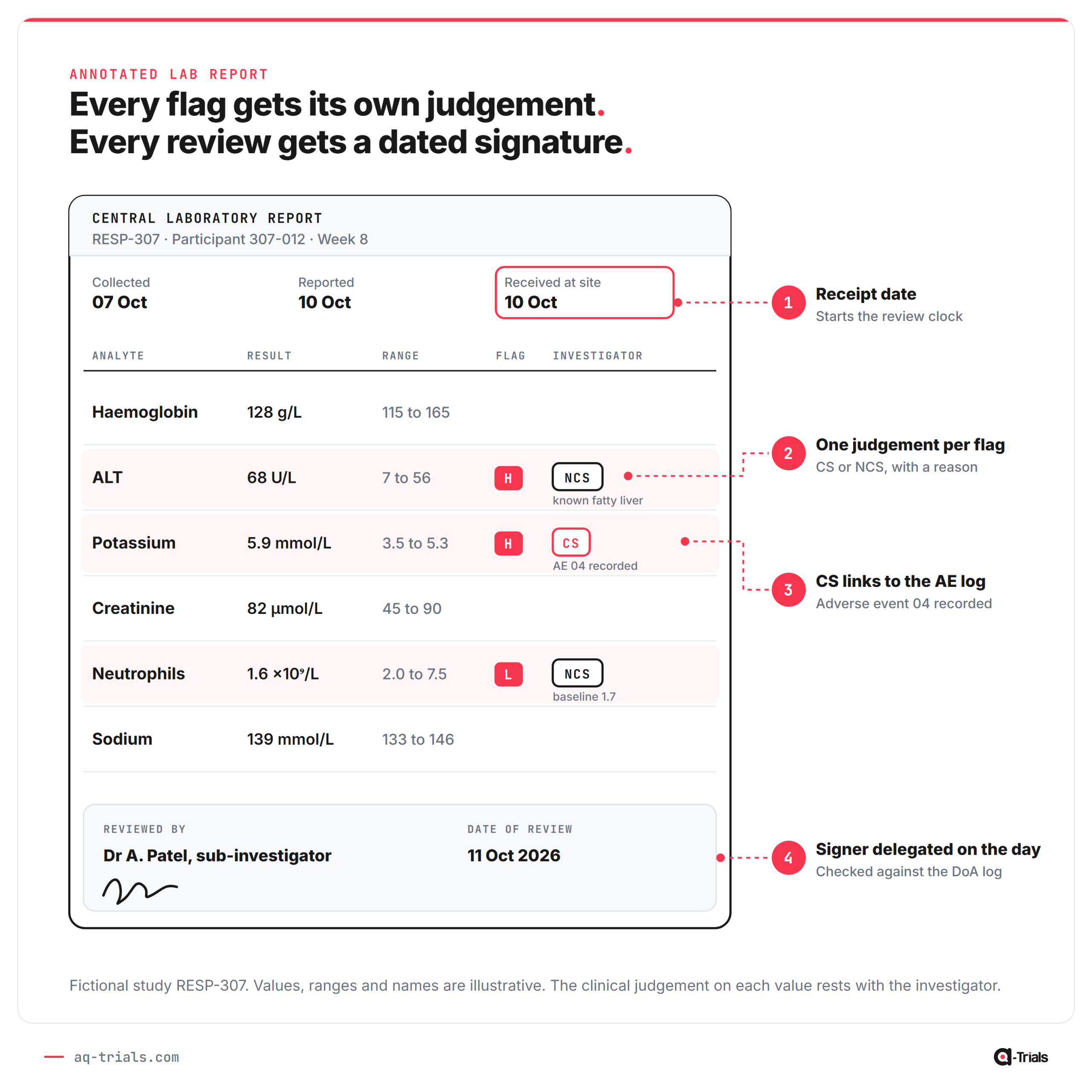
A tick at the foot of the page proves the report was seen. A mark beside each value proves it was judged.
When Does a Clinically Significant Result Become an Adverse Event?
The protocol decides. The ICH E2A guideline defines an adverse event as any untoward medical occurrence in a trial participant, and its definition expressly includes an abnormal laboratory finding. Protocols then set which laboratory abnormalities the site records and reports as adverse events. The ICH guidelines are published on the ICH efficacy guidelines page.
| Typical protocol rule | What it means for the record |
| CS abnormalities are recorded as adverse events | Every CS assessment after first dose links to an adverse event entry |
| Abnormalities that need treatment, cause discontinuation or meet a set grade are adverse events | The CS comment states which criterion applied |
| Abnormalities present at screening are medical history | Baseline CS values sit in medical history, and a later worsening is assessed again |
| Abnormalities named as critical to safety are reported to the sponsor within set times | The report date to the sponsor is recorded beside the review |
| Results meeting serious adverse event criteria follow expedited reporting | The serious adverse event form and its timestamp are filed with the review |
ICH E6 has long expected the investigator to ensure adequate medical care for adverse events, including clinically significant laboratory values, and to report laboratory abnormalities that the protocol identifies as critical to safety within the sponsor’s timelines. The CS assessment is therefore the start of a safety record. An unlinked CS value is a gap a monitor will query.
How Quickly Should Lab Results Be Reviewed?
ICH E6 sets no single deadline in days for result review. The protocol, the lab manual or the sponsor’s safety guidance often sets one, and the site’s own standard operating procedure (SOP) should set a default for studies that are silent. The clock starts at receipt. Four events shorten it:
- Eligibility: screening results must be reviewed before the participant is enrolled or randomised.
- The next dose: protocols with laboratory dosing criteria need review before the next administration.
- Alert values: central laboratories often telephone or email critical values, which need same-day review.
- Safety reporting windows: a result that meets serious adverse event criteria starts the protocol’s expedited reporting clock.
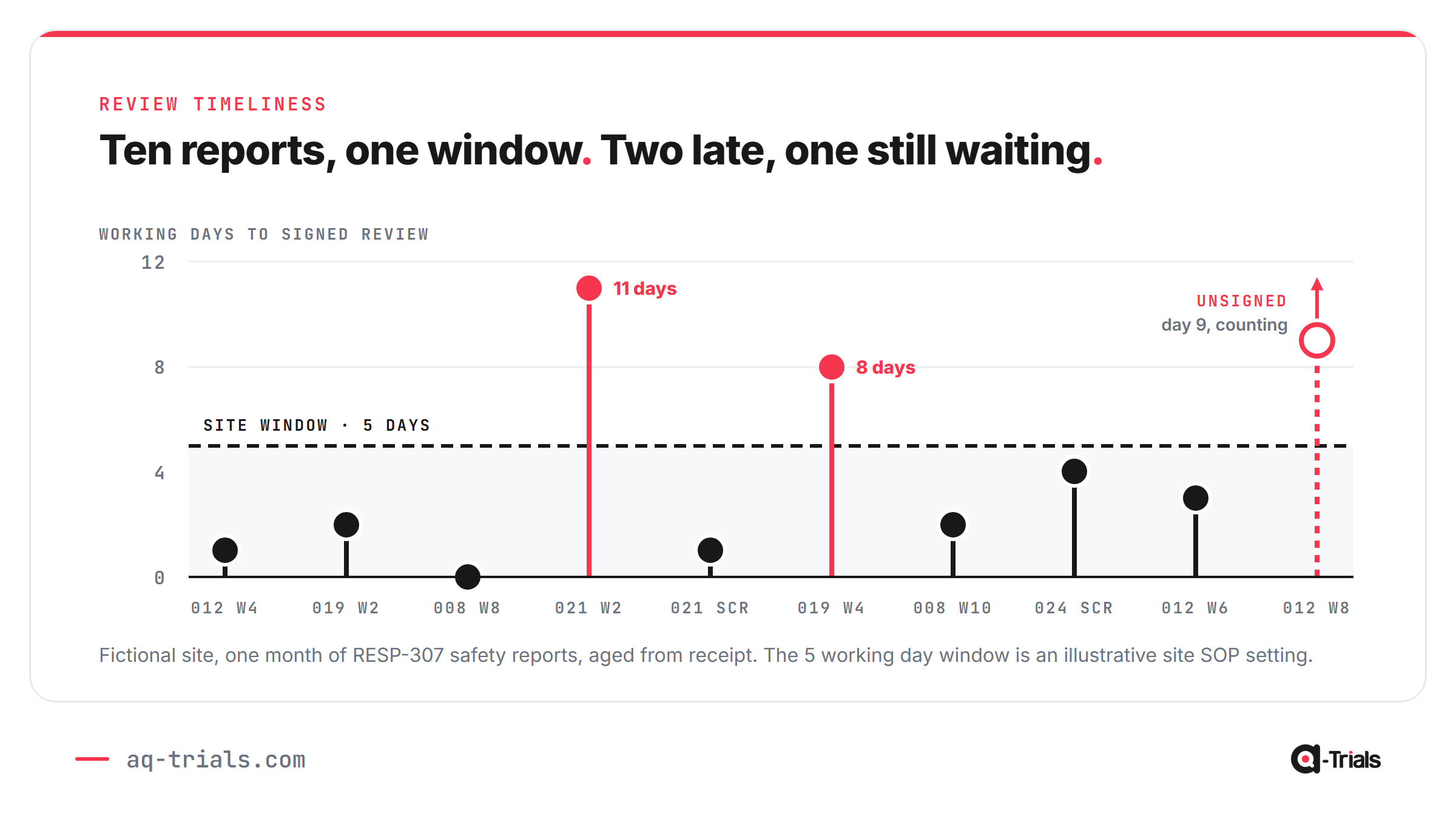
Late review usually has a routing cause: the wrong inbox, an investigator in clinic, a queue nobody can see. A visible list of unsigned reports, aged from receipt, fixes most of it.
Who Can Review Lab Results Under Delegation?
ICH E6 places trial-related medical decisions with a qualified physician (or dentist, where appropriate) who is an investigator or sub-investigator. A CS assessment is a medical decision. The PI may delegate it to named sub-investigators, and the delegation of authority log must show that task against each name, with start dates that cover the review date.
| Task | Typically delegated to | Evidence |
| Receive, file and chase reports | Research nurse, study coordinator | Receipt date and routing record |
| Highlight out-of-range values for review | Research nurse | Flagged report, with no assessment recorded |
| Assess CS or NCS and sign | PI or a delegated medical sub-investigator | Delegation log entry for result review, signature and date |
| Oversee the whole process | PI | Review metrics, SOP and evidence of follow-up |
A sub-investigator who signs before their delegation start date has signed without authority, as our guide to delegation effective dates explains. PI oversight of delegated review follows the same logic as PI oversight in an eSource audit trail.
What Are the Common Findings in Lab Result Review?
The same handful of gaps appear in monitoring reports and audits. Each has a system cause and a system control.
| Finding | How it usually arises | Control |
| Unsigned reports | Reports filed before review, with no list of what is outstanding | A queue of unreviewed reports, aged from receipt |
| Late review | Reports routed to one absent investigator | Review routed to any delegated investigator, with a site window in the SOP |
| Review by staff without delegation | Nurses or new doctors initialling reports to keep work moving | Sign-off restricted to staff delegated the task on that date |
| Batch signing before monitoring visits | Dozens of reports signed on one day | Review dates that show steady, timely review |
| CS values with no adverse event | Assessment and adverse event log kept apart | Each CS assessment checked against the adverse event record |
| Missing reference ranges | Laboratory updates its ranges and the site file keeps the old set | Current ranges and accreditation filed for each laboratory |
Repeated findings belong in the quality system. See managing deviations in clinical research for how a missed review is assessed and escalated.
Reports Signed on Paper Compared With a Review Queue
The central difference is visibility. Paper review records what happened to the reports someone found. A review queue shows every report that has arrived and is still waiting.
| Aspect | Reports signed on paper | Review queue on the sample record |
| Outstanding reports | Found by searching folders and portals | Listed, with age since receipt |
| Who can sign | Anyone holding a pen | Delegated investigators only |
| Assessment | Often one initial per page | CS or NCS per flagged value |
| Adverse event link | Checked by the monitor | Visible beside each CS assessment |
| Timeliness evidence | Handwritten dates | Receipt and signature times in the audit trail |
| Monitoring visit | Folders pulled and read page by page | Review history shown per participant |
What Do Monitors and Inspectors Check About Lab Result Review?
Monitors trace sampled reports forward to the assessment and back to the delegation. The MHRA describes its approach in its good clinical practice inspection guidance. Expect these questions:
- Has every safety report been reviewed, signed and dated by a delegated investigator?
- How long passed between receipt and review, and did review happen before dosing or enrolment decisions?
- Does each flagged value carry its own CS or NCS assessment?
- Does every CS value after first dose appear in the adverse event record where the protocol requires it?
- Are current reference ranges and laboratory accreditation on file in the investigator site file?
Also Read: MHRA GCP Inspections: What to Expect and the Most Common Findings
Also Read: The Investigator Site File Essential Documents Checklist
How Does AQ Labs Support Investigator Review of Lab Results?
AQ Labs is the lab sample management module of AQ Platform. It carries each sample through to result review where the study requires it, on the same record as the site file.
- Safety results appear in one review queue, which shows the investigator every report awaiting review.
- Out-of-range values are highlighted, and the investigator records whether each one is clinically significant, with comments where needed.
- AQ Labs does not pre-select the assessment, which keeps the judgement with the investigator.
- The investigator re-authenticates to record clinical significance and again to sign a result review.
- Trial safety samples sent to the hospital laboratory are tracked alongside research samples, with investigator review recorded.
- Signed result reviews link to the site file as work is completed, and records connect to delegation and training.
AQ Assist, the platform’s assistant, does not assess clinical significance or apply signatures. Result review sits after laboratory queries and before sample reconciliation in the sample lifecycle. AQ Labs is priced and deployed as its own module. Book a live demo to see a flagged result move from receipt to a signed review.
Frequently Asked Questions
What does CS and NCS mean on a lab report?
CS means clinically significant and NCS means not clinically significant. They record the investigator’s medical judgement on each out-of-range laboratory value, and each assessment should be signed and dated by a delegated investigator.
Who can sign off lab results in a clinical trial?
The principal investigator or a medically qualified sub-investigator delegated the task on the delegation log. ICH E6 places trial-related medical decisions with a qualified physician (or dentist) who is an investigator. Nurses and coordinators can receive, file and highlight reports.
Is every abnormal lab result an adverse event?
The protocol decides. ICH E2A includes abnormal laboratory findings in its definition of an adverse event, and protocols commonly record clinically significant abnormalities after first dose as adverse events. Abnormalities present at screening are usually medical history.
How soon must an investigator review lab results?
ICH E6 sets no single deadline. The protocol, lab manual or sponsor guidance often sets one, and the site SOP should set a default. Review must happen before eligibility and dosing decisions that depend on the result.
What do inspectors look for in lab result review?
Signed, dated and timely reviews by delegated investigators, an assessment for each flagged value, CS values carried into the adverse event record, and current reference ranges in the site file.