A delegation of authority log records who is permitted to perform each trial-related task, and from when. The signature confirms that the principal investigator authorised the person. The effective date is what makes the authorisation real. An activity performed before its effective date is unauthorised, regardless of a signature added later. Timing is the control that inspectors test, and it is the control most site files get wrong.
This guide explains what an effective date governs, why it outranks the signature as evidence, and how a retro-dated entry turns into a finding at inspection. It walks a worked example, sets out the fields a defensible log entry needs, and shows where timing links to training records and the site file. The scenarios here are illustrative NHS-style examples, not real trials.
Key Takeaways
- The effective date authorises the activity, not the signature. A task carried out before that date has no valid delegation behind it.
- Delegation is prospective. Authority applies from the effective date forward. A later signature cannot reach back and authorise earlier work.
- Training must complete before the effective date. An effective date that predates competency evidence fails the auditor’s check.
- The end date matters as much as the start. Activity performed after a delegation ends is as unauthorised as activity before it began.
- Timing is a data-integrity question. An unauthorised activity puts the data it produced in doubt, which is why the delegation log is a recurring MHRA finding.
What is a delegation of authority log?
A delegation of authority log, often called a delegation log or DoA log, is the record that shows which trial-related duties the principal investigator has delegated, to whom, and for what period. It sits in the investigator site file and is one of the essential documents an inspector expects to find. For a broader primer on the concept, read our guide to delegation of authority in clinical research.
The principle behind it is set out in ICH-GCP E6(R3). The investigator holds overall responsibility for the conduct of the trial at the site. The investigator may delegate significant trial-related tasks to suitably qualified people, and the investigator retains oversight of everything delegated. The log is the evidence of that arrangement. It converts a general responsibility into a specific, dated, attributable permission for each individual.
A delegation log entry carries several fields, and each field answers a question an inspector will ask.
- Who? The delegate’s name, role, and specimen signature or initials.
- What? The specific tasks delegated, defined precisely enough to test against the protocol.
- From when? The effective start date the authorisation begins.
- Until when? The end date the authorisation stops, whether by trial close, role change, or departure.
- On whose authority? The principal investigator’s signature and the date they signed.
The signature says the investigator agreed. The effective date says when the agreement takes force.
Why do effective dates matter more than signatures?
A signature is easy to treat as the finish line. The investigator signs, the row looks complete, and the log appears in order. That reading misses the point of the record. The signature is a static fact. It confirms that authorisation exists. The effective date is the operational fact. It defines the window inside which the delegated person could lawfully act.
Consider what happens when the two disagree. A research nurse performs an informed consent discussion on 3 March. The delegation log shows the investigator authorised that nurse for consent with an effective date of 10 March, signed on 10 March. The signature is present and valid. The activity still sits outside the authorised window by seven days. The consent discussion was performed without delegated authority, and a signature dated a week later does nothing to change that.
This is why timing outranks the signature as evidence. An inspector reads the effective date against the activity date, not against the signing date. The question is never whether authority was eventually recorded. The question is whether authority existed at the moment the task was performed. For the wider set of controls this sits within, see our guide to inspection readiness in clinical trials.
How a retro-dated gap becomes a finding
Retro-dating is the most common way effective dates go wrong. The activity happens first. The delegation gets recorded afterwards, once someone notices the gap. The following worked example traces how a single timing gap widens into a compliance problem. It is a hypothetical scenario at a fictional NHS site, Northgate General.
- 1 February. A new research nurse joins the study team. The site is busy, and she begins drawing study bloods and recording vital signs the same week.
- 1 to 20 February. She performs delegated procedures on eleven participants. Her GCP training certificate is dated 8 February, one week after she started the tasks.
- 21 February. A monitor prepares for a routine visit and asks for the delegation log. The nurse has no entry.
- 21 February. The investigator signs a delegation log row for the nurse. The effective date entered is 1 February, to match when she started.
- At the visit. The monitor compares the effective date of 1 February against the training certificate of 8 February. The delegation predates the training by a week, so the effective date cannot be genuine.
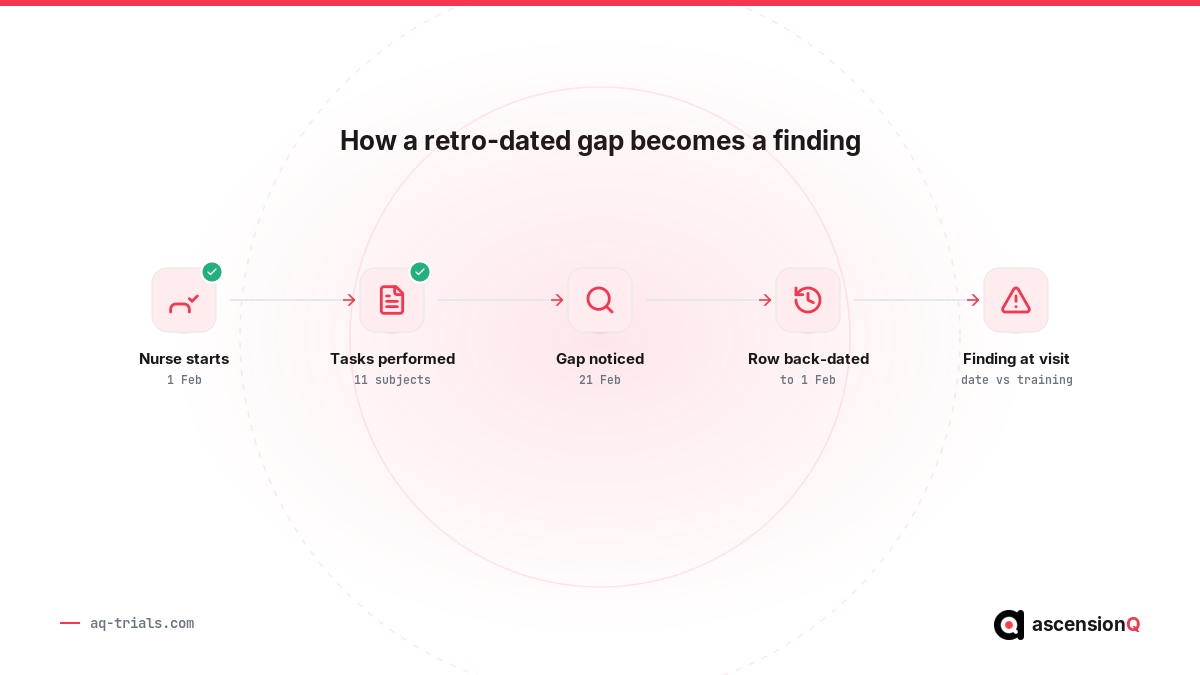
The single gap now touches three records. The delegation log carries an effective date that the training record contradicts. Eleven participants have procedures performed by a person with no valid delegation at the time. The data those procedures generated is open to challenge, because the person who produced it was not authorised to. What began as a missed administrative step became a data-integrity question, which is the category inspectors escalate.
The honest lesson is that back-dating never repairs the gap. It relocates it. A truthful effective date of 21 February would expose twenty days of unauthorised activity. A false effective date of 1 February exposes a contradiction with the training record. A persistent gap of this kind is the point at which a site should open a corrective and preventive action rather than quietly amend a row.
Also Read: CAPA Example: A Clinical Trial Deviation Walked Through Step by Step.
Signature-led vs effective-date-led delegation
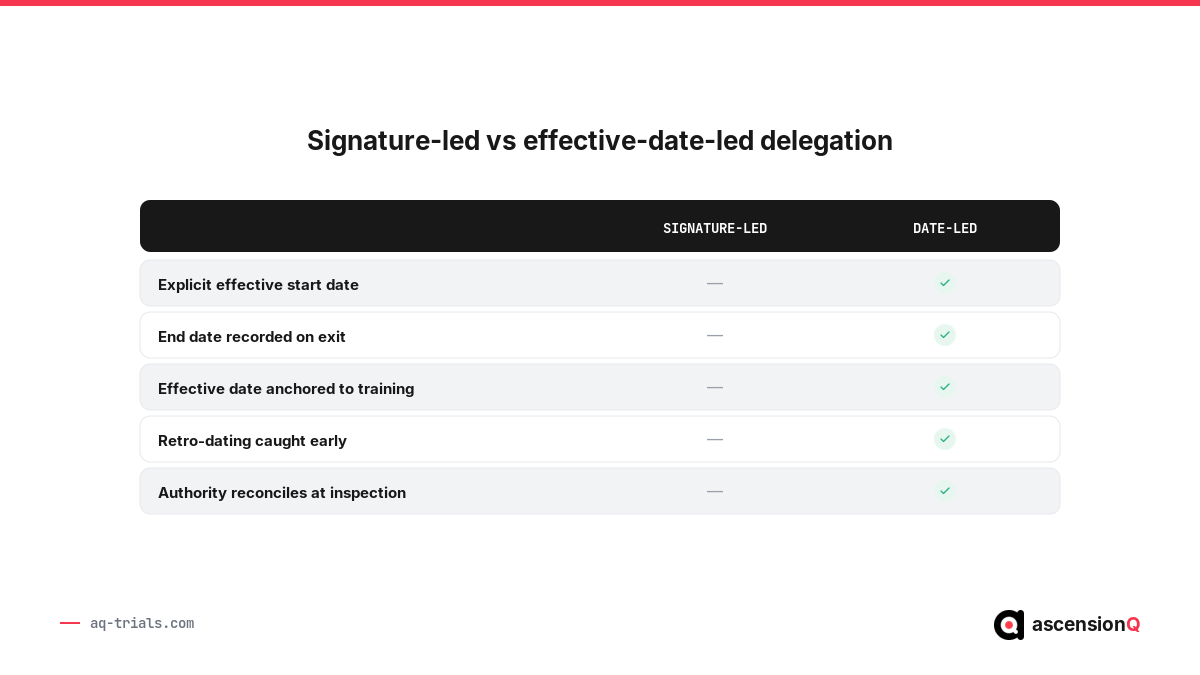
The difference between a log that passes and a log that fails is a difference of emphasis. A signature-led log treats the investigator’s signature as the objective. An effective-date-led log treats the dated window of authority as the objective, with the signature as one part of it. The table below sets the two approaches against the checks an inspector applies.
| Control point | Signature-led log | Effective-date-led log |
|---|---|---|
| What proves authority | The investigator’s signature is present | The activity falls inside a dated authorisation window |
| When authority begins | Assumed from the signing date or left unclear | Fixed by an explicit effective start date |
| Training relationship | Checked separately, if at all | Effective date set on or after training completion |
| Offboarding | Row often left open after a person leaves | End date recorded the day authority stops |
| Retro-dating risk | High, because a late signature looks complete | Low, because the date is checked against other records |
| Inspection outcome | Gaps surface when dates are cross-checked | Authority reconciles cleanly against activity and training |
What does an effective date actually control?
An effective date is not a single administrative field. It governs four separate things, and each one carries its own failure mode. The start point is only the first of the four, and a log that stops there misses the other three.
- The start of authority. The effective start date opens the window. Any delegated task performed before it lacks authorisation, which is the retro-dating failure.
- The end of authority. The end date closes the window. A delegated task performed after it is unauthorised in the same way, which is the offboarding failure.
- The scope of authority. The date attaches to specific tasks. A person authorised for vital signs from a given date holds no authority for consent, so scope and date are read together.
- The link to competency. The effective date must sit on or after the date training and qualification completed. An effective date that predates the evidence of competency is the contradiction inspectors look for.
Each of these produces a clean mechanism. A fixed start date means an activity can be tested against a window, which lets a monitor find an unauthorised task in seconds. A recorded end date means authority closes on departure, which prevents a leaver’s credentials lingering on the log. A task-specific scope means the delegation maps to the protocol, which stops a general permission covering work it never covered. A training-anchored effective date means authority follows competency, which keeps the two records consistent under inspection.
What does a defensible delegation log entry contain?
A defensible entry answers every question an inspector can raise about a single person’s authority without any external reference. The fields below make that possible. The delegation log itself belongs in the electronic Investigator Site File, alongside the training and qualification records it depends on.
| Field | What it records | Why an inspector checks it |
|---|---|---|
| Delegate name and role | The individual and their study role | Ties the authority to a named, attributable person |
| Delegated tasks | The specific duties, defined against the protocol | Confirms scope matches what the person actually did |
| Effective start date | The date authority begins | Tested against the first date each task was performed |
| End date | The date authority stops | Tested against the last date each task was performed |
| Training and qualification | GCP currency, protocol training, role competency | Must complete on or before the effective date |
| PI authorisation and date signed | The investigator’s signature and signing date | Confirms the delegation was made by the responsible person |
| Specimen signature or initials | The delegate’s identifying mark | Links source data entries back to the authorised person |
The delegation log is one of the essential documents that prove a trial was run properly. For the full set and how they are grouped, see the investigator site file essential documents checklist.
How does timing link training and the site file?
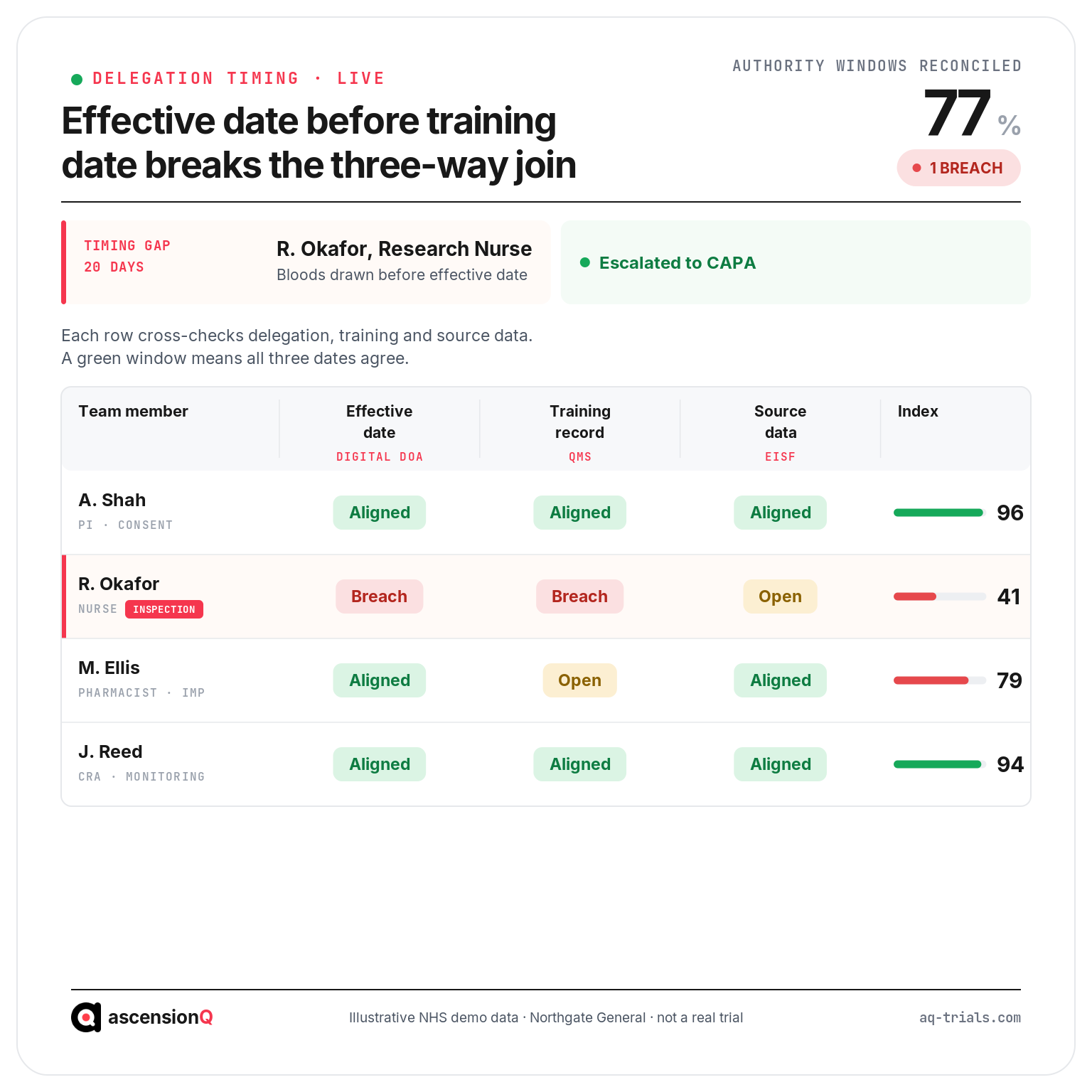
Inspectors rarely read the delegation log in isolation. They read it as one leg of a three-way join. The delegation log says a person was authorised for a task from a date. The training record says the same person was competent for that task from a date. The source data says the person performed that task on specific dates. The three must agree.
The join is where effective dates earn their weight. A delegation effective date that predates the training completion date breaks the join immediately, because authority appears to precede competency. A source data entry that predates the delegation effective date breaks it the other way, because work appears to precede authority. A robust site file keeps all three in step, and a connected quality management system holds the training evidence the effective date has to align with.
Also Read: How an electronic Investigator Site File keeps essential documents current.
Effective dates across the trial lifecycle
Effective dates are tested at every transition in a person’s involvement, not only at study start. Three moments carry the most risk, and each has a specific timing control.
- Onboarding. A new team member needs an effective start date set on or after the day their training and qualification complete. Authority begins there, and any task before it is unauthorised.
- Role change. A person who takes on a new task needs a fresh delegation for that task, with its own effective date. Existing authority for other tasks does not extend to the new one.
- Offboarding. A person who leaves the study, changes site, or moves role needs an end date recorded on the day their authority stops. An open-ended row is a standing invitation to a finding.
Staff turnover concentrates all three risks at once. A departure and an arrival often happen in the same week, and the handover is exactly where timing gaps open. The person changed. The authority record has to change with them, on the correct dates. This pressure is sharper still for a contract research organisation running many sites, which is why CROs move delegation off spreadsheets and onto a centralised system.
What are the risks of getting effective dates wrong?
The consequences of a timing gap run further than a single log correction. Each risk below traces back to an activity performed outside a valid authorisation window.
- Data integrity in doubt. Data produced by an unauthorised person is open to challenge, and challenged data can affect the analysis it feeds.
- Participant safety questions. A safety-critical task performed without delegated authority raises whether the person was competent to protect the participant.
- Inspection findings. Delegation and training gaps are among the areas MHRA inspectors write up most often, as set out in the MHRA good clinical practice inspection guidance.
- Escalation to CAPA. A persistent or repeated timing gap moves beyond a single correction into corrective and preventive action, with root-cause analysis and an effectiveness check.
- Reconstruction cost. A gap found late forces a site to reconstruct who did what and when, across records that a real-time control would have kept aligned.
How AQ Digital DoA supports effective-date control
The AQ Digital Delegation of Authority module treats the effective date as the primary control rather than the signature. It structures each delegation as a dated, task-specific window, and it holds that window against the training and site file records it has to agree with. The mechanisms below describe what the module does, and the section after them describes what it does not.
- Dated authorisation windows. Each delegation carries an explicit start and end date, so authority is defined by a window rather than a single signature.
- Training-linked effective dates. The module holds delegation alongside training evidence, which helps a site keep the effective date on or after competency completion.
- Task-specific scope. Delegation attaches to named tasks, so authority for one duty does not silently cover another.
- Joiner and leaver triggers. Onboarding and offboarding prompt the delegation change, which supports an end date being recorded the day authority stops.
- A complete audit trail. Every entry and change is time-stamped and attributable, which supports the ALCOA+ expectations inspectors apply to electronic records.
The module structures the record. It does not make the judgement. The principal investigator decides who is competent, what to delegate, and when authority should begin and end. AQ holds those decisions as dated, connected evidence and surfaces where a date and a training record disagree. The responsibility for the delegation stays with the investigator, and the platform makes that responsibility auditable. AQ is built around ICH-GCP E6(R3), MHRA expectations, and ALCOA+ principles, and it supports inspection readiness rather than guaranteeing any outcome.
To see how AQ holds delegation, training, and the site file as one connected record, book a 30-minute product tour.