A placeholder document in a Trial Master File is a marker that records an expected document before the real one arrives. It names the record the file should hold, holds its position in the structure, and shows the space as empty. A placeholder makes an absence visible. It does not fill the absence.
A placeholder is a question the file is asking: which record is missing, and who will supply it? A flag on its own leaves that question open. The record still has to be produced, chased, and filed by a named person against a due date. This guide explains what TMF placeholder documents are, where they come from, why a flag without an owner fails at inspection, and how to run a gap model that closes on time and escalates to CAPA management when it does not.
Key takeaways
- A placeholder records an expected document, not a filed one. It reserves the slot and marks the record as outstanding.
- A flag identifies a gap. An owner closes it. A gap with no accountable person and no due date is visibility without control.
- Placeholder, missing, and not applicable are three different states. Each needs a different decision and a different record.
- A persistent, unresolved gap is a quality signal. When a placeholder ages past its due date without progress, it should escalate into a documented CAPA.
- Inspectors read gaps as evidence of oversight. An owned, dated, tracked gap shows control. An orphaned flag shows the opposite.
What is a placeholder document in a TMF?
A placeholder document is an entry in the electronic Trial Master File that represents a record the trial expects to hold but has not yet received. It carries the metadata of the future document: its name, its position in the file structure, the artefact type, and often a target date. The slot exists. The content does not. The placeholder states that fact plainly and keeps the expected record on the map until it arrives.
The concept depends on knowing what the file should contain in the first place. That expectation comes from an expected document list, built from the trial’s own filing plan and mapped to the DIA TMF Reference Model. The Reference Model, maintained by the DIA TMF Reference Model initiative, defines the zones, sections, and artefacts a Trial Master File is structured around. The expected document list applies that structure to a specific study and states which artefacts this trial, at this stage, ought to hold. A placeholder is what sits in each expected slot until the real record replaces it. To see where the file itself fits in the wider documentation picture, read what an eTMF is in clinical trial research.
Placeholders exist because a Trial Master File is never complete at a single moment. Documents arrive across the study lifecycle. Some records are produced at set-up, some accrue during conduct, and some appear only at close-out. The file is expected to be contemporaneous under MHRA good clinical practice guidance, so the gap between an expected record and a filed one is normal. The placeholder is the honest way to represent that gap while it is open.
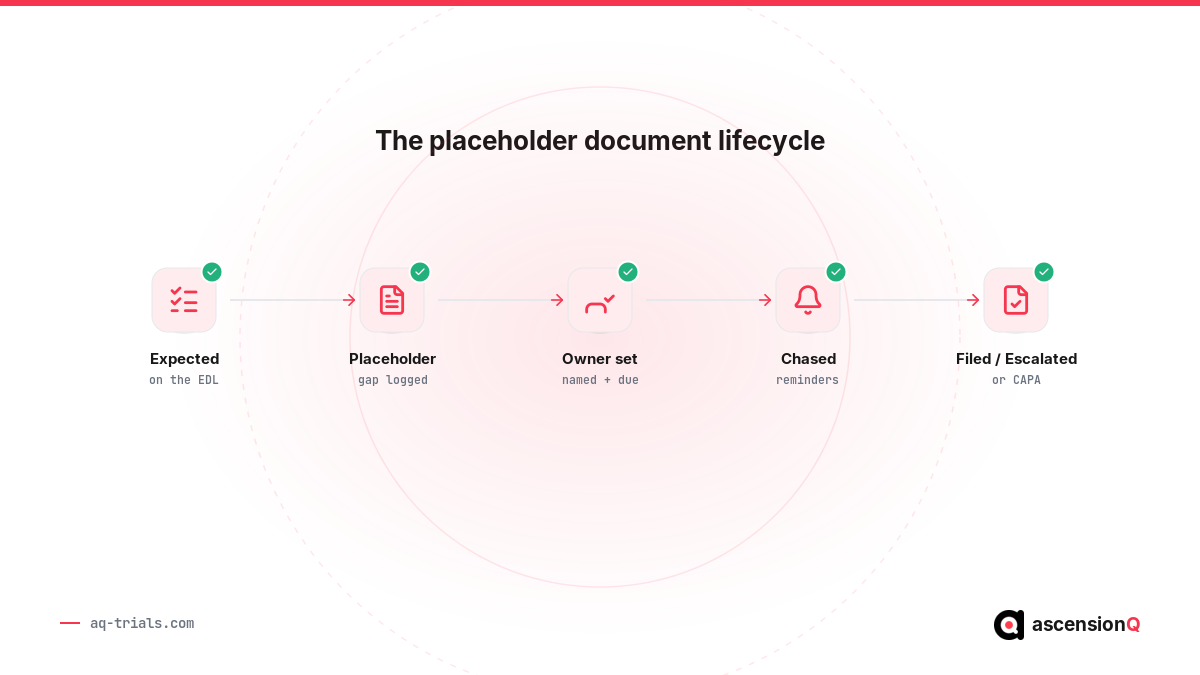
Where do placeholder documents come from?
Placeholders are generated the moment the expected document list is applied to a study. Each expected artefact that has not yet been filed becomes a placeholder. From there, placeholders enter the file through a small number of routine paths.
- Study set-up. The filing plan lists every essential record the trial will need. The system creates a placeholder for each one, so the whole expected structure exists on day one, most of it empty.
- Protocol amendments. An amendment introduces new expected records, such as a revised protocol, updated consent forms, and fresh approvals. Each new expectation adds a placeholder.
- Site activation. Every new site multiplies the site-level expected records, from delegation logs to local approvals. The file grows a set of placeholders per site.
- Milestone triggers. Interim analyses, safety reports, and close-out activities each carry expected outputs. The placeholder appears when the milestone is scheduled, ahead of the record itself.
Placeholders are a feature of a controlled file, not a fault in it. A file with no placeholders is not a complete file. It is a file that has stopped tracking what it still expects to receive.
Why does a flag on its own fail?
A flag marks a gap. That is useful, and it is where many systems stop. The flag sits on a dashboard, the count of outstanding documents is known, and the assumption is that someone will act on it. The weakness is in that assumption. A gap with no named owner belongs to everyone and therefore to no one. It is seen and left.
Consider a worked example, framed as a realistic operational scenario rather than a real trial. A site activates in March. The expected document list generates a placeholder for the current delegation log. The log is drafted, but a later version is expected once two research nurses complete their training. The placeholder stays open. It shows on the completeness report as one amber item among forty. No name sits against it. No due date sits against it. The coordinator assumes the sponsor is chasing it. The sponsor assumes the site will file it once training finishes. Training finishes in April. The updated log is filed nowhere, because the record that was supposed to prompt it was a flag with no owner.
The gap was visible the whole time. Visibility was never the problem.
At a monitoring visit in June, the missing current delegation log surfaces as a finding. The activity performed by the two nurses between April and June now sits against a delegation record that does not reflect their authority. This is the same failure pattern that turns an ordinary gap into an inspection issue, and it connects directly to how sites handle delegation of authority and effective dates. The system flagged the gap. The system did not close it, because closing a gap is an act performed by a person, not a dashboard.
Placeholder, missing, or not applicable: what is the difference?
Not every empty slot means the same thing. Treating all gaps as one undifferentiated pile hides the records that actually matter. The shift to essential records under ICH-GCP E6(R3) sharpens this point, because the file must hold the records and data that matter to a specific trial rather than a fixed checklist. A defensible file distinguishes at least four states, and records the reason for each.
- Placeholder (expected, outstanding). The record is due and has not yet arrived. It needs an owner, a due date, and follow-up.
- Missing (expected, overdue). The record passed its due date without arriving. It needs escalation, not just a longer wait.
- Not applicable (justified absence). The record is not required for this trial or site. It needs a documented rationale, so the absence is a decision rather than an oversight.
- Superseded (replaced by a later version). An earlier expected record was replaced. It needs a version history that shows the current record and retains the prior one.
The distinction between these states is what a monitor or inspector tests. An empty slot marked not applicable with a clear rationale is a controlled decision. The same empty slot with no note is a gap the file cannot explain. The completeness number can look identical in both cases, which is why a raw count of outstanding documents is a weak measure on its own. Deeper measurement is covered in TMF completeness tracking and RAG scoring.
Why does every gap need an owner, not just a flag?
An owner converts a gap from a status into a task. The difference is operational, and it shows up in each attribute the record gains once a name is attached to it.
- An owner creates accountability, which turns a shared assumption into a single responsibility. One named person answers for the record, so the gap stops falling between roles.
- A due date creates urgency, which turns an open-ended wait into a deadline. The record has a point at which absence becomes overdue and escalation begins.
- An assignment enables follow-up, which turns a static flag into a chased action. Reminders reach a real inbox, and the chase has a target.
- Ownership produces evidence, which turns closure into a documented event. The file records who resolved the gap and when, so the audit trail shows control rather than luck.
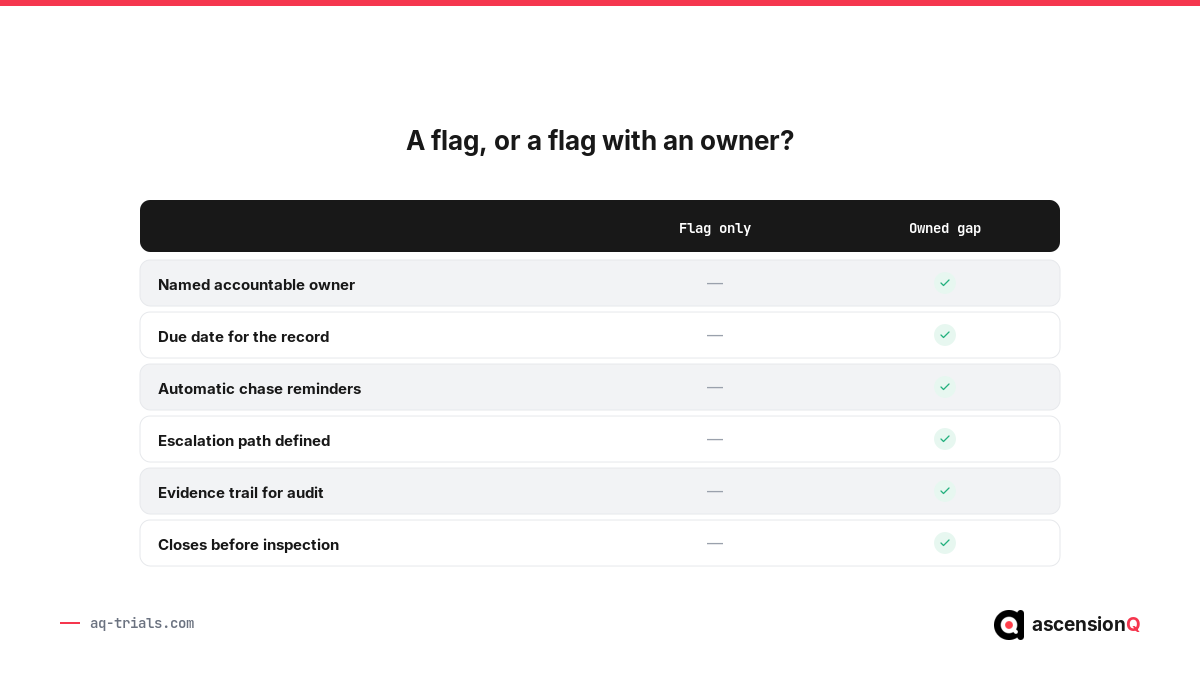
The contrast between a flag and an owned gap is the whole argument of this guide. The table below sets the two side by side.
| Aspect | Flag-only gap | Owned gap |
|---|---|---|
| Accountability | Shared, so effectively unassigned | One named owner answers for the record |
| Timing | Open-ended, closes when someone notices | Due date set, overdue state defined |
| Follow-up | Manual and dependent on memory | Automated reminders to the owner |
| Escalation | None, the flag simply persists | Defined path when the due date passes |
| Audit evidence | Shows the gap existed | Shows the gap was managed and closed |
| Inspection outcome | Reads as a lapse in oversight | Reads as oversight working as intended |
If your team is scoping how it manages outstanding records, our free guide to inspection-ready documentation walks through the owner-and-due-date model in practice. Find my guide.
How do you run a placeholder document model that holds?
A gap model works when every expected record has a state, an owner, and a due date from the moment it is expected. The mechanics are straightforward, and each one produces a specific outcome.
- Generate the expected document list first. Build the full set of expected records from the filing plan and the Reference Model, so every placeholder exists before conduct begins and nothing is expected without being represented.
- Assign an owner to each placeholder at creation. Attach a named, accountable person to the slot as it is generated, so no gap is ever ownerless.
- Set a due date against the milestone that produces the record. Tie the deadline to the event that should generate the document, so the timeline reflects the trial rather than a guess.
- Automate the chase. Send reminders to the owner as the due date approaches and passes, so follow-up does not depend on anyone remembering.
- Record the reason for any justified absence. Capture a rationale wherever a record is marked not applicable, so the file can explain every empty slot.
- Track ageing, not just presence. Measure how long each gap has been open, so a placeholder that drifts past its due date becomes visible as a risk rather than a permanent amber.
The register below shows the model applied to a small set of expected records for an illustrative NHS trust. Each record carries an owner, a state, and a readiness index. The row under inspection scrutiny is the one where the gap is overdue and the owner is still pending.
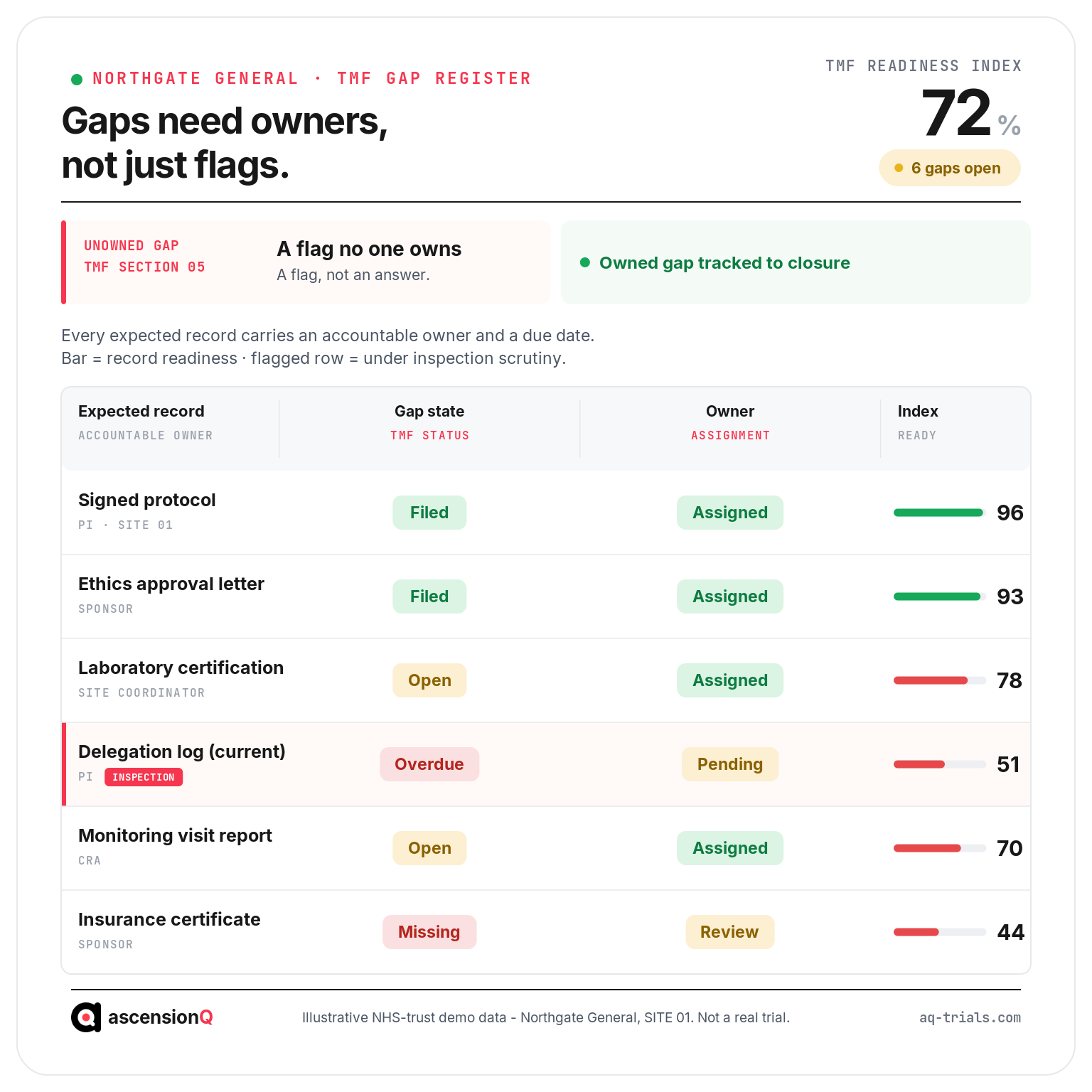
An owned gap is a controlled state. An orphaned gap is a finding waiting for a monitor.
When should a persistent gap escalate to CAPA?
Most placeholders close in the normal course of the study. The record arrives, the owner files it, and the slot fills. Escalation applies to the minority that do not. A gap becomes a quality issue when it stops behaving like a routine outstanding item and starts behaving like a control failure.
The trigger is a judgement, and it rests on a few clear signals: the record is overdue against its due date with no credible plan to close it; the same category of record is repeatedly late across sites, which points at a process cause rather than a one-off delay; or the missing record affects participant safety, data integrity, or the conduct of the trial. Any of these moves the gap from tracking into a CAPA action plan that addresses the root cause, rather than treating each late document as an isolated event.
The distinction matters because a recurring gap has a cause that filing one more document does not fix. A delegation log that is late at every site is not six separate slips. It is one process that produces late logs. Correcting the individual record is the corrective action. Changing the process so the records arrive on time is the preventive action. A worked version of that reasoning runs through this CAPA example of a clinical trial deviation, and the wider question of when to log versus escalate is covered in managing deviations in clinical research.
Also Read: TMF Completeness Tracking: How RAG Scoring Prevents Inspection Findings
What are the risks of flag-only gap tracking?
A file that flags gaps without owning them carries a set of predictable risks. Each one surfaces at the worst moment, usually a monitoring visit or an inspection.
- Gaps persist unnoticed. An outstanding record with no owner drifts until an external party finds it, by which point the activity it should have governed has already happened.
- Completeness numbers mislead. A high percentage complete can hide a small number of critical, ageing gaps, so the metric reassures while the risk grows.
- Accountability disappears at handover. Staff change and shared gaps have no owner to inherit them, so the record falls through the transition.
- Recurring causes stay hidden. Late records treated as one-offs never trigger the root-cause work that would stop them repeating.
- Inspection readiness erodes quietly. The file looks managed on the surface while the orphaned gaps accumulate underneath, which is precisely the condition inspection readiness is meant to prevent.
How AQ eTMF supports gap ownership
The AQ electronic Trial Master File is built around expected records rather than filed ones. It generates the expected document list from the trial’s filing plan mapped to the DIA TMF Reference Model, so a placeholder exists for every record the file should hold from set-up onward. Each placeholder is a tracked object with an owner, a due date, and a state, rather than a line on a report.
- Every gap carries a named owner, so accountability is assigned at creation rather than assumed later.
- Due dates tie to milestones, so the system knows when a placeholder becomes overdue and changes its state.
- Reminders reach the owner automatically, so follow-up runs without depending on memory.
- Ageing is tracked per record, so a drifting gap surfaces as a risk instead of a permanent amber.
- Persistent gaps route into CAPA management, so a control failure is handled as a quality event rather than another late document.
AQ is honest about the boundary of what a system can do. The platform makes every gap visible, owned, dated, and chased. It cannot produce the missing record, and it cannot make the judgement that a persistent gap has become a CAPA. Those remain human responsibilities. The system structures the work and holds the evidence. The people do the closing. That division is the point: technology removes the excuse that a gap was invisible, and leaves the accountability where it belongs.
A Trial Master File is judged on whether it can explain itself at any moment. Placeholders are how it explains what it is still waiting for. Owners are how it makes sure the wait ends. To see how AQ turns expected records into owned, tracked gaps across a study, book a 30-minute product tour.