The Date Site Confirmed is the date of the last contract signature across all the organisations involved at a site, or the date of NHS management permission in Scotland. From January 2026 that date became the end point of the 60-day site set-up metric in UK clinical research delivery reporting. The metric previously ran to the date the sponsor issued green light.
The change is small in wording and large in consequence. A site is now measured on the part of set-up it controls, and the wait between its own confirmation and the sponsor’s green light sits outside the count. This guide covers the definition, what moved, why the two site metrics no longer sum to elapsed time, the six dates a site has to record, where the clock starts, which studies are excluded, and what to change in practice.
Key Takeaways
- Date Site Confirmed is the last contract signature of every organisation in the chain, or NHS management permission in Scotland.
- The 60-day set-up metric now ends at that date. It previously ended at Date Site Ready to Start.
- The 30-day recruitment metric still starts at sponsor green light, so the gap between confirmation and green light falls inside neither metric.
- The 60-day and 30-day figures therefore no longer sum to the time actually elapsed.
- The study-level 150-day metric is unaffected by the change.
- Six data fields carry the whole picture, and each must match the national definition before it flows from LPMS to CPMS.
What Is the Date Site Confirmed?
The Date Site Confirmed marks the end of site set-up. UKCRD guidance on site-level performance reporting defines it as the date of the last contract signature of all the organisations involved, covering the sponsor, the site and any third party in the contract chain. Scotland uses the date of NHS management permission in place of the signature date.
The date carries a condition. A site should issue confirmation only once every step the sponsor required ahead of site initiation is complete.
- Training the sponsor listed as a pre-initiation requirement is finished.
- Study logs requested at site selection are in place.
- Pharmacy preparations stipulated at site selected are complete.
- Any known site-side delay to initiation, such as Principal Investigator availability, is resolved.
Sequence matters here. Site confirmation always takes place after HRA and HCRW Approval in England and Wales, NRS Approval in Scotland, or the equivalent study-wide review in Northern Ireland. A site can run set-up activity in parallel with regulatory review, and it can confirm its capacity and capability only once that review completes.
Example: a trust signs its contract for a commercial CTIMP on 14 March. The sponsor countersigns on 19 March. A third-party imaging provider signs on 22 March. The Date Site Confirmed is 22 March, the last of the three signatures, and not the date the trust itself signed.
What Changed in January 2026?
One milestone moved. The 60-day site set-up metric used to end at Date Site Ready to Start, the date the sponsor confirms green light. It now ends at Date Site Confirmed. Everything else in the site-level calculation holds its position.
| Element | Until December 2025 | From January 2026 |
| End of the 60-day set-up metric | Date Site Ready to Start | Date Site Confirmed |
| Start of the 30-day recruitment metric | Date Site Ready to Start | Date Site Ready to Start |
| End of the 30-day recruitment metric | First Patient First Visit | First Patient First Visit |
| Study-level 150-day metric | Unchanged by this revision | Unchanged by this revision |
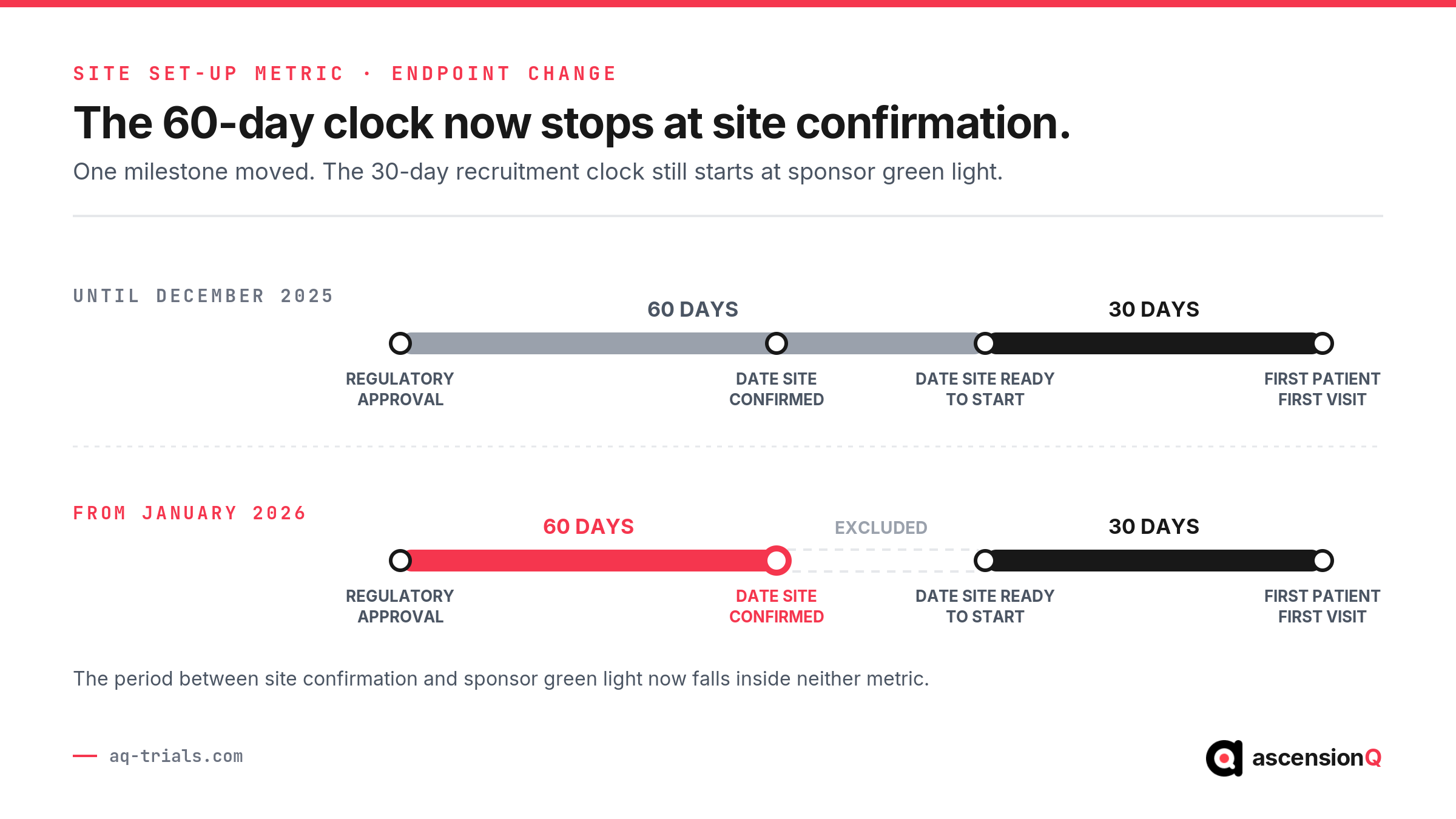
The transition rule is based on the confirmation date rather than the reporting date. The new calculation applies to every site issuing confirmation of capacity and capability from January onwards. Sites that confirmed before January, and NIHR RDN calculations covering 2025, keep sponsor green light as the end of the 60-day metric.
Why Did the End Point Move?
The guidance gives a single reason. The period between confirmation by the site and sponsor green light is outside the control of the site. A sponsor may hold green light for supply, for a competing site, or for its own internal sequencing, and the site can do nothing about the wait. The metric now stops before that wait begins.
- The 60-day metric ends at a signature the site controls, which means a sponsor-side pause after confirmation no longer lands on the site’s set-up figure.
- The 30-day metric still starts at green light, which means the recruitment window stays a full 30 days however long the sponsor takes to release the site.
- NIHR RDN performance-related funding for NHS trusts reads these metrics, which means the change alters what a trust is measured and paid against.
- Reasons for delay stay out of published reports and out of the England funding calculation, which means the recorded dates carry the whole story on their own.
Also Read: Why NHS Sites Miss the 90-Day Set-Up Target and How to Close It
Why Do the 60-Day and 30-Day Metrics No Longer Add Up to Elapsed Time?
The 90-day metric is the sum of the 60-day and 30-day metrics. Those two periods used to run back to back, so the sum matched the time elapsed from the start date to first patient first visit. The two figures now separate, because the span between site confirmation and sponsor green light belongs to neither metric.
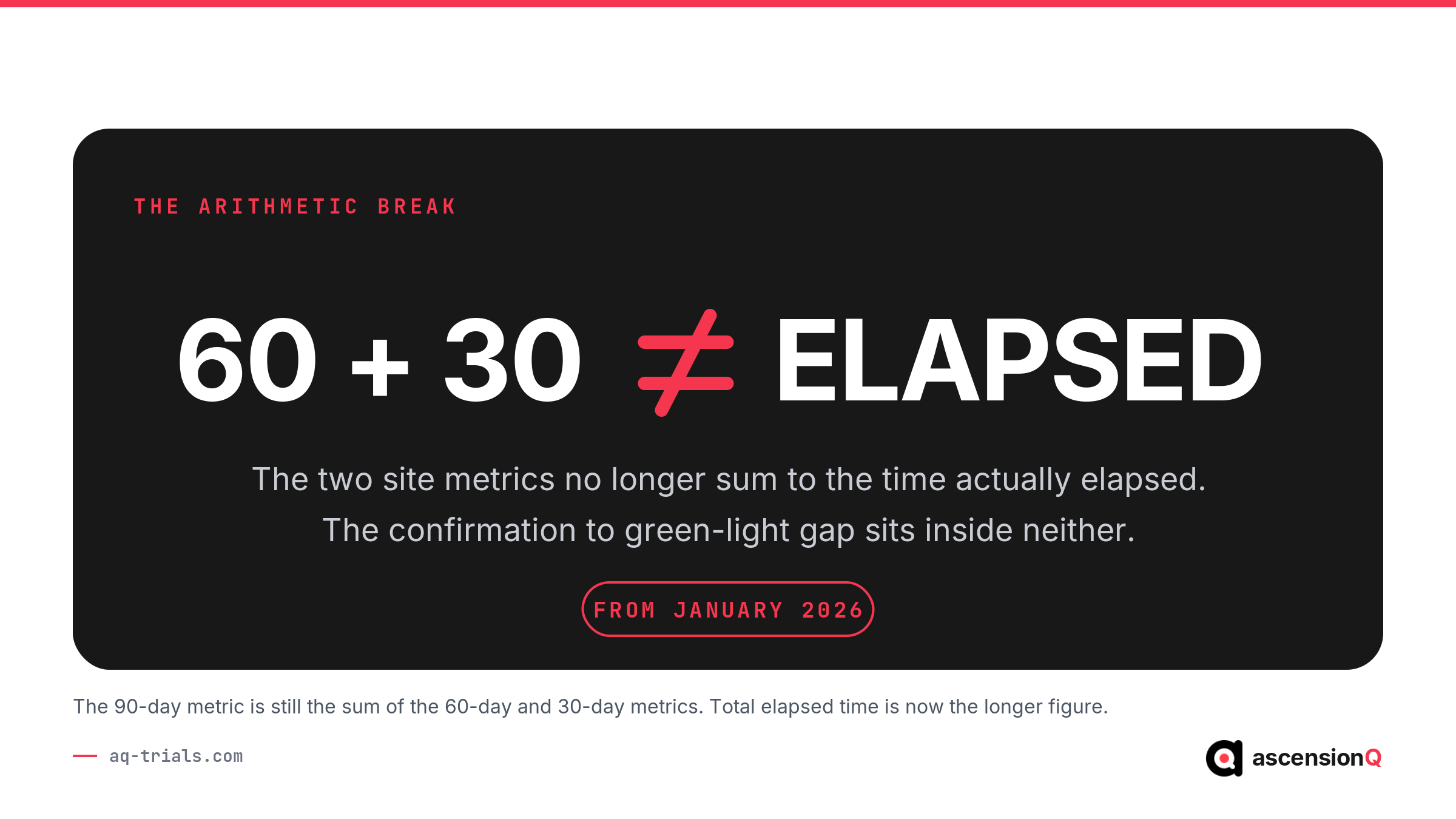
Example: a site’s clock starts at regulatory approval on 1 February. It confirms on 25 March, 52 days later. The sponsor issues green light on 8 April, 14 days after confirmation. The first participant attends on 30 April, 22 days after green light. The reported metrics are 52 days and 22 days, giving a 90-day metric of 74. The elapsed time from approval to first visit is 88 days. The 14-day difference is the excluded gap.
All metrics are measured in calendar days. Anyone reading a site’s numbers against a study timeline should expect the reported figure to sit below the elapsed figure, and the difference between them is a direct measure of sponsor-side hold time. Teams tracking delivery against the UK clinical research delivery KPIs need both numbers to read a site fairly.
Which Dates Must a Site Record?
Six fields carry the site-level picture. A site enters them in its Local Portfolio Management System, and they flow from there to CPMS. Data that fails to match the national definition will not flow through, so the wording of each field matters as much as the date in it.
| Field | Definition | Role in the metrics |
| Date site invited | The date on the sponsor email providing the near-final or final protocol. | Not used in reports. Required for full data entry. |
| Date site selected | The date the sponsor emails the site after due diligence, requesting that set-up begins. | Starts the 60-day clock where it falls after regulatory approval. |
| Non-confirmation status | The recorded reason where a site was not confirmed, chosen from sponsor declined, site confirmed no capacity and capability, or null response. | Status only. It explains a site that did not proceed. |
| Date site confirmed | The last contract signature of all organisations involved, or NHS management permission in Scotland. | Ends the 60-day set-up metric from January 2026. |
| Date site ready to start | The date the sponsor confirms green light and the site may begin recruiting. | Starts the 30-day recruitment metric. |
| First patient first visit | The date of the first study visit of the first participant in an interventional trial, following informed consent. | Ends the 30-day recruitment metric. |
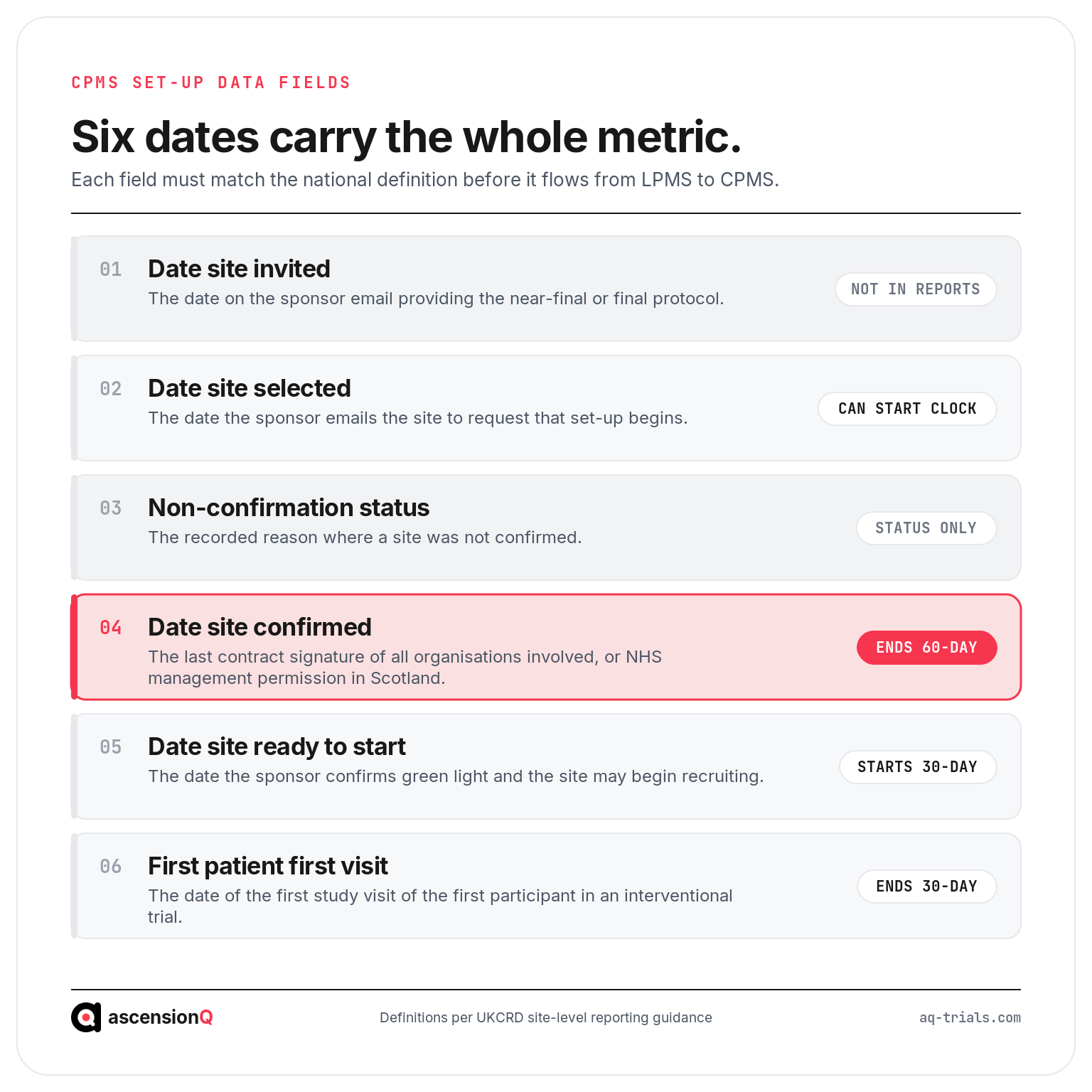
The first patient field deserves attention. The definition sits on the first study visit for interventional trials, and the visit still counts where the participant is later not randomised. Sites that previously reported a consent date for the first recruited participant need to move the value across to the first visit date. Teams that run visit booking inside an e-planner and visit scheduling module already hold that date against the protocol window.
Where Does the 60-Day Clock Start?
The start point is regulatory approval or date site selected, whichever comes later. That single rule resolves into three practical situations, and the situation a site falls into decides which date opens its clock.
| Site situation | Start of the 60 days | Point to watch |
| Selected before or during regulatory review | HRA and HCRW Approval date, NRS Approval in Scotland, or equivalent completion of study-wide review in Northern Ireland. | The combined review outcome date is not the start date. |
| Selected after regulatory approval | The date set in the commercial site selected letter of intent, or the sponsor email confirming site selected. | Set-up activity and reporting start on the same date. |
| Selected during an amendment review | The date set in the letter of intent, or the sponsor email confirming site selected. | Treated the same way as selection after approval. |
The commercial site selected letter of intent lets a sponsor set either the date of receipt or a future date as the point at which set-up starts. A site reading that letter should record the stated date rather than the date the email arrived. Sites approached before approval carry a separate expectation: set-up work runs in parallel with regulatory review rather than after it, which is also the direction of travel in the 2026 UK clinical trials regulations.
Also Read: CTMS vs Spreadsheets: Why Site Capacity Planning Breaks Without One
Which Studies Are Excluded From the Metrics?
Dates should be entered for every timepoint on every study type. Published performance reports then exclude some studies to avoid bias, and the exclusions differ by metric.
| Metric | Excluded study types | Effect |
| 60-day | Extension studies | Excluded from direct payment and performance adjustments |
| 30-day | Extension, rare disease and low-recruiting studies | Excluded from performance adjustments |
| 90-day | Extension, rare disease and low-recruiting studies | Excluded from direct payment |
- Rare disease covers a life-threatening or chronically debilitating disease affecting 5 people or fewer in 10,000 of the UK population.
- Low recruitment covers a study expected to recruit fewer than 1 participant per month, judged on the UK sample size and the proposed recruitment period.
- Extension study covers a roll-over study that lets participants in a parent trial continue under a subsequent related study.
Low-recruiting status is judged on the overall study sample size rather than the individual site target, because site-level targets are unavailable at national level. Study-level exclusions also cover observational, commercial collaborative and non-commercial studies, along with studies where a sponsor opts out of performance reporting. The definitions guidance currently focuses on commercial contract CTIMPs at NHS and HSC sites, with wider 90-day coverage set out separately. Trusts tracking their own position can read their published figures in the UK clinical research delivery key performance indicators.
What Should a Site Change in Practice?
The change lands on data entry habits more than on set-up work itself. A site that already runs a tidy set-up process needs to adjust which date it captures and where it stores it.
- Map each of the six CPMS fields to its equivalent in your LPMS and confirm the local wording matches the national definition.
- Record the last signature across all parties as the confirmation date, rather than the date your own organisation signed.
- Hold confirmation until every pre-initiation step the sponsor listed is complete, so the date stands up to a later challenge.
- Capture the sponsor green light date as a separate field, because the 30-day recruitment clock depends on it alone.
- Move the first participant value from consent date to first study visit date for interventional trials.
- Record a non-confirmation reason whenever a site does not proceed, so the portfolio picture stays complete.
- Check that any FAQ or internal briefing you rely on reflects the January 2026 position, because some published material still describes the 60-day metric as ending at site opening.
- Review SOPs and system configuration on both sides, since sponsors and sites may each need updates to comply.
R&D offices running several studies at once feel this most, because the six fields multiply across the portfolio. Our page for NHS research sites sets out where set-up time is lost across a trust and what teams change to recover it.
Also Read: ICH-GCP E6(R3) and CTMS: What Changes for Study Oversight
How Does AQ Support Accurate Set-Up Milestone Records?
Milestone dates fail for a mundane reason. The date lives in one person’s inbox, the contract lives in a shared drive, and the LPMS entry gets typed weeks later from memory. A CTMS holds the milestone against the study record it belongs to, with the user and timestamp attached, so the value a site enters nationally has a traceable source behind it.
- The CTMS holds site-level milestone dates against each study, which gives an R&D office one place to read where every site has reached.
- Contract and approval documents sit in the site file next to the milestone they evidence, which shortens the check between a recorded date and the signature behind it.
- Recruitment tracking runs from the green light date, which shows the 30-day window against live screening and enrolment rather than a monthly report.
- Visit scheduling holds the first study visit, which is the field that closes the 30-day metric.
The honest limits matter as much as the capability.
- AQ does not submit data to CPMS. Sites enter milestone data in their LPMS, and the national flow runs from there.
- AQ does not decide whether a study is excluded from a metric. That judgement follows the national exclusion criteria.
- AQ does not replace sponsor green light. That date belongs to the sponsor, and the gap before it stays visible rather than hidden.
The value sits in the underlying record. A site that can show the signature, the date and the person who entered it can defend its 60-day figure to a sponsor, an R&D director or an inspector without reconstructing the story from email. Book a live demo to see how AQ holds set-up milestones alongside the documents that evidence them.