Capacity and capability confirmation is the point at which a participating NHS organisation tells the sponsor that it has the staff, facilities and practical arrangements in place to deliver a study, and that it will deliver it. Confirmation is given by signature on the site agreement for commercial studies, or by mutual agreement of the Organisation Information Document where a formal agreement would be disproportionate. Research activity may commence at that organisation once confirmation is given.
The expected period is usually 35 days from receipt of the local information pack, and the exact figure for each study sits in the HRA Initial Assessment letter or the HRA and Health and Care Research Wales (HCRW) Approval letter. This guide covers what confirmation means in practice, the three stages the HRA separates, what starts and stops the clock, the two confirmation routes and why silence means opposite things on each, where the time is actually lost, how the four UK nations differ, and what a site should hold as evidence.
Key Takeaways
- Confirmation is an act of the organisation, given by an authorised signatory, and it closes local set-up rather than opening it.
- The HRA separates assessing, arranging and confirming. Each stage closes on a two-sided act between sponsor and organisation.
- The period is usually 35 days from receipt of the local information pack, and it may be shorter where the approval letter says so.
- Two routes exist. On the formal route, silence means no confirmation. On the opt-out route, silence means the sponsor may assume confirmation.
- Most arranging work can begin at site selection. Only a short list of tasks genuinely waits for approval.
- Confirmation feeds the Date Site Confirmed milestone, which now ends the 60-day site set-up metric in national reporting.
What Is Capacity and Capability Confirmation?
HRA and HCRW Approval covers the study-wide review of regulatory compliance and ethics for the NHS in England and Wales. It removes the need for each participating organisation to repeat those legal checks. What remains at local level is a different question entirely, and it belongs to the organisation alone: can this site actually deliver this protocol, with these staff, in these facilities.
The mechanism of confirmation depends on the study type and on the activities happening locally. The HRA guidance on NHS site set-up in England sets out the routes.
| Study type | How confirmation is given | Who acts |
| Commercial contract studies | Signature on the site agreement, unmodified where a model agreement exists. | An authorised signatory at the organisation. |
| Interventional non-commercial studies | Signature on the agreement for the study type. | An authorised signatory at the organisation. |
| Non-commercial studies with limited local activity or cost | Mutual agreement of the Organisation Information Document by email, with no wet ink signature required. | The research management function. |
| Studies where the HRA waives formal confirmation | No positive act. The organisation may opt out within the stated period. | The sponsor informs the organisation of the decision. |
Two responsibilities stay with the participating organisation whichever route applies. It confirms that the research team, including the Principal Investigator, holds suitable training and experience with appropriate supervision arrangements. It also confirms that no conflicts of interest remain. Those judgements sit outside the HRA assessment and cannot be delegated to the sponsor.
What Do Assessing, Arranging and Confirming Mean?
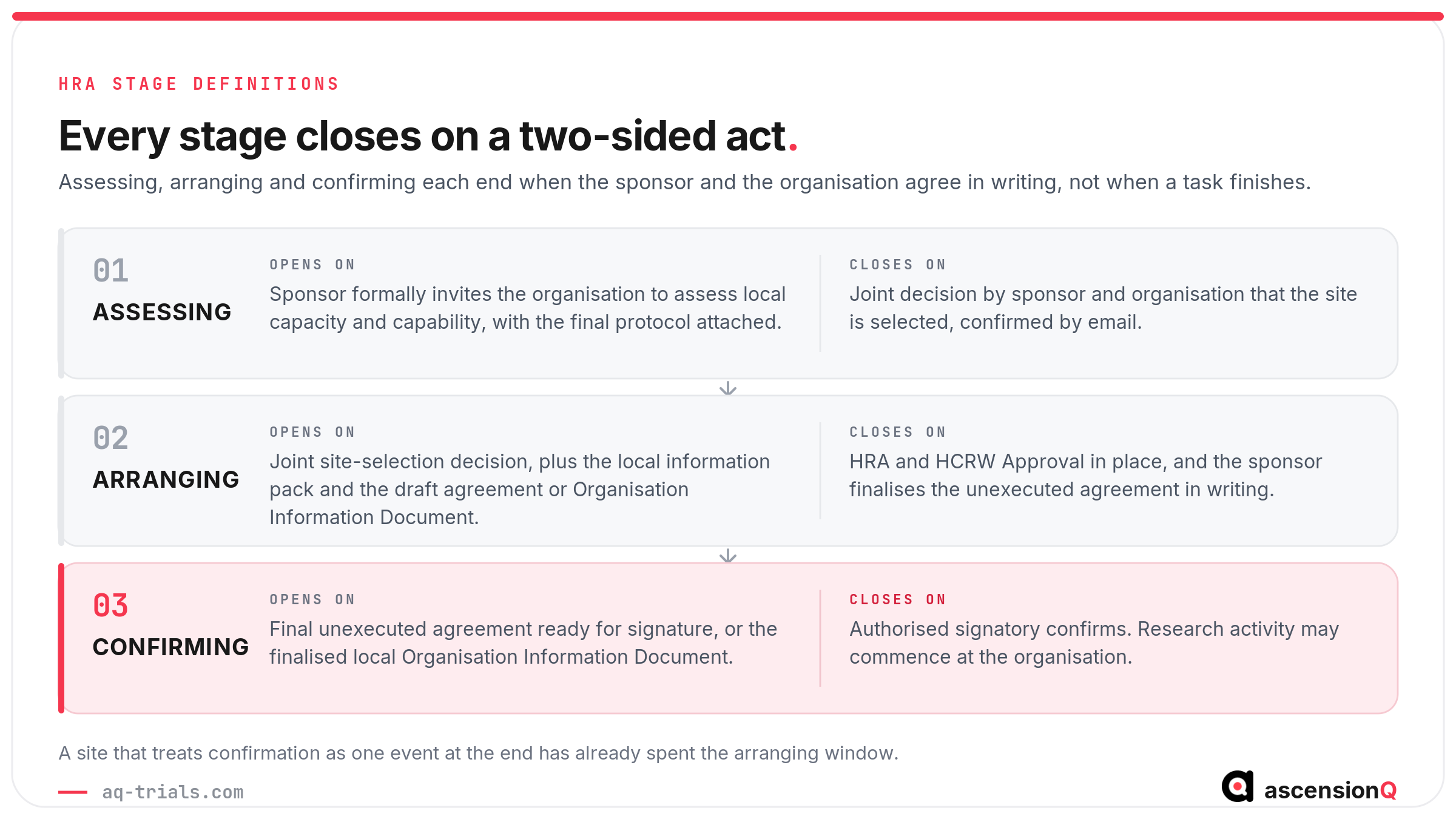
The HRA splits local set-up into three named stages in its clarifications on assessing, arranging and confirming, and the split matters operationally. Each stage has a defined start point, a defined body of work, and an end point that requires both the sponsor and the organisation to act. A site measuring only the final signature is measuring the last few days of a process that ran for weeks.
- Assessing establishes whether the organisation has, or can put in place, the participant population, the equipment, space, specialist services, safety reporting processes and staff the protocol requires. Site selection visits belong here for CTIMPs.
- Arranging puts the practical arrangements in place. It covers staff scheduling, study-specific training, the patient pathway, outsourced services, support departments, honorary research contracts and letters of access, and the financial negotiation.
- Confirming records the outcome. An authorised person signs the agreement or agrees the Organisation Information Document, and research activity may then commence.
The assessing stage may be minimal or absent for some study types. The HRA lists emergency public health research, studies involving only questionnaire distribution or the supply of previously collected data where consent is in place, and studies where the organisation is also the sponsor. Sites should read the approval letter rather than assume a full assessment applies.
Also Read: Why NHS Sites Miss the 90-Day Set-Up Target and How to Close It
How Long Should Confirmation Take?
The working figure is 35 days, measured from receipt of the local information pack rather than from approval or from site selection. The HRA sets the period per study, and the Initial Assessment and Approval letters carry the number, which may be lower than 35. Organisations are encouraged to confirm informally at the earliest opportunity instead of waiting for the stated period to elapse.
The period behaves differently on the two routes, and the difference is the single most misread part of the process.
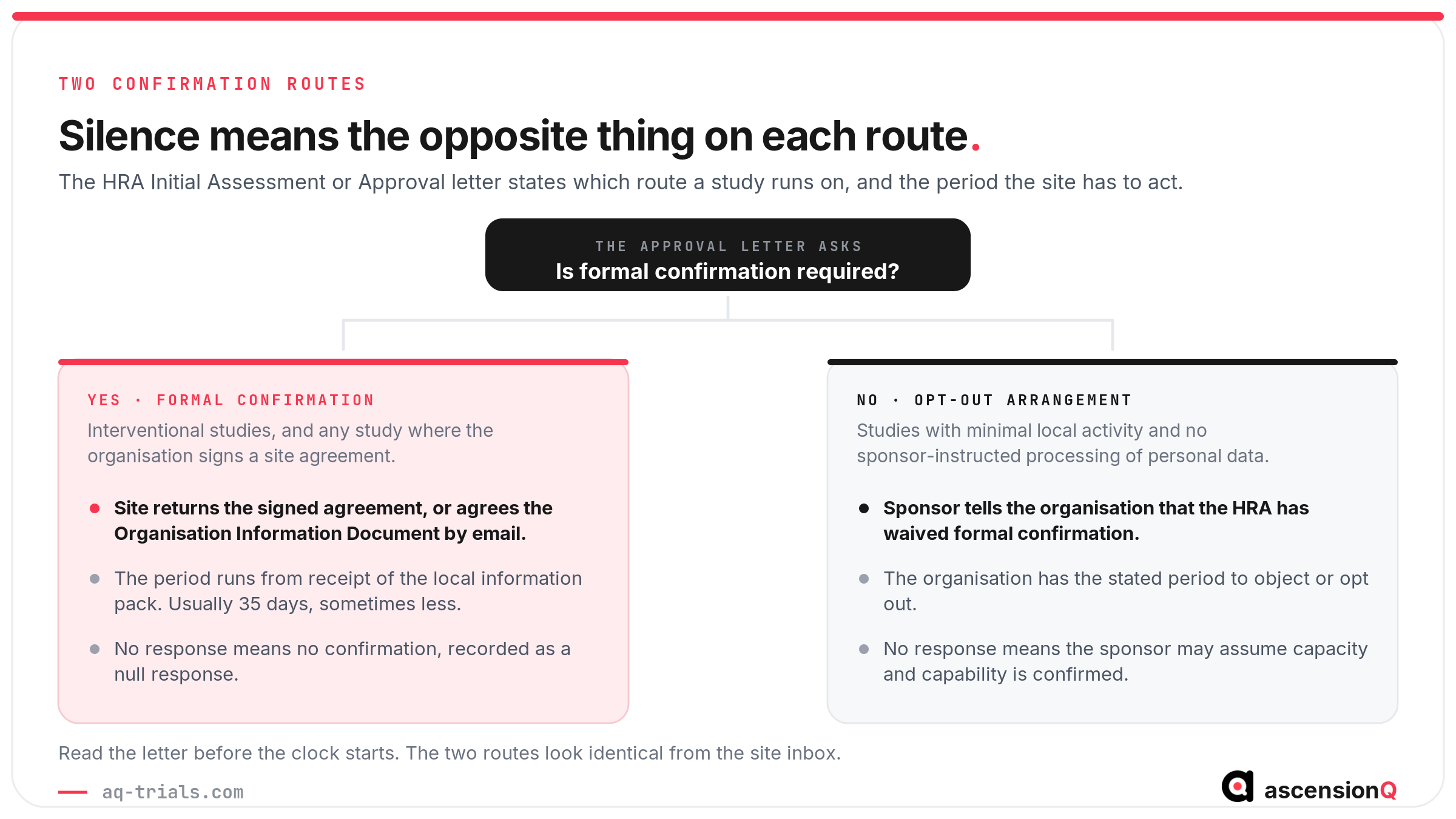
On the formal route, the organisation must return a positive act. Silence produces a null response, which is one of the recorded non-confirmation statuses in national milestone reporting. On the opt-out route, the sponsor may assume that capacity and capability is confirmed where the organisation raises no objection inside the period. The sponsor also carries the duty of telling the organisation which route applies, because the HRA stopped contacting NHS organisations directly about that decision.
Example: an R&D office receives a local information pack on 4 March for a non-commercial observational study. The approval letter states that no formal confirmation is expected and gives 35 days. The office reads the pack, finds the imaging workload unmanageable, and says nothing. On 8 April the sponsor lists the trust as a participating site. The trust is now committed to a study it never agreed to deliver.
Confirmation also feeds national performance data. The date of the last contract signature across every organisation involved is the Date Site Confirmed, which from January 2026 ends the 60-day site set-up metric. A site that confirms late carries that delay directly into its published figure.
What Must Arrive Before the Clock Starts?
The period runs from receipt of the local information pack, so an incomplete pack leaves the organisation holding a clock it cannot act on. The sponsor supplies the pack electronically and simultaneously to the local delivery team, the research management function and the local network contact.
- The documentation submitted to or approved by the HRA, including the protocol version used for the regulatory application.
- The HRA Initial Assessment letter or the HRA and HCRW Approval letter, which states the confirmation route and the period.
- The locally tailored draft agreement or Organisation Information Document, based on the template submitted to the HRA.
- The proposed payments, with the schedule of events or the industry costing template as applicable.
- The named local Principal Investigator or Local Collaborator, or a request for the organisation to identify one, or a clear statement that none is required.
Two practical habits protect the window. The organisation should date-stamp receipt of the pack and record which documents arrived, because that date is the only defensible start point. It should also raise gaps within the first few days rather than at the end, since a pack missing its costing information will consume the entire period in correspondence.
Where Do the 35 Days Actually Go?
Arranging carries the workload, and most of it depends on people outside the research office. The useful way to read the arranging list is by two questions: who has to move this task, and what is the earliest date it can begin. The answers separate the work that genuinely waits for approval from the work that only appears to.
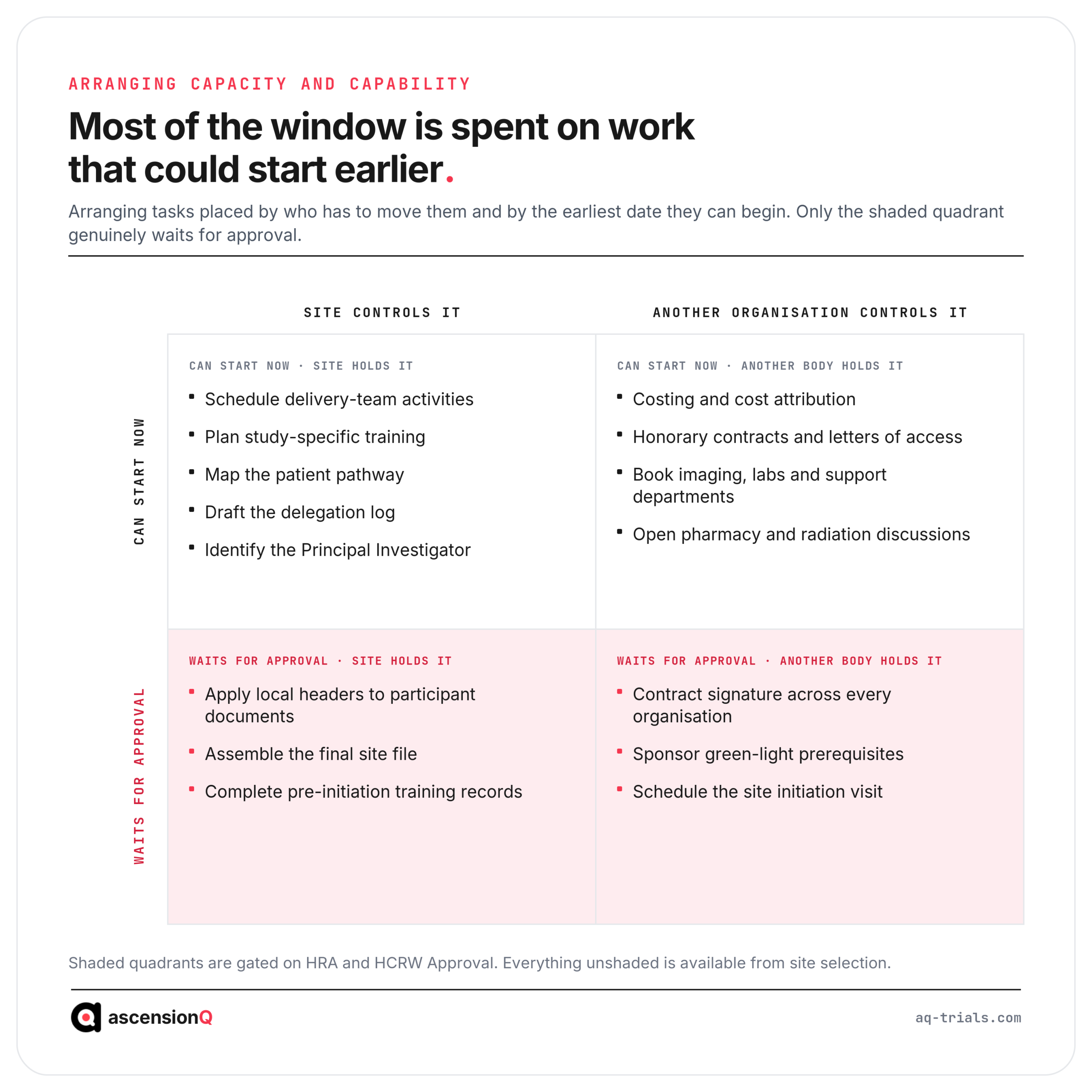
Three items in the gated quadrant deserve attention. Local headers on participant-facing documents require approval to be in place, so that task has a hard dependency. Contract signature runs across every organisation in the chain, which means a third-party laboratory or imaging provider can hold the whole site. The site initiation visit depends on sponsor availability, and slots book out weeks ahead.
Pharmacy is the common special case. Investigational product arrangements run on their own track with their own documentation, and the pharmacy site file is assembled separately from the investigator site file. Sites that open pharmacy discussions at selection rather than at approval routinely recover two to three weeks.
Also Read: ePSF vs eISF: Why Pharmacy Documentation Needs Its Own File
What Delays Confirmation Most Often?
Delay concentrates in a small number of recurring places. Each has an earliest possible start that sits well before the point most sites reach it.
| Delay | Where it sits | Earliest possible start |
| Costing and cost attribution | Finance, with the sponsor and the national costing process | Site selection, using the submitted costing template |
| Contract negotiation on a modified agreement | Contracts team and sponsor legal | Receipt of the draft agreement in the local information pack |
| Honorary contracts and letters of access | HR, for researchers not employed by the organisation | Site selection, once the delivery team is named |
| Pharmacy and radiation arrangements | Research pharmacy and medical physics | Site selection, using the protocol alone |
| Support department capacity | Imaging, laboratories and outsourced services | Site selection, on a provisional booking |
| Principal Investigator availability | The clinical service | Site selection, at the point of expression of interest |
| Third-party signature in the contract chain | External providers named in the agreement | Approval, once the agreement is final |
The pattern is consistent across the published national picture. Sites that miss the set-up half of the window usually have a costing or contracting bottleneck rather than a delivery one, which is visible in the UK clinical research delivery KPIs and in the underlying national performance statistics. Portfolio scale amplifies it, because the same finance team handles every study at once. Trusts running set-up on spreadsheets lose the picture entirely, which is the failure mode described in site capacity planning without a CTMS.
The 35 days is a deadline for arranging. Treating it as a queue spends it.
How Does Confirmation Differ Across the Four UK Nations?
The study-wide review happens once, in the lead nation. What follows locally varies, and multi-nation studies carry more than one convention at the same time.
| Nation | Study-wide approval | Local confirmation |
| England | HRA and HCRW Approval | Confirmation of capacity and capability by the participating organisation |
| Wales | HRA and HCRW Approval | Confirmation of capacity and capability by the participating organisation |
| Scotland | NHS Research Scotland permissions coordination | NHS management permission, which also supplies the Date Site Confirmed value |
| Northern Ireland | Study-wide review shared by the lead nation | Local permission through the HSC organisation |
Sponsors whose lead R&D office sits outside England should contact the HRA early where English sites are involved, so the study-wide review is accepted and the nation-specific elements complete without a second pass. The UK Local Information Pack exists to give all four nations one consistent set of documents, and the Organisation Information Document replaced the older Statement of Activities and Site Specific Information form for that purpose.
What Should a Site Hold as Evidence of Confirmation?
Confirmation is a governance decision, and an inspector or auditor reading the file later will look for the basis of that decision rather than the decision alone. The site file should carry the trail from invitation to signature.
- The dated local information pack and its covering email, which fixes the start of the period and the version of every document assessed.
- The executed agreement or the agreed Organisation Information Document, which is the confirmation itself.
- Evidence of signatory authority, showing that the person who signed held delegated authority to bind the organisation.
- Training records and curricula vitae for the delivery team, which support the suitability judgement the organisation made.
- Honorary contracts or letters of access for anyone delivering research activity without a substantive contract.
- The recorded milestone dates, so the local record and the national submission agree.
These records belong in the investigator site file alongside the other essential documents, and they should be filed as they arrive. A site that assembles the trail retrospectively will find the confirmation correspondence sitting in a departed coordinator’s mailbox. The same discipline applies across a trust’s whole portfolio, which is the subject of NHS R&D site file governance.
The direction of travel supports earlier parallel working. The 2026 UK clinical trials regulations push set-up activity to run alongside regulatory review rather than after it, which makes the record of what was assessed and when more important, not less.
Also Read: Date Site Confirmed: The January 2026 Site Set-Up Change
How Does AQ Support Capacity and Capability Confirmation?
Confirmation slips for a mundane reason. The local information pack lands in one inbox, the costing sits with finance, the honorary contract sits with HR, and no single view shows how many days each has held it. The AQ platform holds those threads against one study record so the position is readable while the window is still open.
- The CTMS holds each set-up milestone with its date and owner, which turns days elapsed since receipt of the pack into a live figure rather than a monthly reconstruction.
- Each handover carries a named owner and a due date, which gives the waiting between departments an accountable holder.
- The electronic Investigator Site File keeps the agreement, training records and delegation entries current and shared, so the evidence behind a confirmation is assembled as it happens.
- Visit scheduling holds the first study visit against the protocol window, which carries the same visibility past confirmation into recruitment.
- Portfolio views show every study in set-up at once, which is the picture an NHS R&D office needs to prioritise between competing studies.
The limits are worth stating plainly.
- AQ does not assess capacity and capability. That judgement belongs to the participating organisation and to no one else.
- AQ does not negotiate or sign agreements. It holds the executed document and the dates around it.
- AQ does not submit data to national systems. Sites enter milestone data in their own local portfolio management system.
The value sits in visibility. A research office that can see which studies are on day 8 and which are on day 30, and who holds each one, confirms inside the window far more often than one working from email. Book a live demo to see how AQ tracks set-up from the local information pack to confirmation.
Frequently Asked Questions
How long does a site have to confirm capacity and capability?
The period is usually 35 days from receipt of the local information pack, and it may be shorter. The figure for each study appears in the HRA Initial Assessment letter and the HRA and HCRW Approval letter. Organisations are encouraged to confirm informally as soon as arrangements are in place.
Who signs the confirmation of capacity and capability?
A person at the participating organisation authorised to bind it signs the site agreement, or the research management function agrees the Organisation Information Document by email where a formal agreement would be disproportionate. The Principal Investigator does not confirm on behalf of the organisation.
What happens if a site does not respond within the period?
The outcome depends on the route. Where formal confirmation is required, no response means the site is unconfirmed and is recorded as a null response. Where the HRA has waived formal confirmation, the sponsor may assume capacity and capability is confirmed if the organisation raises no objection.
Is capacity and capability confirmation the same as HRA Approval?
No. HRA and HCRW Approval is the study-wide review of regulatory compliance and ethics, issued once for the whole study. Capacity and capability confirmation is a separate local decision made by each participating organisation about whether it can deliver that study at its own site.
Does confirmation set the Date Site Confirmed milestone?
Date Site Confirmed records the last contract signature across all organisations involved at a site, or NHS management permission in Scotland. A site should hold confirmation until every pre-initiation step the sponsor listed is complete, so the recorded date stands up to a later challenge.