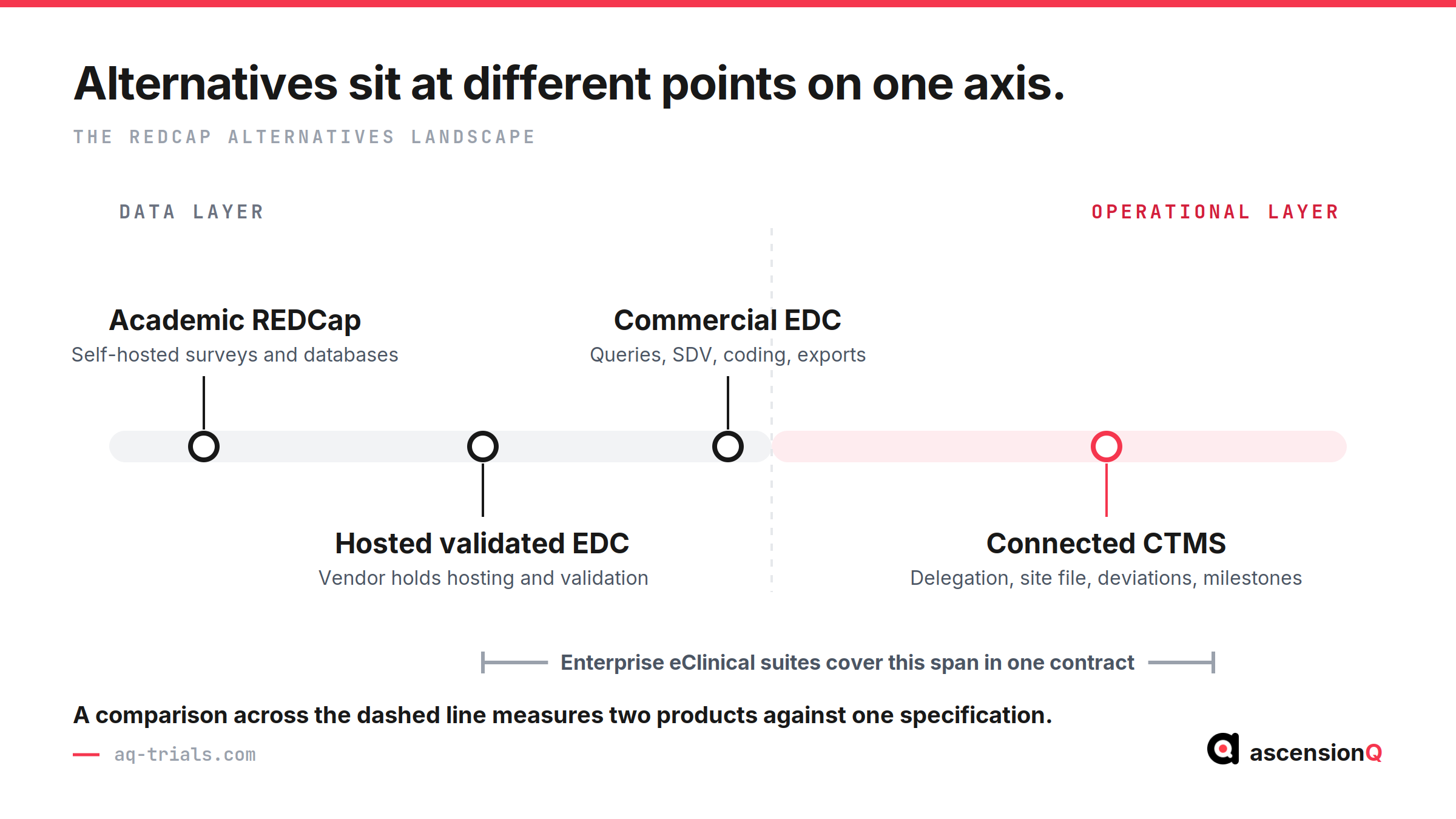
REDCap alternatives divide into two categories, and the right category depends on which part of the study a team is short of. One category replaces the data layer: commercial electronic data capture platforms such as OpenClinica, Castor and Medidata Rave, or a hosted, vendor-validated instance such as REDCap Cloud. The other category adds the operational layer that sits around the data: the delegation log, the investigator site file, monitoring visits, protocol deviations and their corrective actions, and the set-up milestone dates a sponsor or a funder asks for. A clinical trial management system holds that second layer.
REDCap describes itself as “a secure web application for building and managing online surveys and databases”. The description is accurate, and it is also the boundary. Most teams that go looking for an alternative have outgrown the second half of that sentence rather than the first. This guide covers what REDCap’s own materials state about scope, licensing, support and compliance responsibility, the four conditions that send a team looking in 2026, the two questions that separate a data-layer replacement from an operational-layer addition, the products in each category described in their own published terms, and how to plan a move without losing the evidence a team already holds.
Key Takeaways
- What REDCap states it is built for, quoted from its own documentation
- The licensing, hosting, support and validation boundaries the REDCap consortium publishes
- The four conditions that trigger an alternatives search, each traceable to a document
- Two questions that decide whether the data layer or the operational layer is the gap
- The alternatives landscape by category, described from each vendor’s own materials
- The artefacts a study team holds outside any data capture system
- What to carry across in a migration, and what stays where it is
What Does REDCap Say It Is Built For?
REDCap was created at Vanderbilt University in 2004, and the REDCap consortium launched in 2006. The project’s about page states that REDCap “offers a free, easy-to-use, and secure method of flexible yet robust data collection”, and its software page describes the application as “a secure web application for building and managing online surveys and databases”. The published feature set covers audit trails for tracking data manipulation and user activity, branching logic, calculated fields, automated exports to Excel, PDF and common statistical packages, ad hoc reporting, a project calendar with a scheduling module, and interoperability with health records through FHIR.
Four published positions shape how the software reaches a research team. Each one matters to a buying decision, and each one is stated by the consortium rather than inferred by a competitor.
| Published position | What the consortium states | Operational consequence |
| Licence scope | Consortium membership is open to not-for-profit and government organisations, and the software reaches partners at “absolutely no cost” | A commercially funded study sits outside the terms the academic licence was written for |
| Hosting | Partner institutions install and run their own systems, with separate hosted options available | The institution owns the infrastructure, the backups and the uptime |
| Support | “Each REDCap system is independently maintained and supported”, and “Contractors, IT companies, and other third parties are NOT allowed” | Internal IT capacity sets the ceiling on support for the whole portfolio |
| Compliance | “It is the environment into which software is installed that can be called compliant” | Validation evidence is produced and held locally, for each instance |
The compliance line is the one most often misread. REDCap publishes a feature set that supports 21 CFR Part 11 working, and it places responsibility for the compliant environment with the institution running the instance. A research team asked for validation documentation during a sponsor audit is being asked for documentation it wrote itself.
Also Read: What Is EDC in Clinical Trials?
Why Do Teams Search for REDCap Alternatives in 2026?
Four conditions account for most of the searches, and each one traces to a document rather than to a preference.
- A commercially sponsored study enters the portfolio. The consortium FAQ directs “commercially-sponsored research studies being led by a for-profit organization and which need a system maintained in compliance with 21 CFR Part 11” towards REDCap Cloud, which states in its own materials that it is “an independent commercial platform” and separate from the free self-hosted academic software.
- Validation moves from assumed to evidenced. The institution owns the environment, so it owns the installation qualification, the change control record and the periodic review. Many teams meet that obligation for the first time during an audit.
- Support demand passes what the internal team can carry. The consortium terms keep support inside the institution, so a growing portfolio raises load on a university or NHS trust IT department that already runs everything else.
- The UK regulatory position moved. SI 2025 No. 538 came into force on 28 April 2026 and makes compliance with the ICH E6 good clinical practice principles a legal requirement in the UK. Regulation 28 names the development and maintenance of trial specific computerised systems among the functions of the sponsor. System choice now sits inside a documented regulatory responsibility, and the MHRA guidance on compliance with ICH E6 sets out the position. Our guide to the new UK Clinical Trials Regulations covers the wider change.
A hypothetical example makes the pattern visible. A university team runs three investigator-initiated studies in REDCap without difficulty. A commercial sponsor then places a fourth study at the same site and asks for three things: the delegation of authority log, the monitoring visit reports, and the validation documentation for the system holding the data. The first two requests have no home in the database. The third exists, and it belongs to the university rather than to the software.
Which Two Questions Decide the Category of Alternative?
Two questions separate the categories, and they are worth asking in this order. Does the form work, and does the environment around it satisfy the sponsor? Does the record of how the study ran exist anywhere at all? The first question points at the data layer. The second question points at the operational layer, and it is the one that usually produces the search.
| Dimension | Replacing the data layer | Adding the operational layer |
| The problem it solves | The forms, the edit checks and the validated environment around the data | The record of how the study ran around that data |
| What it displaces | REDCap itself | Nothing; the existing database keeps the data |
| Typical trigger | Commercial sponsorship, a Part 11 environment requirement, submission-grade exports | A sponsor or an inspector asks for artefacts the database never held |
| Named artefacts covered | eCRFs, queries, source data verification, medical coding, statistical exports | Delegation log, site file, monitoring visits, deviations, CAPA, milestone dates |
| Migration weight | Study rebuild, historic data transfer and revalidation | Configuration alongside the existing instance |
| Question answered at audit | Is the data trustworthy? | Did the study run the way the records claim? |
The two categories are independent of each other. A team can replace the data layer, add the operational layer, do both in sequence, or keep REDCap exactly where it is and add only the artefacts it never held. The sequence matters for cost, because an operational-layer addition leaves the existing database and its historic studies untouched.
Most teams outgrow the record, and keep the form.
Which REDCap Alternatives Fit Which Need?
The table below describes each category from the vendor’s own published materials. Product claims belong to the vendors that make them, and a shortlist should test each one against the study the team actually runs.
| Category | Examples, in their own published terms | Where it fits | What it leaves to another system |
| Hosted, vendor-validated REDCap | REDCap Cloud describes itself as “an independent commercial platform” and lists “Pre-validated: Part 11, HIPAA, GDPR, GxP”, managed cloud hosting with automated backup, and a dedicated helpdesk | Teams keeping familiar data capture while validation, hosting and support move to a vendor | The study operations record outside data capture |
| Commercial EDC for regulated trials | OpenClinica describes “purpose-built electronic data capture and eCRF software for sponsors, CROs, and academic research teams” with CDASH templates, query management, source data verification and medical coding. Castor describes “a unified EDC platform” running EDC and eCOA on one database, and states compliance with 21 CFR Part 11, ICH GCP, ISO 27001 and GDPR | Teams needing submission-grade data capture with vendor-held validation evidence | Delegation, site file and monitoring records held outside the database |
| Enterprise eClinical suites | Medidata states that its CTMS is “tightly integrated with both Rave and Medidata eTMF” and covers visit monitoring, issue management, document submission and tracking, and study management within the wider Medidata Platform | Sponsors and CROs running large portfolios, with implementation capacity to match | Little in functional terms; the trade is scale of implementation and cost |
| Connected CTMS with the site record | Systems that hold study set-up, delegation, the investigator site file, deviations and corrective actions against one study record, and exchange data with whichever system captures the trial data | Sites, NHS trusts, academic units and CROs whose gap is the operational record | Data capture, which stays in the EDC |
Two points keep a shortlist honest. Categories one and two answer the same question in different commercial models, so a team choosing between them is choosing who holds the validation evidence. Categories three and four answer a different question altogether, so a comparison across that line measures two products against one specification and neither wins fairly.
Veeva, Florence, RealTime and SharePoint appear on many of the same shortlists, and each maps to a different category again. Our comparison of connected clinical trial software sets out where each one sits and what to evaluate.
What Does a Study Team Hold Outside the Data Capture System?
The published REDCap feature set covers the data and the audit trail around it. Seven artefacts sit outside that boundary in every regulated study, and an inspector asks for all of them.
- The delegation of authority log records who held which task from which date, which lets a monitor confirm that the person who performed a procedure was delegated to it on the day.
- The investigator site file holds the essential documents in their current version, which gives an inspector the approved protocol, the ethics approvals and the current CVs in one place.
- Monitoring visit reports and follow-up letters record what was reviewed and what was raised, which evidences sponsor oversight in the gaps between visits.
- Protocol deviations link to the corrective and preventive action that closed them, which turns an isolated event into a documented control.
- Training and qualification records map to the delegated tasks, which supports each delegation entry directly, in place of a separate folder.
- Pharmacy accountability stays in its own file under its own owner, which preserves the separation MHRA inspection expects.
- Set-up and recruitment milestone dates feed national and sponsor reporting, which lets a research office answer a portfolio question without a manual sweep.
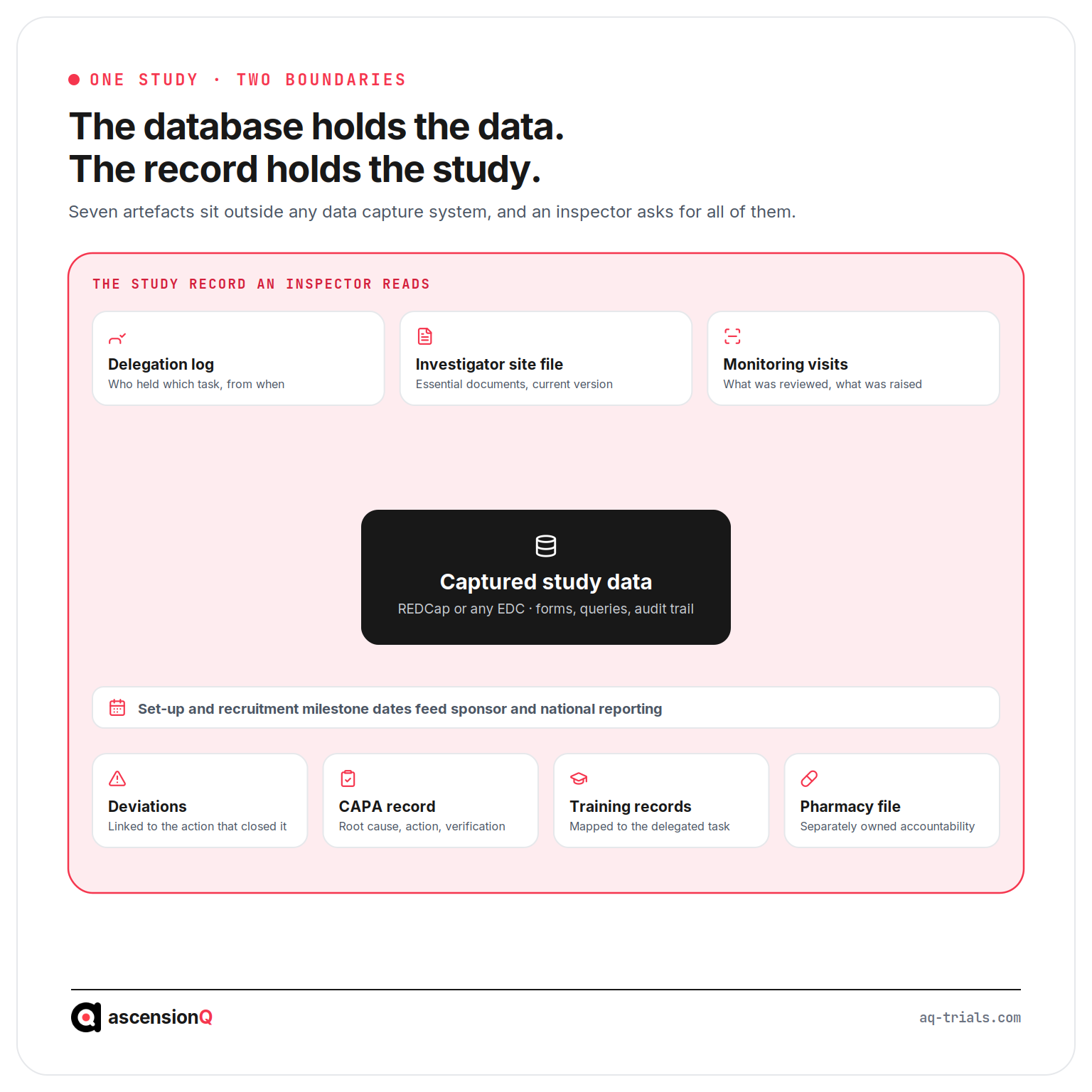
Those artefacts live in a different set of systems: a CTMS for the study record, an eISF for the site file, an eTMF for the sponsor-side file, and a quality management system for controlled documents, training and corrective action. The division of responsibility between capture and management is a settled one, and our guide to CTMS versus EDC sets out where the line falls.
Also Read: Clinical Trial Management Software for NHS Trusts: 2026 Buyer’s Guide
How Should a Move From REDCap Be Planned?
A move goes wrong in predictable ways, and most of them come from treating a rebuild as a copy. Seven steps keep the work in order.
- Fix the scope first. Decide whether the data layer moves, the operational layer arrives, or both happen in sequence.
- Record the licence position per study. Establish which studies sit inside the academic licence terms and which sit outside them, and write the answer down.
- Inventory the evidence already held. Validation documentation, audit trail exports, user access records and change control history belong to the institution, and they support the new system’s file.
- Decide what happens to closed studies. Historic data often stays in place under a read-only archive with a documented retention period, which avoids a transfer that adds risk and no value.
- Rebuild the form design rather than copying it. A field-for-field copy carries old constraints and old workarounds into a system that no longer needs them.
- Run one study in parallel before the portfolio moves. A single live study surfaces the gaps that a test environment hides.
- Write the new arrangement into the SOP set. Record the system change in the quality system, with the training that goes with it.
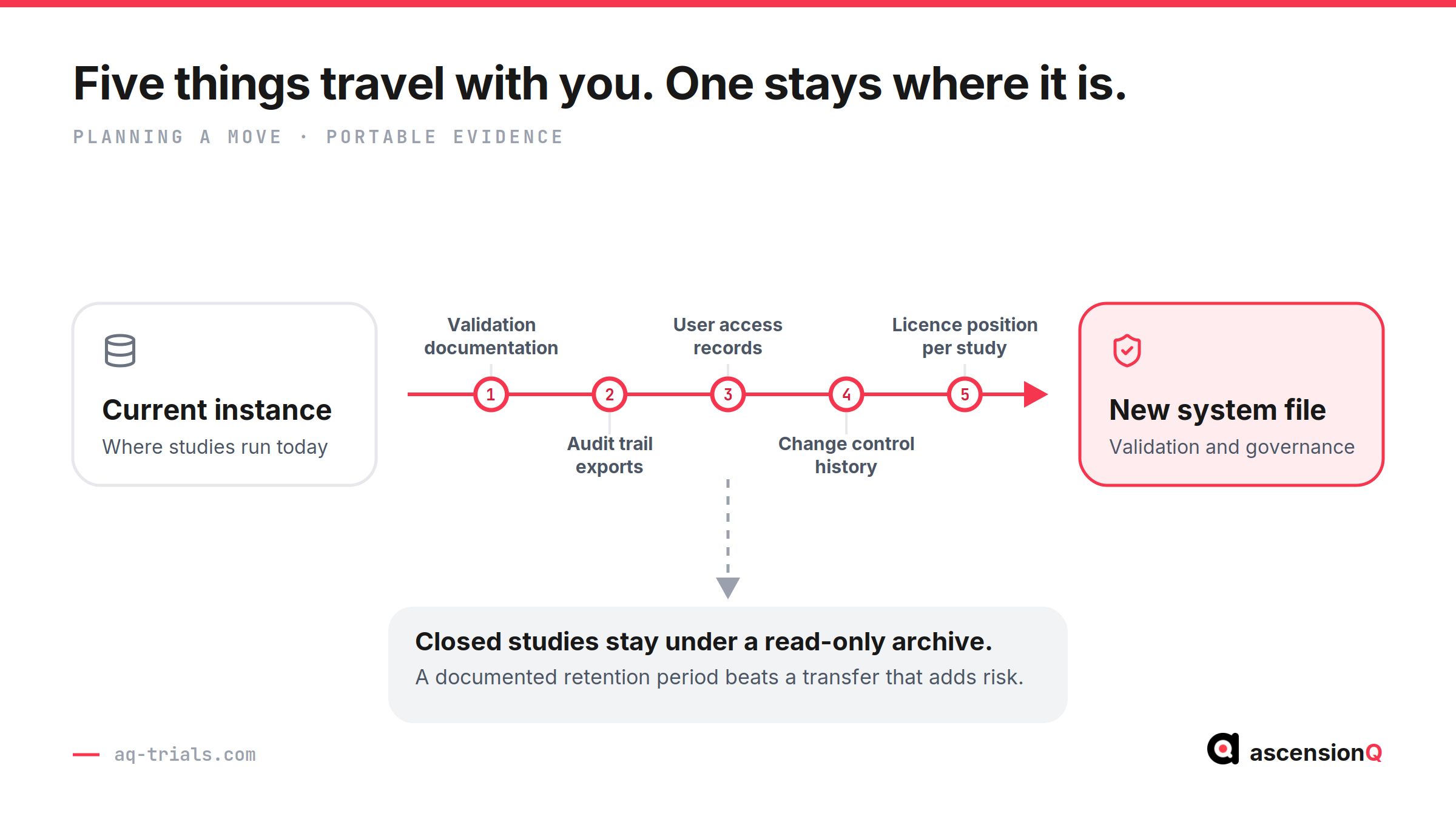
The evidence above stays with the institution through any move. A team that assembles it before the shortlist has a stronger position with a vendor, and a shorter validation exercise afterwards.
What Are the Risks of Choosing on the Wrong Layer?
- A new EDC arrives, the data improves, and the sponsor asks for the delegation log again, so the original gap survives the purchase.
- Study operations stay in spreadsheets alongside a validated database, which leaves the two records to be reconciled at every monitoring visit.
- Historic studies move without a documented reason, which adds migration risk and revalidation work for data nobody will query again.
- The licence position stays undocumented, which surfaces as a question during a commercial sponsor’s due diligence rather than before it.
- An enterprise suite lands in a team of four, and the implementation absorbs the capacity that was meant to run the studies.
- Validation documentation stays with the old instance, so the institution rebuilds evidence it already owned.
Also Read: What Is Clinical Research Software and How to Choose the Right One?
Frequently Asked Questions
What are the main types of REDCap alternative?
There are two categories. One replaces the data layer, through commercial EDC platforms such as OpenClinica, Castor and Medidata Rave, or a hosted instance such as REDCap Cloud. The other adds the operational layer around REDCap and holds the record of how the study runs.
How do you decide which kind of REDCap alternative you need?
Ask two questions in order. Does the form work, and does the environment around it satisfy the sponsor? Then, does the record of how the study ran exist anywhere at all? The answers point to a new data layer, an operational layer, or both.
What does a study team hold outside REDCap?
Seven artefacts sit outside the published REDCap feature set in every regulated study, and an inspector asks for all of them. One example is the delegation of authority log, which records who held which task from which date.
Why do commercially sponsored studies move away from self-hosted REDCap?
The REDCap consortium directs commercially sponsored studies led by a for-profit organisation that need a 21 CFR Part 11 maintained system towards REDCap Cloud, a separately operated commercial host.
What is the biggest risk when replacing REDCap?
Choosing on the wrong layer. A new EDC can improve the data while the delegation log and other conduct records stay in spreadsheets, so the original gap survives the purchase and the two records still need reconciling at every monitoring visit.
How Does AQ Fit Alongside REDCap?
AQ sits in the fourth category. AQ CTMS holds study set-up, milestones, recruitment and visit scheduling as one operational record, so a date is entered once and read wherever it is needed. The data stays in whichever system captures it, and the study record around it becomes the thing a monitor, a sponsor and an inspector all read.
The surrounding modules close the artefacts listed earlier, against that same record.
- AQ Digital DoA records delegation with effective dates mapped to training and qualification evidence, which stops authorisation gaps forming between a task and its signature.
- AQ eISF holds essential site documents in a controlled electronic investigator site file, which lets a monitor review between visits.
- AQ Pharmacy keeps pharmacy accountability in a separately owned file linked to the study, which preserves the separation inspection expects.
- AQ QMS and AQ CAPA carry controlled documents, training and corrective action, which links a deviation to the action that closed it.
- AQ eTMF is built on the CDISC TMF Reference Model, which gives sponsor and site a shared structure to reconcile against.
The fit is common in academic research units and NHS and hospital research teams that keep an established database for data capture and need the operational record alongside it. AQ meets the NHS Data Security and Protection Toolkit standard (Standards Met 2026), holds Cyber Essentials, and provides validation, data protection and governance evidence to institutional teams as an assurance pack.
See how the study record, the delegation log and the site file behave against a study you already run. Book a live demo and bring the artefact list from this guide.