Edge alternatives fall into two groups: systems that replace Edge as the local record of an organisation’s research portfolio, and systems that sit alongside it to hold the regulatory evidence a trial is inspected against. The second group is the one NHS R&D teams usually mean. The starting point is a working portfolio system and an open question about essential documents.
Edge is a research management system with wide adoption across English NHS trusts. Its published feature set covers studies, participants, recruitment, workload, finance, version-controlled documents and electronic delegation logs, and it exchanges study data with the national portfolio system. The evidence layer answers a different question: for one trial, on one date, can the site produce the delegation log entry, the training record, the consent form version and the pharmacy accountability record together, in the structure an inspector reads?
This guide covers what Edge states about its own scope, the four conditions that send NHS teams looking for an alternative, the difference between a portfolio index and a trial index, what the amended UK Clinical Trials Regulations changed on 28 April 2026, and the questions to put to any vendor, Edge included.
What Is Edge?
Edge is a research management system for health and care organisations. Its own materials describe it as a system “which empowers research managers, data analysts, research nurses, clinicians and support services to make the most of their information”. Edge’s published history dates the work to 2000, when Professor James Batchelor was setting up Southampton’s Cancer Research Network for the University of Southampton, based at Southampton General Hospital. The system was first called NOTIS, the Network Oncology Trial System, then ETIS from 2002, with version 1 of the Edge platform launching in 2005. It grew inside a university research unit alongside UK clinical research teams, and that origin explains much of its shape.
Adoption in the UK is broad. Edge’s UK page states that 12 of the 15 Local Clinical Research Networks used Edge, “resulting in over 80% of NHS trusts on board”, with users spanning hospitals, GP surgeries, health boards, research networks and charities. That figure describes the network structure that preceded the current NIHR Research Delivery Network, which now operates as 12 Regional Research Delivery Networks and a coordinating centre. The practical point stands: for a large share of NHS research offices, Edge is the local portfolio management system (LPMS) of record.
Accuracy matters in any comparison, so the table below lists only capabilities Edge names on its own features page.
| Area | Capability Edge names on its own features page |
| Platform | Cloud-based, real-time data management, supported on multiple devices, hosted in a secure Microsoft Azure environment |
| Study and participant records | Secure participant management and recruitment; unlimited bespoke form and field creation |
| Workload | Workflow builder for custom workload assignment; collaborative calendar functionality |
| Documents | Version-controlled document management |
| Delegation | Electronic delegation logs |
| Finance | Comprehensive finance module for invoice tracking and reporting |
| Reporting | Personalised user dashboard; fast, in-depth reporting |
Edge holds documents and it holds delegation logs, and the Clinical Informatics Research Unit publishes its ISO 27001 certification for information security management. Any evaluation that begins by assuming otherwise starts from a false premise and will reach a false conclusion. The useful question concerns how records are structured and retrieved, and the next sections set it out.
Why Do NHS Teams Look for Edge Alternatives?
Four conditions account for most searches. Each one is an operational trigger that arrives from outside the software.
- An inspection is scheduled. An MHRA good clinical practice inspection reads one trial at a time and asks for the complete record set. A team that has organised its records by portfolio faces a mapping exercise before it can answer.
- The trust has become a sponsor. Sponsorship brings Trial Master File responsibility, oversight of participating sites, and serious breach reporting. The record set expands well past the site’s own activity.
- Commercial study volume has grown. Commercial sponsors and contract research organisations arrive with their own monitoring expectations, their own document requests and their own audit schedules. Site staff carry the reconciliation cost.
- Evidence lives in several places. A site file in a network drive, a pharmacy file in a locked cabinet, training records in a learning management system and deviations in a spreadsheet produce four answers to one inspection question.
Each condition signals that a second question has arrived alongside the first. The portfolio question and the inspection question are both legitimate, and they organise records differently. The distinction between them is the whole of this guide.
A portfolio asks what happened across the studies. An inspection asks for the proof behind one of them.
The Portfolio Index and the Trial Index
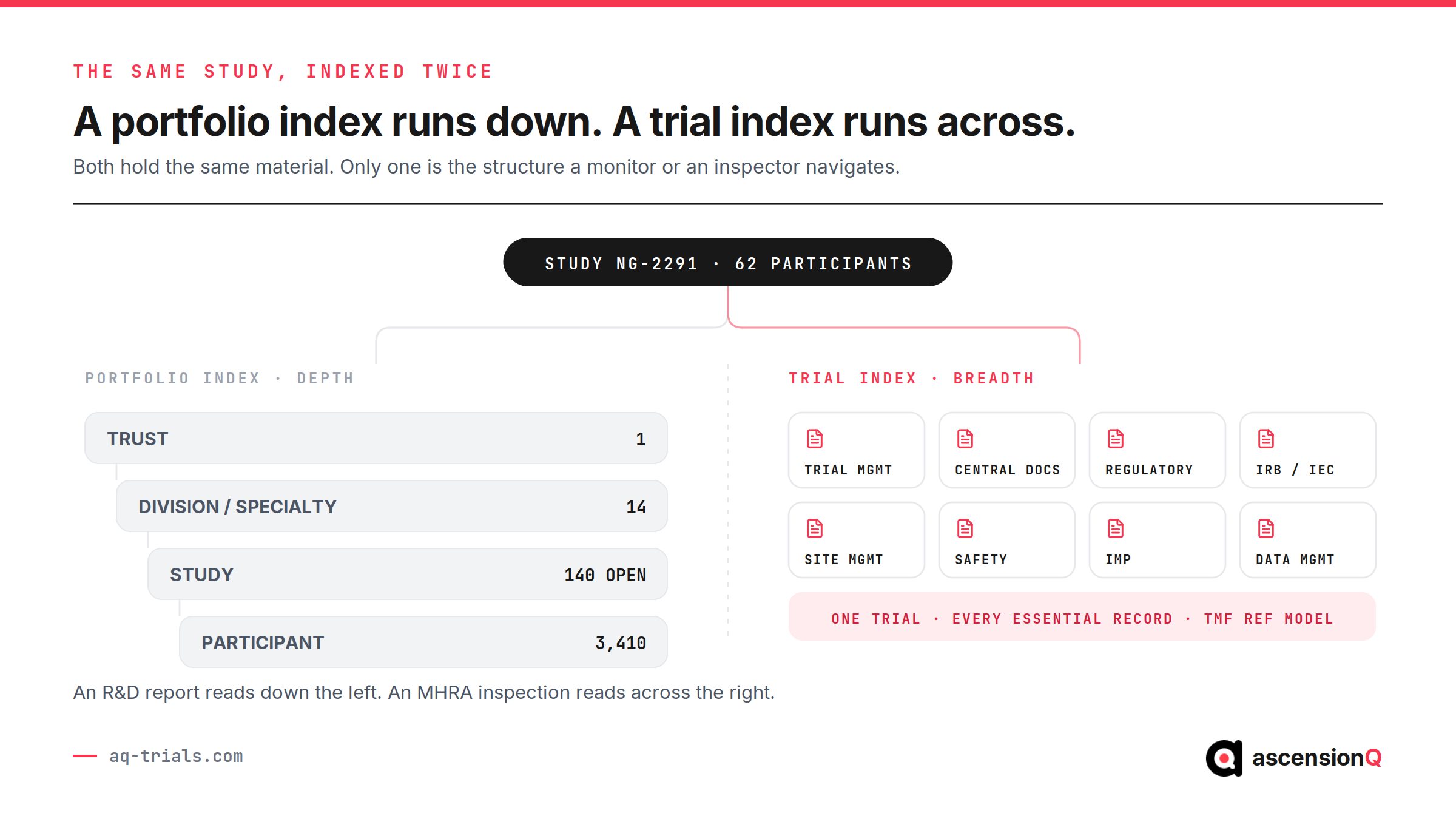
A research office holds one body of information and needs two indexes into it. The portfolio index runs from the organisation downward: trust, division, specialty, study, participant. It answers management questions and it feeds national reporting. The trial index runs from a single trial outward across every essential record that trial generated, in the structure a monitor and an inspector expect to navigate.
The two indexes serve different readers. An R&D manager reading the portfolio index wants recruitment against target across every open study. An inspector reading the trial index wants participant 014, visit 3, on 12 March, and every record that touches it. The index a team relies on determines how fast the second kind of question resolves, whichever systems hold the underlying material.
| Dimension | Portfolio layer | Evidence layer |
| Organising unit | The organisation and its research portfolio | One trial and its essential record set |
| Primary reader | R&D managers, network reporting, finance | Monitors, auditors, MHRA inspectors, sponsors |
| Question answered | What is happening across our studies? | Can we prove what happened on this date? |
| Structure | Studies, sites, participants, staff, invoices, documents | Zones, sections and artefacts of the TMF Reference Model |
| Completeness test | Are the milestone and recruitment fields current? | Is every expected document present, current and attributable? |
| Failure symptom | Reports fall behind delivery | Record-keeping and essential document findings |
Both layers are legitimate and most trusts need both. Trouble starts where one layer is assumed to discharge the other’s obligations.
Also Read: CPMS and LPMS: What Sites Must Enter and When
Which Systems Are on the Shortlist?
Three options appear on most shortlists, and each one answers a different question. The table describes them from published sources rather than from a vendor pitch.
| Option | What it is, in published terms | What it changes | What stays as it was |
| Replace the portfolio layer | ReDA from Infonetica, which its supplier describes as a “clinical trial management system”, and which Health and Care Research Wales procured in 2016 as the All Wales LPMS | The portfolio system, its interfaces and its reporting | The condition of the site file, the delegation record and the pharmacy file |
| Add the evidence layer | A connected CTMS holding an electronic site file, delegation, quality and pharmacy records against one study | The structure and currency of the trial record | The LPMS and its feed to the national portfolio system |
| Extend the incumbent | Edge’s own unlimited bespoke form and field creation, with its workflow builder | The forms available inside the portfolio system | Ownership of validation and change control, which remains with the trust |
The first row carries the heaviest cost, and national reporting is the reason rather than the software. The All Wales LPMS standard operating procedure records the mechanism directly. An interface integrates LPMS and CPMS recruitment activity, so figures maintained locally by study teams reach CPMS for portfolio studies where the upload route is set to LPMS, against a Wales minimum dataset of 59 items that extends the UK-wide set. A replacement inherits that interface as a gating requirement, and it competes on usability and support rather than on what it records.
Can Bespoke Forms Inside Edge Close the Gap?
Edge names unlimited bespoke form and field creation alongside a workflow builder on its features page, so a trust can build evidence-layer structures inside the portfolio system it already runs. The approach is legitimate and some research offices have made it work. It also transfers a set of obligations to the trust, and those obligations belong in the cost comparison.
- Validation sits with the builder. A configured record used as regulated evidence needs documented computerised system validation, and the trust owns that evidence for anything it designs itself. Our guide to GAMP 5 and computerised system validation covers the deliverables an inspector expects.
- Structure has to survive amendments. Essential documents change at every protocol version, so a bespoke form set needs a maintenance owner with time allocated, otherwise it drifts from the current version across the portfolio.
- Change control becomes local. Every field change needs a documented rationale, an approval and a version history, which turns a configuration task into a quality process.
- Sponsor reconciliation stays manual. A bespoke local structure follows local practice rather than the DIA TMF Reference Model, so a sponsor monitor still reconciles two differently shaped files.
Configuration is cheap. The validated maintenance of it is the line item.
A trust with a strong informatics team and a small portfolio carries that load comfortably. A trust running dozens of concurrent studies across several specialties usually finds the maintenance outgrows the saving within two amendment cycles.
What Is the Inspection-Readiness Layer?
The inspection-readiness layer is the set of controls that keeps a trial’s essential records complete, current and attributable without a preparation project before an inspection. Inspection readiness is a standing condition. Six components carry it.
- A structured site file. An electronic investigator site file indexed to the Drug Information Association (DIA) TMF Reference Model gives the site and the sponsor the same map, which allows a monitor to reconcile the site file against the Trial Master File zone by zone.
- An expected document list. The system holds the list of documents a trial should contain at its current stage and reports what is absent, which turns completeness into a live status the team can act on between monitoring visits.
- Delegation with signature control. A delegation of authority record ties each task to a named individual, a date range and a signature, which allows any activity to be traced to a person who was delegated to perform it at the time.
- Training currency tied to delegation. Training records expire against the roles they support, which surfaces a lapsed certificate before a monitor finds an undelegated task.
- Pharmacy accountability in the same record. An electronic pharmacy site file holds temperature excursions, dispensing and accountability logs against the study, which removes the separate cabinet that inspection questions so often lead to.
- Deviation to verified closure. A quality management system with a CAPA workflow records each quality event, its root cause, its actions and its effectiveness check, which produces evidence that the site acted and that the action worked.
Each component produces a specific artefact an inspector can request by name. That is the test of the layer: it holds the artefacts themselves, at the version and date they carried.
What Changed on 28 April 2026?
The amended UK Clinical Trials Regulations took full effect on 28 April 2026, the date set out in the MHRA transitional arrangements guidance. From that date, compliance with the ICH E6(R3) good clinical practice principles became a legal requirement under Regulation 28. The MHRA sets out the position in its guidance on ICH E6 compliance in the United Kingdom. Three consequences bear directly on system choice.
- The principles are binding, and the annexes cannot be ignored. The UK-specific principle requires that the investigator and sponsor “must have regard to all relevant guidance”, and MHRA guidance states that documentation should be retained demonstrating that consideration of the annexes was undertaken.
- Computerised systems must be fit for purpose. MHRA guidance states that systems used in clinical trials “should be fit for purpose (e.g., through risk-based validation, if appropriate)” and proportionate to the risks to participants and the importance of the data.
- The complete file is the basis of inspection. MHRA guidance on good clinical practice inspections states that “the complete TMF is the basis for inspection and all the records in it must be made available to the inspectors”, and that “failure to provide the TMF will affect the results of your inspection”.
The regulation raised the standard for evidence and left the reporting standard where it was. A trust with strong delivery reporting and inconsistent filing now carries more exposure than it did in 2025.
Where Record-Keeping Actually Fails
The MHRA GCP Inspectorate has been explicit about where findings concentrate. Its 2015 guidance on inspecting the trial master file states that for commercial sponsors “the most frequent major finding is in relation to record keeping and essential documents”. The same guidance suggests organisations hold “an overarching mapping document that lists all the essential documents and where they are located”, and expects an inspector to navigate an electronic file after basic training without a guide turning the pages.
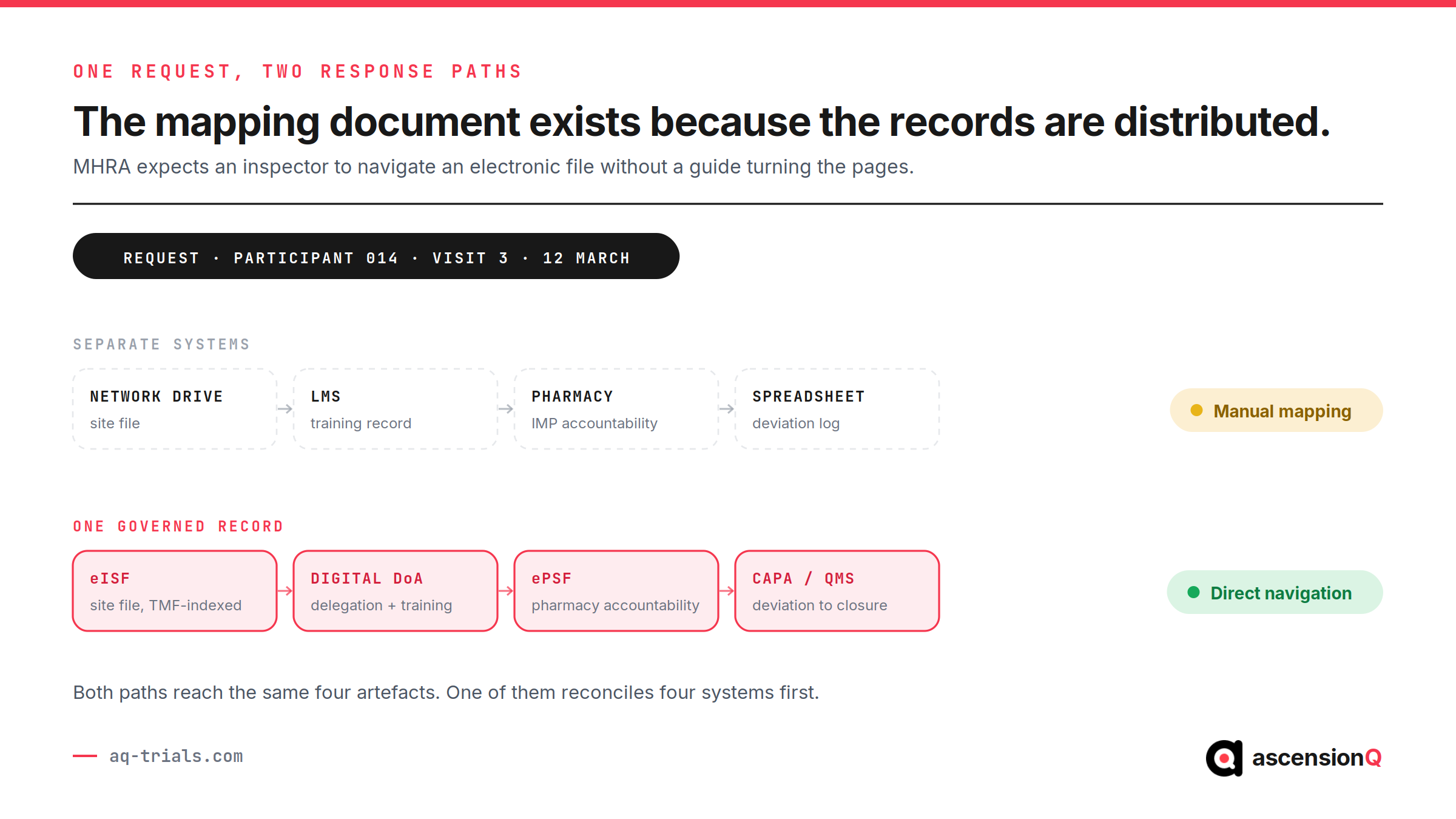
That mapping document is the diagnostic. A map is needed because the records sit in several places. Consider a hypothetical but routine scenario at a mid-sized trust.
- A monitor asks for evidence that the research nurse who took consent from participant 014 on 12 March was delegated and trained for that task on that date.
- The delegation log shows the nurse listed, with a start date of 2 March.
- The training record sits in the trust learning management system and shows GCP training completed on 19 March, seven days after the consent visit.
- The consent form in the site file is version 3.0. The approved version on 12 March was 3.1, issued after a substantial amendment three weeks earlier.
- Four systems hold the four records, and each answer is correct inside its own system. No single view puts the consent date, the delegation date and the training date on one line.
Three separate control failures produced one finding. Every individual involved did their job as they understood it. The records sat in systems with no obligation to each other, so the contradiction stayed invisible until a monitor assembled the dates by hand.
The people were competent. The gap was in how the records were structured.
Also Read: TMF Reference Model and the Investigator Site File: Where eISF Fits
How Should You Evaluate an Edge Alternative?
Put the same questions to every candidate, Edge included, and ask for a live demonstration of each. The questions below target controls, because feature names travel further than the controls behind them. Edge should be assessed against them on the same terms as any alternative.
- Show me one trial’s complete essential document set, indexed to the TMF Reference Model. Ask the vendor to navigate it as an inspector would, without a guide.
- Show me what is missing. A system that lists what it holds is a repository. A system that reports what it should hold and does not is a control.
- Show me who was delegated to do this task on this date, and what training supported it. The two records should resolve together.
- Show me a deviation from detection to verified effectiveness check. Ask to see the closure evidence and the check that confirmed it worked.
- Show me the audit trail on a document that changed. Ask who changed it, when, and what the previous version said.
- Show me the pharmacy record for this participant’s dispensing. Ask whether it lives in the same governed record or a separate file.
- Show me your NHS assurance position. Ask for the Data Security and Protection Toolkit status, Cyber Essentials certification and hosting arrangements in writing.
The answers decide whether the requirement is a replacement or an addition. A trust that answers the first six comfortably in its current system needs no alternative. A trust that reaches for a spreadsheet on question two or four has found its gap.
Also Read: Clinical Trial Management Software for NHS Trusts: 2026 Buyer’s Guide
What Moves in a Migration and What Stays?
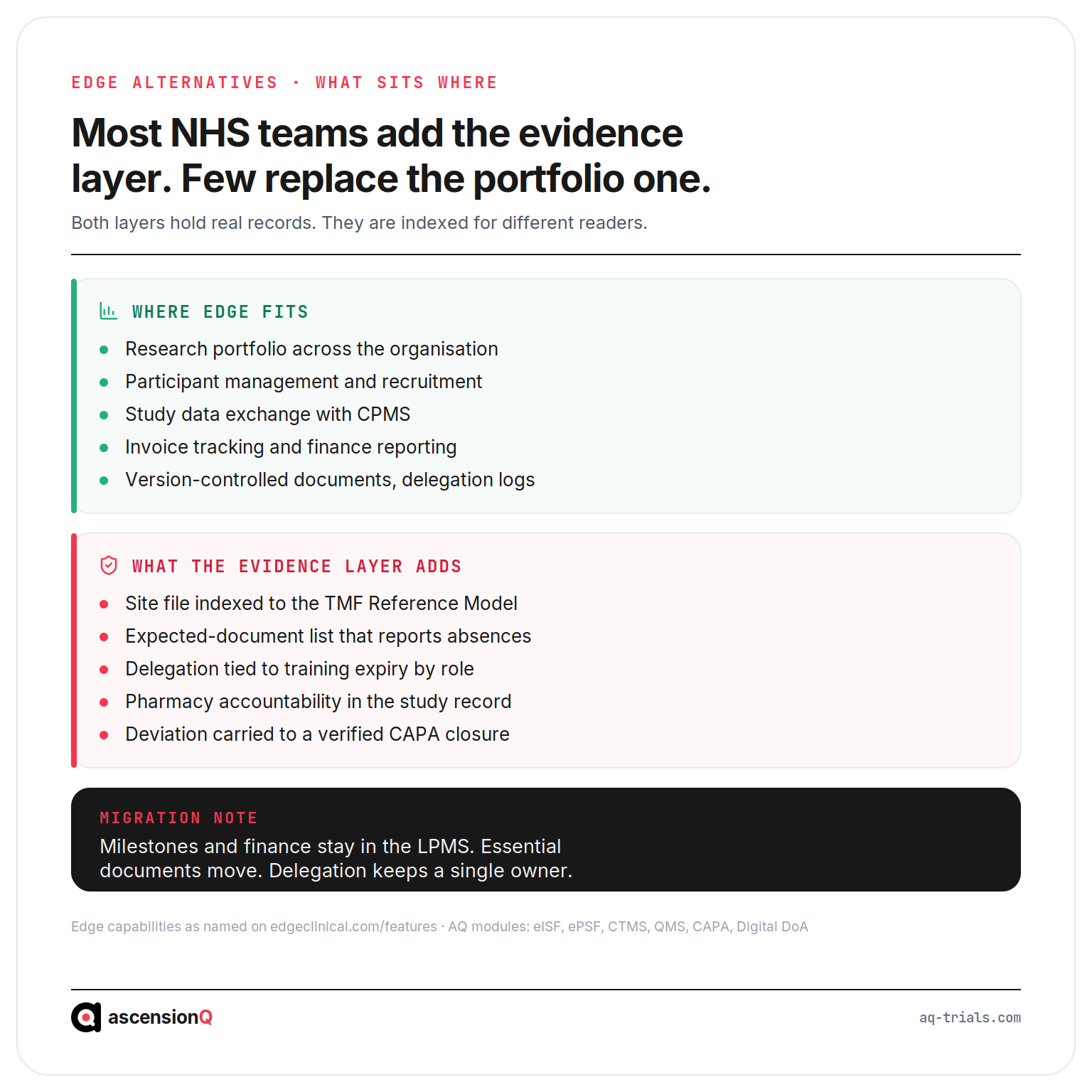
An evidence layer is usually added while the portfolio system stays in place. The national reporting obligation runs through the LPMS, and replacing that pathway creates risk for no benefit. The plan starts with a boundary, ahead of any data export.
| Record | Where it belongs | Why |
| Study milestone and recruitment data | Stays in the LPMS | The exchange with the Central Portfolio Management System (CPMS) runs from it |
| Invoicing and cost recovery | Stays in the LPMS | The finance module is already reconciled to trust ledgers |
| Essential documents for an active trial | Moves to the evidence layer | TMF-model structure, currency reporting and audit trail are the point |
| Delegation of authority (DoA) | Single owner, evidence layer | Two delegation logs create a discrepancy the day they disagree |
| Training certificates | Referenced from the source system | Expiry must drive delegation status in one place |
| Closed studies | Archive in place | Retention obligations attach to the record as filed |
One rule governs the boundary: any record that two systems both claim to own will eventually disagree, and the disagreement will surface during an inspection. Assign each record type a single owner before any data moves.
Teams comparing wider options often look at commercial platforms at the same time. Our comparison of AQ, Veeva, Florence, RealTime and SharePoint maps those categories, and REDCap alternatives covers the equivalent question for academic teams whose starting point is a data capture system.
How Does AQ Cover the Inspection-Readiness Layer?
AQ is a connected platform for NHS hospital research built around the trial index. The modules share one study record, so an answer given in one module holds in the others.
- The eISF holds the site file in the DIA TMF Reference Model structure and reports expected documents that are absent, which gives the R&D office a completeness position at any moment.
- Digital DoA ties delegated tasks to named staff, date ranges and signatures, and reads training expiry against those roles, which surfaces a lapse before it becomes a finding.
- The ePSF holds pharmacy accountability against the same study record, which removes the separate pharmacy file from the inspection path.
- CAPA carries each quality event from detection through root cause and actions to a verified effectiveness check, which produces closure evidence a monitor can read in one place.
- The CTMS holds study set-up, capacity and visit scheduling against the same record, which keeps operational activity and its evidence in one place.
AQ is designed to sit alongside a local portfolio management system. National reporting continues through the existing pathway, and the evidence layer gains a single governed structure. AQ is Cyber Essentials certified, maintains an NHS Data Security and Protection Toolkit (DSPT) submission, and is available through G-Cloud, so most NHS teams can procure through a framework they already use.
See how the modules resolve one inspection question across the site file, delegation record and pharmacy file. Book a live demo with our team.