A scanned record can replace the original source when the copy has been verified to hold the same information as the original, and the site has recorded that verification. The verified copy is a certified copy. It then carries the same standing as the record it replaced, and an inspector may read it in place of the original.
This guide sits in our series on eSource in clinical trials. It covers the regulatory definition of a certified copy, the two accepted ways to verify one, who certifies a copy at a UK research site, which records a scan can and cannot replace, and the conditions that have to hold before an original is destroyed.
A copy carries no standing until someone verifies it.
What Is a Certified Copy in a Clinical Trial?
A certified copy is a copy of an original record that has been verified to hold the same information as that original. The verification is the whole of it. A photocopy, a scan or an exported PDF is an ordinary copy until a person or a validated process confirms the match and leaves evidence of that confirmation.
Three defined terms sit behind the practice, and UK sites answer to all three. ICH E6(R3) supplies the trial definition, and the MHRA GXP data integrity guidance supplies the definitions its inspectors apply.
| Term | Definition | Source |
| Original record | The first or source capture of data or information, such as an original paper record of a manual observation or an electronic raw data file from a computerised system | MHRA GXP data integrity guidance, 6.11.1 |
| True copy | A copy of the original record that has been verified, by a dated signature or by generation through a validated process, to have the same information | MHRA GXP data integrity guidance, 6.11.2 |
| Certified copy | A copy of the original record, verified by a dated signature or by a validated process, to have the same information as the original, including relevant metadata where applicable | ICH E6(R3) glossary |
The MHRA term and the ICH term describe the same control. E6(R3) adds metadata to the wording, which matters for any record produced by a system rather than a pen. Our guide to what counts as source data in a clinical trial sets out the test that separates an original from a copy in the first place.
When Does a Scan Become a Certified Copy?
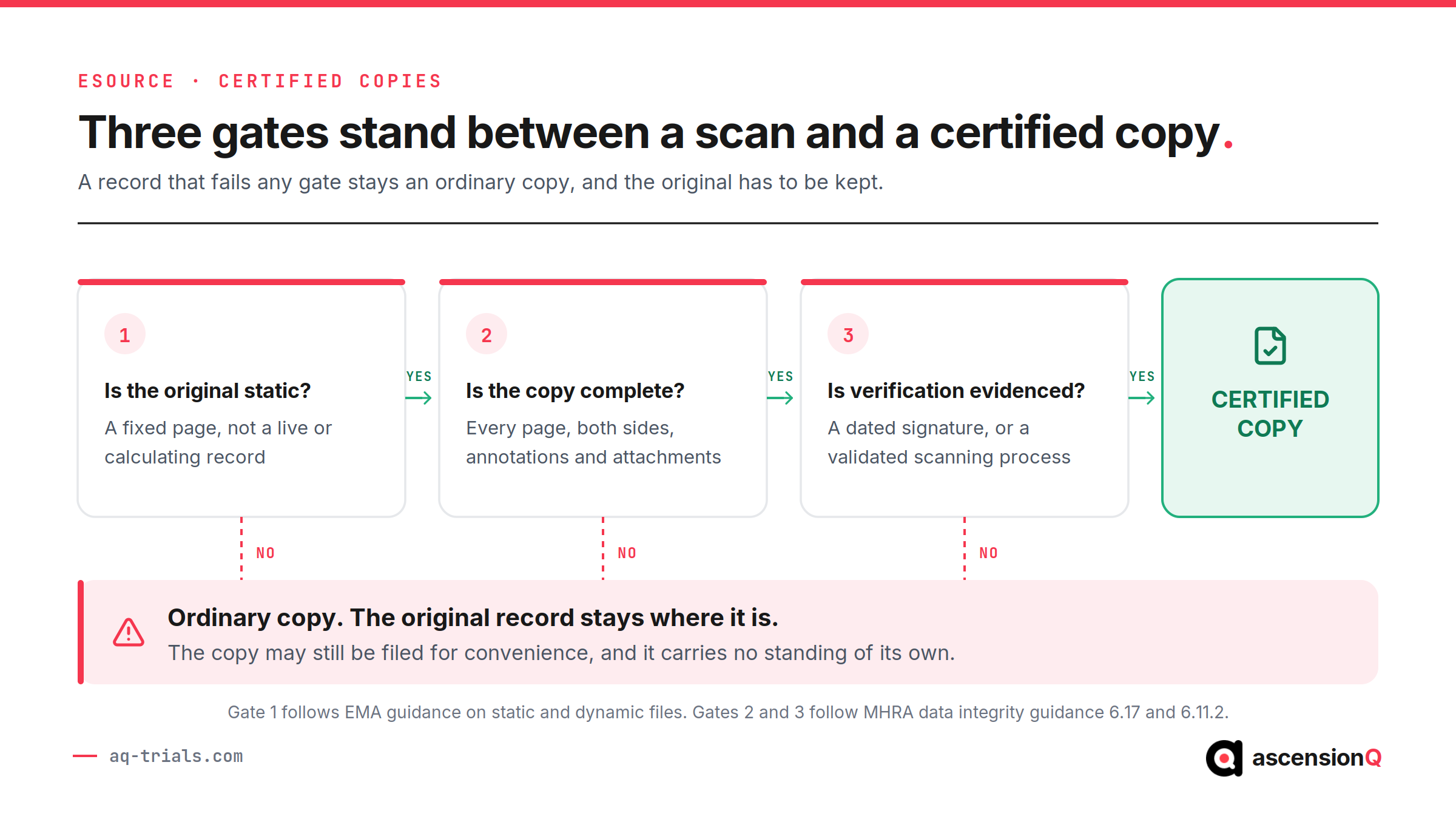
A scan becomes a certified copy at the moment the verification is completed and evidenced. The MHRA states the position for paper directly at section 6.17 of its data integrity guidance: data or a true copy generated in paper format may be retained by using a validated scanning process, provided there is a documented process in place to ensure that the outcome is a true copy.
Four conditions turn a scan into a certified copy at a research site:
- A written procedure defines the scanning process, the verification step and the person responsible for each.
- The copy reproduces the complete record, including both sides of every page, annotations, initials and any attachment.
- Verification confirms the match, either by a dated signature on the copy or by a scanning process that has been validated to produce a faithful output.
- The evidence of verification stays with the copy for the life of the record, in the investigator site file or the system that holds it.
The procedure itself belongs to the site’s quality management system. An undocumented scan produces a copy with no standing, however accurate the scan happens to be.
How Is a Copy Verified, and Who Certifies It?
Two routes are accepted, and a site chooses one route for each record type. The EMA guideline on computerised systems and electronic data in clinical trials describes the same two routes at section 6.5, and requires the result of the copy process to be verified to hold the same context, content and structure as the original.
| Aspect | Manual verification | Validated process |
| What happens | A named person compares the copy against the original page by page | A qualified system produces the copy under a validated configuration |
| Evidence created | A dated signature and a certification statement on the copy | Validation documentation, plus the system record of the copy event |
| Suits | Low volumes, mixed formats, one-off records | High volumes of a consistent format |
| Main risk | Volume pressure produces signatures without a real comparison | A configuration change after validation goes unassessed |
The person who certifies is a member of site staff delegated to that task by the principal investigator. The task belongs on the delegation log in the same way as data entry does. The site certifies copies of the records it holds, and the sponsor certifies copies of the records held at the sponsor.
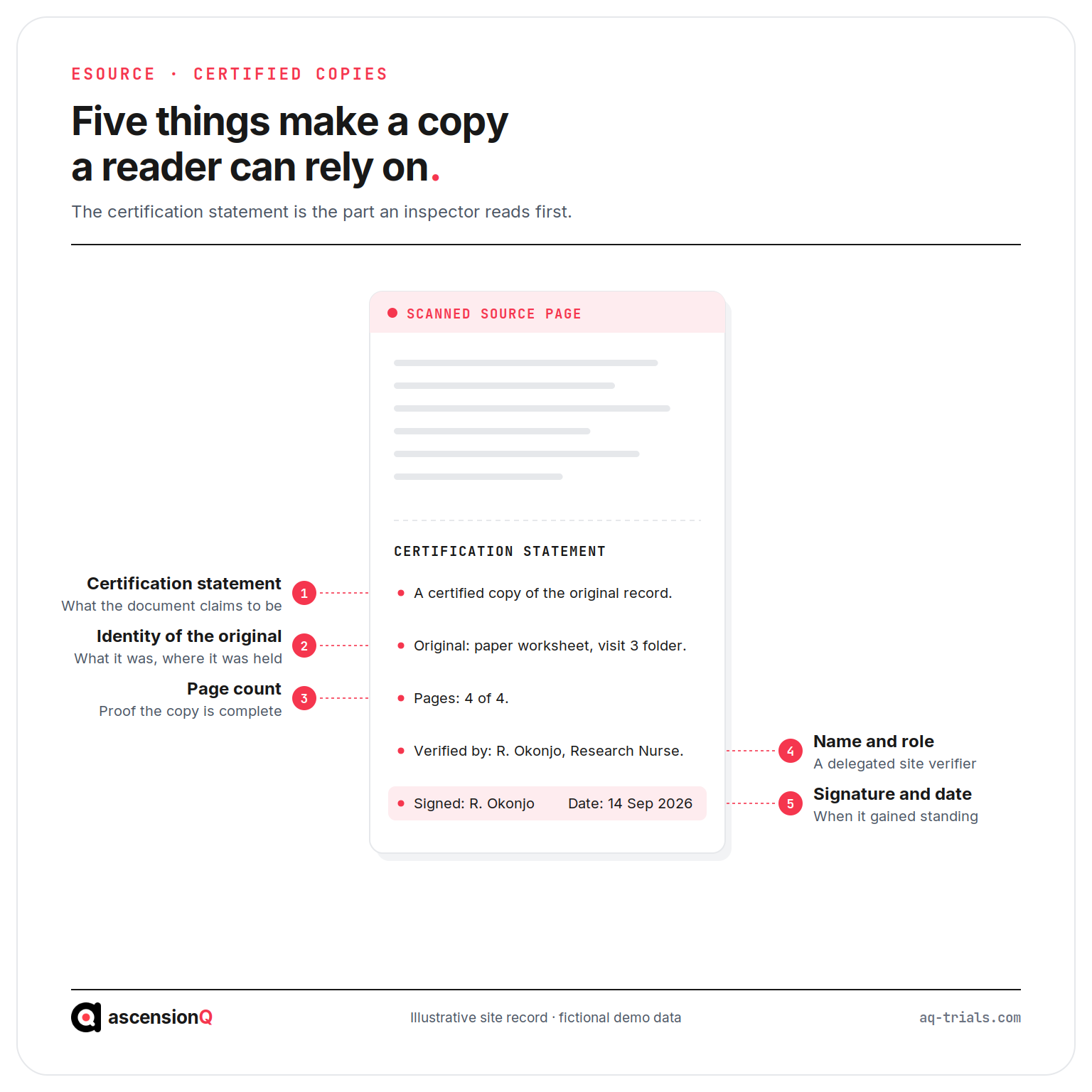
A certification statement carries five elements:
- A statement that the copy is a certified copy of the original record.
- Identification of the original, including what it is and where it was held.
- The number of pages, so a later reader can see whether the copy is complete.
- The name and role of the person who verified it.
- The signature and the date of verification.
Which Records Can and Cannot Be Replaced by a Scan?
The answer turns on whether the original is static or dynamic. The EMA guideline draws this distinction at section 6.5: a static file such as a signed paper form holds fixed content, and a dynamic file such as a worksheet with automatic calculations holds behaviour as well as content. A scan captures a static record in full. It captures the surface of a dynamic record and discards the rest.
| Original record | Static or dynamic | Can a scan certify it? |
| Signed consent form on paper | Static | Yes, when the scan is complete and verified |
| Paper source worksheet with handwritten corrections | Static | Yes, when crossings out, initials and dates remain legible |
| Laboratory report issued on paper | Static | Yes, when the full report including reference ranges is copied |
| Entry in an electronic source system | Dynamic | No, because the audit trail and metadata do not survive a print |
| Screen view of the electronic patient record | Dynamic | No, because the printout shows one filtered view of a live record |
| Spreadsheet holding formulas | Dynamic | No, because the calculation behind each value is lost |
Dynamic records stay where they are, and the site records that location instead of copying them. Our guide to which record is the source when data sits in both the EPR and the trial system covers how a site declares that location for each data point.
When Can the Original Paper Record Be Destroyed?
An original may be destroyed once a certified copy of it exists and every other condition below is satisfied. MHRA archiving and retention guidance requires original records or certified true copies to be retained, and requires scanning processes to be validated to ensure authenticity and completeness. The choice of which one to keep sits with the site and the sponsor together.
- A certified copy exists, and its verification evidence has been checked.
- The sponsor has agreed in writing, because the clinical trial agreement or the protocol may require originals to be kept.
- The record is not an NHS health record, which the trust retains under its own records management policy whatever the trial decides.
- The copy will remain readable for the full retention period, including any migration to a new format.
- The destruction itself is recorded, covering what was destroyed, when, by whom and under which procedure.
Retention periods now run to at least 25 years for trials applied for from 28 April 2026. Our guide to what the MHRA expects from electronic source systems under the 2026 UK regulations covers the statutory access duty that sits alongside that period.
Destroying an original is a decision about evidence, not about storage space.
What Do Inspectors Find Wrong With Certified Copies?
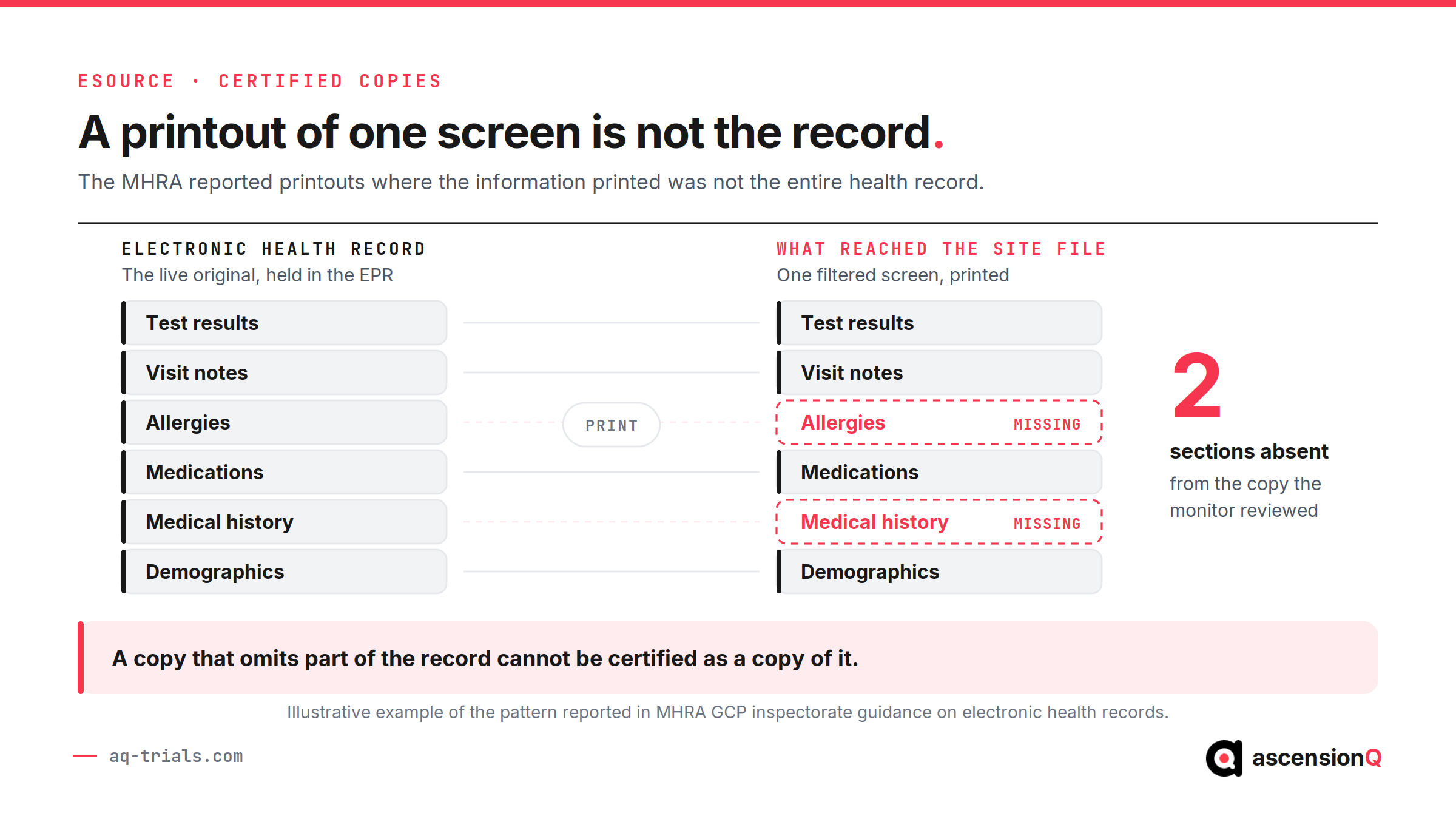
Inspectors find copies that were never certified and copies that were never complete. The MHRA GCP inspectorate published both patterns in its guidance on electronic health records. It reported printouts of source documents from electronic health record systems that monitors had used for source data verification, with no evidence that these had been certified copies. It also reported printouts where the limited information printed was not the entire health record, because the patient’s medical history was absent.
Four failures account for most findings:
- The copy holds no certification statement, so nobody can say who verified it or when.
- The copy is partial, because a filtered screen view reached the file in place of the whole record.
- The original was destroyed before verification, which leaves the error permanent.
- A dynamic record was printed, so the audit trail that gave the value its standing was left behind.
Each failure is a process condition rather than an individual error. A site with a written scanning procedure, a certification statement template and a delegated verifier avoids all four. The attributes at stake are original and complete, and our guide to whether eSource meets ALCOA+ maps each attribute to the control that evidences it.
Certified copies arise wherever a site holds part of its source on paper and the rest in a system. AQ is launching eSource soon as part of the AQ platform, so that the original stays electronic and the question of certifying a copy of it falls away for the data captured there. Book a live demo to see the AQ platform today.