How should a site manage IMP returns, reconciliation and destruction? A site manages them as one continuous record rather than three separate tasks. Every unit that comes back is logged against the participant who received it, counted into a running balance, and held in quarantine until the sponsor authorises its disposal in writing.
An investigational medicinal product (IMP) leaves the pharmacy with a record attached to it. The same record has to close when the product comes back, and the closing entries are where UK sites lose most of their inspection findings. This guide covers the per-participant returns log, who counts and who witnesses, the written authorisation behind any destruction, the routes a site can use, what a certificate of destruction must show, and how a discrepancy is investigated.
- A return is logged per participant, not per delivery. The count is a by-product of the log.
- Nothing is destroyed without written sponsor authorisation naming what may go.
- A returned kit stays out of the dispensable pool from the moment it is booked back in.
What Counts as an IMP Return at a Site?
A return is any unit of IMP that comes back into pharmacy custody after it has left. The participant hand-back is the obvious case. Four others carry the same record, and a site that logs only the first will not reconcile at close-out.
| Type of return | What comes back | What the log must capture |
|---|---|---|
| Participant hand-back | Used, part-used and unused units issued to one participant | The participant code, the kit number, units issued, units returned and units taken |
| Unused dispensed stock | A kit prepared and labelled for a participant who never received it | Why it was never issued, and whether the protocol permits re-allocation |
| Expired stock | Units that passed their expiry or re-test date in the pharmacy | The expiry date, the date segregated, and the quantity at that date |
| Recalled or quarantined stock | Units withdrawn by the sponsor or held after a temperature excursion | The sponsor instruction, the batch affected and the hold decision |
| Close-out stock | Everything still on the shelf when the site closes | The final count per batch, reconciled before the last monitoring visit |
The receipt end of the same chain is covered in receipt and quarantine, and the full custody path from depot to participant is set out in from depot to patient.
What Does a Per-Participant Returns Log Record?
ICH E6(R3) section 2.10.4 sets the minimum. The investigator or institution, or a pharmacist or other appropriate individual, should keep records of delivery and inventory, of use by each participant including confirmation that participants received the doses the protocol specifies, and of return to the sponsor and destruction or alternative disposition of unused product. The same section requires those records to carry dates, quantities, batch or serial numbers, expiry dates where applicable, and the unique codes for the product and the participants.
Section 2.10.1 places responsibility for that management with the investigator or institution. Section 2.10.2 permits delegation to a pharmacist or another individual under local rules, and states that the person should be under the oversight of the investigator or institution. A returns entry therefore carries two names: the person who performed the count and the person accountable for it.
- Participant code and visit, which ties the return to the dispense it closes rather than to a date in isolation.
- Kit or pack number and batch, which is what lets a single unit be traced back through the chain later.
- Units issued, units returned and units taken, which gives per-participant compliance as an arithmetic result rather than a separate exercise.
- Date of return and date of entry, which shows whether the record was made contemporaneously.
- Counted by and checked by, which answers the question an inspector asks about every count.
- Current disposition, which states whether the units are quarantined, awaiting authorisation, destroyed or returned to the depot.
These entries live in the clinical trial pharmacy site file for the study. The reconciliation formula that uses them, with a worked example, is owned by the guide to IMP accountability in clinical trials.
Who Counts the Returns, and Who Witnesses the Count?
One person counts and a second person verifies. The counter is a member of pharmacy staff delegated that activity and trained on the protocol. The verifier confirms the figure independently, and signs. Sites that run a single-signature count find the practice holds until the first discrepancy, at which point there is no second record to test the first against.
The witness requirement rises with the risk the product carries. A blinded kit, a controlled drug and a cytotoxic product each attract a second signature as standard UK practice, and many sponsors write that expectation into the pharmacy manual. Check the manual for the study before the first return arrives rather than at the first count.
Also Read: Drug Accountability Logs: What Auditors Actually Check
The Running Balance a Site Pharmacy Keeps
A site pharmacy’s real control is a running balance, not a reconciliation at the end. The balance moves on every transaction: received, dispensed, returned, quarantined, destroyed, sent back. A site that keeps it current can answer the quantity question on any day. A site that reconstructs it at close-out is answering the question from memory and paperwork, months after the events.
A reconciliation at close-out is an audit of the record. A running balance is the record.
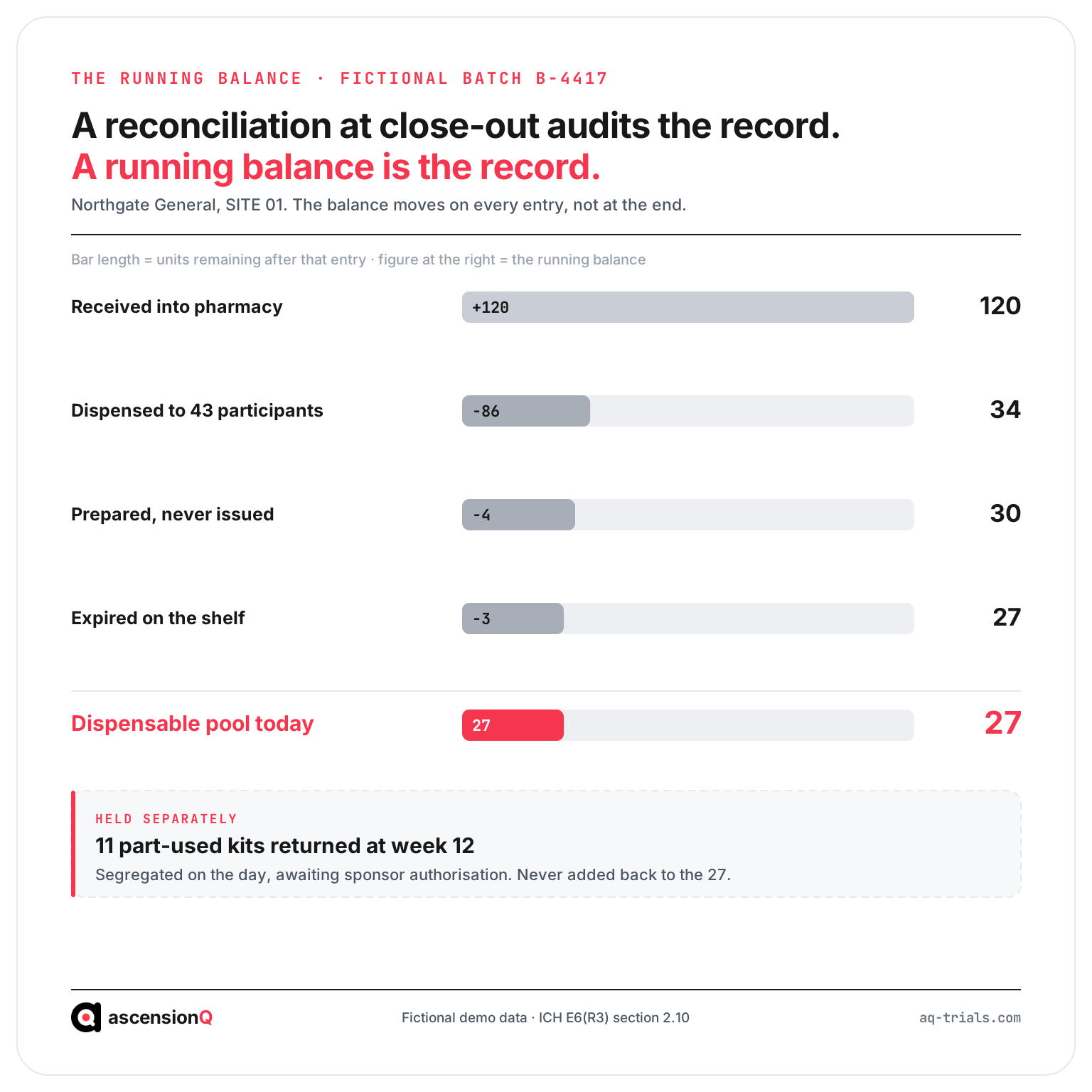
Take a hypothetical study as the worked example. Northgate General, recorded as SITE 01, receives 120 kits of batch B-4417. Pharmacy dispenses 86 across 43 participants. Eleven participants return part-used kits at their week 12 visit. Four kits were prepared and never issued. Three kits expired on the shelf. The dispensable pool on that date is 120 minus 86 dispensed minus 4 prepared minus 3 expired, which is 27. The eleven returns do not go back into that 27. A site that lets them back in has the error this guide returns to below.
AQ Pharmacy keeps this running balance per kit and per participant, so the quantity position and the per-participant compliance figure come from the same entries rather than from two separate counts. The difference between holding that balance on paper and holding it in a system is covered in paper versus electronic IMP accountability.
What Authorisation Does a Site Need Before It Destroys IMP?
Written sponsor authorisation comes before any destruction. The authorisation is study-specific and names what may be destroyed. A standing instruction in a pharmacy manual is a general permission, and most sponsors still ask for a per-batch or per-event confirmation on top of it. The site keeps both in the clinical trial pharmacy site file.
- The reconciliation is complete and accepted first, because destroyed stock cannot be recounted if a figure is later questioned.
- The monitor has verified the accountability record, which is the step most sponsors make a condition of the authorisation.
- The authorisation identifies the units, by batch, kit range or category, so the scope of what was approved is readable afterwards.
- The authorisation is signed and dated by a named sponsor representative, which is what turns a conversation into a record.
The MHRA guidance on oversight and monitoring activities, published on 28 January 2022 and last updated on 31 July 2026, lists among the aims of the close-out visit that “all trial materials and IMP is accounted for and returned or destroyed”. The accounting comes first in that sentence for a reason.
On-Site Destruction or Return to the Depot?
Two routes close the chain, and the sponsor chooses. A site that assumes the route will find out at the first return that it assumed wrong.
| Dimension | Destruction at the site | Return to the sponsor’s depot |
|---|---|---|
| Who decides | The sponsor, in writing, against the site’s own capability | The sponsor, usually where central reconciliation is required |
| What the site needs | A licensed waste route, a written procedure and trained staff | A shipping account, packing to the protocol and a courier record |
| The evidence produced | A certificate of destruction, plus the waste transfer record | A proof of collection and the depot’s receipt confirmation |
| Where the risk sits | Destroying before the count is agreed | Units in transit that are counted at neither end |
| Blinded studies | Harder, because the site may not open or inspect units | Often preferred, so unblinding risk stays with the sponsor |
The MHRA oversight guidance also sets monitoring effort by trial type. It states that for a Type A trial, where the IMP is used in normal clinical practice, “no recording of IMP accountability takes place beyond normal clinical practice”. For a Type C trial it states that “monitoring of the accountability should take place in more detail than for IMP in a Type A trial”. The destruction route a sponsor picks usually follows the same risk logic.
What Must a Certificate of Destruction Show?
A certificate of destruction is the document that closes the quantity. It is read alongside the returns log, so the two have to agree on their face. A certificate that states a total with no batch detail cannot be reconciled against a log that is kept per kit.
- The study identifier and the site, so the certificate cannot be filed against the wrong record.
- The batch numbers and the quantity destroyed per batch, which is what the running balance is reduced by.
- The kit or pack numbers where the study is kit-allocated, which is what makes a single unit traceable to its end.
- The date and method of destruction, which has to fall after the date of the sponsor authorisation.
- The signature of the person who carried it out and the witness, which matches the two names on the count.
- A reference to the sponsor authorisation it was performed under, which closes the loop an inspector will walk.
How Does UK Waste Law Classify a Destroyed Trial Medicine?
A destroyed IMP is waste, and UK waste law classifies it on its own terms. This is the part most trial guidance skips, and it is the part an NHS pharmacy has to get right because the duty falls on the organisation producing the waste rather than on the sponsor.
The Environment Agency and Defra guidance on how to classify healthcare and related wastes, published on 21 March 2014 and last updated on 26 August 2026, states plainly that “you must classify the waste your business produces before it is collected, disposed of or recovered”. It treats cytotoxic and cytostatic medicines as hazardous, and other medicines as non-hazardous. A medicine counts as cytotoxic or cytostatic for classification where it is acutely toxic, carcinogenic, mutagenic or toxic for reproduction.
| Waste category | Code for human healthcare | What it means for the pharmacy |
|---|---|---|
| Cytotoxic and cytostatic medicines | 18 01 08* | Hazardous, so it travels on a consignment note and a licensed route |
| Other medicines | 18 01 09 | Non-hazardous, and still disposed of under the trust’s waste policy |
Two records therefore exist for the same destruction. The certificate of destruction satisfies the sponsor and the trial record. The waste transfer or consignment documentation satisfies the trust and the regulator for waste. File a copy of both, because an inspector who asks how a cytotoxic IMP was destroyed is asking about the second one.
What Happens When the Returns Count Does Not Match?
A discrepancy is investigated before it is explained. The temptation to write “participant reports taking all doses” into the log and move on is what turns a counting difference into a data integrity finding. The investigation is short, and it is documented.
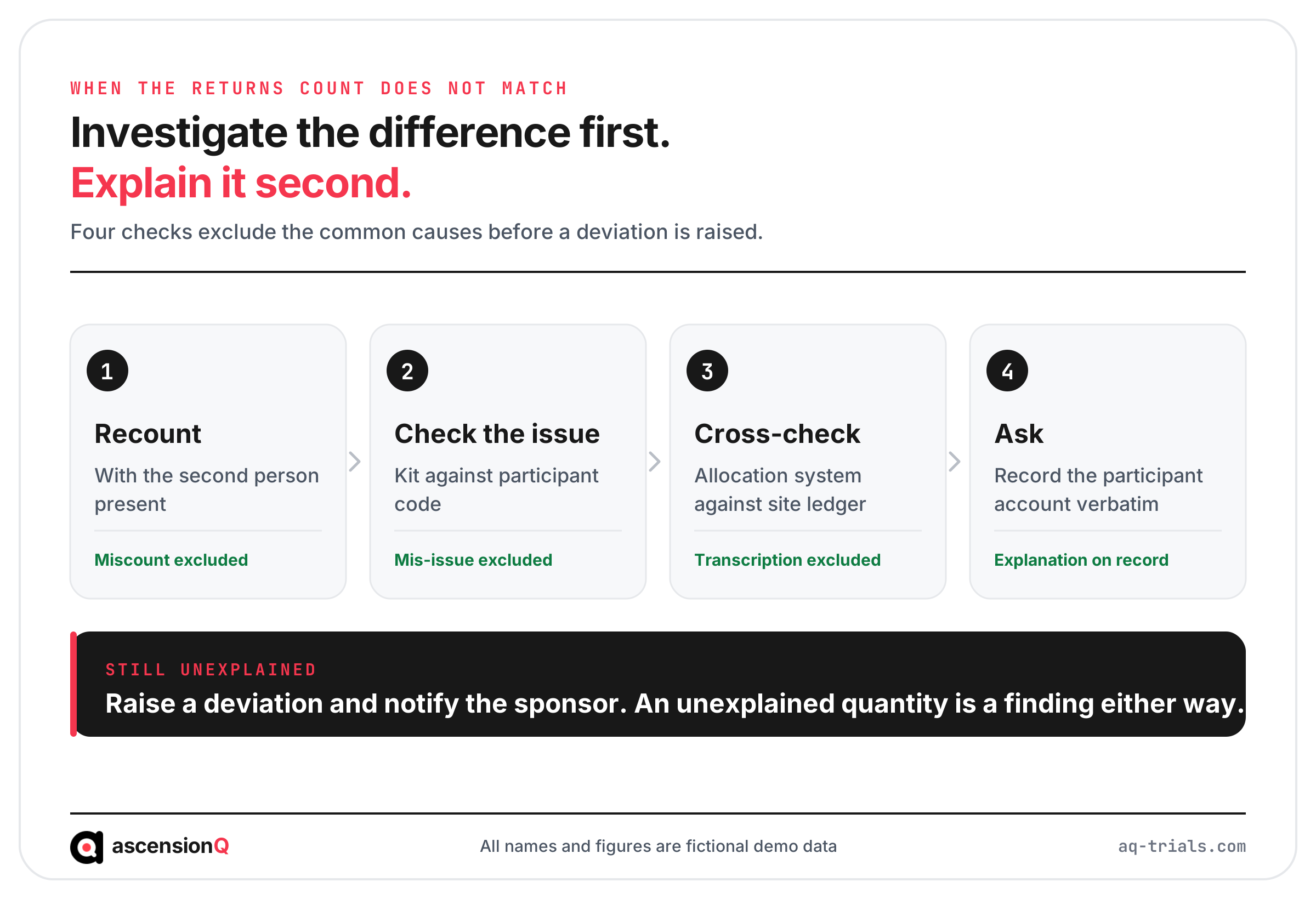
- Recount with the second person present, because a miscount is the most common cause and the cheapest to exclude.
- Check the dispensing entry against the kit, because a kit issued to the wrong participant code shows as a shortfall in one record and a surplus in another.
- Check for a transcription error between systems, because the sponsor’s allocation system and the site ledger hold different fields and are reconciled by hand at many sites.
- Ask the participant and record the account verbatim, because a documented explanation is evidence and an assumed one is not.
- Raise a deviation where the difference remains unexplained, and notify the sponsor, because an unexplained quantity is a finding whether or not the site reports it.
The split between what the sponsor’s allocation system holds and what the site ledger holds is set out in RTSM and IRT versus the pharmacy record.
The Returned Kit That Goes Back on the Shelf
The most expensive error at a busy site is a returned or destroyed kit that finds its way back into the dispensable pool. It happens where the returns log and the stock position are two records. Pharmacy books a kit back on the returns log on Monday, the stock list still shows it on the shelf, and a colleague dispenses it on Thursday.
A kit leaves the dispensable pool the moment it is booked back in, or it never really left.
- Segregate physically on receipt of the return, into a marked returns area that is not the live stock shelf.
- Change the kit’s status in the record at the same moment, so the paper position and the shelf position never disagree.
- Treat a prepared but unissued kit as returned stock, and re-allocate it only where the protocol says so in writing.
- Keep destroyed kit numbers readable in the record after destruction, so a later query about that kit resolves to a disposition rather than to silence.
How Does AQ Pharmacy Hold the Running Balance?
AQ Pharmacy keeps a running balance per kit and per participant. Each receipt, dispense, return, quarantine and disposal entry moves that balance at the moment it is recorded, so the quantity position and the per-participant figure are read from one set of entries rather than assembled from two.
The clinical trial pharmacy software page covers the module in full.
Book a live demo and bring one study with returns outstanding. We will walk a kit from receipt to its final disposition against your own pharmacy process.
Frequently Asked Questions
How should a site manage IMP returns, reconciliation and destruction?
Log every returned unit against the participant who received it, move a running balance on each entry, and segregate the stock on the day it comes back. Reconcile against that balance rather than rebuilding it at close-out. Destroy only what a written sponsor authorisation names, and file the certificate of destruction with the waste documentation.
Who authorises destruction of IMP?
The sponsor authorises it in writing, and the authorisation names the units it covers. Most sponsors require the accountability record to be reconciled and verified by the monitor before they issue it. The site keeps the authorisation in the clinical trial pharmacy site file alongside the certificate it produced.
Can a site destroy IMP on site?
A site can destroy IMP on site where the sponsor has authorised that route and the site has a written procedure, trained staff and a licensed waste route. The alternative is return to the sponsor’s depot, which sponsors often prefer for blinded studies. The sponsor decides, and the decision is recorded for the study.
What does a destruction certificate have to show?
It shows the study and site, the batch numbers and the quantity destroyed per batch, the kit numbers where the study is kit-allocated, the date and method, the signatures of the person who carried it out and the witness, and a reference to the sponsor authorisation. A certificate that gives only a total cannot be reconciled against a log kept per kit.
What happens when the returns count does not match?
Recount with the second person present, then check the dispensing entry and look for a transcription error between the sponsor’s allocation system and the site ledger. Ask the participant and record the account as given. Raise a deviation and notify the sponsor where the difference stays unexplained.
Is destroyed trial medicine hazardous waste?
It depends on the product. The Environment Agency and Defra classification guidance treats cytotoxic and cytostatic medicines as hazardous, under code 18 01 08* for human healthcare, and other medicines as non-hazardous under 18 01 09. The duty to classify falls on the organisation producing the waste, which is the trust rather than the sponsor.
Can a returned kit be dispensed to another participant?
Only where the protocol permits it in writing, and the common case is a kit prepared but never issued. A kit handed back by a participant stays out of the dispensable pool. Segregate it physically and change its status in the record on the same day, so the shelf and the ledger agree.