Study set-up challenges fall into six recurring operational classes: protocol instability, authorisation dependency, agreement settlement, site readiness, supply readiness and evidence assembly. Each class carries the same structural signature. A dependency that governs the start date sits in a state the study record does not hold, so the delay becomes visible after it has already been spent.
Set-up runs from the decision to open a study to the first participant’s first visit at a site. The work inside that window is distributed across sponsors, sites, ethics committees, regulators, pharmacies, laboratories and service providers, and every one of those parties holds part of the start condition. A site opens on the day the last part arrives.
This guide sets out the six classes as an operational taxonomy, names the artefact that settles each one, and describes what a clinical trial management system has to hold for a team to see a start-up problem while it can still be fixed. The framing applies to commercial sponsors, CROs and academic sponsors alike, because the classes follow the structure of the work in every market.
Set-up rarely fails at a task. It fails at a dependency nobody was holding.
What Does Study Set-Up Cover?
Study set-up covers every activity that has to be complete before a participant can be enrolled at a given site. The boundary matters, because it decides which delays belong to set-up and which belong to conduct. Six outputs have to be simultaneously true for a site to open:
- An approved protocol, at a version every participating site has acknowledged.
- A regulatory authorisation and a favourable ethics opinion that cover the site.
- Executed agreements between the sponsor, the institution and any service provider performing trial-related activities.
- Named staff with documented qualifications, current training and a signed delegation record.
- Investigational product released, labelled and held under controlled conditions, with the ancillary supplies the assessment schedule requires.
- An essential records file that already holds the evidence the first five outputs produced.
Markets fix the earliest possible start date through different instruments. The three below cover most sponsors, and each one sets a floor beneath the start date.
| Market | Instrument | What fixes the earliest start |
| United States | IND under 21 CFR part 312 | The IND takes effect thirty days after FDA receives it, unless FDA imposes a clinical hold. An investigator may not administer the investigational drug until the IND is in effect. |
| European Union | Regulation (EU) 536/2014 | Validation within ten days, Part I and Part II assessment reports within forty-five days of validation, and a decision notified within thirty days of the reporting date. A missed decision deadline authorises the trial tacitly. |
| United Kingdom | The amended Clinical Trials Regulations | A single combined review of the regulatory and ethics applications, with compliance against the ICH E6 GCP Principles a legal requirement from 28 April 2026. |
The instrument sets the earliest date a study could open. Nothing in it prevents a site opening months afterwards, and the distance between those two dates is the subject of the rest of this guide. The MHRA approval clocks behave the same way: they bound the regulator’s work and say nothing about the local work that follows it.
The Six Classes of Study Set-Up Problem
Six classes account for most start-up delay across markets and sponsor types. Two properties separate them: where the dependency originates, and how late it becomes visible. Those properties decide how much warning a team gets, and they explain why some classes are recoverable inside a set-up window while others are already terminal by the time anyone notices.

1. Protocol Instability
The protocol changes while set-up is running. Amendments are a normal feature of drug development, and the operational cost lands on every downstream artefact that quoted the previous version. A benchmark study by the Tufts Center for the Study of Drug Development, covering 950 protocols and 2,188 amendments contributed by sixteen companies, reports a mean of 3.3 amendments per protocol, rising to 3.5 in Phase III. Only 23% were classified as avoidable, which places most of this class outside anyone’s control and makes the handling of amendments the variable that a team can actually manage.
Two figures from that study describe the operational problem precisely. The mean time from identifying the need to amend through to final oversight approval was 260 days, with a median of 190. Sites ran on differing protocol versions for an average of 215 days.
- Where it shows: the consent form, the schedule of assessments, the site training record and the laboratory manual all quote a version number.
- What it delays: re-consent, re-training and re-approval at every site already activated, plus the ethics submission for every site still in set-up.
- The failure signature: two sites work to different versions on the same day, and nobody can name which sites acknowledged which version without asking them.
2. Authorisation Dependency
Authorisation is a decision taken outside the sponsor’s organisation on a clock defined by regulation. The length of that clock is published and predictable. The operational difficulty comes from the events that stop and restart it, and from the ambiguity about which internal date corresponds to the regulator’s.
- Where it shows: the submission log, the request for further information, and the dated response that restarts the assessment.
- What it delays: every site in the study at once, because a single authorisation covers the whole application.
- The failure signature: a team reports the study as awaiting approval for six weeks, and the response to a question was sent in week two.
3. Agreement and Cost Settlement
Agreements sit between organisations, so no single party controls the pace. ICH-GCP E6(R3) section 3.6.1 requires that agreements between the sponsor and the investigator, institution or service provider are documented prior to initiating the activities they cover. Section 2.5.1 requires the investigator or institution to sign the protocol or an alternative contract to confirm agreement with the sponsor, and section 2.3.4 extends the same duty to agreements the site makes with its own service providers.
Activity that starts ahead of its documented agreement creates an evidence gap that a later signature cannot close. The work happened on a date, and the authority for it began on a different one.
- Where it shows: the executed agreement, the cost schedule, and the dated record of what each party agreed to perform.
- What it delays: site activation at the specific sites whose terms are unsettled, which fragments a multi-site study into staggered openings.
- The failure signature: a contract completed by one function sits for weeks before the function that needs it learns that it is ready.
4. Site Readiness and Delegation
Readiness is a statement about people. E6(R3) section 2.2.2 requires the investigator to have sufficient time, an adequate number of available and qualified staff, and adequate facilities for the foreseen duration of the trial. Section 2.3.1 allows delegation of trial-related activities while the investigator retains ultimate responsibility, and section 2.3.3 requires a record of the persons and parties to whom activities have been delegated.
Those three requirements convert into three artefacts: a curriculum vitae, a training record and a delegation log. Each has to be current on the day the site opens and has to remain reconstructable afterwards.
- Where it shows: the delegation log, protocol and GCP training certificates, and the qualification records behind each delegated task.
- What it delays: the green light itself, because the last certificate to arrive sets the activation date.
- The failure signature: a site is operationally ready and administratively unopened, waiting on a document that has yet to arrive.
5. Supply and Pharmacy Readiness
Investigational product runs on its own track through set-up. Release, labelling, shipment, storage conditions, temperature monitoring and accountability all have to be settled before a first dose, and pharmacy frequently reports to a different management line from the research team. The electronic pharmacy site file exists because that track produces its own evidence set, which is why it is kept separate from the investigator site file.
- Where it shows: the product release certificate, the temperature record, the accountability log and the pharmacy manual acknowledgement.
- What it delays: dosing, so a study can screen and consent participants and still be unable to treat them.
- The failure signature: every research milestone reads complete and the pharmacy has not been asked for a date.
6. Evidence Assembly
The first five classes each produce records. Appendix C of E6(R3) sets out the essential records for the conduct of a clinical trial, and section 4.2.2 requires that changes to source records stay traceable, leave the original entry visible and carry an explanation where one is needed. Records created during set-up are the ones an inspector reads first, because they establish that the trial started under proper authority.
A file assembled after activation records what a team remembers. A file assembled during set-up records what happened. The electronic investigator site file and the electronic trial master file hold that evidence at site and sponsor level respectively.
- Where it shows: the site file index, the version history of each filed document, and the audit trail behind every entry.
- What it delays: nothing visible during set-up, which is what makes this class the most expensive of the six.
- The failure signature: filing begins after the first participant, and the dates on the documents no longer match the dates on the activity.
Also Read: CTMS vs eTMF vs EDC vs eISF: Which System Do You Actually Need?
Why Do All Six Classes Fail the Same Way?
Each class fails at the point where a dependency changes state and the study record stays as it was. Most teams manage set-up as a plan, which is a list of tasks with dates attached. A plan answers what should have happened by now. It cannot answer what is currently true, because the truth lives in the artefacts and the plan only holds a report about them.
| Aspect | Set-up tracked as a plan | Set-up tracked as a record |
| The unit of control | A task with an owner and a due date | A dependency with a state, an owner and an artefact |
| “Complete” means | Somebody reported the task done | The artefact exists, is current and is filed |
| Protocol version | Held in the document each site last received | Held once, with each site’s acknowledgement dated against it |
| A change mid-set-up | Re-planned, then communicated by email | Restated once, and every dependent record reopens |
| Status of a waiting item | Known by asking the person holding it | Visible with the number of days it has been waiting |
| Evidence afterwards | Reconstructed from correspondence at inspection | Already assembled, dated and attributable |
ICH E8(R1) makes the same argument about study quality generally. Section 3.1 states that retrospective activities such as document review and monitoring are insufficient on their own, and that quality improves through prospective attention to the design of the protocol, the procedures and the operational plans. Section 3.3.5 puts it plainly: the foundation of a successful study is a protocol that is both scientifically sound and operationally feasible.
A plan tells you the study is late. A record tells you which dependency made it late, on the day it happened.
Where Does the Time Actually Go?
Published start-up data points at the administrative layer. A 2025 study in the Journal of Clinical and Translational Science examined 308 site activations across thirteen consecutive investigator-initiated multicentre trials, comparing groups that used a standardised workflow, a dedicated site navigator and an electronic tracking system against groups that used only some of those elements.
- Sites using all three elements activated in a median of 133 days.
- Sites without the dedicated navigator took a median of 191 days.
- Sites without the standardised workflow took a median of 277 days, slightly more than double the first group.
- Only 31% of sites in the best-performing group met a 90-day activation goal.
The milestone breakdown inside the best-performing group is the more instructive part. Contract partial execution came at a median of 32 days and the ethics submission at 48 days. The delegation of responsibility log landed at 58 days. The training and certificates milestone landed at 121 days, twelve days before activation at 133.
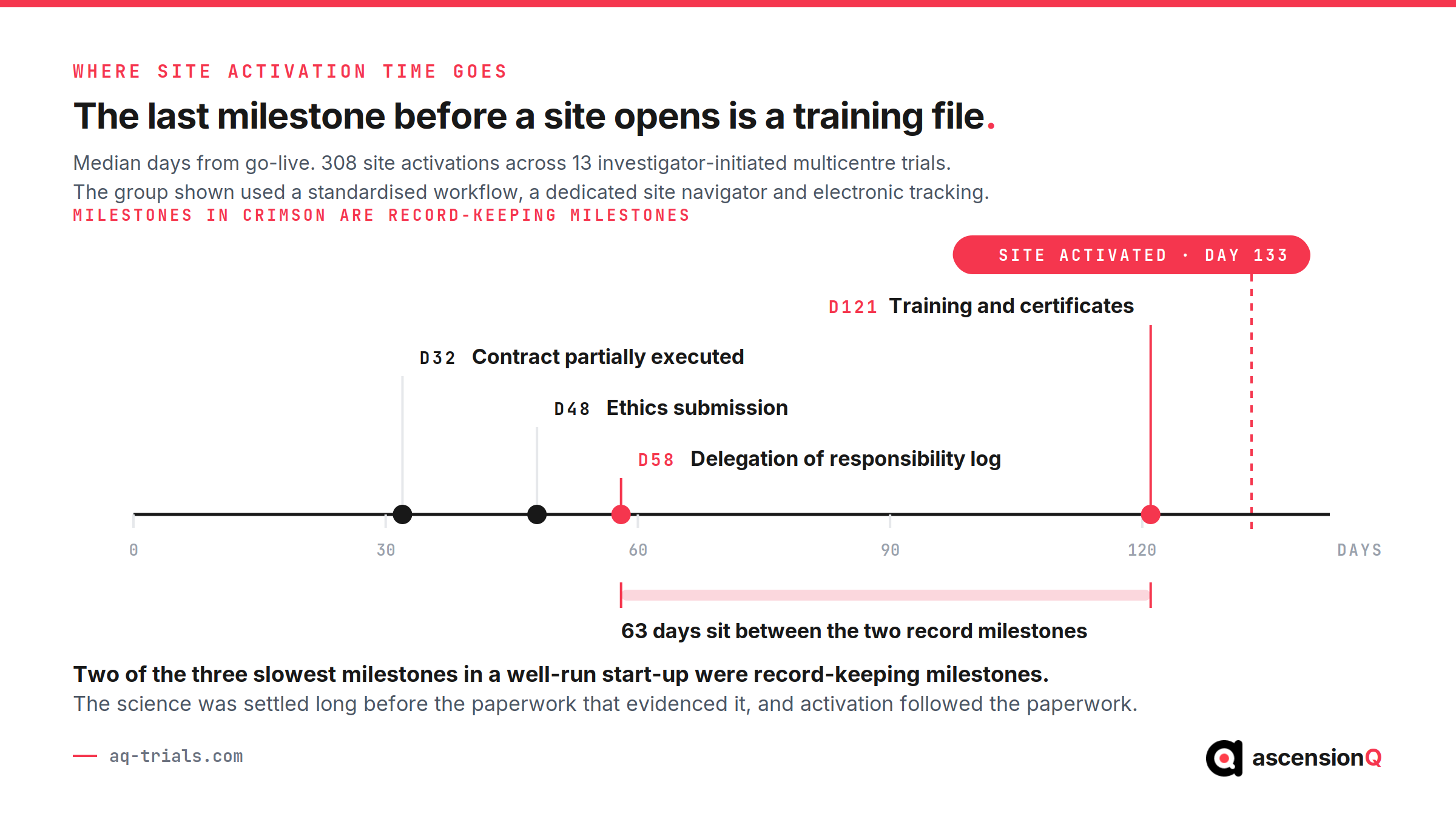
Two of the three slowest milestones in a well-run start-up process were record-keeping milestones. The science was settled long before the paperwork that evidenced it, and the activation date followed the paperwork. That result holds across sponsor types, and it is the strongest available argument for treating set-up as a records problem with a schedule attached rather than a schedule with records attached.
Also Read: CTMS vs Spreadsheets: Why Site Capacity Planning Breaks Without One
The Operational Difference a Controlled Record Makes
A controlled set-up record changes what a team can see, and visibility is the mechanism that produces every downstream benefit. Each item below states the mechanism first and the operational outcome second.
- Every dependency carries a state and a named owner, which turns an unanswered handover into a countable item on a list.
- Each milestone holds its own date, which allows days-at-current-state to be read directly instead of reconstructed at a monthly meeting.
- The protocol version is held once with every site acknowledgement dated against it, which makes the population of sites on an outdated version a query the system answers.
- Delegation, training and qualification records sit against the person and the task, which allows a team to see the specific certificate that is holding the green light.
- Site file completeness is measured continuously, which moves evidence assembly into set-up and removes the retrospective filing exercise that follows activation.
- Deviations and their corrective and preventive actions attach to the study from the first day of set-up, which captures the amendment-driven problems that arise before any participant is enrolled.
What Must the Study Record Hold Before the First Participant?
The table below maps each class to the artefact that settles it and to the provision that requires it. A team can use it as a pre-enrolment check on any study in any market, because every reference is drawn from an international standard.
| Class | The artefact that settles it | Reference |
| Protocol instability | Current protocol version with a dated acknowledgement per site | E6(R3) 2.5.1; Appendix B |
| Authorisation dependency | Authorisation and favourable opinion covering the site, with the dates that produced them | 21 CFR 312.40; Regulation (EU) 536/2014 Articles 5 to 8 |
| Agreement settlement | Executed agreements dated ahead of the activities they cover | E6(R3) 3.6.1, 2.3.4 |
| Site readiness | Delegation log, training records and qualification evidence per delegated task | E6(R3) 2.2.2, 2.3.1, 2.3.3 |
| Supply readiness | Product release, storage conditions and accountability records held in the pharmacy file | E6(R3) Appendix C |
| Evidence assembly | Essential records filed with a traceable audit trail on a validated system | E6(R3) Appendix C; 4.2.2; 4.3.1 to 4.3.8 |
The last row governs the other five. E6(R3) sections 4.3.1 to 4.3.8 set expectations for computerised systems covering procedures, training, security, validation, system release, failure management, technical support and user management. A set-up record that carries regulatory weight has to meet those expectations before it can be relied on as evidence.
Also Read: The ISF Essential Documents Checklist
What Goes Wrong Without a Controlled Set-Up Record?
The consequences of an uncontrolled set-up appear long after set-up has ended, which is why the problem persists in organisations that measure their start-up performance carefully. Five outcomes recur:
- Retrospective filing. Evidence is assembled after activation from correspondence, so the file records a reconstruction of events instead of a contemporaneous account.
- Version drift. Sites operate to differing protocol versions for extended periods, and the reconciliation cost falls on data management at analysis.
- Unattributable authority. Activity performed before its documented agreement or delegation leaves a gap that later signatures cannot close.
- Staggered openings. Sites activate in an order set by administrative luck rather than by recruitment potential, which weakens the enrolment curve the study was designed around.
- Repeat findings. The same class of problem recurs on the next study, because the organisation holds no dated record of where the previous one stalled.
Those five outcomes are the practical content of inspection readiness at the start-up stage. An inspector reading a set-up file is testing whether the trial began under proper authority, and every one of the six classes leaves its evidence in that file.
How Does AQ Support Study Set-Up?
AQ Trials holds study set-up as one connected record, so each of the six classes reports its state into the same place.
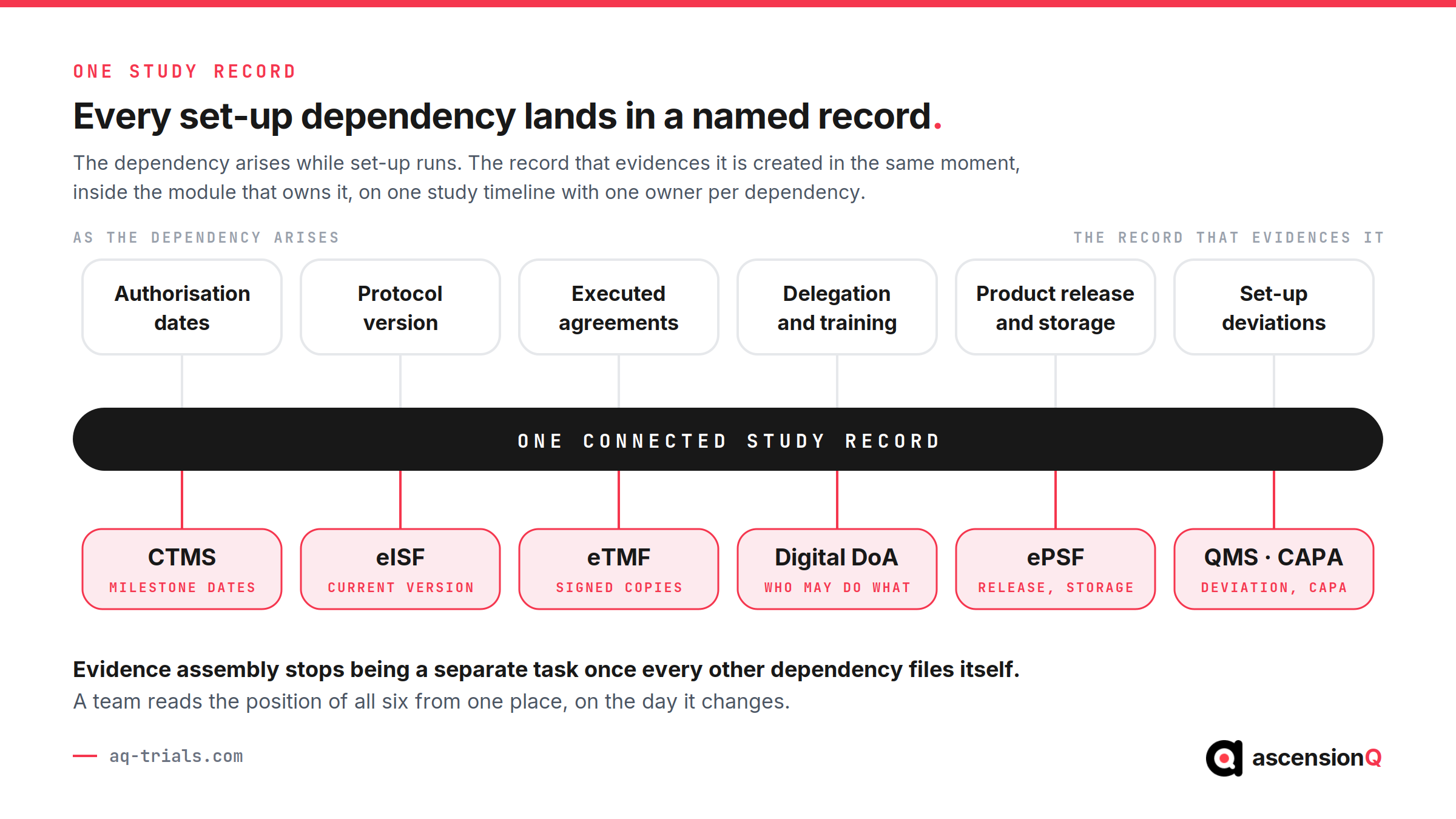
- The CTMS carries every set-up milestone with its own date and owner, so days-at-current-state is a live figure for each study and each site.
- The eISF holds site essential records as they are produced, which places evidence assembly inside set-up instead of after it.
- The eTMF, built on the DIA TMF Reference Model, gives the sponsor the same completeness view across every participating site.
- The ePSF tracks the pharmacy readiness track separately, so a supply dependency is visible before it becomes a dosing delay.
- Digital DoA ties delegated tasks to current training and qualification evidence, which shows the specific record holding a green light.
- The QMS and CAPA modules capture deviations and their corrective actions from the first day of set-up rather than from first participant.
AQ does not negotiate a contract, complete an ethics submission or release investigational product. It makes the position of every set-up dependency visible, dated and owned, which is the difference between a delay a team can act on and a delay a team reports afterwards. The platform is assured for public sector procurement through G-Cloud, the Data Security and Protection Toolkit and Cyber Essentials.
Book a live demo to see how AQ tracks study set-up from the first dependency to the first participant.
Sources
- ICH Guideline for Good Clinical Practice E6(R3), International Council for Harmonisation.
- ICH General Considerations for Clinical Studies E8(R1), International Council for Harmonisation.
- 21 CFR 312.40, Electronic Code of Federal Regulations.
- Regulation (EU) No 536/2014, EUR-Lex.
- Compliance with ICH E6 good clinical practice in the United Kingdom, MHRA.
- Hillery S. et al., “Accelerating start-up cycles in investigator-initiated multicenter clinical trials”, Journal of Clinical and Translational Science, 24 October 2025, DOI 10.1017/cts.2025.10180.
- “New Benchmarks on Protocol Amendment Practices, Trends and their Impact on Clinical Trial Performance”, Tufts Center for the Study of Drug Development. Sample: 950 protocols and 2,188 amendments from sixteen companies, with completion dates between 2016 and 2021.