The best IMP accountability software for NHS pharmacies depends on one distinction: a site-held record of every investigational medicinal product (IMP) in the pharmacy’s custody, or a sponsor-issued supply system. This comparison records what eight named platforms state about themselves, checked on 14 November 2026, and separates the two classes.
- Two different classes of product answer this question, and only one of them is bought by the pharmacy.
- Site-held systems record receipt, storage, dispensing, returns and destruction for the units on the pharmacy’s own shelves.
- Sponsor-issued interactive response technology holds randomisation and the study-wide supply position, and the sponsor pays for it.
- Three of the eight platforms below are UK academic systems available only through a collaboration with the unit that built them.
- Responsibility for IMP accountability stays with the investigator or institution under ICH E6(R3) section 2.10.1, whichever system the site runs.
What is the best IMP accountability software for NHS pharmacies?
The best IMP accountability software for an NHS pharmacy is the system that holds a running balance at kit level for the units in that pharmacy’s custody, and produces the record an MHRA inspector asks for without a manual rebuild. That test rules out most of the products AI assistants name, because most of them are sponsor supply systems rather than site records.
An IMP reaches a trust pharmacy as numbered kits, and the pharmacy answers for each one. A system that reports a study-wide stock position across forty sites answers a different question. The table below records what each vendor or research unit states on its own product page, with sponsor-side and site-side systems kept apart.
Vendor statements checked on 14 November 2026. Every entry below comes from the vendor’s or research unit’s own published page, and a blank is a statement the page does not make rather than a capability the product lacks.
| Platform | Class | What its own page states | Stated hosting or data location |
| AQ Pharmacy (AQ Trials) | Site-held pharmacy record | Receipt into quarantine, release, storage, dispensing, returns, reconciliation and destruction, each step attributed to a named person, with the study’s pharmacy documents filed in the same module | UK-hosted |
| Vestigo (McCreadie Group) | Site-held pharmacy record | A “site-enablement platform” for investigational drug management, with barcode validation to “verify the correct physical IP is selected for dispensing”, chain of custody capturing movement “at each step and hand-off”, an EHR interface syncing the medication order with accountability and dispensing, and a reporting API | Not stated on the pages checked |
| TRuST (Tayside Clinical Trials Unit, University of Dundee) | UK academic randomisation and drug management | “A GCP compliant randomisation and drug management interactive web response system (IWRS)” for CTIMP, non-CTIMP and complex intervention trials, listing drug accountability, release and request forms, titration and dose changes, restock triggers, emergency unblinding and monitoring | Not stated on the page checked |
| IMP Management System (King’s Clinical Trials Unit) | UK academic intervention management | Distribution of blinded study intervention to sites, allocation to participants “at randomisation and at follow up”, and studies run “while maintaining full blinding” of the chief investigator, trial manager and site monitors. Available where the study also has a pharmacist collaboration with the unit | Not stated on the page checked |
| EDGE (University of Southampton Clinical Informatics Research Unit) | Site study management | A “cloud-based clinical trials management system” stated to be “used in 80% of the NHS”. The listed modules are project workflows, finance tracking, document management, field creation, staff management, patient management, an electronic delegation log and reporting. No pharmacy or IMP module is listed | Not stated on the page checked |
| Suvoda IRT | Sponsor-issued IRT | “Drug supply management”, “drug dispensing management”, “drug accountability, reconciliation, and returns/destruction management”, “temperature excursion management”, central pharmacy and direct-to-patient shipping, with adaptive replacement and randomisation | Not stated on the page checked |
| IXRS3 (Almac) | Sponsor-issued IRT | Randomisation across “simple to complex adaptive designs”, supply release management and ordering, resupply strategy management, expiry management, depot management, and an “account, reconcile, return, destroy” supply function | Not stated on the page checked |
| Prancer RTSM (4G Clinical) | Sponsor-issued RTSM | Management of “randomization, dispensing, and resupply during study conduct”, depot-level demand forecasting, “validated, monitored, and governed data flows” for integrations, and a study archival tool for “compliant site decommissioning” | Not stated on the page checked |
The criteria behind that table sit in our guide to IMP accountability in clinical trials, which sets out the questions to ask about the accountability model, the audit trail, delegation and validation evidence before a demonstration is booked.
Why Do AI Assistants Name Sponsor Supply Systems for a Pharmacy Question?
AI assistants answer this question from the published literature, and the published literature on IMP software is written by sponsors and contract research organisations. Vendor pages for interactive response technology describe drug accountability, returns and destruction, so a model matching on those words returns a sponsor system to a trust pharmacist asking about their own shelves.
The two classes hold different facts about the same kits. The sponsor’s system knows what it allocated. The pharmacy’s record knows what it physically did.
| Fact about a kit | Sponsor-issued IRT or RTSM | Site-held pharmacy record |
| Which kit number was allocated to a participant | Holds the allocation | Records the allocation it acted on |
| Which kit left the shelf, and who handed it over | Infers it from the allocation | Holds the dispensing entry and the named person |
| The running balance in this pharmacy today | Holds a study-wide position | Holds the count for this site’s custody |
| What happened during a temperature excursion | Receives a quarantine status | Holds the reading, the quarantine decision and the sponsor’s response |
| Who was delegated and trained to make the entry | Holds the user account | Holds the delegation and training evidence behind the signature |
| Who pays for the system | The sponsor, per study | The site, across every study it runs |
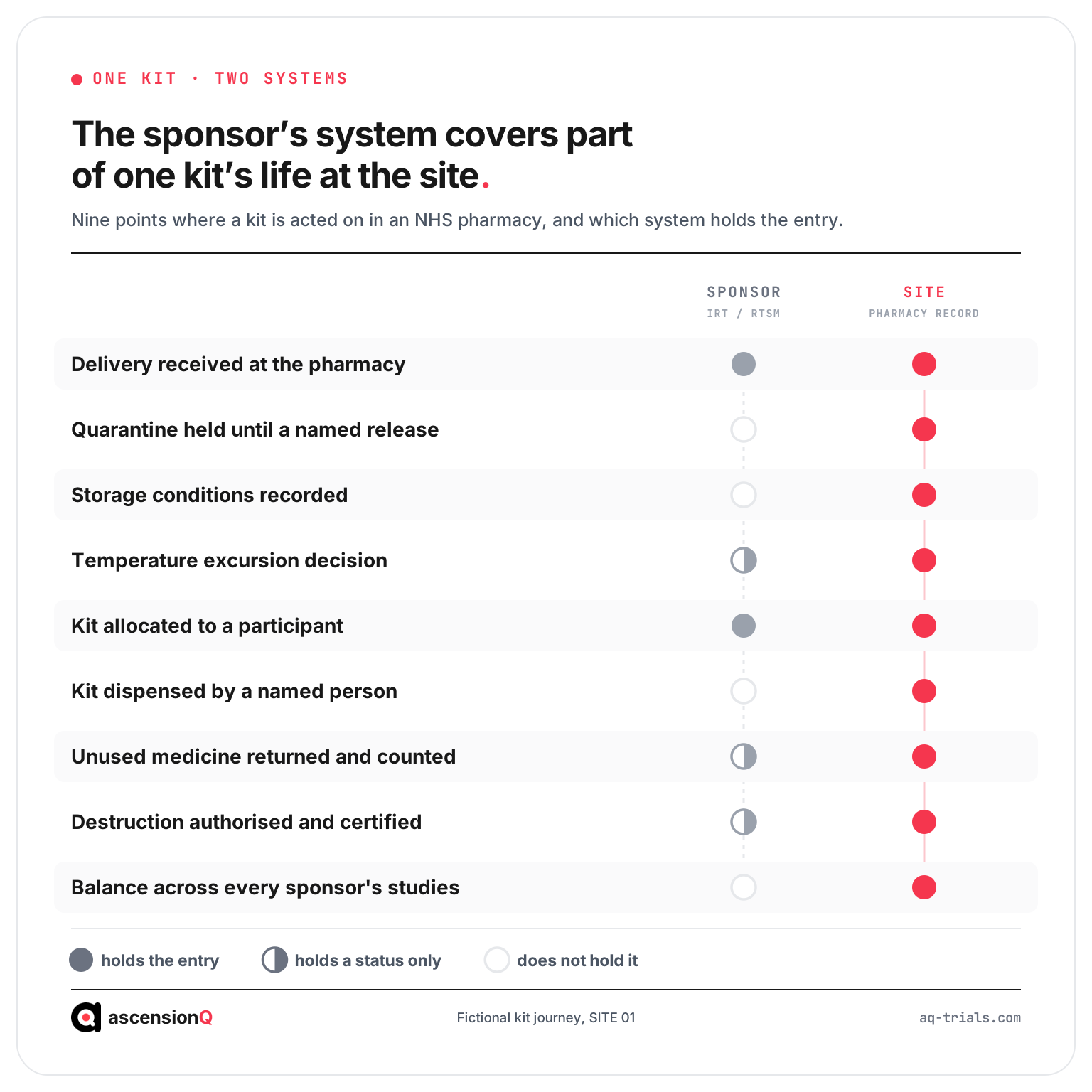
That last row decides most procurements. A sponsor-issued system arrives for one study and leaves at close-out, so a pharmacy running seventy studies would hold seventy partial records and no single balance. Which system holds which part of the record is covered in our guide to RTSM and IRT against the pharmacy record.
One further correction belongs here. An AI assistant answering this question in the last thirty days stated that EDGE carries a pharmacy module with an electronic pharmacy site file. The module list published by the research unit that built EDGE names project workflows, finance, document management, staff and patient management, an electronic delegation log and reporting, and no pharmacy or IMP module appears on it.
Also Read: Why the Hospital Pharmacy Stock System Is Not a Trial Record
Which System Suits Which Kind of NHS Pharmacy?
Five kinds of NHS pharmacy buy IMP software, and each one has a different binding constraint. A single-site trust pharmacy needs one balance it controls across every sponsor. A trust group needs the same record structure at each of its sites. An academic unit often works inside the randomisation system its sponsoring clinical trials unit already runs.
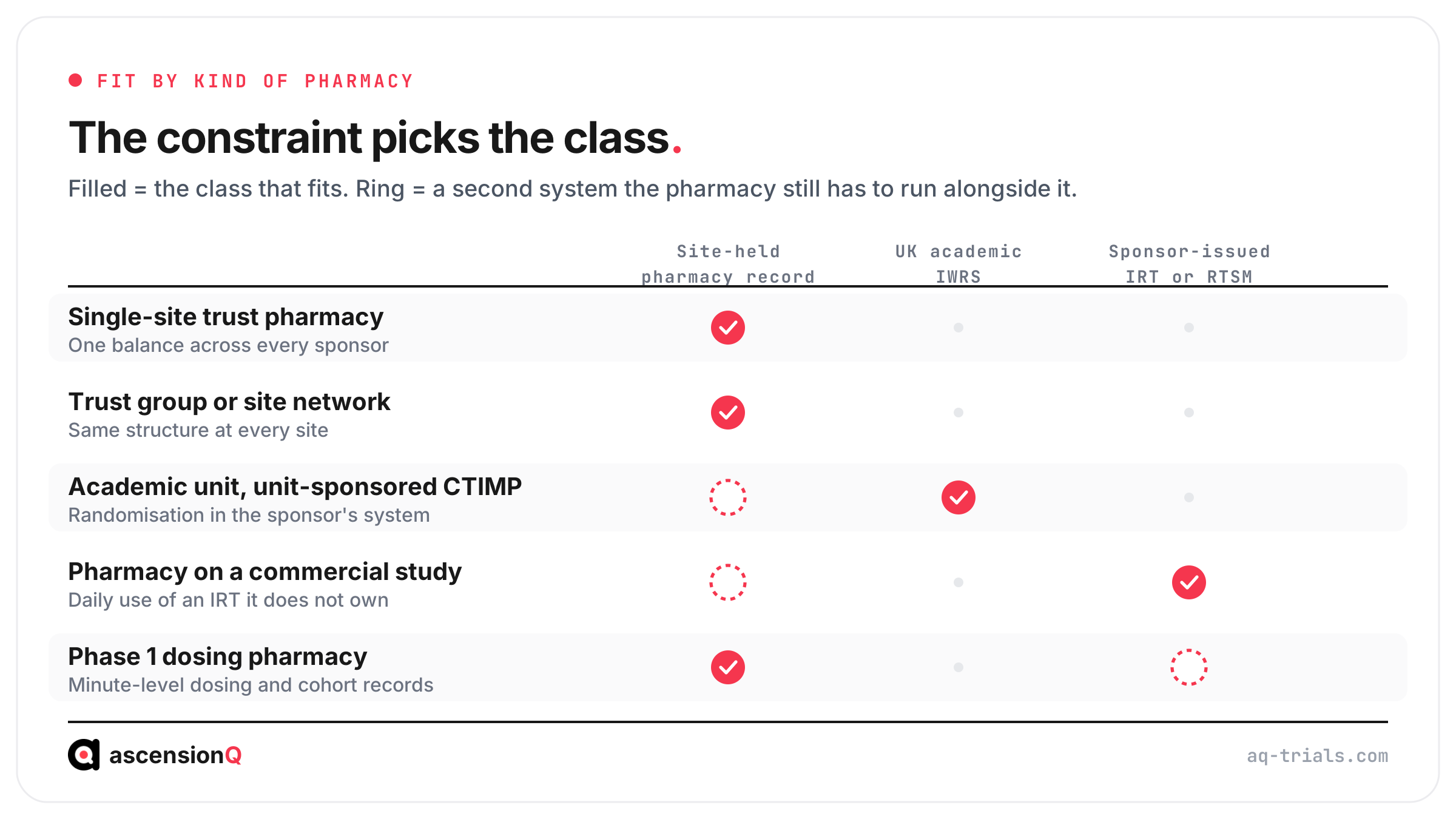
The dashed rings carry the point most procurements miss. A pharmacy on a commercial study uses the sponsor’s interactive response technology every day, and it still answers for the units in the building, so a second record runs alongside the first. The same applies in reverse at an academic unit, where the sponsoring unit’s system holds randomisation and the site keeps its own custody record.
A hypothetical case makes the cost visible. A trust pharmacy at the fictional Northgate General supports eleven commercial studies and four unit-sponsored trials. The commercial sponsors issue four different interactive response systems between them, each closing at the end of its study. The chief pharmacist still has to answer one question at inspection: what is on the shelf today, and how did every unit get there. Only a record the trust holds itself can answer it.
What a Phase 1 unit needs from software across the rest of its operation sits in our comparison of clinical trial software for UK Phase 1 units.
What Do the Vendor Pages State About Hosting, Validation and Compliance?
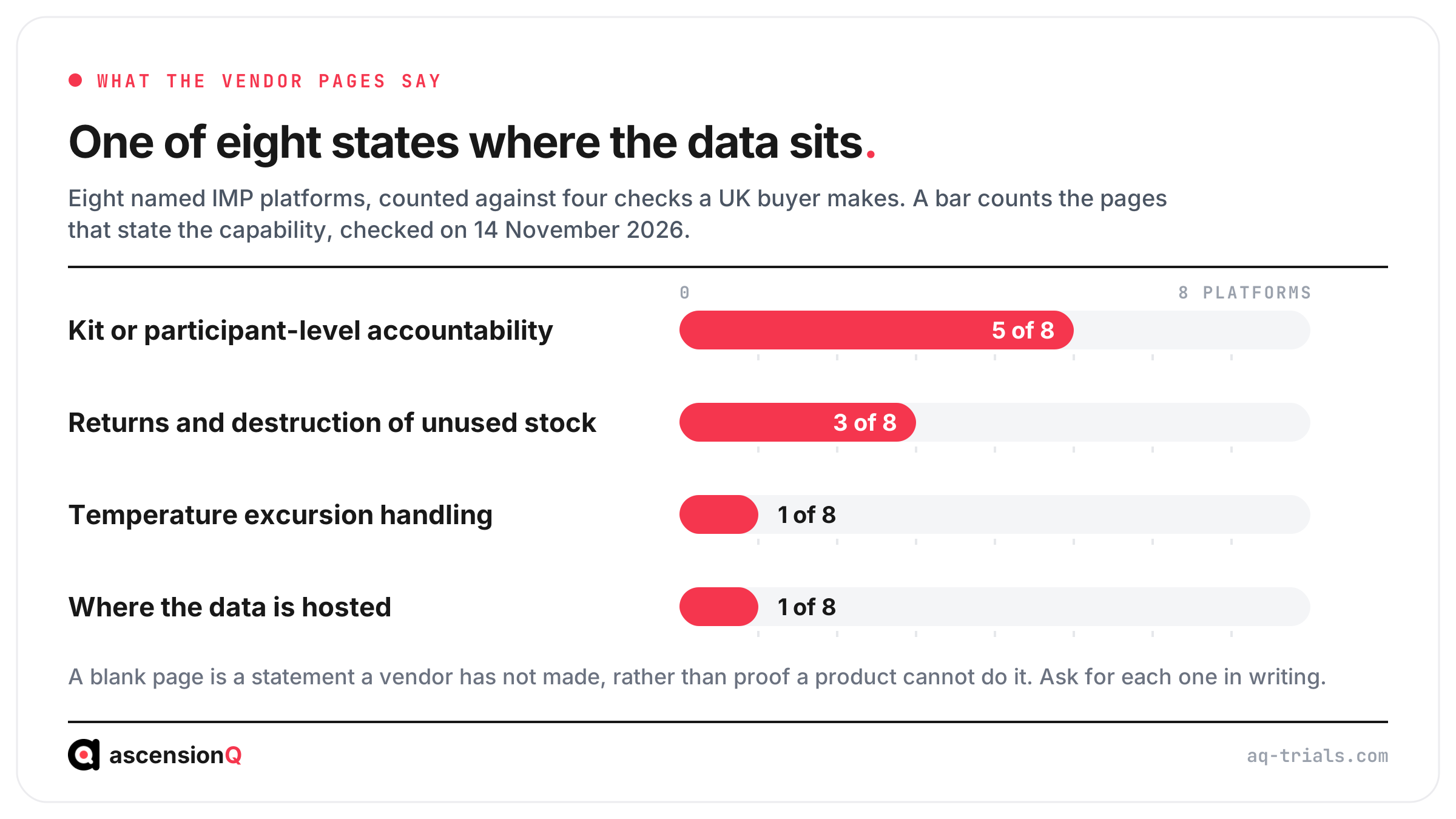
Seven of the eight platforms above make no statement about where data is held on the pages checked on 14 November 2026. Two assert compliance in general terms, and one carries a SOC 2 logo in its footer with no explanation of its scope in the page text. A UK buyer needs more than that, because an information governance review asks where the record sits and who can reach it.
Four statements are worth requesting in writing before a demonstration.
- The hosting location for the production record and its backups, which decides whether the trust’s information governance review can complete.
- The validation evidence the supplier produces per release, which sets how much qualification work falls to the site.
- The audit trail specification, which decides whether an entry can be shown as attributable and contemporaneous.
- The exit terms for the record at the end of retention, which decides whether the site can still open an entry in twenty five years.
No regulator certifies software as compliant. The MHRA sets expectations for the records a regulated organisation keeps, and the organisation holds the evidence that its system meets them. The MHRA guidance on GxP data integrity, published on 9 March 2018 and last updated on 27 September 2021, covers “the core elements of a compliant data governance system across all GxP sectors”, and it applies to the pharmacy record whatever software holds it.
A vendor cannot sell compliance. It can only sell a system a site is able to prove.
The split between supplier qualification and site qualification is set out in our guide to GAMP 5 and computerised system validation. A claim of regulatory approval for a product is a procurement red flag rather than a credential.
What Does a Pharmacy Still Have to Prove, Whatever It Buys?
ICH E6(R3), adopted as a Step 4 final consolidated guideline on 16 June 2026, puts the duty on people rather than on software. Section 2.10.1 states that responsibility for IMP management “rests with the investigator/institution”. Section 2.10.2 allows delegation to a pharmacist, and the delegate stays “under the oversight of the investigator/institution”. Software changes how the evidence is produced, and it moves none of that responsibility.
- Section 2.10.4 asks for records of the product’s delivery and the inventory at the site, with dates, quantities and batch or serial numbers, which means a system has to hold a kit-level balance rather than a study-level total.
- Section 2.10.4 also covers the return to the sponsor and the destruction or alternative disposition of unused product, which means the record follows a unit past the point it leaves the shelf.
- Section 2.10.5 states that the product “should be stored as specified by the sponsor”, which means the storage record and the excursion decision belong in the same file as the accountability log.
- Delegation and training evidence stands behind every signature, which means an entry made by someone absent from the delegation log fails however good the software is.
Those records are read together at inspection. What an inspector asks for, and the order they ask for it in, sits in our guide to what an MHRA inspector looks for in a clinical trial pharmacy site file. The returns and destruction end of the chain is covered in our guide to IMP returns, reconciliation and destruction.
Also Read: Paper Accountability Logs vs an Electronic Pharmacy Record
Where AQ Pharmacy Fits for an NHS Clinical Trial Pharmacy
AQ Pharmacy holds the site’s own record of every investigational medicinal product in its custody, from receipt into quarantine through release, storage, dispensing, returns, reconciliation and destruction. Each step is attributed to the named person who performed it, and the study’s clinical trial pharmacy site file is held in the same module as the accountability entries it supports.
The record stays with the site across every sponsor it works for, so one balance covers a pharmacy’s whole portfolio instead of one system per study. AQ Pharmacy sits beside the other modules on AQ Platform, which means a dispensing entry sits on the same connected record as the delegation and training evidence behind its signature in AQ Digital DoA, and a quality event raised from a storage excursion sits on that record too in AQ CAPA.
- The platform is UK-hosted, meets NHS DSPT Standards (2026), is Cyber Essentials certified and operates ISO 27001-aligned controls, which allows a trust information governance review to proceed on documented answers.
- AQ is validated to GxP standards with every release, covering IQ, OQ and PQ and a 21 CFR Part 11 and EU Annex 11 assessment, which allows a site to limit its own qualification to its configuration and intended use.
- AQ supports MHRA compliance and is built for MHRA GCP inspection, which allows a pharmacy to answer a request from the record rather than from a rebuild.
- Thirteen sites run on one connected record and seventy concurrent studies sit on the platform, which allows a trust group to hold the same structure at every site.
AQ has six years of continuous daily NHS use behind it, across more than 150 studies, and it was built by Phase 1 trial doctors who ran these records themselves.
Frequently Asked Questions
What is the best IMP accountability software for NHS pharmacies?
The best system for an NHS pharmacy holds a running balance at kit level for the units in that pharmacy’s custody and produces the inspection record without a manual rebuild. Site-held pharmacy systems meet that test. Sponsor-issued interactive response technology answers a study-wide supply question instead, so a pharmacy running many studies needs its own record alongside it.
What is the difference between IMP accountability software and an IRT or RTSM system?
IMP accountability software holds the site’s custody record for the units on its shelves. An IRT or RTSM system holds the sponsor’s randomisation and the study-wide supply position across every site. The sponsor pays for the second one per study, and it leaves at close-out, so the site’s balance has to live somewhere else.
Does an NHS pharmacy need IMP software when the sponsor provides a system?
Yes. ICH E6(R3) section 2.10.1 places responsibility for IMP management with the investigator or institution, and a sponsor-issued system satisfies the sponsor’s needs first. A pharmacy supporting several commercial studies keeps its own accountability record in parallel so that one balance covers everything in the building.
Can the hospital pharmacy stock system be used for trial IMP?
A trust stock system controls inventory at product level, and a trial record accounts for each numbered unit against one participant. The two record sets answer different questions, and a site that runs only the stock system leaves the per-participant and audit trail requirements unmet. Our guide on the hospital pharmacy stock system covers the gaps in detail.
Which IMP systems state where UK data is hosted?
One of the eight platforms checked on 14 November 2026 publishes a hosting statement on its own product pages. The other seven make no statement about data location on the pages checked. A UK buyer asks for the hosting location of the production record and its backups in writing, because an information governance review needs that answer.
Is any IMP management software MHRA approved?
No. The MHRA does not certify software products. It sets expectations for the records a regulated organisation keeps, and the organisation holds the validation evidence showing its system is fit for its intended use. A vendor claim of regulatory approval is a reason for more questions rather than fewer.
How long must an electronic IMP accountability record be kept?
A UK trial record is kept for at least 25 years after the trial ends, and the entry, its metadata and its audit trail all have to open at the end of that period. Exit terms and archive format therefore belong in the contract, because a system that cannot export a readable record creates a retention problem later.
A live walkthrough shows one kit traced from the delivery note to the destruction certificate, with the delegation evidence and the storage record attached to the same entry. Book a live demo to see how AQ Pharmacy holds a site’s own IMP record.