Clinical trials involving multiple CROs operate across different TMF structures, systems, and SOPs. One CRO may manage monitoring documentation within its own eTMF system, while another handles data management documents using a different structure or taxonomy. Documents within the same study follow inconsistent classification rules, workflows, and naming conventions.
A standardised eTMF means the Trial Master File operates under a single, defined model where structure, metadata, workflows, and access are controlled and applied consistently across all CROs. It includes:
- a TMF structure aligned with the TMF Reference Model (Zones, Sections, Artifacts)
- a controlled metadata schema and naming convention for document classification
- unified workflows for document upload, QC, review, and approval
- defined ownership and responsibility for each document
- role-based access control aligned with regulatory requirements
- integration with CTMS, EDC, eISF, and QMS for traceable document flow
- Expected Document List (EDL) tracking for real-time completeness
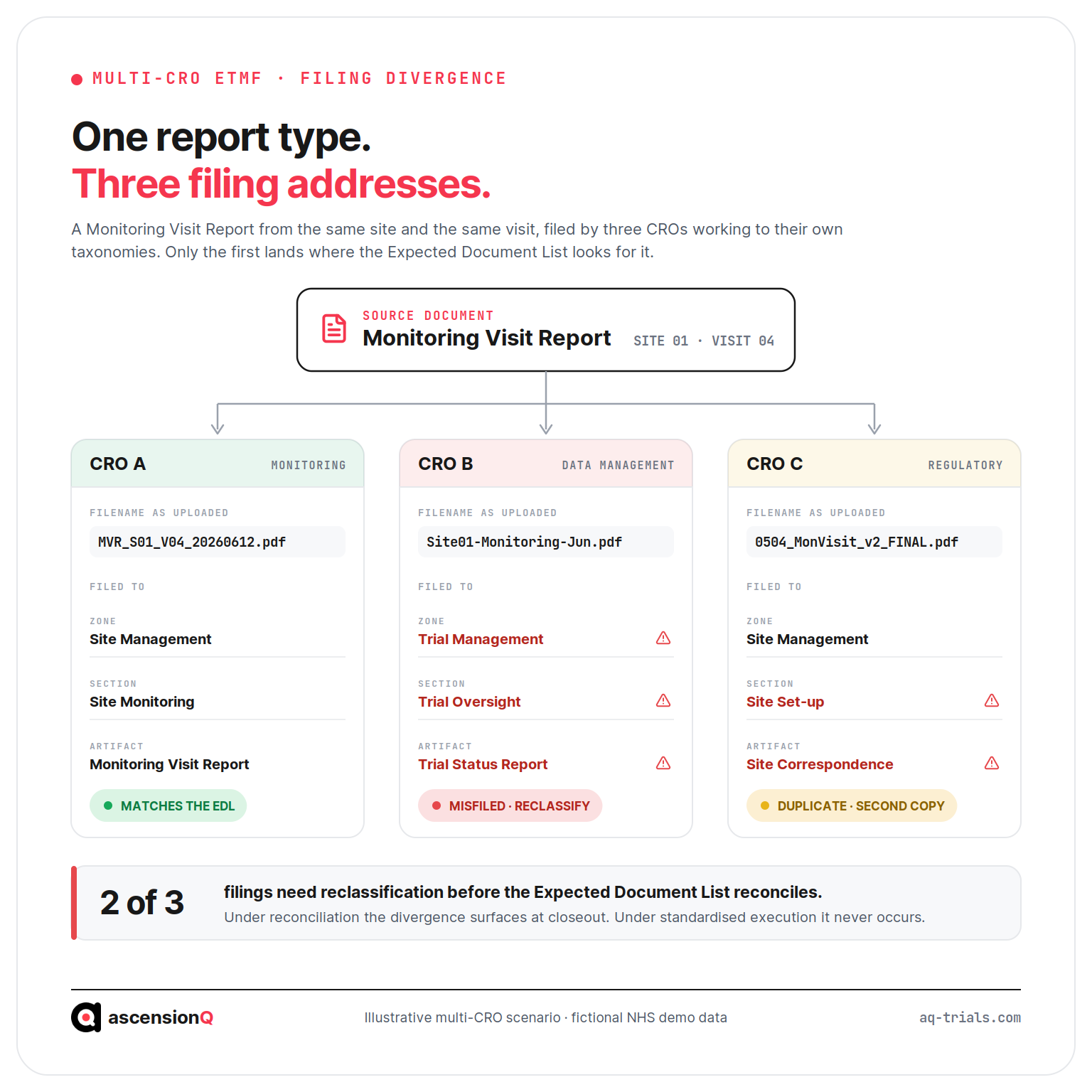
Without standardisation, the Trial Master File fragments across CROs, documents are filed in different artifacts, metadata varies across systems, and workflows follow different timelines, which removes a unified view of completeness for sponsor teams. For example, a Monitoring Visit Report generated through CTMS may be filed under different sections by different CROs, which disrupts EDL tracking and creates duplicate records that require reconciliation.
eTMF standardisation brings all CROs under one controlled framework, with documents following the same structure, classification, and workflows, enabling real-time completeness tracking, continuous sponsor oversight, and consistent inspection readiness throughout the study lifecycle.
Also Read: What is an eTMF in Clinical Trial Research?
eTMF Reconciliation vs Standardised Execution Across CROs
In multi-CRO trials, reconciliation means you fix the TMF after things go wrong. Each CRO works in its own way, so documents end up filed differently, named differently, or missing altogether.
For instance, one CRO files Monitoring Visit Reports under a different section than another, so teams must later find and reclassify them. The Expected Document List may show missing reports, requiring follow-up with CROs, while duplicates or multiple versions need cleanup. Near closeout, teams end up chasing documents and fixing gaps. That’s reconciliation. It’s reactive, late, and usually stressful.
Standardised execution flips this. Instead of fixing issues later, you prevent them from happening. All CROs follow the same structure, same rules, and same workflows from day one. Monitoring Visit Reports are always filed in the same artifact, naming follows a defined format, and Expected Document Lists track required vs actual documents continuously. Documents land in the right place, with the right format, and are tracked in real time, so missing or incorrect items are identified immediately. As a result, there is no need to search, reclassify, or reconcile documents at the end.
Just to be clear…
If you rely on reconciliation, you have to accept that inconsistencies will happen and will be fixed later. It will create delays, rework, and inspection risk. But if you standardise execution, you get to control the process upfront, which gives you real-time visibility, fewer errors, and a TMF that stays ready throughout the study, not just at the end.
Operational Outcomes of a Standardised eTMF Across CROs
- TMF Reference Model–aligned structure ensures documents are filed in predefined artifacts, which removes ambiguity and prevents misclassification across CRO uploads
- Standardised metadata schema enforces consistent document tagging, which enables accurate filtering, reporting, and cross-study retrieval
- Configured QC, review, and approval workflows apply the same validation logic across CROs, which reduces rejection cycles and rework
- Integration with CTMS, EDC, eISF, and QMS links operational events to TMF artifacts, which eliminates manual document handling and duplicate entry
- Expected Document List (EDL) mapping tracks required vs actual documents in real time, which allows teams to identify missing or overdue documents instantly
- Centralised dashboards aggregate TMF completeness, timeliness, and quality metrics, which gives sponsors full visibility across all CRO-managed activities
- Controlled structure and metadata prevent duplicate and inconsistently named documents, which reduces reconciliation effort during study closeout
- Standardised workflows and ownership models ensure documents move through defined timelines, which makes approval cycles predictable and trackable
- Role-based access control with audit trails and versioning maintains data integrity under 21 CFR Part 11, which ensures traceability during audits
- Continuous document flow and QC alignment maintain TMF completeness during study conduct, which removes the need for end-stage inspection preparation
- Unified framework across CROs, regions, and studies ensures consistent execution, which allows trials to scale without changing TMF processes
Also Read: What is the Difference Between CTMS and eTMF?
Typical eTMF vs Standardised eTMF
| Aspect | Typical eTMF (Multi-CRO, Unaligned) | Standardised eTMF (Multi-CRO, Controlled) |
| TMF Structure | CRO-specific folder structures and artifact mapping create inconsistent document placement | TMF Reference Model–aligned structure enforces uniform artifact placement across all CROs |
| Metadata & Classification | Free-text or CRO-defined metadata leads to inconsistent tagging and difficult retrieval | Controlled metadata schema standardises document classification for accurate filtering and reporting |
| Document Filing | Documents filed under different sections by different CROs create duplication and confusion | Predefined artifact mapping ensures documents are filed correctly at source without reclassification |
| Workflows (QC, Review, Approval) | CRO-specific workflows create variation in QC checks, timelines, and approval processes | Standardised workflows enforce consistent QC, review, and approval cycles across all CROs |
| Document Ownership | Unclear ownership leads to delays, pending documents, and accountability gaps | Defined responsibility matrix ensures clear ownership for upload, review, and approval |
| System Environment | Multiple disconnected eTMF systems require manual coordination and data transfer | Unified or interoperable system ensures consistent execution and centralised control |
| Integration with Clinical Systems | Limited or no integration causes manual uploads from CTMS, EDC, or eISF | Integrated document flow links CTMS, EDC, eISF, and QMS directly to TMF artifacts |
| Completeness Tracking (EDL) | Manual tracking using spreadsheets delays identification of missing documents | EDL-driven tracking provides real-time visibility into expected vs actual documents |
| Visibility & Oversight | Sponsors rely on CRO reports or multiple systems for status updates | Central dashboards provide real-time TMF health across all CROs and sites |
| Duplication & Misfiling | Duplicate documents and inconsistent naming require cleanup during reconciliation | Controlled structure and metadata prevent duplication and misfiling at source |
| Reconciliation Effort | End-of-study reconciliation required to align CRO outputs with sponsor TMF | Continuous alignment removes need for separate reconciliation activities |
| Compliance & Audit Trail | Inconsistent audit trails and version control increase inspection risk | Full audit trail, versioning, and access control ensure traceability under 21 CFR Part 11 |
| Inspection Readiness | TMF prepared reactively near audits with last-minute document collection | TMF remains continuously inspection-ready during the entire study lifecycle |
| Scalability Across CROs | Each additional CRO introduces new processes and increases complexity | Standardised framework scales across CROs, regions, and studies without process changes |
Sponsor-Controlled Governance Model for eTMF Standardisation
According to the DIA Trial Master File (TMF) Reference Model, developed and maintained by the DIA TMF Reference Model Working Group (a global collaboration of sponsors, CROs, and technology providers), a standardised framework defines how clinical trial documents are structured using Zones, Sections, and Artifacts, along with guidance on classification and filing. This model is publicly available through the DIA community and is widely adopted as the industry baseline for TMF standardisation.
At the same time, ICH Good Clinical Practice (ICH GCP) establishes that the sponsor remains responsible for TMF completeness, accuracy, and accessibility, even when TMF activities are delegated to CROs. Notably, it creates the need for a sponsor-controlled governance model that applies a single structure, process, and control layer across all CROs within a study.
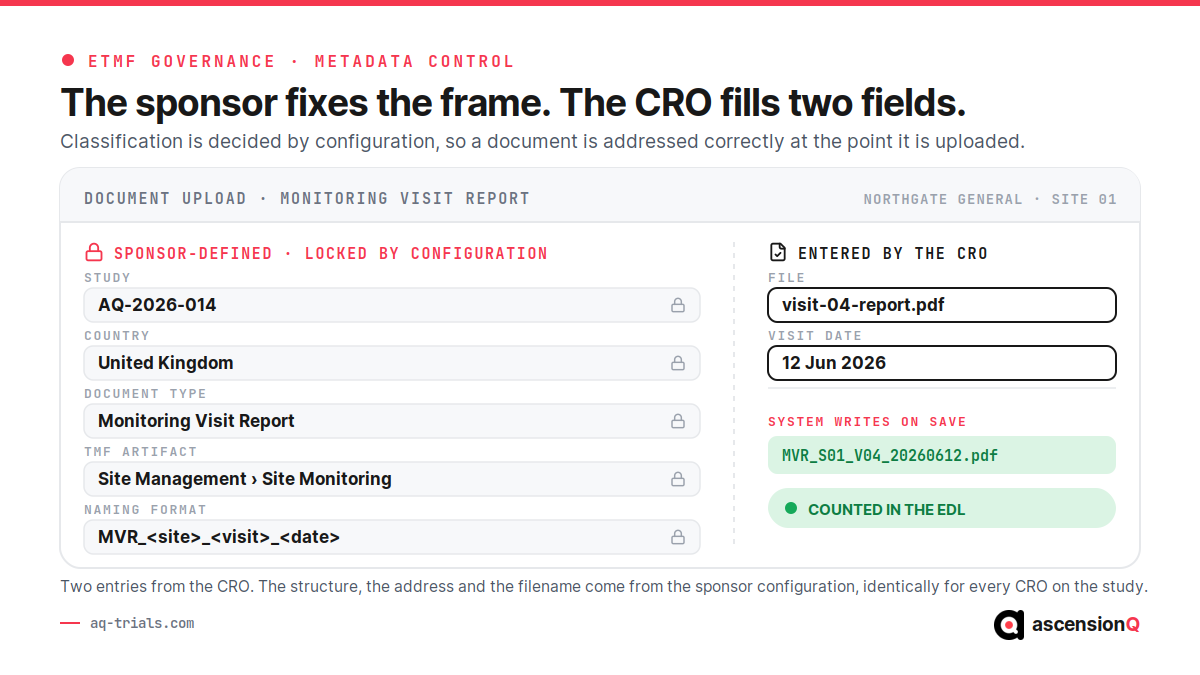
A sponsor-controlled governance model uses the TMF Reference Model as the structural foundation and defines how documents are created, classified, reviewed, and tracked across all contributors.
Governance Components and Operational Outcomes
| Governance Component | What Is Defined by Sponsor | How It Is Applied Across CROs | Operational Outcome |
| TMF Structure (DIA TMF Reference Model) | Standard Zones, Sections, and Artifacts | Fixed structure configured in eTMF system | Documents are filed consistently, enabling reliable completeness tracking |
| Metadata Framework | Controlled fields (study, site, country, document type, status) | Enforced through system validation and dropdowns | Documents are uniformly classified and easily retrievable |
| TMF Management Plan (TMP) | Filing rules, document expectations, timelines | Shared with all CROs at study start | All CROs follow the same document handling process |
| Responsibility Matrix (RACI) | Ownership for upload, QC, review, approval | Defined per artifact and stakeholder | Clear accountability removes delays and ownership gaps |
| Workflow Configuration | Standard lifecycle (upload → QC → review → approval) | System-driven workflows with defined SLAs | Predictable approval timelines and reduced rework |
| Access Control Model | Role-based permissions across sponsor, CROs, sites | Configured under 21 CFR Part 11 controls | Secure access and data integrity across stakeholders |
| System Strategy | Sponsor-owned or aligned eTMF environment | CROs operate within defined system structure | Single source of truth across all contributors |
| Integration Framework | Mapping CTMS, EDC, eISF, QMS outputs to TMF artifacts | API or workflow-based integration | Documents flow directly into correct TMF locations |
| Completeness Framework (EDL) | Expected Document List per study, site, country | System tracks expected vs actual documents | Missing or overdue documents identified in real time |
| QC and QA Standards | Standard QC checklist and validation rules | Applied across all CRO uploads | Consistent document quality and reduced rejection cycles |
| KPI and Metrics Framework | Completeness, timeliness, QC rejection rate, TMF health | Dashboards and periodic reviews | Measurable performance and controlled execution |
| Oversight and Review Cadence | Regular TMF reviews and governance checkpoints | Sponsor-led monitoring of CRO performance | Early identification and resolution of issues |
| Training and Onboarding | Standard training on structure, workflows, system use | Role-based onboarding for CRO users | Consistent execution across all contributors |
How to Standardise eTMF Across CROs?
The eTMF must be configured and governed as a controlled, standardised system of record. It must enforce a single structure, classification model, workflow logic, and oversight framework across all CROs. This ensures that every document is filed, processed, and tracked using the same rules from study start through closeout.
To achieve this, the eTMF must be designed and configured to:
- Define a standard TMF structure: Enforce TMF Reference Model–aligned Zones, Sections, and Artifacts so all CROs file documents in predefined locations
- Configure metadata and naming conventions: Define mandatory metadata fields (study, site, country, document type, status) and controlled document naming formats to ensure consistent classification
- Establish document ownership and responsibility matrix: Assign upload, QC, review, and approval responsibilities at artifact level to ensure clear accountability
- Implement role-based access control: Configure permissions for sponsor, CROs, and sites to control document visibility and editing rights in line with regulatory requirements
- Standardise document lifecycle workflows: Define and enforce workflows for upload, QC, review, and approval with fixed timelines and escalation rules
- Establish a unified or interoperable eTMF environment: Enable CROs to operate within the same system or align systems using a common TMF structure and standards
- Configure Expected Document List (EDL) and completeness tracking: Map required documents by study, site, and country and track expected vs actual documents, with real-time identification of missing or overdue items
- Align Quality Control (QC) and Quality Assurance (QA): Apply standard QC checklists and validation rules across all CRO uploads to ensure document accuracy and completeness
- Integrate eTMF with CTMS, EDC, eISF, and QMS: Ensure documents generated during trial operations are automatically mapped and filed into the correct TMF artifacts
- Define KPIs for completeness, timeliness, and quality: Personalise dashboards to monitor TMF health, QC performance, and document timelines across all CRO activities
- Conduct eTMF kickoff alignment across CROs: Align TMF structure, metadata, workflows, responsibility matrix, and system usage at study initiation before document flow begins
- Train CRO teams on standardised processes: Provide role-based onboarding to ensure consistent use of system configuration, metadata rules, and workflows
Risks and Failure Points Without eTMF Standardisation
- Documents get stored in different places by different CROs, so teams struggle to find the right files
- Same document may appear multiple times or in different versions, causing confusion during review
- Important documents can be missing, and teams only realise this late in the study
- Teams spend time chasing CROs for files instead of tracking them in real time
- Workflows differ across CROs, so some documents move faster while others get stuck
- No clear ownership means documents sit pending with no one responsible
- Sponsors cannot see the full TMF status in one place, which delays decision-making
- Systems like CTMS or EDC are not connected, so documents have to be uploaded manually
- Audit trails and version history may be incomplete or hard to follow
- Teams rush to fix the TMF before audits instead of keeping it ready throughout
- Adding more CROs increases confusion and makes the TMF harder to manage
Also Read: Why do CROs Need a Centralised Digital DOA System?
AQ eTMF: Standardising Documentation, Workflows, and Oversight Across CROs
AQ eTMF standardises how clinical trial documents are organised, reviewed, and tracked across multiple CROs by operating as a single, structured system of record built on the DIA TMF Reference Model. It removes dependency on fragmented sources such as shared drives, emails, and CRO-specific systems, where document status is often unclear and requires manual reconstruction.
Instead of relying on reconciliation to understand TMF status, AQ eTMF maintains continuous oversight by:
- organising documents within a predefined structure, so all CRO uploads follow the same filing logic
- tracking document completeness, approvals, and follow-up in real time across studies and sites
- applying consistent review and approval workflows, so documents move through the same process regardless of source
- enabling direct access for sponsors, CROs, and oversight teams, eliminating document requests and transfers
- maintaining traceable document history and version control, so audit and inspection reviews do not require reconstruction
- highlighting missing documents and pending actions early, instead of identifying gaps at closeout
- reducing manual reconciliation effort, since document status is continuously tracked within the system
- providing operational dashboards that show TMF status, review progress, and outstanding actions across CRO activities
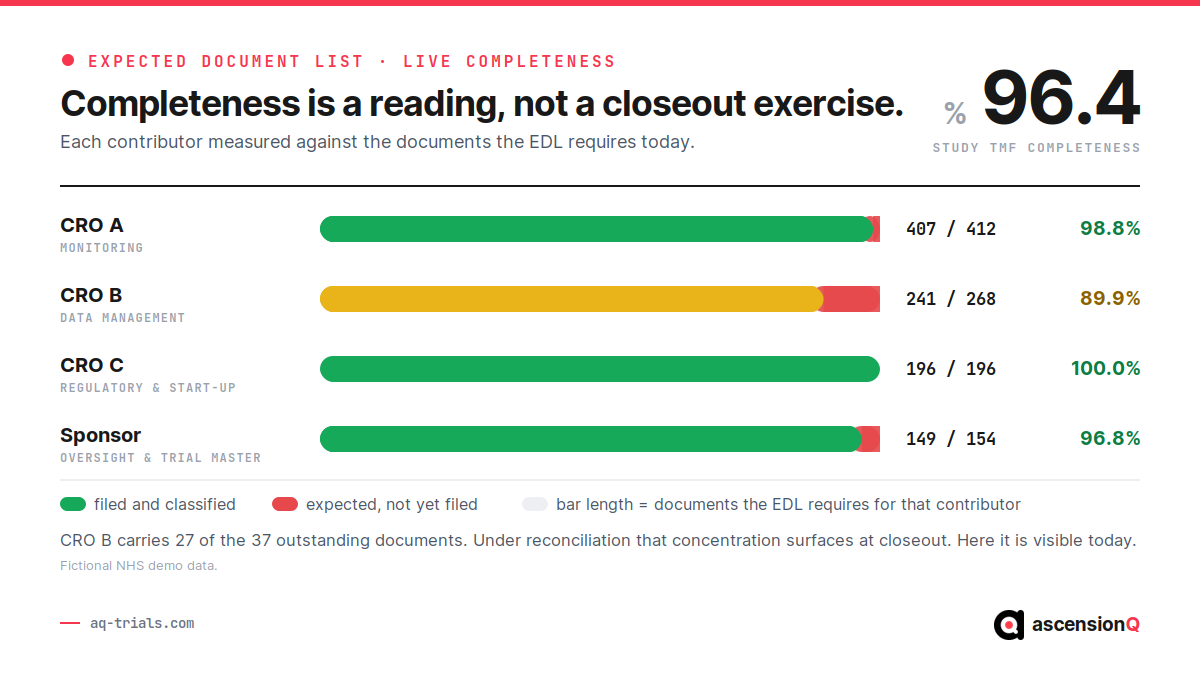
AQ shifts eTMF from a passive document repository to an active oversight system, where documentation, workflows, and follow-up remain connected throughout the study lifecycle. So, ultimately, CROs can maintain clear visibility, reduce operational effort, and keep the TMF inspection-ready without end-stage cleanup. AQ eTMF works alongside AQ CTMS, AQ eISF, and AQ QMS as part of one connected platform. See how the modules compare on our features and comparison page.
Book a live demo to see how AQ eTMF standardises documentation, workflows, and oversight across every CRO in your study.