Clinical trial visit scheduling software books every participant appointment against the visit window the protocol defines, and it tests each proposed date against that window before the booking is confirmed. A clinical trial management system (CTMS) carries that function in its appointment and visit management module, which AQ calls the E-Planner. The module turns a protocol schedule of assessments into a working diary of booked slots, assigned staff, and reserved rooms.
The difference shows at the point of booking. A paper diary or a shared calendar records the date a coordinator chose. A scheduling module calculates the permitted range of dates from each participant’s own anchor date, then checks the proposed slot against that range while the appointment is still being made. The first approach surfaces an out-of-window visit weeks later during monitoring. The second raises it at the moment the date is offered, while the booking can still change.
What this guide covers:
- What a visit window is, how it is calculated, and who sets it.
- Why appointments drift outside the window on a manual diary.
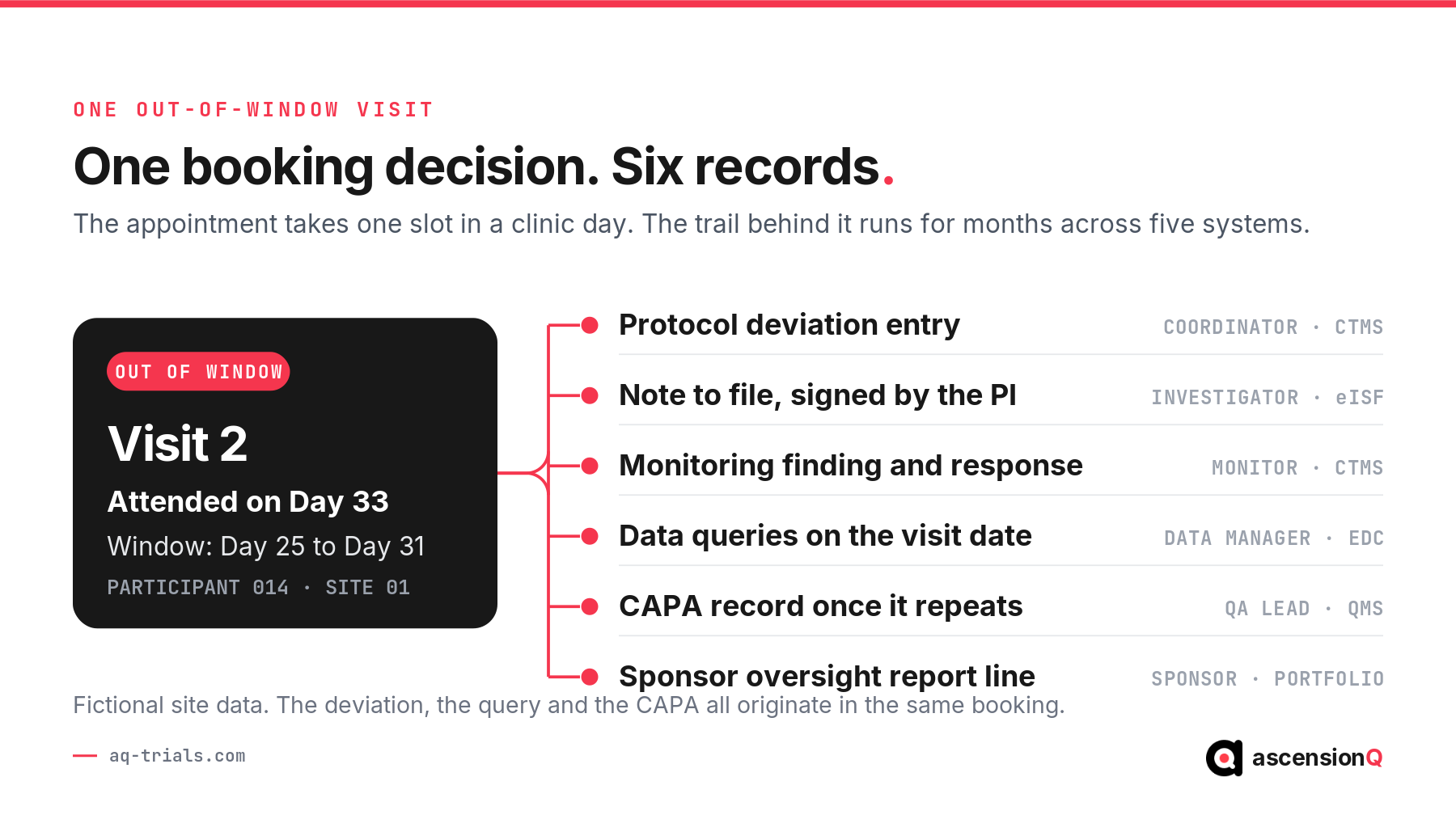
- What a single out-of-window visit costs in records across five systems.
- The fields a defensible visit diary entry carries.
- How cohort and capacity scheduling work when many participants share one clinic.
- What inspectors examine in visit records, and how AQ supports the controls they look for.
What Is a Visit Window, and Who Sets It?
A visit window is the range of days around a target study day within which an assessment remains protocol compliant. The protocol sets it. The target day is counted from an anchor event for that participant, usually randomisation or first dose, recorded as Day 0 or Day 1. Every participant therefore carries a personal calendar derived from the day they entered the study.
The window is a tolerance measured in days, and it belongs to the participant rather than the clinic.
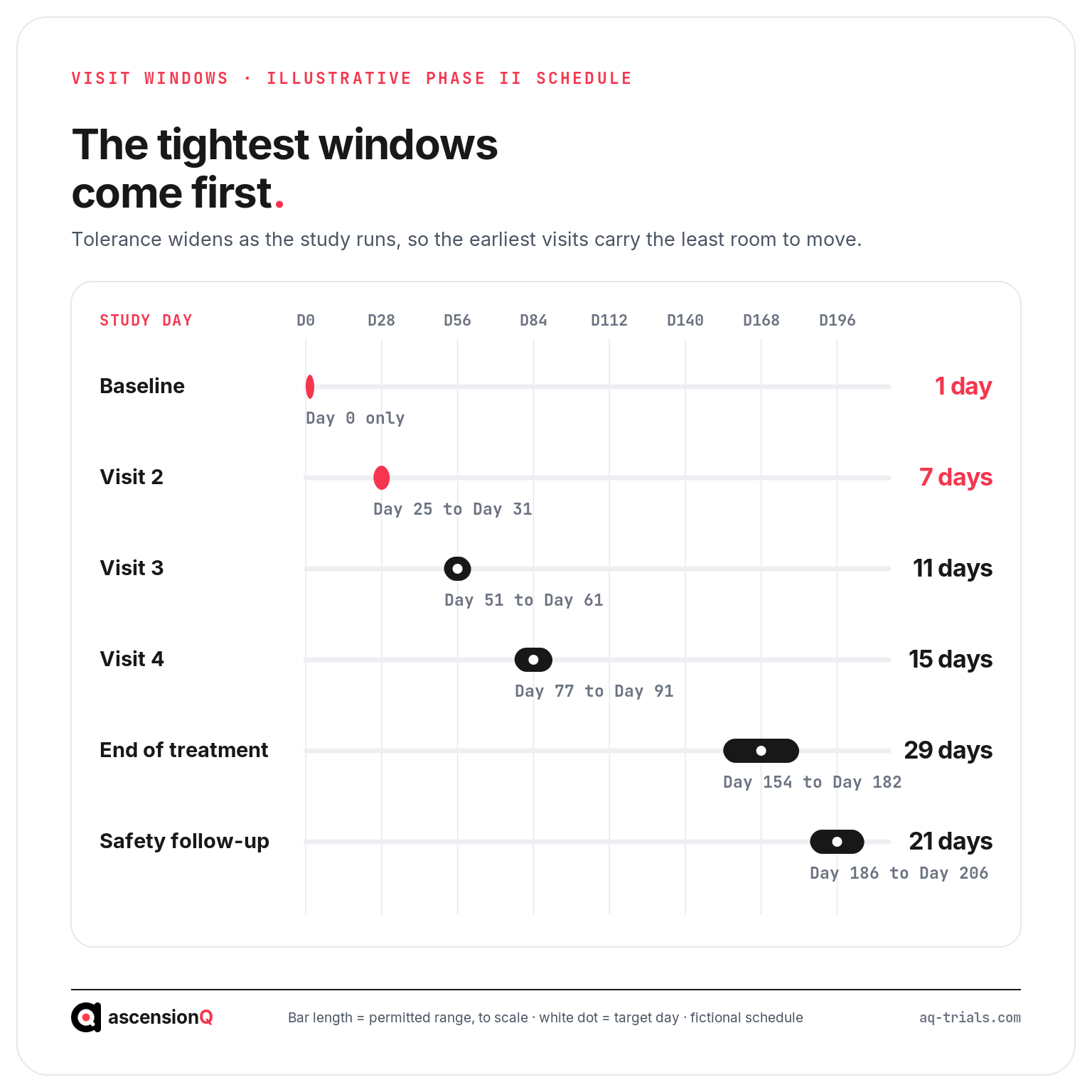
Windows vary in width across a single schedule of assessments. Early visits that establish a baseline or a dosing interval are usually tight. Later follow-up visits are usually wider, because a few days of drift have less effect on the endpoint. The table below shows an illustrative schedule for a fictional Phase II study.
| Visit | Target study day | Window | Permitted range (Day 0 = randomisation) |
| Screening | Day -14 | Plus or minus 14 days | Day -28 to Day -1 |
| Baseline / randomisation | Day 0 | Fixed | Day 0 only |
| Visit 2 (dose review) | Day 28 | Plus or minus 3 days | Day 25 to Day 31 |
| Visit 3 | Day 56 | Plus or minus 5 days | Day 51 to Day 61 |
| Visit 4 | Day 84 | Plus or minus 7 days | Day 77 to Day 91 |
| End of treatment | Day 168 | Plus or minus 14 days | Day 154 to Day 182 |
| Safety follow-up | Day 196 | Plus or minus 10 days | Day 186 to Day 206 |
Three properties of the window make it harder to manage than a clinic appointment book suggests.
- The window belongs to the participant. Anchor dates differ, so two participants booked on the same clinic day can sit at opposite ends of their own permitted ranges.
- The window narrows where the science is tightest. Pharmacokinetic sampling visits often carry a tolerance of one day, and some carry a tolerance measured in hours.
- A moved visit moves nothing else. Later target days usually stay anchored to Day 0 unless the protocol re-anchors them, so a visit taken at the late edge of its window shortens the gap to the next one.
Why Do Visits Drift Outside the Window?
Out-of-window visits are usually a scheduling failure rather than a clinical one. The visit was clinically appropriate and the participant attended willingly. The date was chosen from information that was incomplete at the moment of choosing. Five conditions produce most of the drift.
- The anchor date and the diary live in different places. A coordinator books from the consent date held in the site file while the randomisation date sits in the trial system, and the whole downstream schedule shifts by several days.
- Reschedules arrive by telephone. A participant rings to move an appointment, the new date goes straight into the clinic diary, and nobody recalculates the permitted range for that visit.
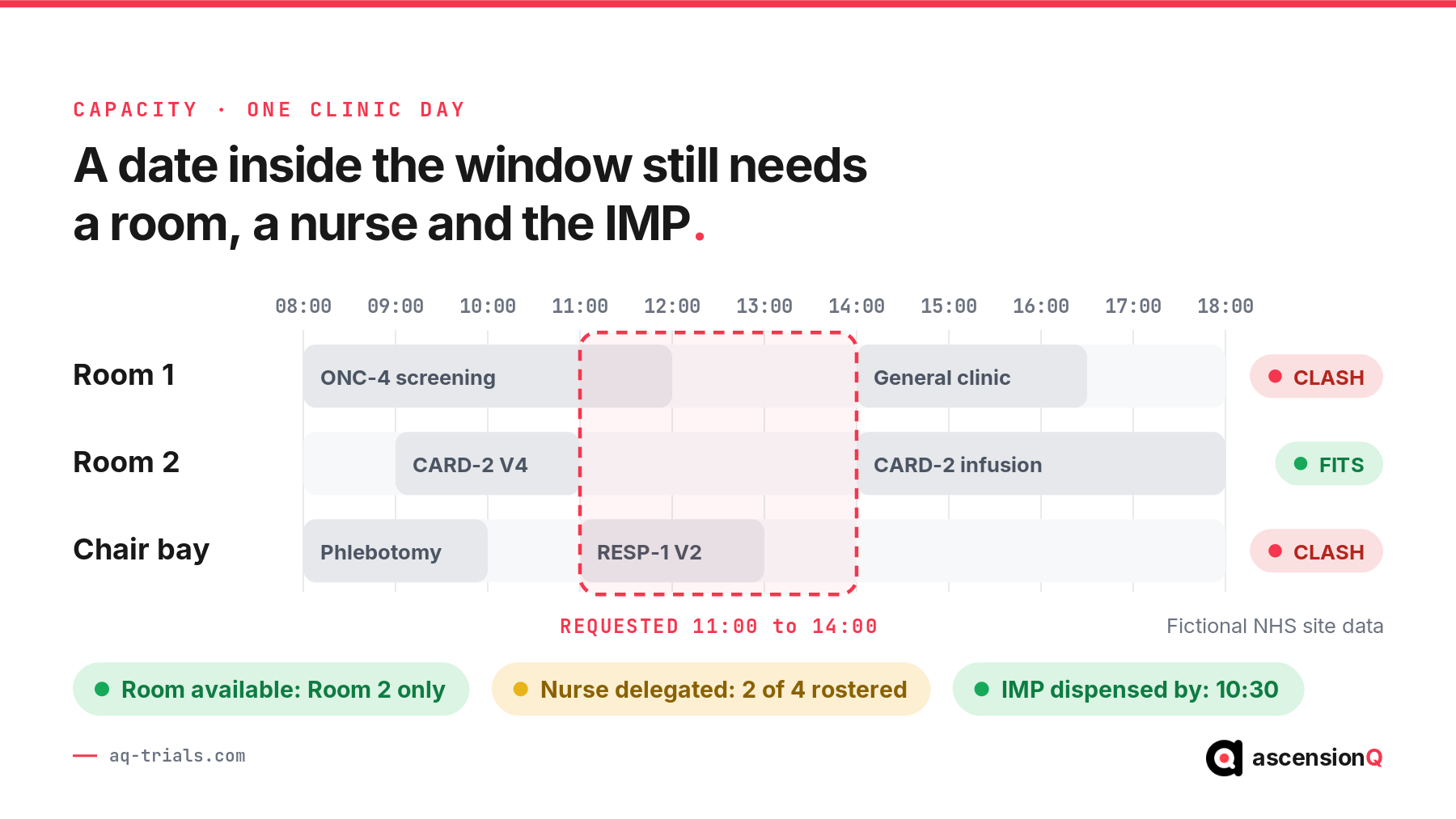
- Capacity overrides compliance. The only free slot inside Day 25 to Day 31 has no research nurse rostered, so the visit slides to Day 33 where a room happens to be free.
- Eligible staff are unavailable on the compliant dates. Only two of the four rostered nurses hold current delegation for the assessment. Staff availability then drives the date and the window follows it. The effective date on the delegation of authority log governs who counts as eligible on any given day.
- The diary belongs to one person. Annual leave, sickness, or a role change removes the only reliable view of who is due when, and visits at the edge of their windows are the first to be missed.
Example: participant 014 at a fictional NHS site is randomised on 4 March, which is Day 0. Visit 2 carries a window of Day 25 to Day 31, so the permitted range runs from 29 March to 4 April. The coordinator books 6 April from a wall planner that shows clinic capacity and nothing else. The visit is clinically uneventful, the assessment is complete, and the record sits two days outside the protocol window.
Also Read: What is the Best Way to Manage Deviations in Clinical Research?
What Does One Out-of-Window Visit Cost?
The appointment takes one slot in a clinic day. The record trail behind it runs for months and crosses several systems. One booking decision creates work for the coordinator, the investigator, the monitor, the data manager, the quality lead, and the sponsor’s oversight team.
- A protocol deviation entry with the date, category, and an assessment of impact on participant safety and data integrity.
- A note to file, where site standard operating procedures call for one, recording the circumstances and the Principal Investigator’s assessment.
- A monitoring finding raised at the next visit, with a response due date and a follow-up check at the visit after that.
- Data queries in the electronic data capture (EDC) system, where the assessment date falls outside the expected range for that visit code.
- A CAPA record where the deviation is significant or recurs, because a repeat pattern moves the event from isolated to systemic.
- A line in the sponsor oversight report, where protocol compliance by site is a standing metric.
The cost compounds at portfolio level. A site running a full portfolio, each study carrying a few out-of-window visits, accumulates a deviation backlog that competes with the quality lead’s other work and gives the sponsor a compliance signal the site struggles to explain. A worked CAPA walkthrough shows how much analysis a single deviation absorbs once it reaches root cause.
What Does a Visit Diary Entry Hold?
A visit diary is the forward-looking record of every booked and completed study visit at a site, held per participant and readable across studies. It differs from a clinic appointment book in what it carries alongside the date. A defensible diary entry answers three questions on its own: what was supposed to happen, what happened, and who made the change between the two.
| Field | What it records | Why it matters at inspection |
| Participant identifier | The pseudonymised study number | Links the appointment to the enrolment record without exposing identity |
| Visit code | The protocol label, for example V3 or Week 8 | Ties the appointment to the schedule of assessments |
| Anchor date | Randomisation or first dose for that participant | The date every permitted range is calculated from |
| Target day and permitted range | Day 56, Day 51 to Day 61 | Makes the compliance test visible on the record itself |
| Booked date | The date offered and accepted | Shows the intended plan at the time of booking |
| Actual attendance date | The date the participant was seen | The date the protocol window is judged against |
| Assigned staff and role | Named individuals per task | Cross-checks against the delegation log for that date |
| Room and equipment | Clinic room, chair, or scanner reserved | Evidences that capacity existed for the visit as booked |
| Investigational product requirement | Dispensing or preparation needed for the visit | Connects the appointment to pharmacy lead time and accountability |
| Status | Booked, attended, rescheduled, missed, withdrawn | Separates a visit that moved from a visit that never happened |
| Reason for change | Free text captured at the moment of the change | Supplies the deviation narrative without later reconstruction |
| Audit entry | User, timestamp, previous value, new value | Gives the monitor a reconstructable history of the appointment |
How Does a CTMS Enforce the Window Before the Booking?
Scheduling control is arithmetic applied at the right moment. The system holds the schedule of assessments as study configuration, so it derives the permitted range for every visit from the protocol. Each mechanism below produces a specific operational outcome.
- The system derives each window from the participant’s anchor date, which means the permitted range updates automatically when the anchor is confirmed.
- The booking screen marks the dates inside the range, which removes day-counting from the coordinator during a call with a participant.
- A date outside the range is flagged at the point of selection and carries a recorded reason, which puts the compliance question in front of the coordinator while the booking is still open.
- Slots are held against room and staff availability, which means a confirmed appointment already has a place and a qualified person attached to it.
- Automated email and SMS reminders go to the participant ahead of the visit, which reduces the non-attendance that pushes a rebooked visit past its window.
- A reschedule recalculates the range and re-tests the new date, so the compliance check survives the change and applies to the visit that actually happens.
- Every change writes an audit entry with user, timestamp, and reason, which gives the study team a defensible history without a reconstruction exercise.
The control does not get louder. It moves earlier.
| Aspect | Manual diary or shared calendar | Scheduling inside a CTMS |
| Window calculation | Counted by hand from a date held elsewhere | Derived from the participant anchor date in the system |
| Compliance check | Applied at monitoring, weeks after the visit | Applied at the point the date is offered |
| Out-of-window date | Accepted silently | Flagged at selection, with the reason recorded |
| Capacity | Checked separately, if at all | Tested against room and staff availability in the same step |
| Reschedules | Overwrite the original date | Recalculate the range and retain the original entry |
| Multi-site visibility | One diary per site, compared by email | One live view of visit adherence across every site |
| Evidence at inspection | Assembled from calendars, emails, and memory | Available as a dated record with an audit trail |
How Do Cohort and Capacity Scheduling Work?
One participant is an arithmetic problem. A cohort is an arithmetic problem under constraint. A site running several studies books every visit into the same finite set of rooms, chairs, and rostered research staff, and the binding constraint is rarely the calendar.
Four resources decide whether a compliant date is also a workable one.
- Rooms and equipment. Long visits with sequential timepoints occupy a room for most of a day, which removes it from every other study on the schedule.
- Staff by role and delegation. A visit needs a person delegated for each task on that date, and the effective date on the delegation log decides whether that person is eligible.
- Pharmacy lead time. Investigational medicinal product (IMP) preparation and dispensing sit ahead of the appointment, and the electronic pharmacy site file (ePSF) holds the accountability record that follows it.
- Concurrent study demand. Recruitment surges in one study consume the capacity another study assumed, which is why live enrolment visibility and scheduling belong in the same system.
Cohort scheduling books a group of participants whose visits share a resource, then spreads them so that no single day exceeds what the site can deliver. Three rules make that workable in practice.
- Stagger inside each participant’s own window. Six participants due in the same fortnight can be spread across four clinic days, and every one of them stays compliant because each has a range to move within.
- The tighter window wins the contested slot. A participant with a range of three days takes the slot ahead of a participant with a range of a fortnight, because the second has somewhere else to go.
- A moved anchor date re-plans the whole sequence. A delayed randomisation shifts every downstream window for that participant, and the cohort has to absorb the change before the next visit is booked.
The value appears at the portfolio level. A research delivery manager at an NHS research site can see the week ahead across every study and move a flexible visit before a tight one is put at risk.
Also Read: CTMS vs Spreadsheets: Why Site Capacity Planning Breaks Without One
What Do Inspectors Check in Visit Records?
Protocol compliance is a core obligation under ICH-GCP E6(R3), published among the ICH efficacy guidelines, and visit timing is among the most countable forms of it. The MHRA guidance on good clinical practice sets the UK expectations that inspectors apply, alongside the UK clinical trials regulations. The EMA scientific guideline on ICH E6 holds the European text of the same guideline. Inspectors work through visit records in a predictable order.
- Whether each visit occurred inside the protocol window, evidenced by the source document rather than the appointment system alone.
- Whether every out-of-window visit carries a deviation record with a dated impact assessment.
- Whether the person who performed each assessment held delegation for that task on that date.
- Whether visit dates agree across the source document, the trial system, and the EDC system.
- Whether repeated out-of-window visits triggered analysis and a corrective action rather than a growing list of individual deviations.
- Whether the record of a rescheduled visit shows the original date, the new date, the reason, and the person who made the change.
Inspectors therefore treat visit timing as part of the wider condition of inspection readiness. A site that can produce a dated, reconstructable visit history for any participant has removed a recurring preparation task from the weeks before an inspection.
Also Read: ICH-GCP E6(R3) and CTMS: What Changes for Study Oversight
Frequently Asked Questions
What is a visit window in a clinical trial?
The range of days around a target study day within which an assessment remains protocol compliant. The protocol sets it.
Why do visits drift outside the window?
Usually through a scheduling failure rather than a clinical one. The visit was clinically appropriate and the participant attended, but the booking was made without checking the window.
How does a CTMS enforce the visit window?
It holds the schedule of assessments as study configuration, derives the permitted range for every visit from the protocol, and tests each proposed date against that range before the booking is confirmed.
How Does AQ Support Visit Scheduling?
E-Planner is the appointment and visit management module inside AQ’s CTMS, and it runs on the same study configuration that holds the schedule of assessments. The connection to the rest of the AQ Platform is what turns a booking into an evidenced activity.
- E-Planner holds visit diaries, appointment scheduling and cohort visit coordination against the study’s configured schedule of assessments, which keeps the permitted range attached to the participant.
- Capacity and resource management holds rooms and staff against the same slot, so a confirmed visit reflects what the site can actually deliver that day. Study-wide dashboards then show visit adherence alongside the wider operational picture a CTMS maintains.
- Delegation records in Digital DoA make staff eligibility for a task visible at the point of assignment, which removes the second finding that often accompanies a timing deviation.
- Visit activity connects to the electronic Investigator Site File (eISF) and the pharmacy record, so source filing and product accountability follow the appointment.
- Out-of-window visits and missed appointments feed the deviation tracking that the quality management system (QMS) governs, which gives the quality lead a dated operational event to work from.
The system does not make the clinical judgement. A coordinator still decides whether a participant is well enough to attend, and the Principal Investigator still owns the protocol decision behind a visit taken outside its window. What the platform adds is the arithmetic and the evidence: the permitted range calculated for each participant, the check surfaced at the point of booking, and the dated record of what changed and why.
The date a coordinator can defend is the one the system tested before it was offered.
Book a live demo to see how E-Planner schedules visits inside protocol windows across a full study portfolio.