The 90-day set-up target is the window an individual NHS site has to take a clinical trial from regulatory approval to a first participant. A site meets it when that participant attends a first visit within 90 days of either receiving regulatory approval or being selected as a site, whichever falls later. The UKCRD describes it as the site-level part of the national 150-day target, and it now reports performance against it trust by trust every month. Most sites miss it.
This guide explains what the target measures, how large the gap is in the published data, where the 90 days actually go stage by stage, why the same target produces 100% at one trust and 0% at another, who owns each handover, and how a research team can measure its own window while there is still time to act.
Key takeaways
- The 90-day site target sits inside the 150-day study target. Regulatory approval consumes the first portion, and the site controls what remains.
- Published performance splits sharply. Several trusts clear the target on every eligible study, and six trusts with three or more studies clear it on none.
- Ninety days is enough time only where stages overlap. Set-up run in sequence takes roughly twice the window.
- The delay concentrates in handovers between organisations rather than inside any single task.
- National reporting arrives about six months late, so a trust needs its own leading indicators to manage the window.
What Is the 90-Day Set-Up Target?
The target defines a single measured window at site level. The clock starts at the later of two events, and it stops at one:
- Clock start, option one: the date of HRA and HCRW Approval in England and Wales, or NRS Approval in Scotland.
- Clock start, option two: the date set in the commercial site selected letter of intent, where a site is chosen after approval.
- Clock stop: the first participant’s first visit at that site.
Three national numbers describe the same journey at different resolutions, and teams often treat them as separate demands. They are one window measured three ways:
| Target | Level | Runs from | Runs to |
|---|---|---|---|
| 150 days | Study | Regulatory application | First participant anywhere in the study |
| 90 days | Site | Approval or site selection | First participant at that site |
| 60 days | Site | Regulatory approval | Site open to recruitment |
| 30 days | Site | Site open to recruitment | First participant recruited |
The 60-day and 30-day indicators add to the same 90 days the site-level report measures directly. A team that hits both sub-targets hits the 90-day target by arithmetic. The value of the split is diagnostic, because it shows whether a site loses its time before opening or after it.
One definitional change deserves attention. The end point of the set-up portion moved in January 2026 from Date Site Ready to Start, which recorded the sponsor green light, to Date Site Confirmed, which records the last contract signature across every organisation involved. Sites that measure their own performance to the green light now report against a later marker than the national figure uses.
How Big Is the Gap?
The national picture and the trust picture tell the same story at different scales. The June 2026 UKCRD key performance indicators put both halves of the window well below target, and the trust-level report shows how unevenly that average is composed.
- 55% of studies opened to recruitment within 60 days of approval, against a 90% target.
- 58% of studies recruited a first participant within 30 days of opening, against the same 90% target.
- The 30-day measure has sat below target every year since 2017.
- Median time to complete set-up ranged from 5 days at the fastest reporting trust to 512 days at the slowest.
The last figure carries the argument. A hundredfold spread between organisations working to identical regulations, identical protocols and a shared national target points at local process rather than national policy. Rare disease, extension and low-recruiting studies sit outside the measure, so the spread describes work that everyone expected to move at a normal pace.
Ninety days is achievable. Some trusts achieve it on every study.
Also Read: UK Clinical Research Delivery KPIs (June 2026): What the Data Says About Trial Set-Up.
Where Do the 90 Days Actually Go?
Set-up decomposes into nine stages between approval and a first visit. The table below sets out a working allocation for a straightforward commercial interventional study. It is operational guidance rather than a published standard, and local circumstances will move individual figures.
| Stage | Typical duration | Target window |
|---|---|---|
| Site selection confirmed, documents issued | 10 days | Days 0 to 10 |
| Costing through NCVR | 25 days | Days 5 to 30 |
| Capacity and capability assessment | 25 days | Days 10 to 35 |
| Contract signature, Date Site Confirmed | 25 days | Days 20 to 45 |
| Pharmacy set-up and green light prerequisites | 25 days | Days 25 to 50 |
| Site file, delegation log, training records | 25 days | Days 30 to 55 |
| Site initiation visit | 20 days | Days 45 to 65 |
| Green light and site open | 15 days | Days 60 to 75 |
| Screening and first participant consent | 25 days | Days 65 to 90 |
The stage durations total roughly 195 days. The window is 90. That arithmetic is the whole problem, and it produces the single most useful conclusion in this guide.
Ninety days works only where stages overlap. Sequential set-up cannot fit.
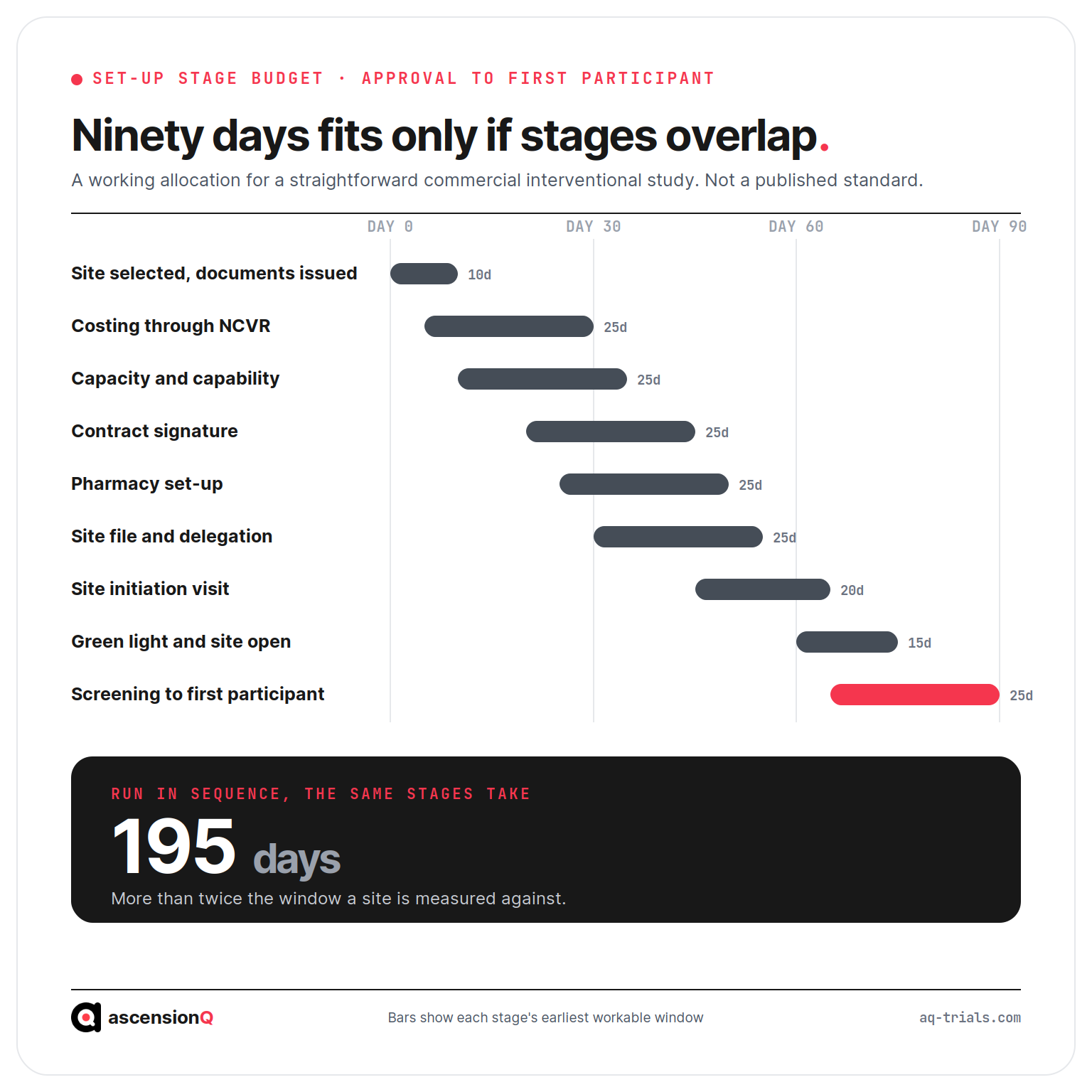
A site that waits for costing to close before starting capacity assessment, then waits for the contract before opening pharmacy discussions, spends more than twice its budget. High performers run these stages concurrently and accept that some work will occasionally be wasted when a study falls away.
Why Does the Same Target Produce 100% and 0%?
Two trusts running the same protocol under the same regulations land at opposite ends of the table. The difference is structural, and it shows up in how each organisation handles the space between tasks rather than the tasks themselves.
| Aspect | Sequential set-up | Governed set-up |
|---|---|---|
| Stage order | Each stage starts when the previous one closes | Stages start on their earliest possible date |
| Handover | An email, then a wait nobody is counting | A dated record with a named owner |
| Visibility | Status known by asking the person holding it | Status visible to sponsor and site at once |
| Trigger for action | A chase from the sponsor | A threshold on days elapsed |
| Failure discovered | In the national report, two quarters later | Inside the window, while recoverable |
Delay concentrates in the gaps. A contract that takes four working days to review can sit for three weeks between the finance team completing it and the R&D office noticing. No individual is slow in that scenario, and the study still loses twenty days. Set-up performance improves where the waiting itself has an owner, which is the same principle that governs site file governance across a trust’s portfolio.
Who Owns Each Stage?
Set-up crosses at least five functions, and most overruns happen at a boundary between two of them. Naming the owner for each stage, and for each handover between stages, removes the ambiguity that lets a study sit still.
- R&D office holds capacity and capability, coordinates the overall window, and owns the green light decision.
- Finance and contracting holds costing through NCVR or SoECAT, and drives the contract to Date Site Confirmed.
- Pharmacy holds investigational product arrangements and the pharmacy site file, which runs on a separate track from the investigator site file.
- Site research team holds the delegation log, training records, and the essential documents in the investigator site file.
- Sponsor or CRO holds document supply, the site initiation visit, and the release to recruit.
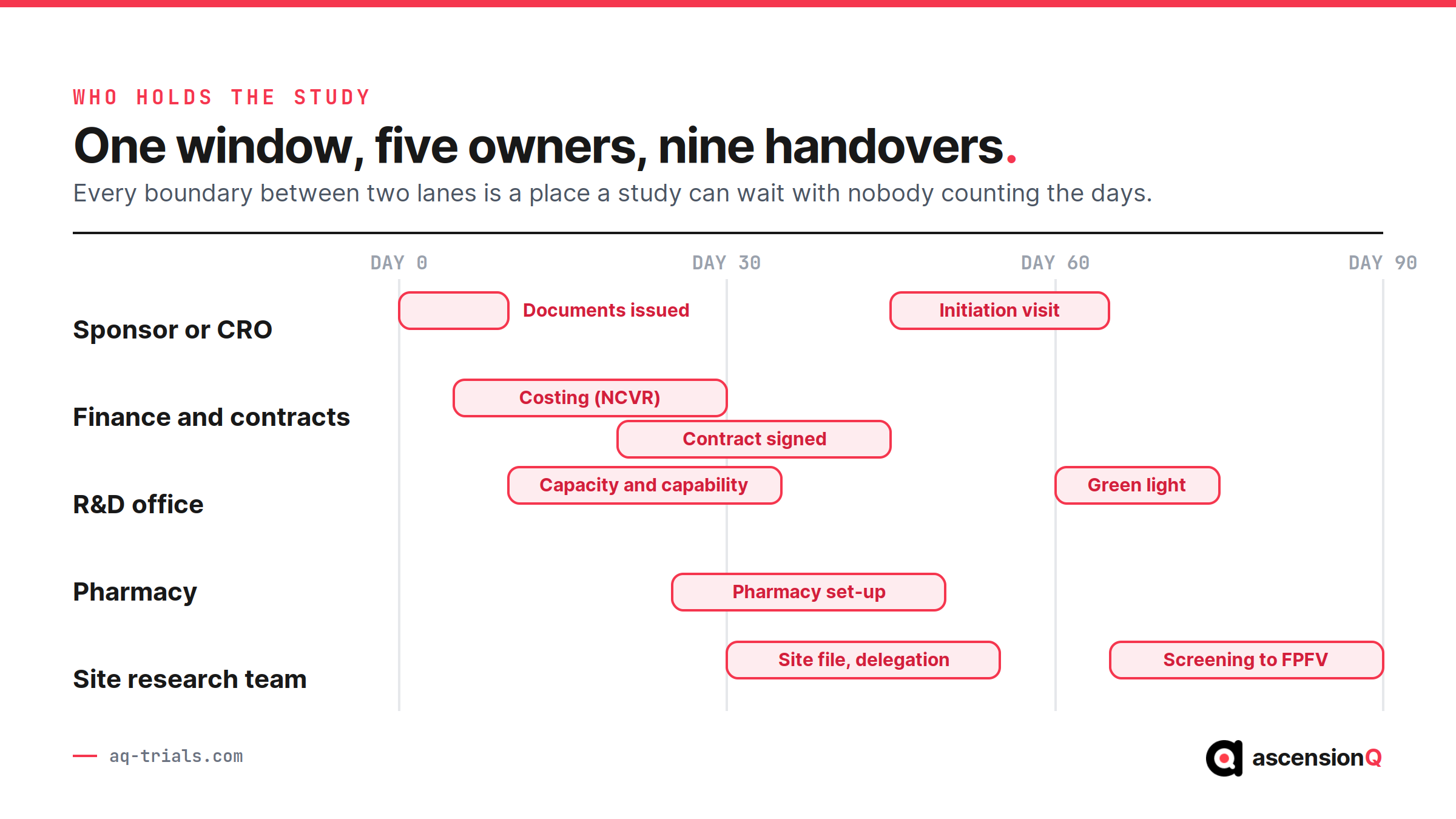
The pattern in the published data suggests where to look first. Trusts that miss the 60-day half of the window usually have a costing or contracting bottleneck. Trusts that open on time and then miss the 30-day half usually have a screening or scheduling constraint, which is a capacity question rather than a governance one.
Also Read: CTMS vs Spreadsheets: Why Site Capacity Planning Breaks Without One.
How Should a Trust Measure Its Own Window?
The national report publishes about six months behind the activity it describes. A trust reading its own published score is looking at studies it set up half a year ago, and every study currently inside its window is absent from that figure. Internal measurement has to fill that gap, and four leading indicators cover it:
- Days elapsed since the clock start, per study and per site, refreshed daily. This single number tells a team which studies are at risk while recovery is still possible.
- Days a study has spent at its current stage, which exposes the waiting that stage-completion reporting hides.
- Open handovers with no named owner, counted weekly. Every item on that list is a study standing still.
- Rolling six-month set-up performance, which matches the discipline the national report applies and smooths the small monthly samples.
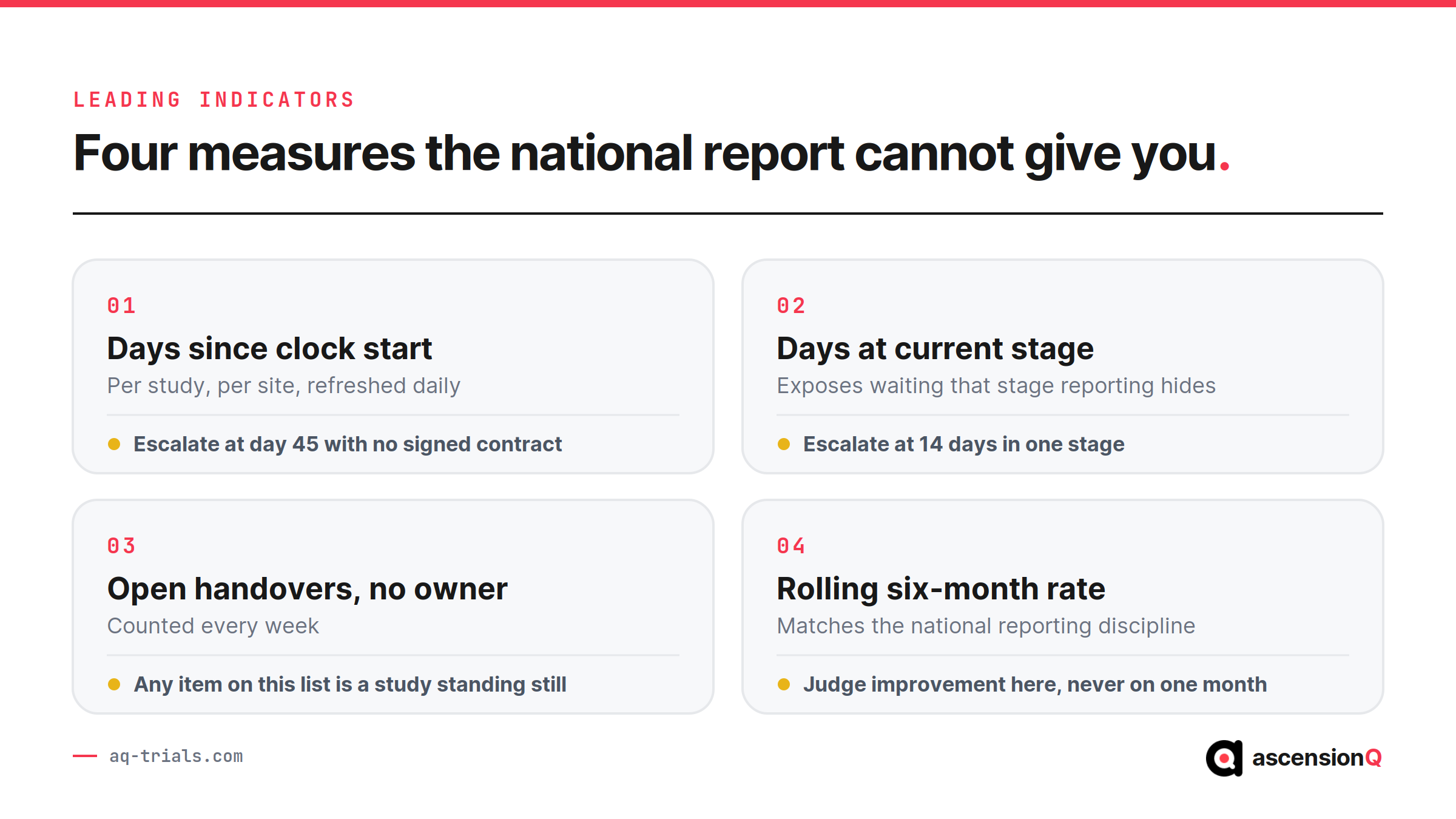
Thresholds turn those indicators into action. A study at day 45 with an unsigned contract needs escalation that week. A study at day 70 with no scheduled screening visit will miss, and the useful response is to say so early rather than to record the miss later.
My Guidance: Closing the Gap
I read the trust-level data as encouraging rather than damning. A target that several organisations meet on every study is a target the system can hit, and that removes the argument that 90 days is unrealistic. The question worth asking is what the top of that table does differently, and the answer is unglamorous.
High performers start stages before their predecessors finish. They keep one dated record of where each study sits instead of a status that lives in an individual’s inbox. They treat a study sitting at the same stage for three weeks as an event that needs a response. None of that requires new regulation, extra funding, or a larger team. It requires the local stage to be as visible and as governed as the regulatory stage already is.
My practical advice to an R&D office starting this work is to instrument first and reorganise second. Most teams believe they know where their days go, and the elapsed-days view usually surprises them. Measure the window for one quarter, find the two stages where studies actually wait, and fix those before restructuring anything else.
Approval is fast. The 90 days after it are yours.
How Does AQ Support 90-Day Set-Up?
AQ Trials runs study set-up as one connected record, so the window a trust is measured against stays visible while a team can still act on it.
The CTMS holds every set-up milestone with its date, so days-since-approval and days-at-current-stage are live figures rather than a quarterly reconstruction. Each handover carries a named owner and a due date, which turns the waiting between stages into a managed queue. The electronic Investigator Site File keeps essential documents, delegation records and training evidence current and shared, so a sponsor sees a site’s real position instead of asking for it. Live recruitment tracking carries the same visibility past the green light into the 30-day screening window.
AQ does not sign contracts or complete a capacity assessment. It makes the position of every study visible, dated and owned, which is what separates the trusts at the top of the table from the trusts at the bottom. Book a live demo to see how AQ tracks the 90-day window from approval to first participant.
Frequently Asked Questions
What is the 90-day set-up target for NHS sites?
A site meets the target when its first participant attends a first visit within 90 days of either receiving regulatory approval or being selected as a site, whichever occurs later. The UKCRD publishes trust-by-trust performance against it every month for commercial interventional studies in England.
How does the 90-day target relate to the 150-day target?
The 90 days is the site-level portion of the 150-day study target. Regulatory approval consumes the earlier part of the 150 days, and the 90-day window covers the work an individual site controls after that.
Why do NHS sites miss the 90-day set-up target?
Set-up stages run to roughly 195 days when performed in sequence. The window fits only where costing, capacity assessment, contracting, pharmacy and site file work overlap. Most of the lost time accumulates in handovers between organisations rather than inside any single task.
What changed with Date Site Confirmed in January 2026?
Date Site Confirmed replaced Date Site Ready to Start as the end point of the set-up portion. It records the last contract signature across all organisations involved, or NHS management permission in Scotland, rather than the sponsor green light.