A pharmacy site file holds every record that proves how a trial pharmacy set up, received, stored, dispensed, reconciled and disposed of investigational medicinal product (IMP) for one study. It is one file per study, kept in the pharmacy, and organised so that each numbered section has a named owner and a named signatory.
The file is where the accountable record set out in the complete guide to IMP accountability in clinical trials physically lives. This article lists what goes in it, gives a numbered folder structure, and sets out who maintains and signs each section.
- The ICH E6(R3) Essential Records Table supplies fifteen records that a pharmacy site file typically holds.
- A twelve-section structure covers set-up, supply, participant-level records and close-out.
- Every section has three roles: the person who maintains it, the person who signs entries in it, and the people who only read it.
- Records shared across studies are filed once in a pharmacy master file and referenced by file note from each study.
What Is a Pharmacy Site File?
A pharmacy site file (PSF) is the study-level repository the pharmacy keeps for the records it generates and the sponsor documents it works from. ICH E6(R3) section C.2.3 requires essential records to be “maintained in or referred to from repositories” held by the investigator or institution. The pharmacy site file is the pharmacy’s part of that repository.
NIHR guidance on suggested investigator site file contents makes the same split from the other side. It states that IMP accountability records “will be with the clinical trials pharmacist”, and it asks for a file note in the investigator site file where handling and shipping records sit with pharmacy. The reasons the two files stay separate are covered in why pharmacy documentation needs its own file.
- One study, one file. Each study gets its own file, which lets a monitor or inspector review that study alone.
- Held in the pharmacy. The file stays with the stock it describes, which keeps entries close to the work.
- Findable from the investigator site file. A file note in the investigator site file states where the pharmacy records are, which satisfies the E6(R3) C.2.4 duty to record where essential records are located.
Which Essential Records Belong in the Pharmacy Site File?
The essential records that belong in the pharmacy site file are the IMP entries in the E6(R3) Essential Records Table, together with the delegation and training records for pharmacy staff. The table marks some records with an asterisk, meaning they “should generally be in place prior to the start of the trial”. Those are flagged below.
| Essential record (E6(R3) Appendix C) | In place before the trial starts? | Where it usually comes from |
|---|---|---|
| Sample of label(s) attached to IMP containers | No | Sponsor |
| Instructions for handling IMP, for example a pharmacy manual | Yes | Sponsor |
| Shipping records for IMP and trial materials | Yes | Sponsor, then pharmacy on receipt |
| Certificate(s) of analysis of IMP shipped | Yes | Sponsor |
| IMP accountability at the investigator site | No | Pharmacy |
| IMP storage conditions, including during shipment | No | Pharmacy and courier |
| Records of relabelling of IMP at the site | No | Pharmacy |
| IMP destruction or alternative disposition | No | Pharmacy, on sponsor authorisation |
| Emergency decoding procedures for blinded trials | Yes | Sponsor |
| Instructions for important trial systems, such as the IRT user manual | Yes | Sponsor |
| Maintenance and calibration records for equipment used for important trial activities | Yes | Pharmacy or the equipment owner |
| Treatment allocation and decoding documentation | No | IRT and pharmacy |
| Trial-specific training records | Yes | Pharmacy |
| Documentation of delegation by the investigator | Yes | Principal investigator |
| Signature sheet, unless only electronic signatures are used | Yes | Pharmacy staff |
The master randomisation list is also an essential record. It normally stays with the sponsor or its IRT, and it reaches the pharmacy file only where the protocol places it there. The kit itself, and who numbers it, is defined in what an investigational medicinal product is under UK law.
The table sets the minimum. The protocol decides the rest.
E6(R3) section C.3.2 states that the table “is not an exhaustive list”, and C.3.3 adds that some records depend on trial design and may never be produced. A trial with no relabelling at site has no relabelling records, and its file carries a file note saying so.
A Numbered Folder Structure for the Pharmacy Site File
A numbered folder structure gives every record one fixed home, so the same record sits in the same section in every study the pharmacy runs. Local trust indexes differ in order and in the number of dividers. The twelve sections below follow the order in which a study generates its pharmacy records.
| Section | What it holds |
|---|---|
| 01 Study documents and approvals | Current protocol and amendments, investigator brochure or SmPC, copies of approvals, local confirmation that the study can proceed |
| 02 Pharmacy manual and procedures | Sponsor pharmacy manual, study-specific dispensing procedure, IRT user manual and access records |
| 03 Delegation, signatures and training | Pharmacy section of the delegation log, signature sheet, trial-specific training records, GCP certificates |
| 04 Labels and relabelling | Label sample or master label, relabelling records and label reconciliation |
| 05 Randomisation and code break | Emergency decoding procedure, code break test record, unblinding records |
| 06 Release, orders and shipping | Sponsor release documentation, certificates of analysis, orders, packing lists, receipt confirmations |
| 07 Storage and temperature | Storage condition records for the study’s stock, transit logger data, excursion documentation |
| 08 Equipment | Calibration and maintenance certificates, or a file note pointing to the pharmacy master file |
| 09 Prescriptions and dispensing | Sample trial prescription, completed trial prescriptions, dispensing records and check signatures |
| 10 Accountability logs | Study-level master log and participant-level logs with running balances |
| 11 Returns, destruction and recalls | Returns counts, sponsor destruction or return authorisations, destruction certificates, recall records |
| 12 Monitoring, correspondence and file notes | Monitoring visit log, file note log, sponsor correspondence, superseded documents |
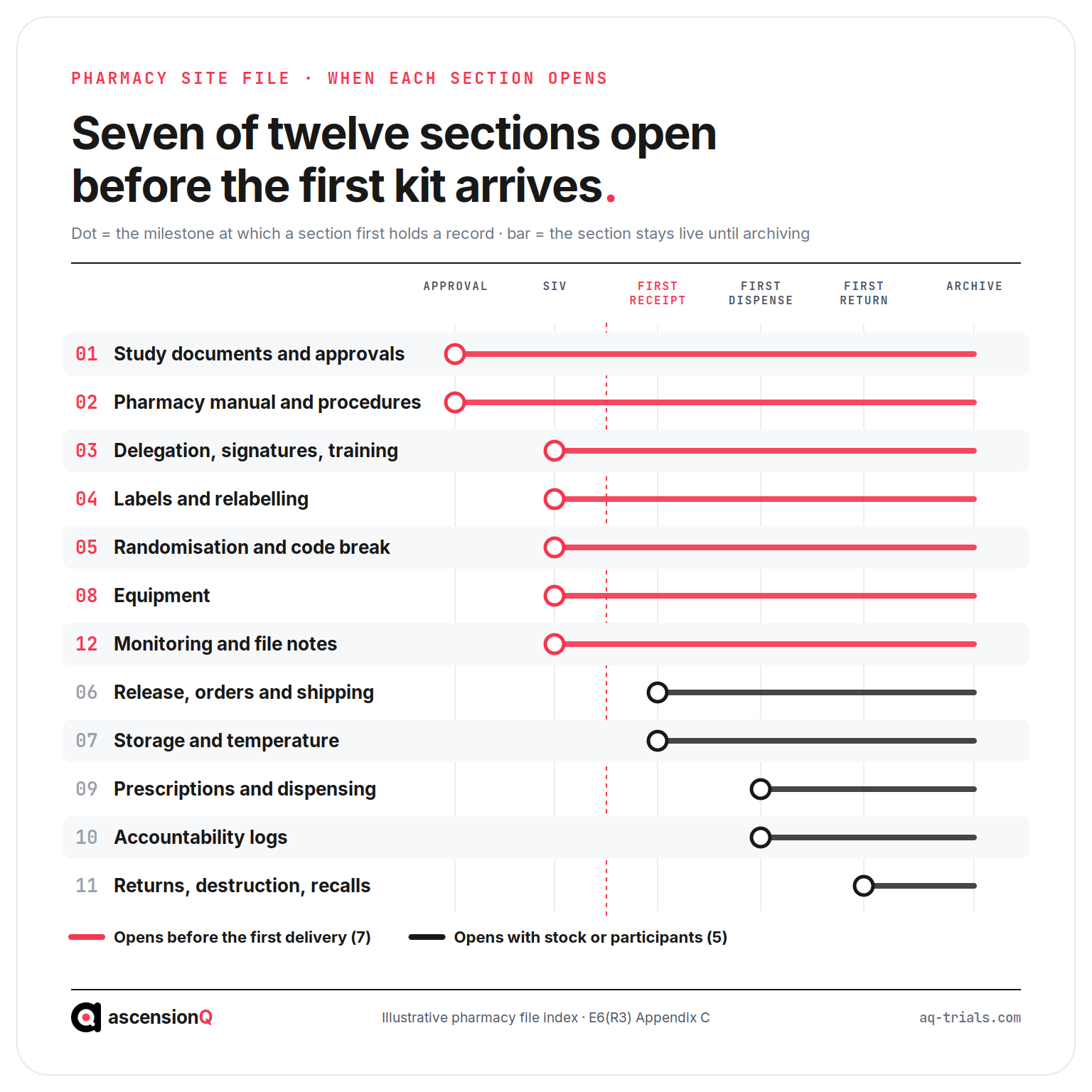
Sections 01 to 05 are built before the first delivery, section 06 fills with it, and sections 09 to 11 fill once dispensing starts. Storage records for section 07 follow the storage record set in the investigational product storage records checklist. The pharmacy manual in section 02 is usually a sponsor document, and the NHS Specialist Pharmacy Service guidance on constructing a pharmacy manual lists the headings it normally covers.
Also Read: From Depot to Patient: The Twelve Steps a Trial Medicine Takes
Who Owns and Signs Each Section?
Each section is owned by the person who maintains it, signed by the person whose action it records, and read by people who never change it. The principal investigator stays responsible for the whole record under E6(R3) section 2.10.1, and section 2.10.4 names “a pharmacist or other appropriate individual” as the person who may keep the IMP records. The local pharmacy procedure fixes the split below for each site.
| Section | Maintained by | Entries signed by | Read by |
|---|---|---|---|
| 01 Study documents and approvals | Trials pharmacist | Sponsor and approving bodies (source documents) | Monitor, QA, inspector |
| 02 Pharmacy manual and procedures | Trials pharmacist | Sponsor (manual); pharmacy approver (local procedure) | All delegated pharmacy staff |
| 03 Delegation, signatures and training | Trials pharmacist | Principal investigator (delegation); each staff member (signature sheet) | Monitor, inspector |
| 04 Labels and relabelling | Trials pharmacist | Person who relabels and the person who checks | Monitor |
| 05 Randomisation and code break | Unblinded pharmacist | Person who breaks or tests the code | Unblinded monitor, inspector |
| 06 Release, orders and shipping | Pharmacy technician | Person who receives and the person who releases for use | Monitor |
| 07 Storage and temperature | Pharmacy technician | Person who reviews each record | Monitor, QA |
| 08 Equipment | Equipment owner | Engineer or calibration provider | QA, inspector |
| 09 Prescriptions and dispensing | Trials pharmacist | Authorised prescriber; dispenser; second checker | Monitor |
| 10 Accountability logs | Pharmacy technician | Person making each entry | Monitor, sponsor, inspector |
| 11 Returns, destruction and recalls | Trials pharmacist | Sponsor (authorisation); destroyer and witness | Monitor |
| 12 Monitoring, correspondence and file notes | Trials pharmacist | Monitor (visit log); author of each file note | Inspector |
A signature counts only when the signer appears on the delegation log for that task on that date. E6(R3) section C.2.1 adds that records should carry “authors, reviewers and approvers as appropriate, along with date and signature”.
The file proves who acted. The delegation log proves they were allowed to.
Also Read: Drug Accountability Logs: What Auditors Actually Check
Which Records Sit Outside the Study File?
Three kinds of record sit outside the study file and are reached from it by file note. E6(R3) section C.2.12 recognises records “not specific to a trial” that relate to facilities, processes and systems used across many trials. Section C.2.11 asks for care in sharing records where blinding applies.
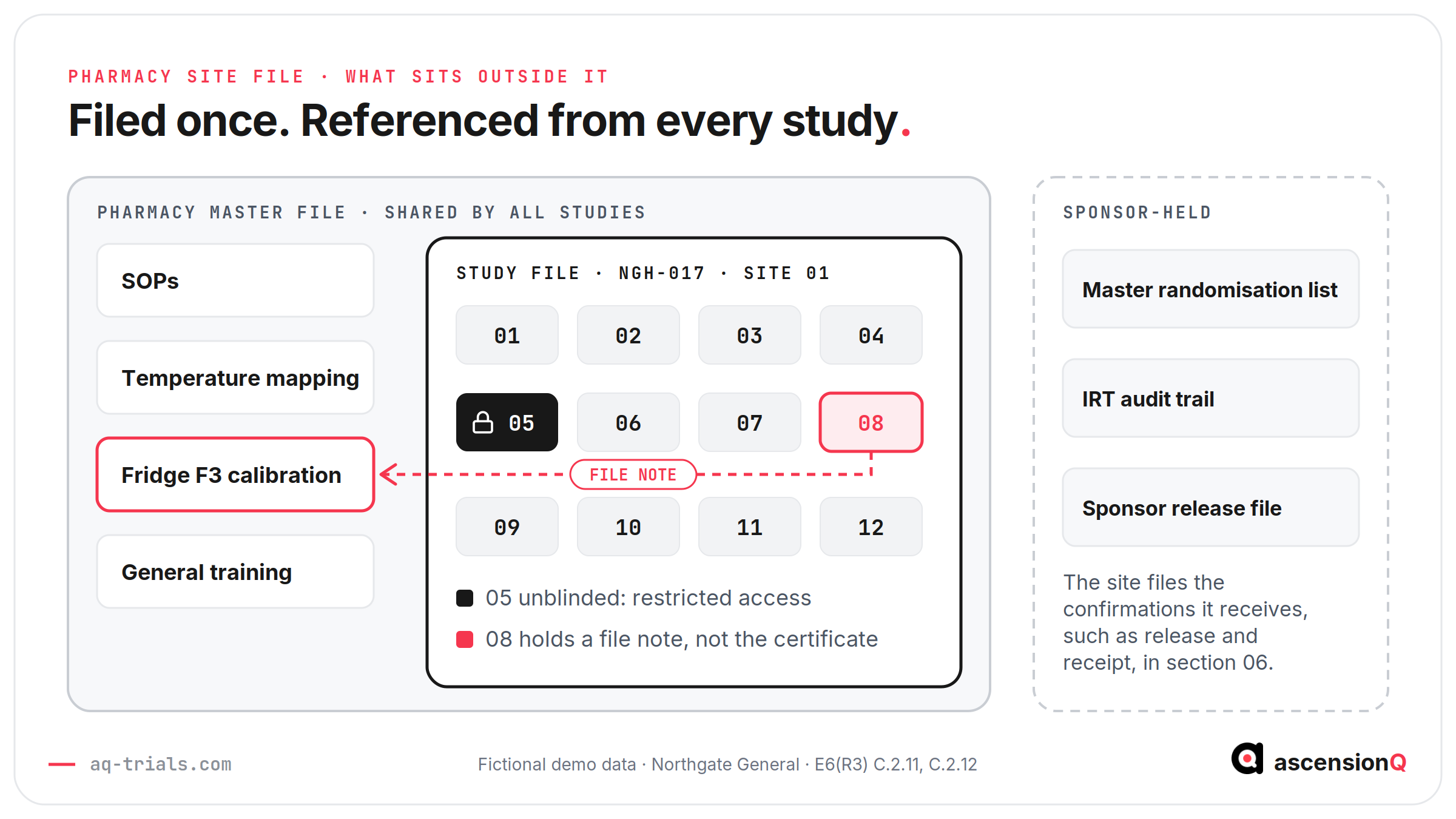
- Pharmacy master file records cover SOPs, fridge and freezer calibration, temperature mapping and general training, and are filed once so a single certificate supports every study that relies on that equipment.
- Restricted unblinded records cover code break material and unblinded dispensing records, and sit apart under restricted access so the blinded team never sees treatment identity.
- Sponsor-held records cover the master randomisation list, the IRT audit trail and the sponsor’s release file, and the site keeps the confirmations it receives from them.
A hypothetical example shows the file note at work. Study NGH-017 at Northgate General (SITE 01) stores its IMP in fridge F3, which also holds stock for four other studies. The calibration certificate for F3 lives once in the pharmacy master file. Section 08 of the NGH-017 file holds a dated file note naming the certificate, its location and the date the next calibration falls due.
How Is the Pharmacy Site File Kept Current?
The pharmacy site file is kept current by filing each record when it is produced and by keeping every superseded version readable. E6(R3) section C.2.5 asks for records to be filed “in a timely manner”, and section C.2.6 requires any alteration to stay traceable. The MHRA GXP data integrity guidance applies the same expectation to paper and electronic records alike.
- Version control records the version and date on every controlled document, which shows which pharmacy manual applied on the day of each dispensing.
- Superseded documents are marked as superseded and moved to section 12, which keeps the history intact without leaving old versions in working sections.
- File notes explain any gap, move or absent record, which stops an empty section from reading as a missing record.
- Certified copies replace originals only when verified, as E6(R3) section C.2.9 requires and as set out in when a scanned record can replace the original.
A pharmacy site file works when every section has an owner and every entry has an authorised signer. AQ’s electronic pharmacy site file page sets out how AQ approaches pharmacy records as part of one connected site file. Book a live demo to talk through how your pharmacy file structure connects to the rest of your study evidence.