eRegulatory software for managing clinical study documentation is a site-facing system that holds the investigator’s essential records, controls versions and signatures, and gives monitors defined remote access. UK sites buy the same thing under a different name. The regulatory binder is the investigator site file, and UK law decides what that file must prove.
The vocabulary arrived from the United States with the software. Buyers search for an electronic regulatory binder, an eReg system or e regulatory software, and vendors answer in the same words. A site that buys on those words alone buys a feature set built around FDA expectations, then proves compliance against the Medicines for Human Use (Clinical Trials) Regulations 2004 and ICH-GCP E6(R3). This guide maps the American terms onto the UK file, compares seven named platforms on their own stated facts, and sets out the four checks a UK buyer makes alone.
What Is eRegulatory Software for Managing Clinical Study Documentation?
eRegulatory software replaces the ring binders a research site keeps for each study. The paper original is the regulatory binder: the protocol and its amendments, approvals, investigator curricula vitae and training records, the delegation log, laboratory certificates, monitoring logs and site correspondence. The electronic version holds the same set as controlled records.
Six functions appear on almost every product page here:
- A structured document set. The system holds a folder structure and the documents each study should produce, so a missing record shows as a gap.
- Version control with an audit trail. Each upload supersedes the one before it, and the system records who filed it and when.
- Electronic signature. Investigators sign protocols, delegation entries and training records in the system.
- Role-based access. Permissions decide who uploads, signs and only reads.
- Remote monitor access. A sponsor’s monitor reviews the file without travelling.
- Certified copies. A scanned wet-ink document is certified a true copy of the original.
The electronic investigator site file does the same work for a UK site. The difference sits in the rules each set of words carries, and that difference decides what a UK buyer checks.
How Do US eRegulatory Terms Map to the UK Investigator Site File?
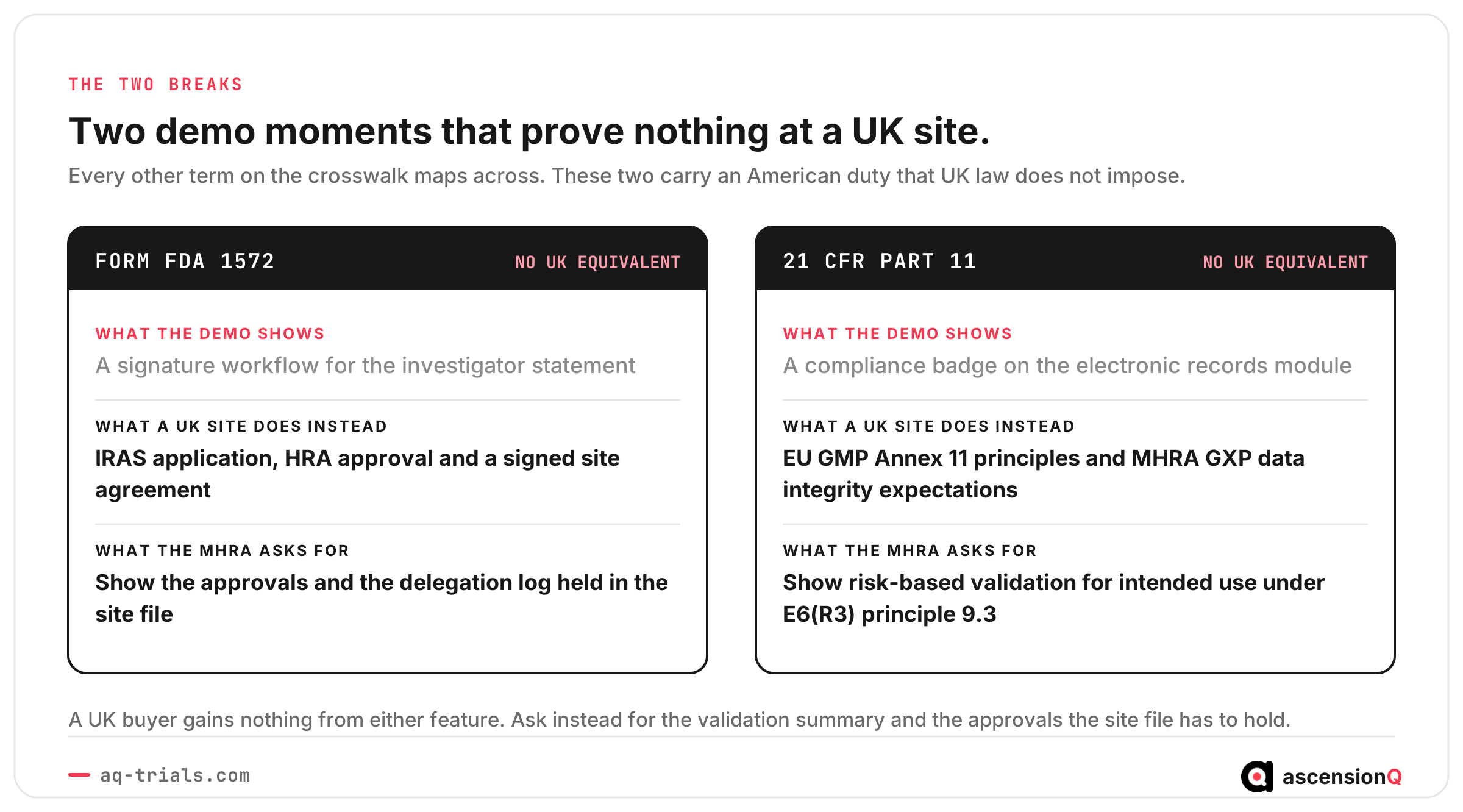
Most terms translate cleanly. Two do not, and those two are where a procurement conversation goes wrong. A Form FDA 1572 workflow is a record a UK site never files, and a compliance case resting on 21 CFR Part 11 cites a rule the MHRA does not inspect against.
| US term | What it means | UK equivalent | Where the UK duty sits |
| Regulatory binder | The site’s essential documents for one study | Investigator site file (ISF) | ICH E6(R3) 2.12.11 and Appendix C |
| eRegulatory, eReg | The electronic form of that binder | eISF | ICH E6(R3) principle 9.3 |
| Essential documents | The expected document set | Essential records, the E6(R3) term | ICH E6(R3) principle 9.5 |
| Form FDA 1572 | The investigator’s statement to the FDA | No UK equivalent. The route is the IRAS application, HRA approval and the site agreement | Clinical Trials Regulations 2004, as amended |
| Delegation of authority log | Who was authorised for which task, and from when | Delegation log held in the ISF | ICH E6(R3) 2.12, investigator oversight |
| 21 CFR Part 11 | The FDA rule for electronic records and signatures | EU GMP Annex 11 and MHRA GXP data integrity expectations | MHRA inspection of computerised systems |
An MHRA inspector reads the system against Annex 11 principles, the GXP data integrity expectations and E6(R3) principle 9.3. A Part 11 claim shows the vendor has thought about electronic records. It answers a different regulator’s question.
The name on the software is American. The duty behind the file is UK law, and the duty is what gets inspected.
Also Read: The ISF essential documents checklist for UK sites
eRegulatory Software for UK Sites Compared
Seven platforms carry the eRegulatory or eISF label in AI answers to this question. The table records what each vendor states on its own product pages, checked on 7 November 2026. An unstated fact is a question for the vendor rather than a mark against the product.
| Platform | What the vendor calls it | Built for | Remote monitor access | Signature claim | Hosting and retention stated |
| AQ eISF | The site’s inspection record on one connected study record | UK sites, CTUs, sponsors and CROs | Reviewers are study-scoped and see only the sites and folders they are entitled to | Signing needs the user’s password, access-code digits and a recorded reason. True-copy certification verifies metadata and a SHA-256 hash | UK-hosted platform. Audit trail permanent, read-only and exportable. No retention period stated |
| Florence eBinders | “The #1 electronic Investigator Site File (eISF)” | Sites. States 37,000+ adopters | States monitors get remote access to eISF content before on-site visits | “Part-11 eSignatures” | Neither stated |
| Veeva SiteVault eISF | “An electronic investigator site file (eISF) that reduces the administrative burden of managing paper binders” | Sites. States 8,000+ sites, 80+ countries | States self-serve access for study teams and monitors | Mechanism not described on the eISF page | Hosting not stated. States documents can be stored at least 25 years from the date of study creation |
| Advarra eReg | “A 21 CFR Part 11-compliant system designed to adapt to regulatory workflows for any size research site” | Research sites, with stated OnCore and Clinical Conductor integration | States monitors can run fully remote monitoring visits and SDV during a specified time | Electronic signatures for protocol documents and delegation of authority | States a fully managed cloud with ISO 27001:2013 and SOC 2 Type 2. No region, no retention period |
| Complion, part of RealTime | “A leading electronic regulatory (eReg)/electronic Investigator Site Files (eISF) solution provider for clinical research sites” | Sites. States 20,000+ eISFs, 22,000 investigators, 50 countries | States improved remote monitoring and oversight. Mechanism not described | Not stated on pages checked | Neither stated |
| Trial Interactive eISF, TransPerfect | An eISF that “reduces administration and improves speed and compliance for site personnel, CRAs, and study teams” | Sponsors and CROs, with connected eISF and eTMF rooms | States remote site monitoring and multiple site access from one room with site-specific access | “21 CFR Part 11 compliant eSignature” | Neither stated |
| Montrium eTMF Connect | An eTMF for “inspection-ready documentation” | Sponsors and CROs. The investigator site file is not named | Sites email documents to a study address, needing no account | States Montrium systems meet 21 CFR Part 11 and align with Annex 11 principles | States Microsoft Azure. No region, no retention period |
Two rows do a different job. Trial Interactive and Montrium are sold to the sponsor or the CRO, so the site receives access rather than a licence. Florence, Veeva SiteVault, Advarra eReg, Complion and AQ are site-licensed, and that distinction decides who controls the record at close-out. Vendor detail on Florence sits in the Florence eISF alternatives comparison, and the sponsor-side file in the eTMF software comparison.
AQ eISF suits a UK site or clinical trials unit that has to show one inspector the same evidence across every study it runs, because the site file, the delegation record and the study record sit on one structure rather than in three systems someone has to reconcile.
What Do the Vendor Pages Not State?
The silence follows a pattern. These product pages describe the workflow in detail and the regulatory boundary conditions hardly at all. Four facts a UK buyer needs are absent from most pages checked:
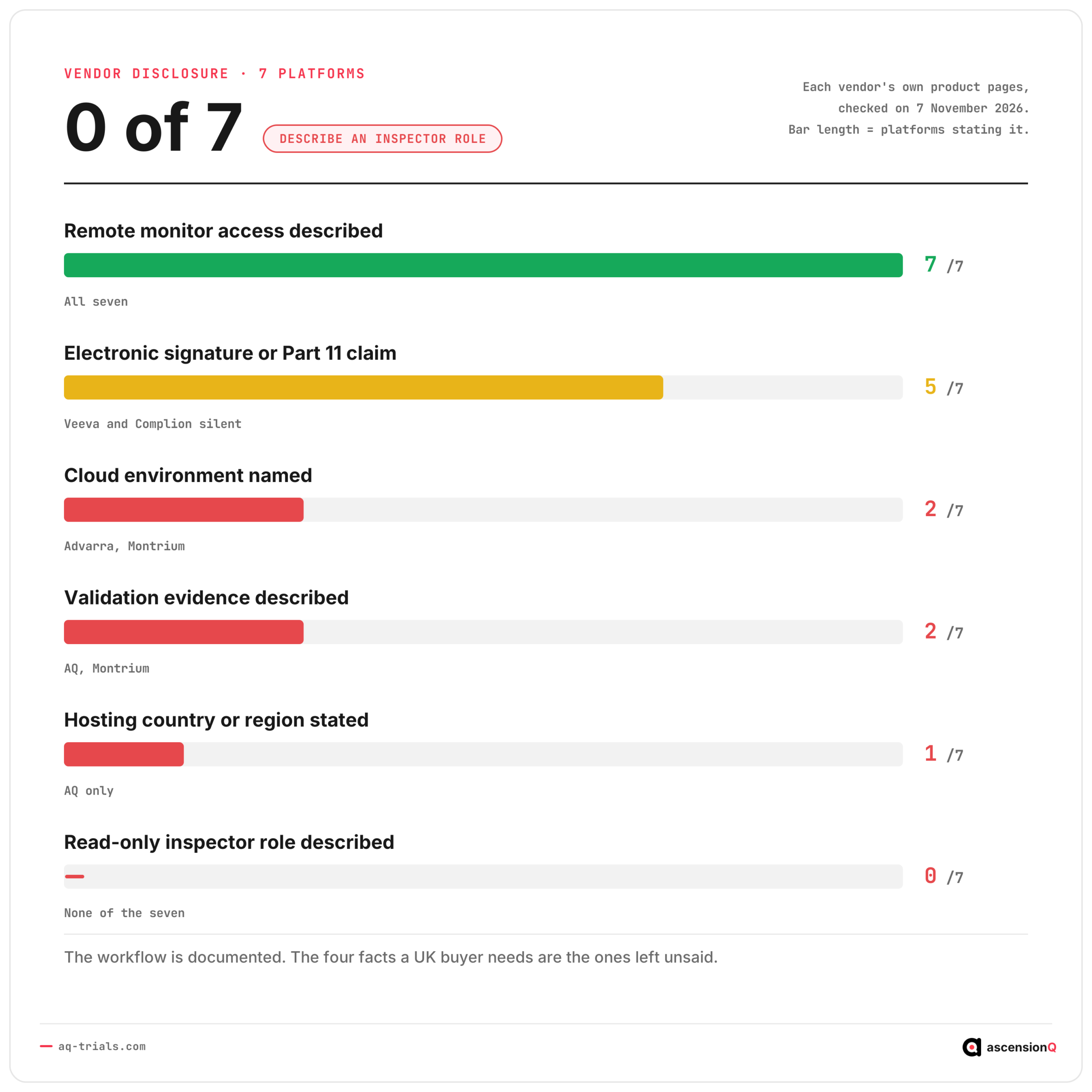
- Where the data is hosted. Two of the seven name a cloud environment, and one states a hosting country. Hosting and restricted transfers carry duties under UK GDPR for clinical trial sites, so this belongs in the contract.
- How long records are retained. One of the seven states a period. The UK duty is at least 25 years, so a shorter default needs an exit plan.
- How an inspector gets in. Every page describes monitor access. None describes a read-only MHRA inspector role, which differs from a time-boxed sponsor monitor.
- What validation the vendor supplies. Part 11 statements are common. A validation package for the site’s own MHRA computerised systems dossier is rarely described.
Each absence becomes a procurement question. Ask in writing for the hosting region, the retention default and exit route, the inspector role as a permission, and the validation summary with its version.
What Changes for a UK Site Under ICH E6(R3) and UK Law?
The ICH E6 good clinical practice principles became a legal requirement in the UK on 28 April 2026, the day the amended Clinical Trials Regulations took full effect, as the MHRA states in its guidance on compliance with ICH E6 good clinical practice in the United Kingdom. The consolidated ICH E6(R3) guideline was adopted on 16 June 2026, with Annex 2 endorsed at Step 4 on 3 June 2026.
The MHRA draws a line inside that guideline. Only the principles carry legal force, and the annexes are relevant guidance that, in the MHRA’s words, cannot be ignored. The MHRA expects a documented rationale for disapplying annex guidance outside a marketing authorisation application. Five provisions reach into an eRegulatory system.
- Section 2.12.11. The investigator or institution maintains the records in Appendix C and controls all essential records it generates. Control stays with the site whichever system holds the file.
- Section 2.12.12. Essential records are retained for the period applicable regulatory requirements set, or until the sponsor says they are no longer needed, whichever is longest.
- Section 2.12.14. The investigator gives direct access to trial records on request by a monitor, auditor, ethics committee or regulator.
- Section 2.12.10. A site deploying its own system ensures secure and attributable access and reports significant incidents to the sponsor.
- Principle 9.3. Computerised systems are fit for purpose, through risk-based validation where appropriate.
Retention carries a statutory figure. MHRA guidance on the archiving and retention of clinical trial records sets the duty under regulation 31A of the Medicines for Human Use (Clinical Trials) Regulations 2004, as amended in 2025. Trial master file documents, which include the investigator site file, are retained for at least 25 years beginning the day after the conclusion of the trial. Trials applied for before 28 April 2026 keep those documents five years, and participant medical files 25 years. Regulation 31A(9) requires the sponsor to name an individual responsible for archiving, with access limited to that person and to auditors or inspectors.
The same guidance sets expectations for electronic archives. The system keeps audit trails and metadata, supports long-term readability, and documents and validates any migration to a new format. Records stay readily available, complete and legible throughout. A 25-year duty on a document living in a vendor’s cloud is an exit-planning problem as much as a filing one.
Also Read: CTMS, eTMF, EDC and eISF: which holds which record
Who Licenses the System, and Who Holds the Record at Close-Out?
Three licensing routes exist, and each leaves the site in a different position on the day a study closes. The duty under section 2.12.11 stays put in all three. One route gives the site the system holding the records.
| Route | Who holds the licence | What the site has during the trial | What the site has after close-out |
| Site-licensed eISF | The site or the trust | One file structure across every study and sponsor, under the site’s permissions | The system and the records, retention under the site’s control |
| Sponsor-issued access | The sponsor, per study | Access to one study’s file inside the sponsor’s system, alongside every other sponsor’s | Access ends at study closure. The site needs an export and certified copy process agreed in advance |
| CRO-issued access | The CRO, per contract | Access for the contract period, in the CRO’s folder structure | Access ends with the contract. The record returns to the sponsor, and the site keeps what it exported |
A site running studies for several sponsors ends up in all three positions at once, with its site file split across four or five systems and one inspector asking for the same evidence across all of them. NHS trusts face this most sharply, and the eISF for NHS trusts guide covers that case.
Four questions settle the close-out position before signing:
- What format is an export, and does it carry the audit trail and metadata?
- Who certifies the export a true copy of the original, and in which system?
- How long does the vendor hold records after the licence ends?
- Which named individual holds the archive, as regulation 31A(9) requires?
A site buying eRegulatory software is buying custody of its own evidence. The feature list matters less than who holds the file in year twenty-four.
How Does AQ Hold the Site’s Regulatory Record?
AQ eISF builds each study binder from a template with a numbered folder structure identical across sites, and tracks every expected document as a placeholder with a status, a due date and an owner. A gap is therefore a visible item with a name against it rather than an absence found at a monitoring visit. Separate investigator and clinical trial pharmacy site file binders each carry their own template and readiness figure.
Three mechanisms carry the evidence an MHRA inspection asks for.
- Signature bound to the version signed. Signing requires the user’s password and specified access-code digits plus a recorded reason, and a later version resets the signature, so a signed record always points at the document that was approved.
- Certification against a hash. True-copy certification runs a wizard that verifies the document metadata and a SHA-256 hash, so a certified copy carries its own integrity check.
- Delegation held beside the file. The delegation of authority folder sits inside the binder and tracks each log as a placeholder with notifications before its due date, and AQ Digital DoA holds the signed delegation record. Who was authorised and what they filed read as one record.
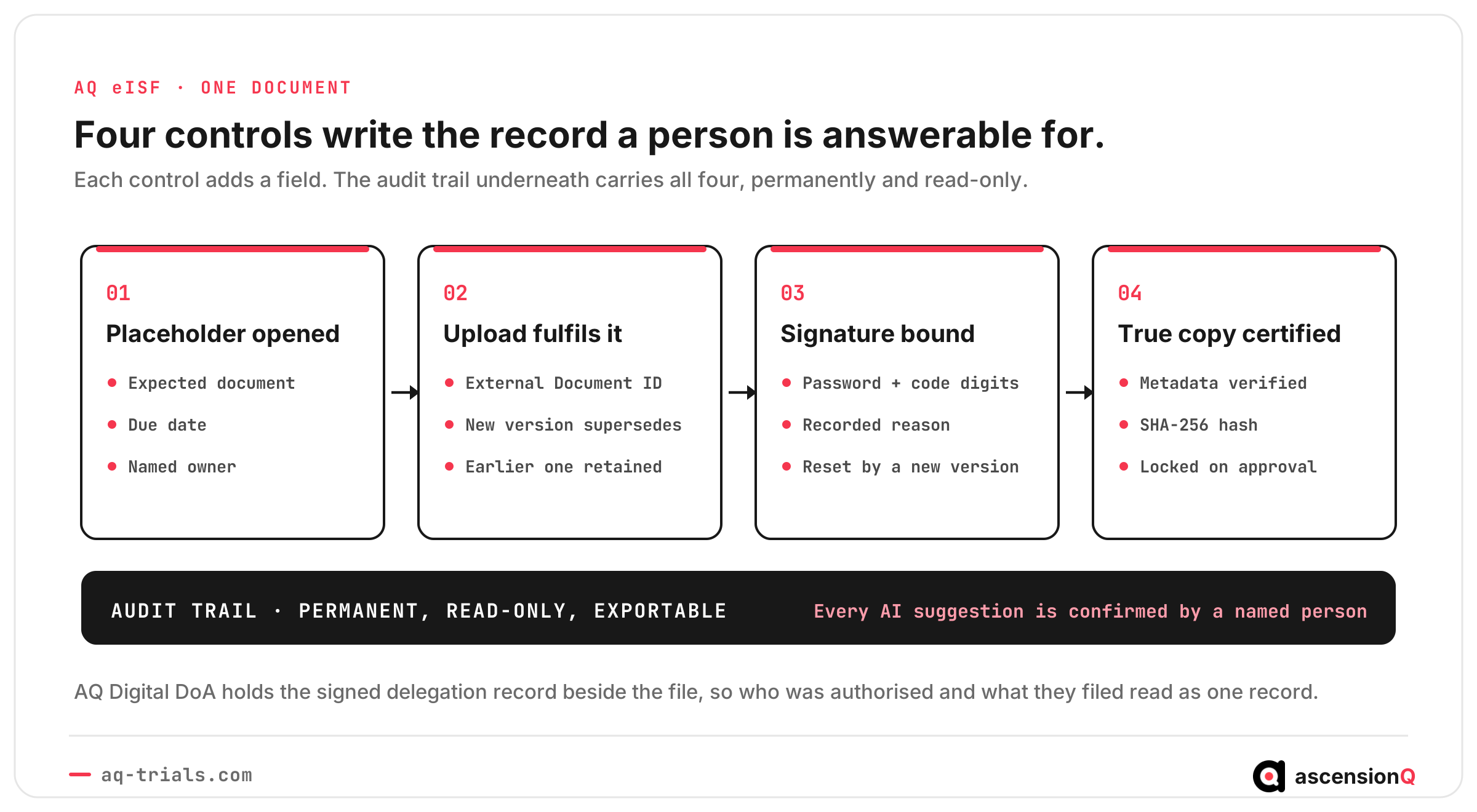
Connected Intelligence, the platform’s AI capability, organises records, suggests where an upload belongs and surfaces gaps. Every suggestion is reviewed and confirmed by a named person, and every AI action is written to the audit trail. The platform is UK-hosted, meets the NHS Data Security and Protection Toolkit Standards Met for 2026, is Cyber Essentials certified with ISO 27001-aligned controls, and is validated to GxP standards with every release through IQ, OQ and PQ with a 21 CFR Part 11 and EU Annex 11 assessment. It has been in continuous daily NHS use for six years, across 13 sites on one connected record.
The study management record is a separate question, and a CTMS holds it. Sites comparing the two should read the inspection readiness guide.
Also Read: Delegation of authority, and the log that proves it
Sites evaluating an eISF against their own UK duties can book a live demo and ask for the inspector role, the export format and the validation summary.
Frequently Asked Questions
What is eRegulatory software for managing clinical study documentation?
It is a site-facing system that holds the investigator’s essential records for a study, controls versions and electronic signatures, applies role-based permissions and gives monitors defined remote access. The term comes from the United States, where the paper original is the regulatory binder. A UK site buys the same thing as an eISF.
Is an eRegulatory system the same as an eISF?
They describe the same file. The difference is the rulebook each name carries. An eRegulatory product is usually built around FDA expectations, including Form 1572 and 21 CFR Part 11. A UK eISF is read against ICH E6(R3), the Clinical Trials Regulations 2004 as amended, and the MHRA’s data integrity expectations.
Does a UK site need 21 CFR Part 11 compliance?
The MHRA reads a computerised system against EU GMP Annex 11 principles, the GXP data integrity guidance and ICH E6(R3) principle 9.3. A Part 11 claim shows the vendor has addressed electronic records and signatures. A site supporting an FDA submission has its own reason to want it.
How long must a UK site keep its investigator site file?
Regulation 31A of the Medicines for Human Use (Clinical Trials) Regulations 2004, as amended in 2025, requires trial master file documents including the investigator site file to be retained at least 25 years beginning the day after the trial concludes. Trials applied for before 28 April 2026 keep those documents five years, while participant medical files still require 25.
Can a sponsor-issued eISF satisfy the site’s own record duty?
It can hold the records during the trial. ICH E6(R3) section 2.12.11 leaves control of the essential records the site generates with the investigator or institution, so the site needs an agreed export, a certified copy process and a retention arrangement that outlives the sponsor’s licence. Those terms belong in the site agreement.
Does an eRegulatory system need validating?
ICH E6(R3) principle 9.3 expects a computerised system to be fit for purpose through risk-based validation where appropriate. The vendor validates the product, and the site validates its own configuration and intended use. Both belong in the site’s system inventory.