Veeva SiteVault eSource alternatives for NHS and academic sites fall into four groups: site eSource platforms the site licenses for itself, the eSource system a sponsor issues for a single study, the hospital electronic patient record used as the source, and forms the site builds in its own data capture tool. Veeva places SiteVault eSource in the first group. Veeva’s own materials describe it as a product still arriving at sites rather than one in general use.
This guide sets out what Veeva publishes about SiteVault eSource, where it sits in a UK site’s operations, and which routes are open to a site opening a study this year. Every supplier statement below comes from that supplier’s own materials. Our complete guide to eSource in clinical trials covers the definitions and regulatory duties that sit underneath the choice.
A site can run only the option that exists on the date it opens the study.
What Is Veeva SiteVault eSource?
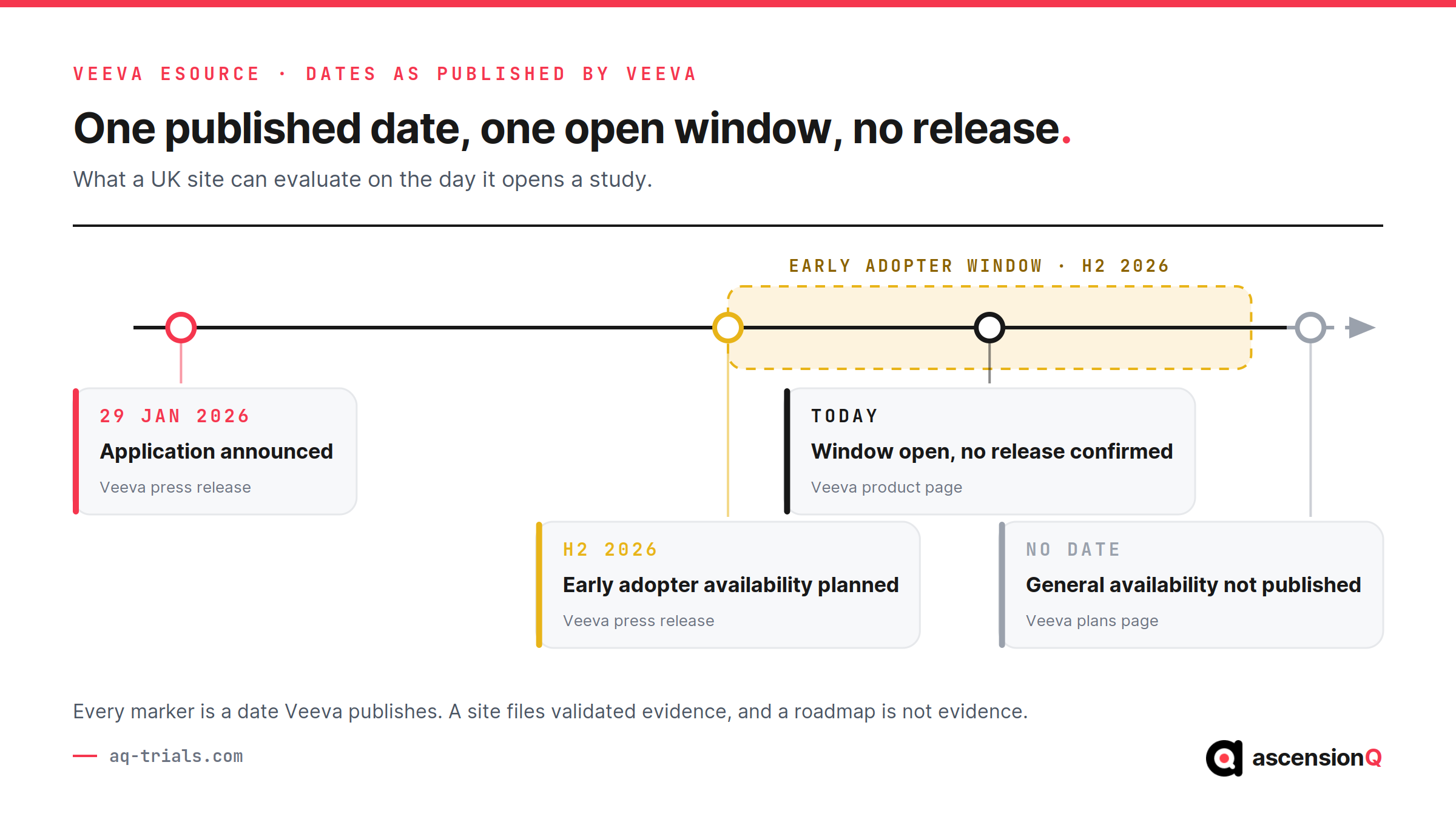
Veeva SiteVault eSource is a data capture application Veeva has announced as part of SiteVault, its product suite for research sites. Veeva describes it on its eSource product page as “a holistic data capture application that will provide research sites with everything they need to capture patient data digitally at the source”. The future tense in that sentence is Veeva’s own.
Six statements from Veeva’s materials define the product as it stands:
- Veeva announced the application on 29 January 2026 and states that early adopter availability is planned for the second half of 2026.
- Veeva states eSource “will be built to integrate with Electronic Health Records (EHRs) and unified with the industry-leading Veeva Electronic Data Capture (EDC)”.
- Veeva states that an open API enables connection to any EDC system, and that eSource “can be used no matter the EDC”.
- Veeva states the product is “designed for all site types as a product within Veeva SiteVault”.
- Veeva’s plans page lists eSource in both the free and the enterprise tier, with the open API and EHR integration in the enterprise tier only.
- Veeva states the free tier covers up to 20 active studies, with unlimited archived studies.
Two further statements in Veeva’s SiteVault FAQ matter to a UK site. Veeva states that SiteVault runs on AWS infrastructure in the United States, in Europe (Germany and Ireland) or in Japan according to customer location. Veeva also states that sites have access to all of the validation documentation from within SiteVault, and that the system is maintained in a validated state consistent with 21 CFR Part 11 and Annex 11.
Where Does SiteVault eSource Fit at an NHS or Academic Site?
SiteVault eSource fits the direct data capture form of eSource, where delegated site staff record an observation straight into an electronic form. Our guide to the four types of eSource sets that form out alongside the EPR as source, EHR-to-EDC transfer and ePRO.
The application sits inside SiteVault, so the fit depends on what the site already runs there:
- A site already using SiteVault for its site file and study management adds one more application inside a system its staff know, which shortens training.
- A site running a different site file system adds a second supplier relationship for one part of the record, which adds a second validation file and a second exit arrangement.
- An academic site with a portfolio inside the 20 active study limit meets Veeva’s stated condition for the free tier.
- A site whose sponsors mandate their own capture tools uses any site-owned system for the remaining data only, which narrows the value of a licence.
Availability decides the rest. A site opening a study in the next few months evaluates products it can validate, train staff on and use now. Our eSource guide for UK research sites covers the preparation that runs before any of these decisions.
Which eSource Routes Are Open to a UK Site Today?
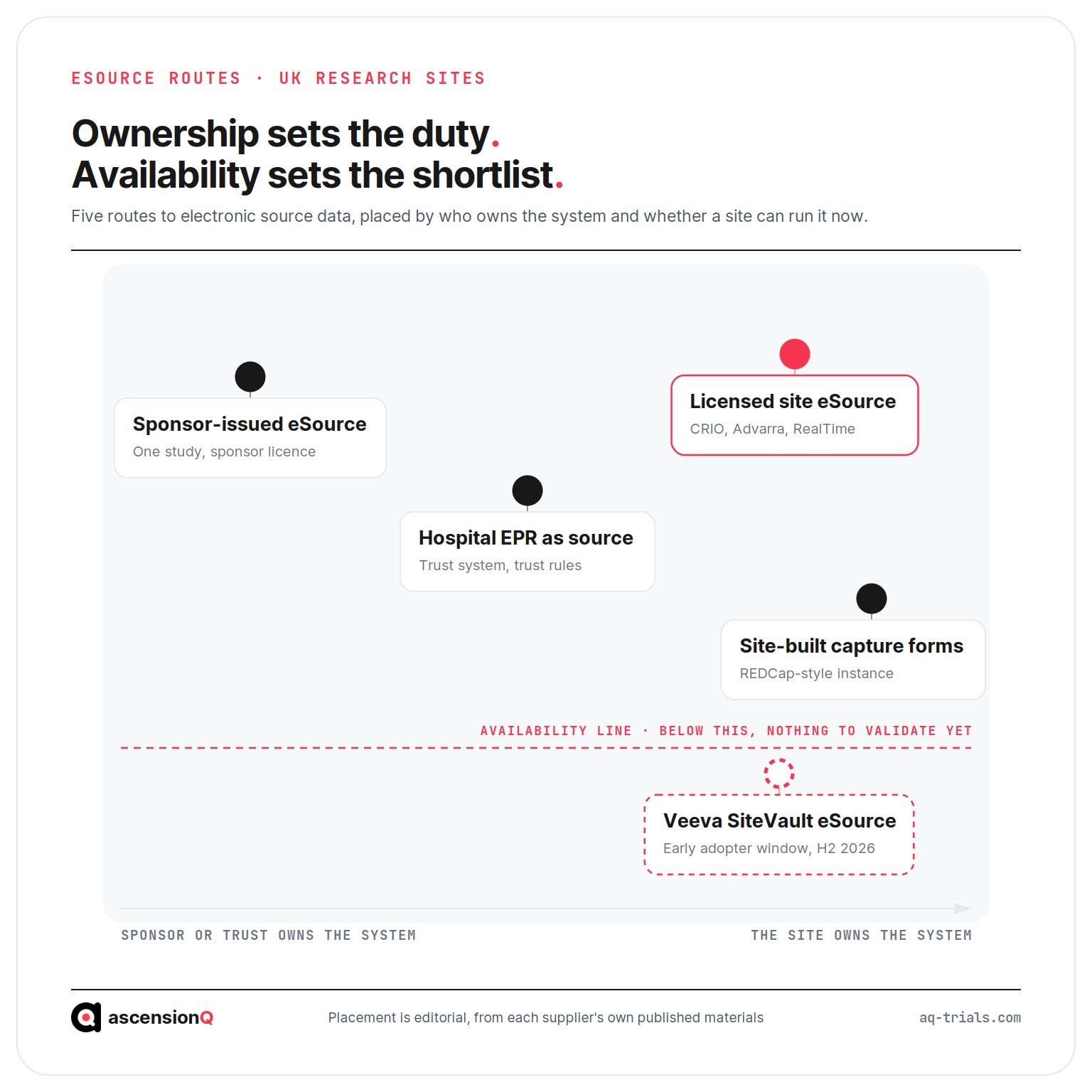
Four routes are open to a UK site today. They differ by who owns the system rather than by what the form looks like on screen, and ownership decides who validates it and who holds the record at the end.
| Route | Who owns the system | Who validates it | What happens at study close |
| Site eSource platform the site licenses | The site, under its own contract | Vendor documentation plus site user acceptance testing | The site keeps the record and exports it under its exit terms |
| eSource issued by the sponsor for one study | The sponsor | The sponsor, with site training records | The site receives a copy it retains for the full period |
| Hospital EPR used as the source | The NHS trust | The trust, as a clinical system | The record stays in the EPR under trust retention rules |
| Forms built in the site’s own data capture tool | The site or its university | The site, in full | The site keeps the record and runs its own archive |
The EPR route carries its own approval chain. Our guide to EHR-to-EDC integration versus site eSource at an NHS trust compares that route against site forms on data coverage, the trust approval chain and where the cost falls.
What Do the Site eSource Vendors Publish About Themselves?
Three suppliers besides Veeva publish site eSource products for research sites, site networks and academic medical centres. The wording in the table is each supplier’s own.
| Supplier | How the supplier describes the product | Stated connections | Stated compliance position |
| Veeva eSource | “A holistic data capture application” for capturing patient data digitally at the source | Veeva EDC, an open API to any EDC, EHR integration in the enterprise tier | SiteVault maintained in a validated state consistent with 21 CFR Part 11 and Annex 11 |
| CRIO | “eSource Technology for Sites, Sponsors, and CROs”, with a site eSource product for sites and academic centres | “Fully integrated with Site CTMS, eRegulatory, and eConsent solutions”, plus an open API | Lists HIPAA, FDA, EU Annex 11, GDPR and GCP compliance on its product page |
| Advarra eSource | “Built for research sites and site networks”, to capture and manage data and “eliminate the need for paper source documents” | Advarra EDC, Clinical Conductor, OnCore CTMS, a FHIR lab results interface and a data export API | A “21 CFR Part 11-compliant, integrated system” with audit trails and secure signatures |
| RealTime-eSOURCE | “A cloud-based electronic source (eSource) data capture solution” | RealTime-CTMS, and EDC Connect for transfer to EDC | States that “Part 11 and GDPR compliance are baked in”, with electronic audit trails |
Each entry is a supplier’s description of its own product, and one input to an evaluation. Our guide to how to validate an eSource system before first patient in sets out the split between the documentation a vendor supplies and the testing the site performs itself.
Also Read: eSource vs EDC: Where Source Data Ends and the CRF Begins
What Changes When the Sponsor Supplies the eSource System?
A sponsor-supplied system moves the licence, the validation and the form design to the sponsor. The site keeps every duty that attaches to the people who use it.
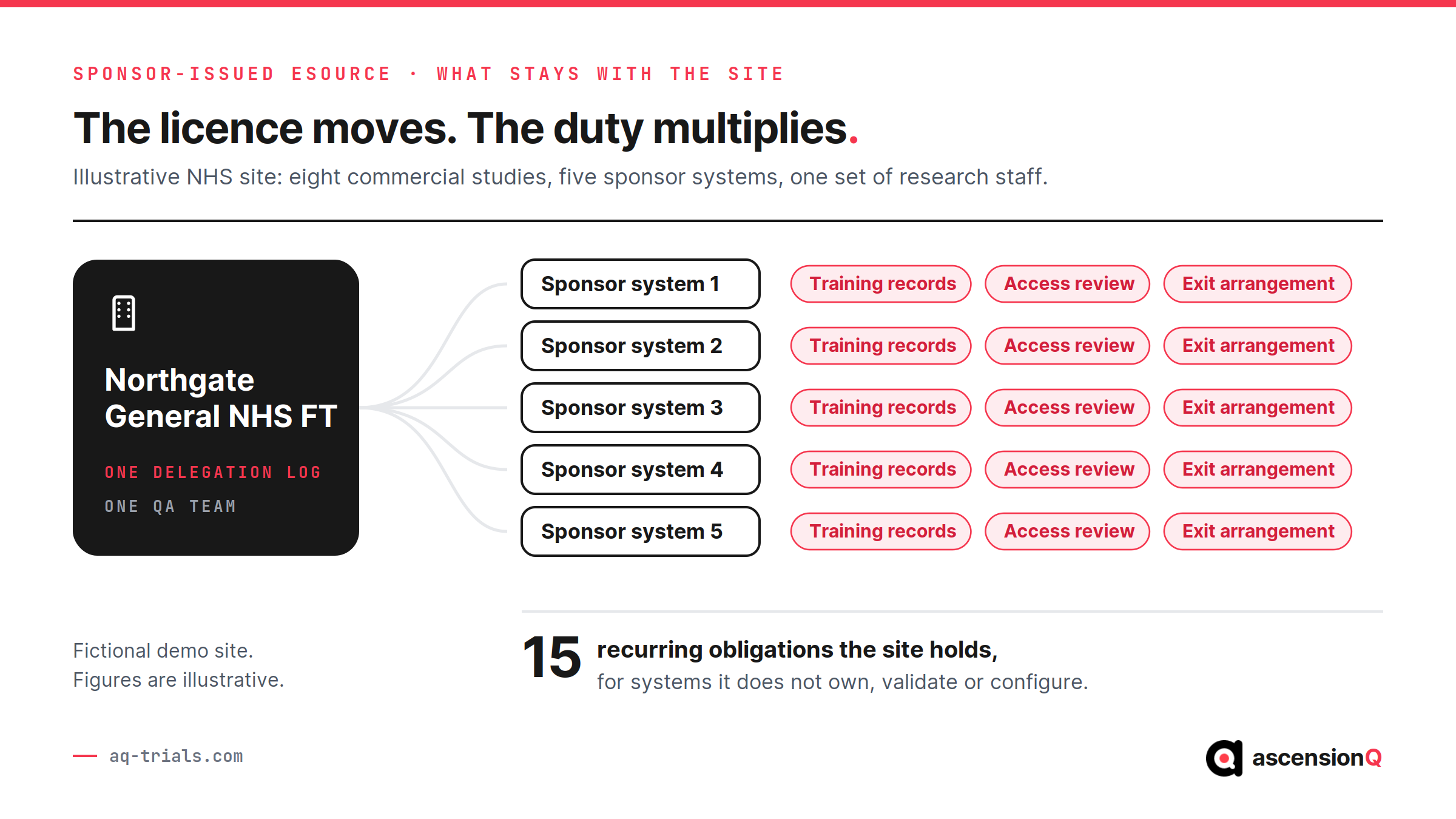
- The sponsor validates the system, and the site files evidence that its own staff were trained before their first entry.
- The sponsor grants the accounts, and the site reconciles those accounts against its delegation log at every change of staff.
- The sponsor closes the study, and the site retains its own copy of the source for the full UK retention period.
- The sponsor designs the forms, and the site records which system held the original for each data point.
A portfolio multiplies each of those duties. A hypothetical NHS site running eight commercial studies across five sponsor systems holds five sets of training records, five access review cycles and five exit arrangements, for one set of research staff. That arithmetic is the practical case for a system the site owns, and it is also the reason a site-owned system rarely covers the whole portfolio.
Our guide to who uses eSource, from research nurse to sponsor covers which roles may change data in any of these systems and which may only read it.
Can an Academic Site Use Its Own Data Capture Tool as Source?
An academic site can use its own data capture tool as source where it declares that tool as the original record and holds the evidence to support the declaration. REDCap is the common example in UK universities. The REDCap consortium describes REDCap as “a free, easy-to-use, and secure method of flexible yet robust data collection” and offers membership to not-for-profit institutions.
The decision is a governance decision ahead of a software decision. Four conditions apply to a site-built instance on the same terms as a licensed product:
- The site declares the source per data point before the study opens, as covered in our guide to which record is the source when data sits in both the EPR and the trial system.
- The site holds validation evidence for the instance it runs, including the configuration of each individual project.
- The site keeps the audit trail enabled and reviewable for the full retention period.
- The site maps user roles to its delegation log and reviews access on a stated cycle.
Scope is the practical limit. A data capture tool holds the values a study collects, and the operational record around those values sits elsewhere. Our guide to REDCap versus a CTMS sets out that boundary and what each system owns.
Which Questions Separate These Options for an NHS or Academic Site?
Five questions separate the options quickly. Our guide to what to compare in eSource software before you buy works through the full evaluation criteria and the evidence that settles each one.
- Can the supplier provide validation documentation the site can review this quarter?
- Does the audit trail record every entry, change and deletion, with no option to switch it off?
- Do user roles map to the site’s delegation log, and can monitor access be scoped to one study?
- Does the supplier hold current NHS assurance evidence, including a Data Security and Protection Toolkit submission and Cyber Essentials?
- Do the exit terms return the record, its metadata and its audit trail in a readable format for the full UK retention period?
Dates matter as much as answers. A product announced for a future release answers question one on a roadmap, and a site files documents rather than roadmaps. The MHRA GXP data integrity guidance applies to the system in use on the day the data is captured.
Also Read: eSource Software for UK Research Sites: What to Compare Before You Buy
Book a live demo to see the AQ platform today.
Frequently Asked Questions
Is Veeva SiteVault eSource available now?
Veeva describes SiteVault eSource in the future tense, as an application that will give sites everything they need to capture patient data at the source. A UK site should confirm what is released and validated before planning a study around it.
Which eSource routes are open to a UK research site?
Four routes: a site eSource platform the site licenses itself, an eSource system a sponsor issues for one study, the hospital electronic patient record used as source, and forms the site builds in its own data capture tool. They differ by who owns and validates the system.
What changes when the sponsor supplies the eSource system?
The sponsor takes on the licence, the validation and the form design. The site keeps every duty attached to the people who use it, including evidence that its staff were trained before their first entry.
Can an academic site use REDCap as its eSource?
Yes, where the site declares its data capture tool as the original record and holds the evidence to support that declaration. REDCap is the common example in UK universities.
What should a site ask an eSource supplier before buying?
Ask for validation documentation the site can review, an audit trail that records every entry, change and deletion with no option to switch it off, user roles that map to the delegation log, current NHS assurance evidence, and exit terms that return the record with its metadata and audit trail.