You build a source data plan before the site initiation visit by settling, for every data point the protocol collects, what the original record is, who may create it and how the value reaches the sponsor. The site drafts those decisions against the systems it actually runs, the sponsor agrees them in writing, and the investigator signs the result before the visit takes place.
This guide is for UK research sites preparing a study to open. It covers the six decisions the plan settles, how the site and sponsor agree them, the four documents it produces, a build sequence in weeks, and the failure modes of a late plan. The wider context sits in our complete guide to eSource in clinical trials.
The initiation visit is a good place to confirm a plan and a poor place to write one.
What Is a Source Data Plan?
A source data plan is the site’s documented decision about how each data point in the protocol is captured and where its original is held. It covers every field on the schedule of events from the first participant onwards. Sites and sponsors also call it a source data agreement or a source data identification list.
The plan is the decision. The source data location log records it. Three further documents sit around both, each settling a different question.
| Document | What it settles | Who owns it |
| Protocol and schedule of events | Which data the study collects, and at which visit | Sponsor |
| Source data plan | How each value is captured and where the original sits | Site, agreed with sponsor |
| Source data location log | The signed index of those decisions, row by row | Investigator |
| Data flow description | The route a value takes to the sponsor’s database | Sponsor |
| Monitoring plan | How often and how deeply the sponsor verifies | Sponsor |
The distinction matters at inspection. An inspector reads the log first and then tests the practice behind it, so a template filed unchanged fails the second question. Our guide to what counts as source data in a clinical trial sets out the usual original for each data type.
Why Must the Plan Be Settled Before the Site Initiation Visit?
The duty is explicit in ICH E6(R3). Section 2.12.2 states that the investigator should define what is considered to be a source record, the methods of data capture and their location prior to starting the trial. The EMA guideline on computerised systems and electronic data in clinical trials repeats it at section 6.1, asking that the location of all source data is specified prior to the start of the trial and updated during conduct.
The initiation visit is the practical deadline for that work. Four conditions place the plan ahead of it:
- The sponsor trains the team on the procedures for data recording at the visit. Staff can be trained only on decisions that already exist.
- MHRA oversight and monitoring guidance expects documented evidence that the sponsor has ensured the site team is trained, set up and ready to conduct the trial.
- Access arrangements take longer than the visit. A monitor needing a trust electronic patient record account waits on local information governance approval, covered in our guide to how NHS sites give monitors EPR access.
- Electronic capture carries a lead time. EMA Annex 2 section A2.7 states that the responsible party should sign off the release of a computerised system prior to initial use.
MHRA guidance also allows initiation without a physical visit, through central training or an initiation package sent to the site. The evidence the sponsor holds stays the same, and the plan is what that evidence describes.
What Decisions Does a Source Data Plan Have to Settle?
Six decisions cover every data point. The plan is complete when each field on the schedule of events answers all six, and a field with five answers is the one that generates queries in month two.
- What is the original record? The system or document where the observation is first written down.
- Who may create it? The role authorised to make that original, matched to the delegation log.
- Does a copy exist elsewhere? Any second record carrying the same value, and the record it is reconciled against.
- Which record is the source when the value sits in two places? Our guide to which record is the source when data sits in both the EPR and the trial system sets out the test.
- How does the value reach the sponsor? Direct entry, transcription into a case report form, or an automated transfer.
- How is a correction made? The workflow, the reason for change, and the audit trail the change lands in.
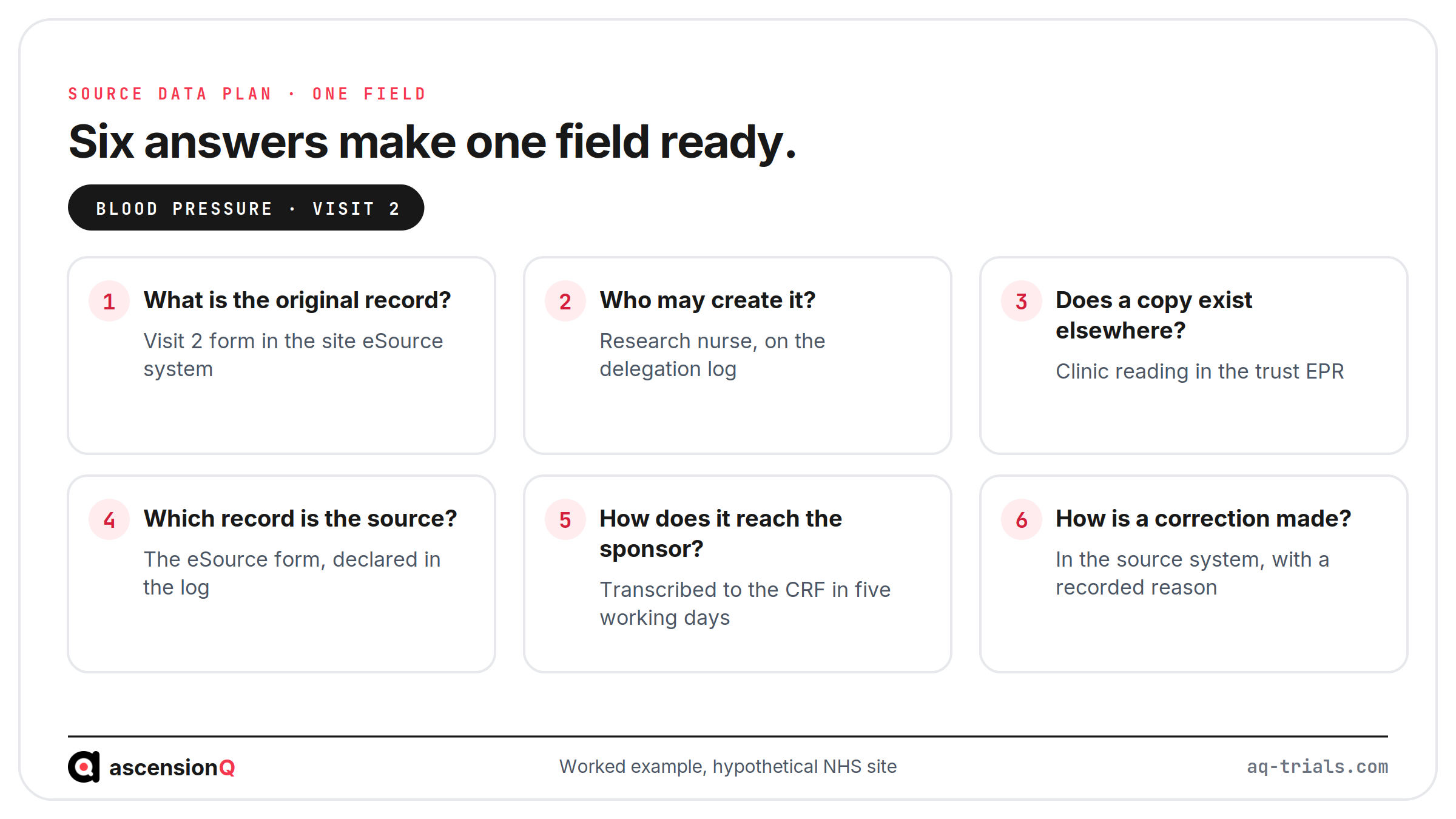
Blood pressure at visit two shows the six answers combining, from the nurse’s entry on the visit form through to the correction route in the same system.
Also Read: eSource vs EDC: Where Source Data Ends and the CRF Begins
How Do the Site and Sponsor Agree the Plan?
Agreement follows a fixed division of knowledge. The sponsor knows which data the protocol needs and how its database receives them. The site knows which systems exist and who may use them.
ICH E6(R3) section 3.6.3(b) requires the sponsor to obtain the investigator’s agreement to comply with procedures for data recording and reporting, so the plan records a two-sided commitment. Section 2.12.11 keeps control of the essential records generated at the site with the investigator, and MHRA guidance states that the sponsor should not have exclusive control of a source document.
| Question | Decided by | Evidence it lands in |
| Which data the protocol collects | Sponsor | Protocol and schedule of events |
| Which local system holds each original | Site | Source data location log |
| Whether a sponsor system is the source | Both, in writing | Plan and system release record |
| Who may create each record | Investigator | Delegation log |
| Which records a monitor may open | Both, with IG approval | Monitoring plan and access request |
| How much data is verified | Sponsor, on risk | Monitoring plan |
The common failure at this step is silence. A sponsor template arrives naming systems the site does not run, the site files it unchanged, and the disagreement surfaces at the first monitoring visit. Verification scope belongs in the same conversation, because MHRA guidance asks that it focuses on the data that matters to the reliability of the results. Our guide to remote source data verification with eSource covers that scope in practice.
What Documents Does the Plan Produce?
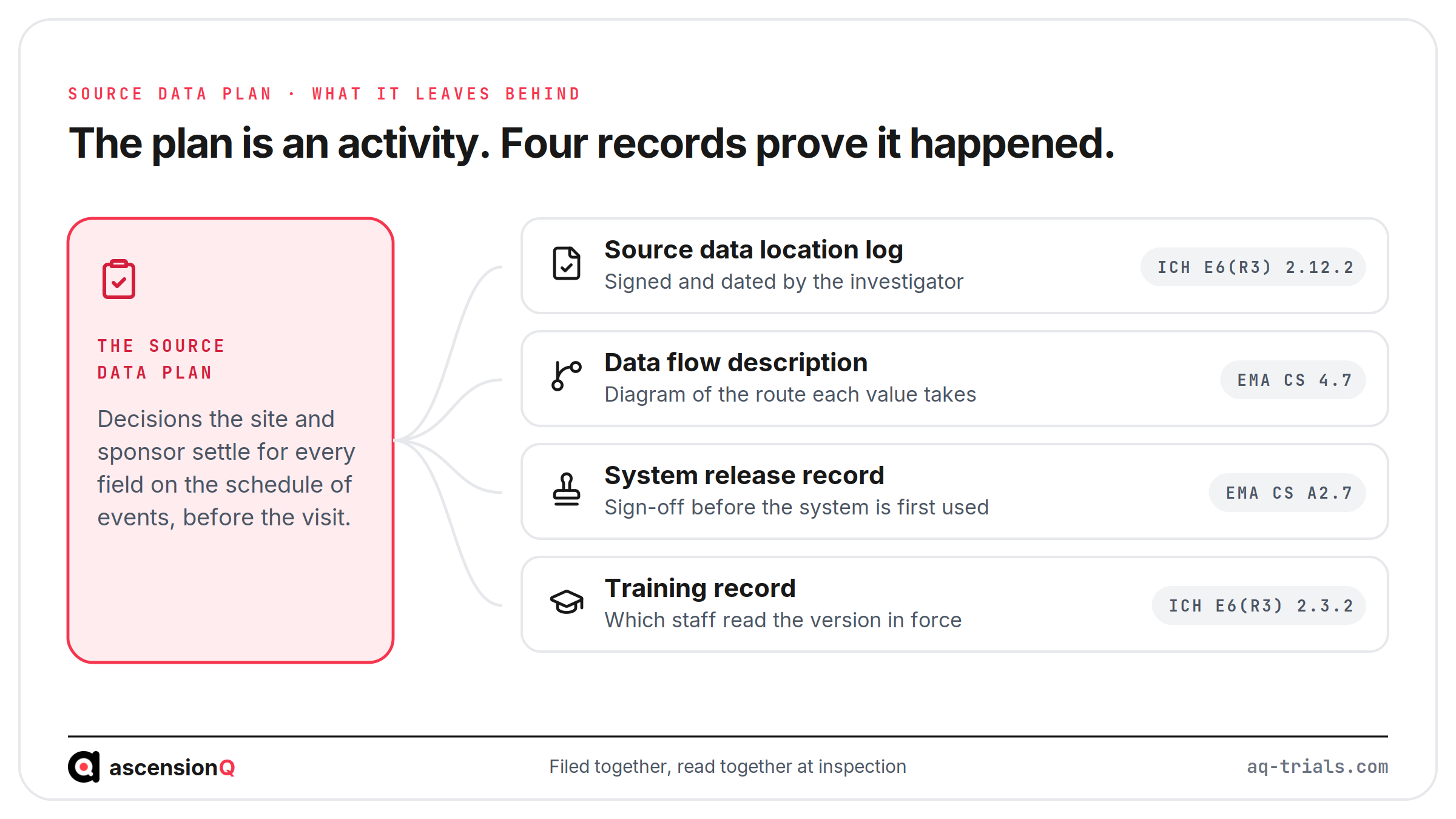
The plan is an activity, and it leaves four records behind. An inspector reads them together.
- The source data location log, signed and dated by the investigator before the first participant is enrolled, under ICH E6(R3) section 2.12.2.
- A description of the data flow. EMA section 4.7 asks for a detailed diagram and description of the transmission of electronic data in a protocol-related document.
- A release record for every electronic system capturing source, signed off before initial use under EMA Annex 2 section A2.7.
- A training record showing which staff read the version in force. ICH E6(R3) section 2.3.2 ties training to the activities each person is delegated.
The four records are filed in the investigator site file, and the procedures controlling their versions sit in the site’s quality management system. Each carries a version and an effective date, so a later change traces to the day it took effect.
What Is the Build Sequence in the Weeks Before the Visit?
The sequence below works backwards from the visit date. The intervals suit a study of ordinary complexity at one NHS site, and several electronic systems need longer. The schedule of events the first task maps from sits in the site’s clinical trial management system.
| Weeks out | The site does | The sponsor does |
| 8 | Maps the schedule of events onto local systems | Issues the protocol, CRF specification and template |
| 6 | Names the original record for every field | Reviews the site draft against the CRF |
| 4 | Raises information governance and access requests | Confirms the access model and verification scope |
| 2 | Drafts the location log for the research team | Agrees the final version in writing |
| 1 | Investigator signs the log, and staff read it | Prepares initiation training on the agreed plan |
| 0 | Confirms the plan against the live systems | Trains the team and records the evidence |
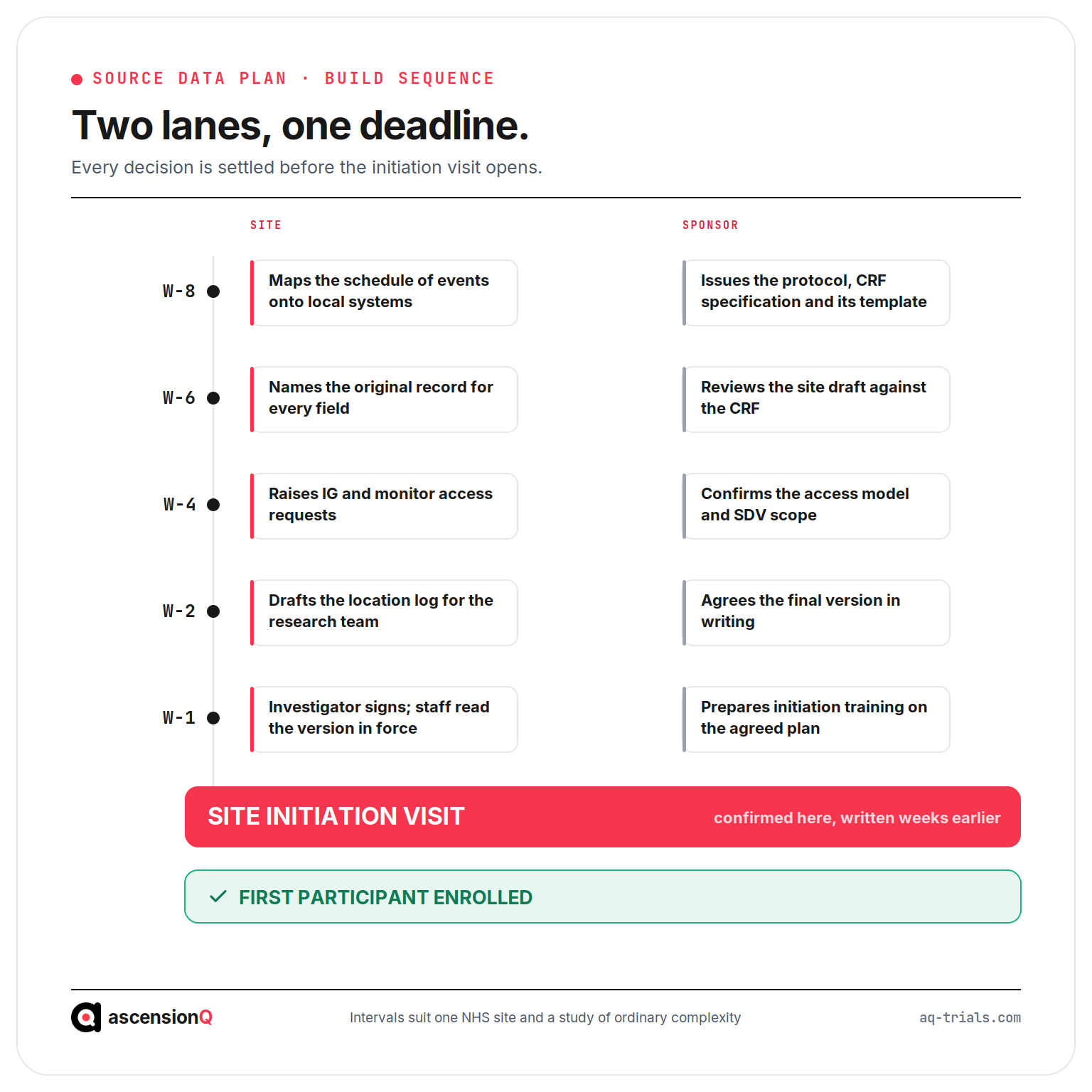
Week four carries the most schedule risk at an NHS trust. An information governance review runs on the trust’s own timetable, and a plan reaching it late pushes the access decision past the visit.
What Happens at the Site Initiation Visit Itself?
The visit tests a plan that already exists. Five checks separate a confirmed plan from a paper one:
- The team opens each named system and retrieves a record, so the written description matches the screen staff actually see.
- The monitor confirms that the access agreed at week four works under their own named account.
- The investigator confirms the delegation log covers every role the plan names, with effective dates that precede recruitment.
- The sponsor records the training against the version of the plan in force that day.
- Any correction agreed on the day is issued as a new version before recruitment opens.
A site reaching the visit with all five in hand spends the session on the protocol. A site arriving with an unsigned plan spends it on documentation.
What Goes Wrong When the Plan Is Late?
A late plan produces a predictable set of findings, and each stays visible in the records long after the study closes.
- The first participants are recorded under an arrangement nobody wrote down, and the site reconstructs it afterwards from memory.
- Two members of staff record the same field in different places, so the value has two originals and no declared source.
- A monitor arrives with no account, and the monitoring visit converts into an access request.
- An electronic form goes live mid-recruitment, splitting one study across two media, as compared in our guide to eSource versus paper source worksheets.
- The delegation log names staff for tasks the plan never assigned to a record.
- A protocol amendment adds an assessment, and no route exists to carry it into the plan.
Each of these is a governance condition rather than a personal failing. MHRA GXP data integrity guidance expects data to meet the ALCOA+ attributes across the full lifecycle, and a value whose original was decided after it was recorded fails on originality. Our guide to whether eSource meets ALCOA+ maps each attribute to the control that evidences it.
A plan written after the data is a reconstruction.
Also Read: What Is a Source Data Location Log and Who Signs It Off?
Sites running several studies carry a separate plan for each, and the effort concentrates in keeping every one current through amendments. AQ is launching eSource soon as part of the AQ platform. Book a live demo to see the AQ platform today.