A clinical trial pharmacy is the pharmacy service that receives, stores, dispenses and accounts for investigational medicinal product (IMP) on the investigator’s behalf at a research site. It differs from routine dispensing in one respect that shapes everything else. Each unit belongs to a trial, so the pharmacy traces it from receipt all the way to return or destruction, well past the point of supply.
This article covers what the service is, how it differs from routine dispensing, what it does that routine dispensing leaves out, and the three models that run it: in-house, outsourced and homecare. It sits under the complete guide to IMP accountability in clinical trials, which sets out the record the trial pharmacy keeps.
- A clinical trial pharmacy is the usual home of the IMP work that ICH E6(R3) section 2.10.2 lets an investigator delegate to a pharmacist.
- Routine dispensing and trial dispensing share the clinical check. They differ on stock ownership, authority to supply, labelling and the length of the record.
- Three service models run a trial pharmacy: in-house, outsourced and homecare. Responsibility stays with the investigator or institution in all three.
- Most service failures happen where trial supply slips back into routine habits, such as out-of-hours supply from general stock.
What Is a Clinical Trial Pharmacy?
A clinical trial pharmacy is a defined service, inside or contracted to a research site’s pharmacy, that manages IMP for each study the site runs. ICH E6(R3) section 2.10.1 places responsibility for IMP management, “including accountability, handling, dispensing, administration and return”, with the investigator/institution. Section 2.10.2 lets that work be delegated “to a pharmacist or another individual in accordance with local regulatory requirements”, under the investigator’s oversight. The trial pharmacy is where that delegation usually lands at a UK site.
The service runs across the whole life of a study. Six activities make it up.
- Set-up review. The pharmacy reads the protocol and pharmacy manual before the study opens, which fixes the procedure every later entry follows.
- Receipt and release. Deliveries are checked against the sponsor’s shipping documents and held until released for use, which starts each unit’s line in the log.
- Storage. Stock is kept under the sponsor’s conditions and apart from general stock, and the storage record set proves those conditions held.
- Dispensing. A trial prescription is checked and the allocated kit is issued, which ties one unit to one participant and one visit.
- Returns and reconciliation. Unused medicine is counted back and the balance is tested, which proves where each unit went.
- Close-out. Remaining stock is returned or destroyed on the sponsor’s written authority, which closes the record.
The people who deliver these activities, and which of them hold accountability, are set out in who is accountable for IMP at a trial site. The records the service keeps for each study are listed in what belongs in a pharmacy site file.
How Does a Trial Pharmacy Differ from Routine Dispensing?
A trial pharmacy differs from routine dispensing in who owns the stock, what authorises each supply and how long the record lasts. Routine dispensing supplies a medicine against a prescription for a patient’s care. The Royal College of Pharmacy’s Professional Standards for Hospital Pharmacy Services expect prescriptions to be reviewed for clinical appropriateness by a pharmacist before dispensing (descriptor 5.4). A trial pharmacy performs the same check and then applies a second test: whether the protocol allows this supply.
| Aspect | Routine dispensing | Clinical trial pharmacy |
|---|---|---|
| Owner of the stock | The trust, bought through its own procurement | Usually the sponsor, supplied for one study |
| What authorises supply | A valid prescription for the patient’s care | A trial prescription from a delegated prescriber, within the approved protocol |
| Which unit is issued | Any suitable pack from general stock | The kit the sponsor’s allocation system assigned to that participant |
| Labelling | A dispensing label for the patient | Trial labelling that meets the UK clinical trial labelling rules |
| Who may act | Pharmacy staff working under the trust’s procedures | People on the study delegation log, trained on the protocol |
| Record kept | The dispensing record and the stock movement | A unit-level log with batch, expiry, kit and participant codes |
| Where the record ends | At supply to the patient | At return to the sponsor or authorised destruction |
| Who reviews the record | Internal audit and professional regulators | Also the monitor, sponsor auditors and GCP inspectors |
Routine dispensing ends at the patient. A trial record ends at the last unit.
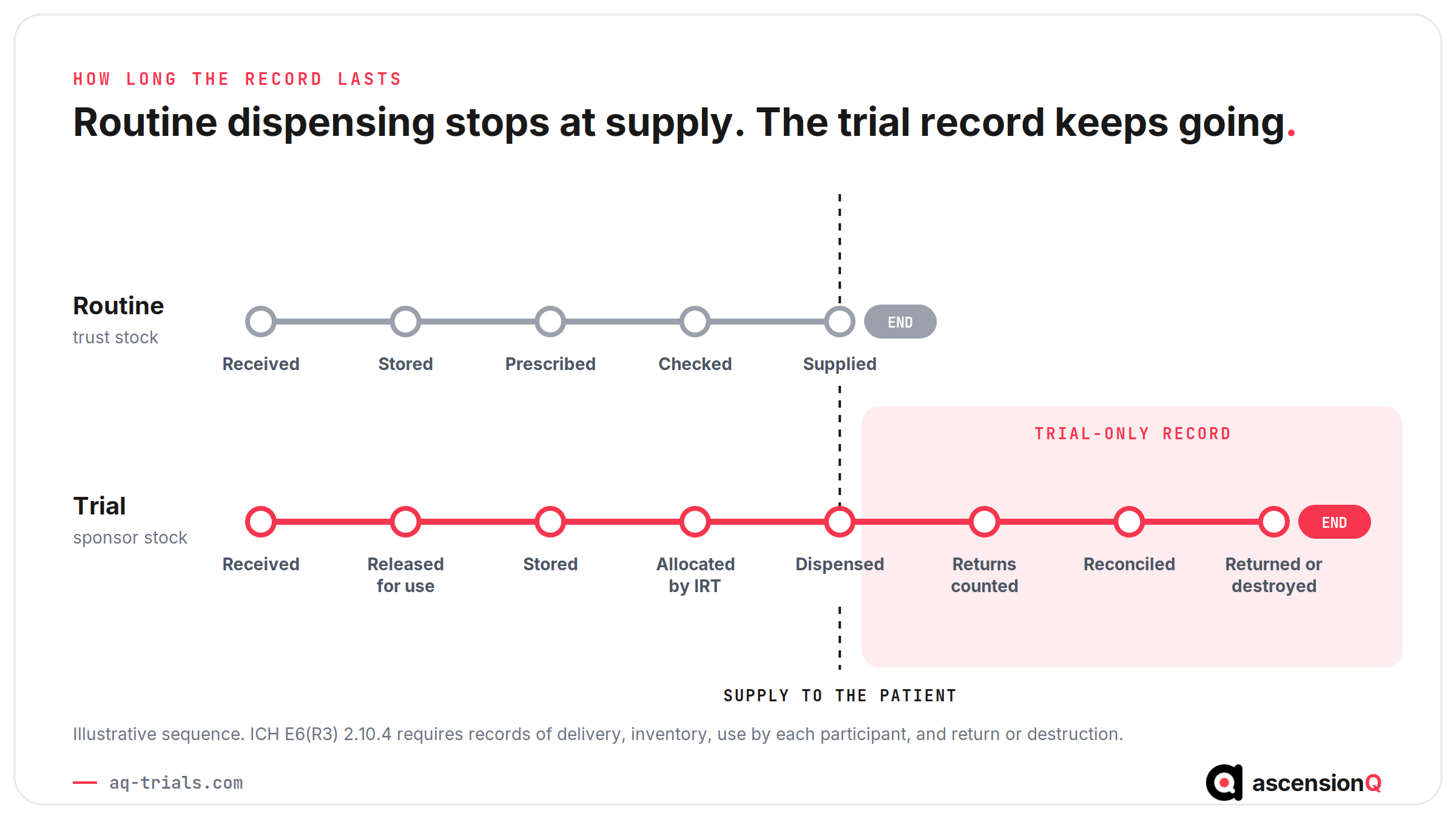
Ownership explains most of the other differences. Sponsor-supplied stock never belongs to the trust, so the pharmacy has no authority to use, move or destroy it outside the protocol and the sponsor’s instructions. ICH E6(R3) section 2.10.4 sets out what the record must hold: delivery, inventory, use by each participant, and return or destruction, with dates, quantities, batch numbers, expiry dates and code numbers.
What Does a Trial Pharmacy Do That Routine Dispensing Does Not?
A trial pharmacy does six things that routine dispensing leaves out. Each one protects the accountability record or the trial’s design.
- Quarantine on receipt. A new delivery stays unusable until a named person releases it, which keeps unchecked stock out of the available balance.
- Allocation through the sponsor’s system. The pharmacy issues the kit that the sponsor’s interactive response technology (IRT) assigns, which keeps the site ledger reconcilable with the sponsor’s record.
- Participant-level logs. Every kit is recorded against a participant code, which lets a monitor test the doses each participant received against the protocol.
- Blinding controls. Kit numbers hide the treatment, and unblinded pharmacy staff hold their records apart, which protects the design that E6(R3) section 2.11 requires the site to follow.
- Returns counting. Returned units are counted and segregated from usable stock, which feeds both reconciliation and the participant’s compliance check.
- Sponsor-authorised disposition. Stock is returned or destroyed only on written authority, which gives every line in the record a documented end.
Some trial pharmacies also assemble IMP. The MHRA Inspectorate has explained that regulation 37 of the 2004 Regulations exempts a hospital or health centre from holding a manufacturer’s authorisation for this work. The exemption applies when a doctor or pharmacist, or someone under a pharmacist’s supervision, carries out the assembly, and the product is used only at sites in the same trial. Assembly here means packaging and labelling only.
Also Read: Drug Accountability Logs: What Auditors Actually Check
Which Service Models Run a Trial Pharmacy?
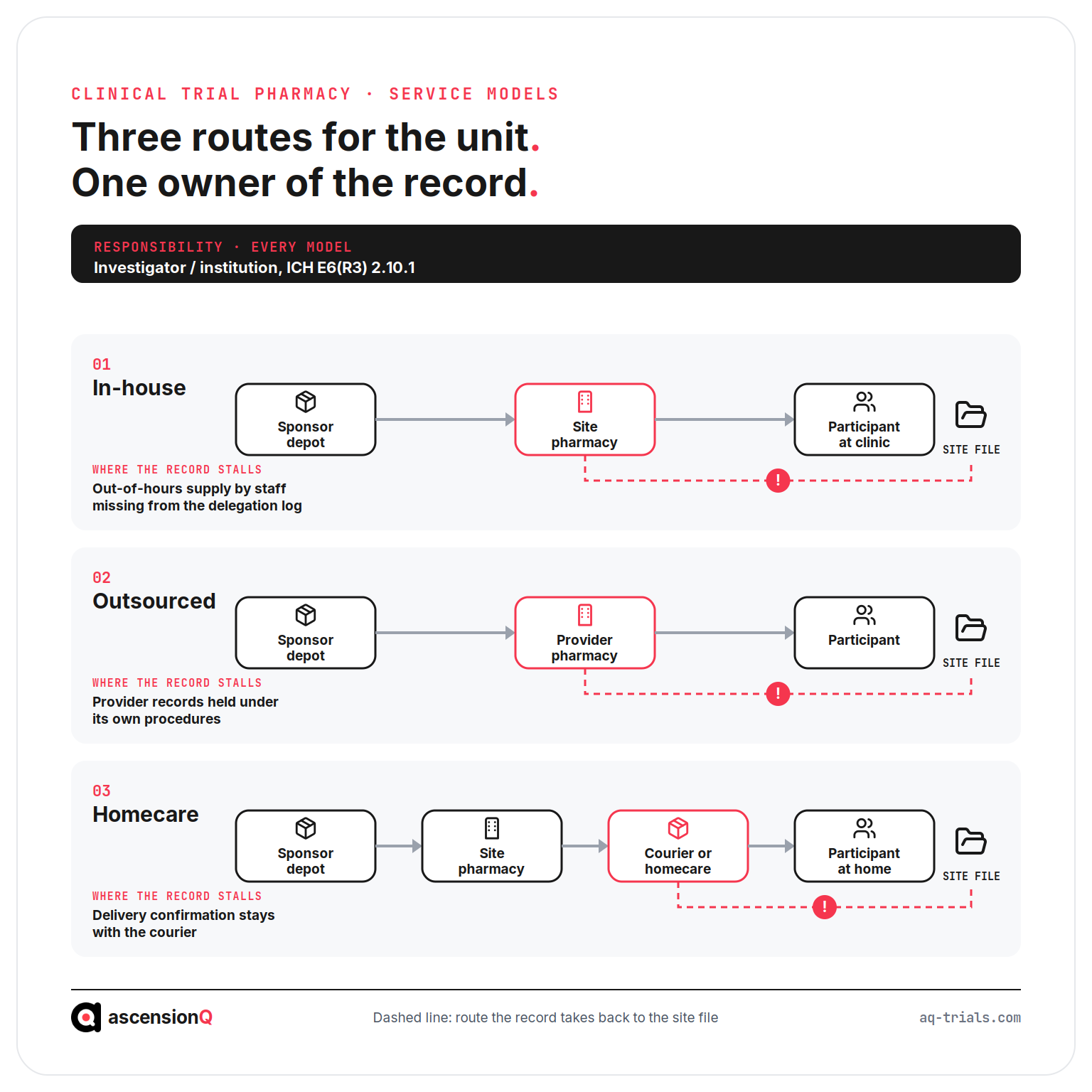
Three service models run a trial pharmacy at a UK site: in-house, outsourced and homecare. Responsibility stays with the investigator/institution in every model. The model changes who handles each unit and where its record is written.
| Model | Who handles the IMP | Where the record is written | What must be in place |
|---|---|---|---|
| In-house | The site’s own pharmacy team | The site’s pharmacy file and accountability logs | A delegation log entry and trial training for each person who acts |
| Outsourced | A service provider the site contracts, such as another hospital pharmacy | Partly by the provider, then returned to the site’s file | A documented agreement under E6(R3) section 2.3.4, with a route for the provider’s records back to the site |
| Homecare | A homecare provider, courier or local pharmacy that delivers to the participant | Delivery confirmations, plus the site’s own log | A protocol that permits the route under section 2.10.8, and proof that each unit reached the right participant |
E6(R3) defines a service provider as “a person or organisation (commercial, academic or other) providing a service used by either the sponsor or the investigator to fulfil trial-related activities”. The hospital pharmacy standards expect outsourced and shared pharmacy services, including homecare, to be performance-managed through service level agreements (descriptor 6.2). The MHRA Inspectorate notes that the regulation 37 exemption does not apply to companies with a contract to supply hospitals or health centres.
The homecare model follows section 2.10.8, which allows IMP to be “shipped to the participant’s location or supplied to/dispensed at a location closer to the participant”. The joint position statement on decentralised trial methods from the HRA, the MHRA and the devolved administrations covers trial activities that take place “at homes of trial participants or at health care or other facilities which are local to trial participants”. A network in which one central pharmacy prepares and ships IMP to several sites is a further variant, known as the hub-and-spoke model.
Every unit on each of these routes still sits somewhere in the site’s count. The twelve steps a trial medicine takes from depot to patient show where the extra handovers fall.
Where Does a Trial Pharmacy Service Break?
A trial pharmacy service breaks where trial supply slips back into routine habits. The routine process is familiar and fast, and it records less. Five patterns recur.
- Out-of-hours supply by an on-call pharmacist who is missing from the study delegation log.
- A licensed comparator taken from general hospital stock, with no trial accountability line.
- Stock rotation rules that pick the kit expiring first in place of the kit the sponsor’s system allocated.
- A homecare delivery confirmation that stays with the courier and never reaches the site file.
- An outsourced provider’s records held under its own procedures, with no agreed route back to the site.
A hypothetical example shows how the first two combine. Study NGH-022 at Northgate General (SITE 01) uses a licensed comparator as its reference arm. A participant needs a dose one evening, and the on-call pharmacist supplies the comparator from general stock against the trial prescription. The participant receives the right medicine at the right dose. The next morning the trial log holds no line for that dose, and the general stock system shows one pack issued to a ward.
The care was right. The record sits in the wrong system.
The fix makes trial supply its own pathway.
- An out-of-hours procedure names who may supply trial medicine, which keeps every supply inside the delegation log.
- Trial stock carries its own log from the first unit, or the sponsor documents an alternative approach for an authorised product under section 2.10.4, which removes the ambiguity about which record counts.
- Each outsourced or homecare agreement states how records return to the site, which keeps the pharmacy file complete.
- A file note records the evening supply, with the reason and the stock movement, which lets the monitor reconcile the dose.
A clinical trial pharmacy is measured by its record as much as by its dispensing. AQ’s electronic pharmacy site file page sets out how AQ approaches pharmacy records as part of one connected site file. Book a live demo to talk through how your trial pharmacy’s records connect to the rest of your study evidence.