A randomisation and trial supply management (RTSM) system and the site pharmacy record hold different halves of the same story. The RTSM belongs to the sponsor. It holds the randomisation, the kit allocation decision and the supply position across every site in the study. The pharmacy record belongs to the site. It holds custody of the physical units that arrived at that site, and the evidence of what pharmacy did with each.
The two records describe the same kits from opposite ends. The sponsor’s system records what the study decided. The site record proves what happened. IMP accountability holds only while both agree on every unit.
This guide sets out what each record owns, the four points where a value crosses between them, and why a UK site keeps its own ledger.
What Is an RTSM or IRT System in a Clinical Trial?
An RTSM system in a clinical trial is the sponsor’s software for randomising participants and managing the supply of investigational medicinal product across the study. The same system is widely called interactive response technology (IRT). Earlier names described the interface rather than the function, from interactive voice response systems (IVRS) on the telephone to interactive web response systems (IWRS) in a browser. Sponsors use RTSM and IRT for the same platform.
A site meets the system at a few moments. The rest happens between sponsor and depot.
- Randomisation assigns the participant to a treatment arm, which fixes the arm at the moment of enrolment.
- Kit allocation returns a specific kit number for a participant and visit, which ties one physical pack to one person.
- The treatment code sits behind the kit number, which lets pharmacy account for every unit while blinded staff stay blinded.
- Stock forecasting watches the level held at each site and triggers resupply, which keeps the depot ahead of demand.
- Shipment tracking records what left the depot and what the site confirmed, which gives the sponsor a study-wide supply position.
- Expiry and kit status remove unusable kits from the allocatable pool, so the system stops offering a pack the site should not dispense.
The kit number is the shared key. It is printed on the pack, held in the sponsor’s system and written into the pharmacy log, and what an investigational medicinal product is and who numbers a kit covers where it comes from. An RTSM is a computerised system used in a regulated trial, so the data governance expectations in Annex 1 of ICH E6(R3) apply, including validation, security, user management and an audit trail.
What Does the Sponsor’s RTSM Own?
The sponsor’s RTSM owns every decision about which unit should go where, plus the study-wide view of supply. A site sees its own stock. The sponsor sees all of it, and moves product between depots and sites on that basis.
- The randomisation list and the treatment code, held so that allocation stays independent of the site.
- The allocation decision for each participant at each visit.
- The study-wide inventory position and the resupply triggers that follow from it.
- Shipment records from depot to site, which open the chain of custody.
- Kit status as the sponsor holds it: available, allocated, expired, damaged or quarantined.
- The unblinding transaction, where the protocol routes a code break through the system.
The RTSM holds the decision. It does not hold the medicine.
What Does the Site Pharmacy Record Own?
The site pharmacy record owns physical custody, and every act performed on a unit while it sat at that site. Section 2.10.4 of ICH E6(R3) places delivery, inventory, use by each participant, and return or destruction in the site’s records, with dates, quantities, batch numbers, expiry dates and the code numbers of product and participant.
- The receipt check against the packing list, which records the condition and completeness of the goods on arrival.
- Batch numbers and expiry dates read from the packs in hand, which an inspector compares against the shelf.
- The named release decision that moves stock out of quarantine into usable stock.
- Storage conditions for the time the stock was held, covered in the storage records checklist.
- The dispensing entry against a signed trial prescription, made by a person named on the delegation log for that study.
- Returns counted at the site, which is where the count of what the participant brought back is made.
- Destruction or return under the sponsor’s written authorisation, with the certificate that closes each unit’s line.
- The running balance and the physical count that tests it.
These records live in the pharmacy site file, and what belongs in a pharmacy site file sets out the full index. Responsibility for the set rests with the investigator or institution under section 2.10.1, and who is accountable for IMP at a trial site places each role against it.
Also Read: What Belongs in a Pharmacy Site File?
Which Record Answers Which Question?
Each record answers the questions it was built to answer. The table places the questions a monitor or inspector asks at a site with their owner. The empty cells are the point.
| The question | The sponsor’s RTSM | The site pharmacy record |
|---|---|---|
| Which arm is this participant in? | The randomisation it holds | Nothing, while the site stays blinded |
| Which kit should this participant receive today? | The allocation returned at the visit | Nothing; pharmacy acts on the allocation |
| Which kit did this participant actually receive? | The allocation it expected to be used | The dispensing entry, signed and dated |
| What sits on the shelf right now? | The balance the system expects | The counted balance, including quarantined stock |
| What condition did the stock arrive in? | The despatch record from the depot | The receipt check and the transit temperature review |
| Who performed the dispensing? | Nothing | The signature, checked against the delegation log |
| Was the unit destroyed, and on whose authority? | The disposition instruction it issued | The witnessed record and the destruction certificate |
Two rows are answered by one record alone. A site that treats the sponsor’s system as its accountability record loses them.
Where Do the Two Records Hand Over?
The two records hand over at four points in a kit’s life. A value crosses the boundary at each one, and two people make two entries.
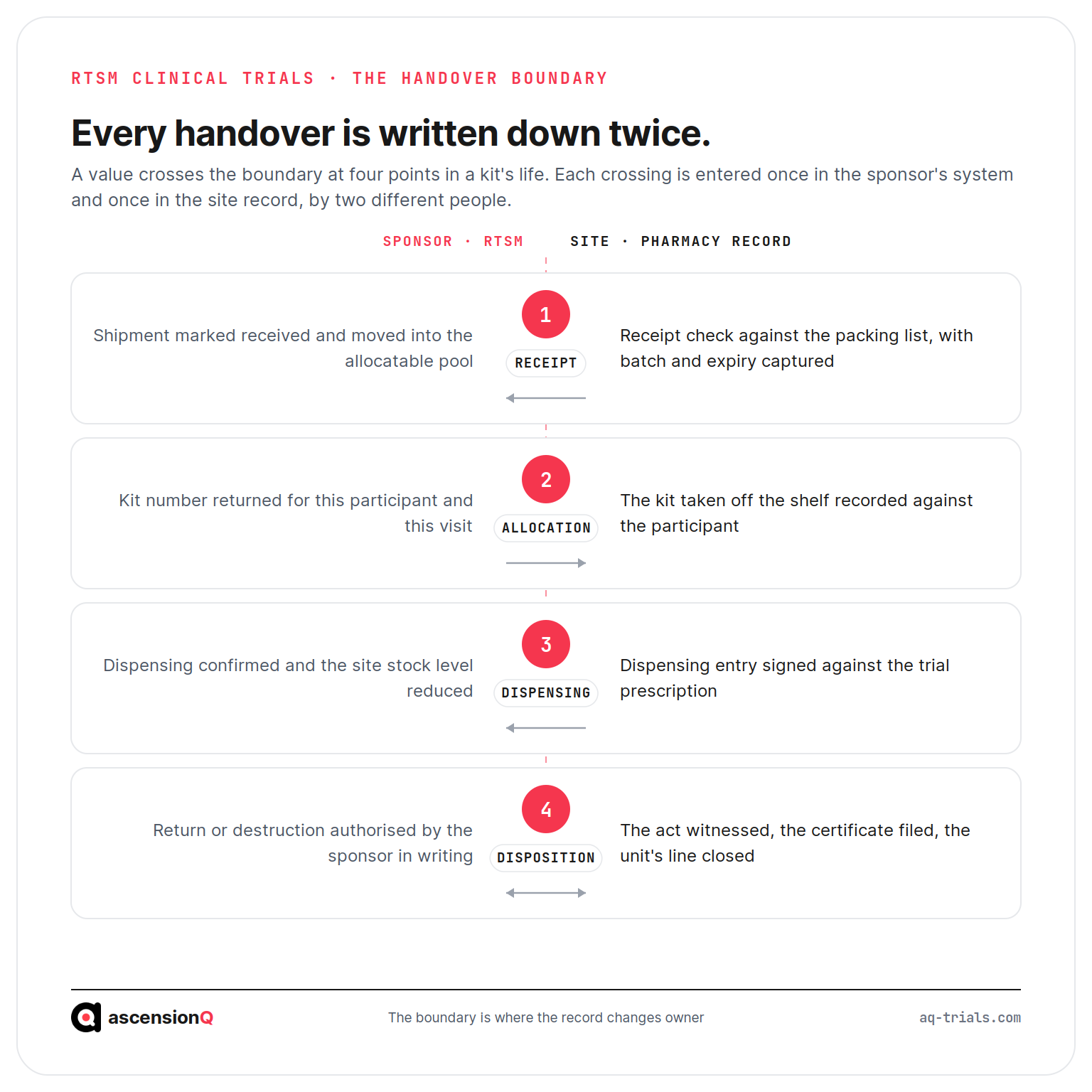
- Receipt confirmation travels from site to sponsor. Pharmacy confirms arrival in the RTSM and writes its own receipt entry.
- Allocation travels from sponsor to site. The system returns a kit number at the visit, and pharmacy records the kit it took off the shelf.
- Dispensing confirmation travels from site to sponsor. Pharmacy confirms it in the system and signs the dispensing entry in its own record.
- Disposition travels in both directions. The sponsor authorises return or destruction, and the site records the act and files the certificate.
Nothing forces the two entries at a crossing to be made at the same moment. The gap between them is where the records drift apart, and the twelve steps a trial medicine takes from depot to patient sets out the full chain.
Also Read: From Depot to Patient: The Twelve Steps a Trial Medicine Takes
Why Does a Site Still Keep Its Own Ledger?
A site keeps its own ledger because responsibility for IMP management rests with the investigator or institution, and the sponsor’s system cannot evidence what the site did. Five reasons hold independently.
- The duty sits at the site. Section 2.10.1 of ICH E6(R3) places accountability, handling, dispensing, administration and return with the investigator or institution. No sponsor system discharges that duty.
- The act needs its own evidence. The RTSM records an allocation. The pharmacy record proves a named person dispensed a named kit against a signed prescription.
- Access ends with the study. The site does not control the sponsor’s system and usually loses access after close-out, while its own retention duty continues.
- The shelf holds more than the system tracks. Locally sourced comparator and non-investigational medicinal products sit in the same fridge, and the pharmacy record covers them.
- Reconciliation needs two sources. A comparison has meaning only where the two records were produced independently.
Two records that were always one record cannot reconcile.
The site ledger reconciles against the sponsor’s system and does not replace it. The guide to IMP accountability for UK pharmacy teams covers the four directions a monitor tests it from.
What Happens When the RTSM and the Pharmacy Record Disagree?
A disagreement between the RTSM and the pharmacy record is investigated and documented, and the physical count settles what is on the shelf. A status disagreement carries more risk than a count disagreement, because it can put a unit into a participant’s hands.
The MHRA GCP Inspectorate’s inspection metrics report for 1 April 2018 to 31 March 2019 records a critical finding at a non-commercial organisation where IMP stock was quarantined in pharmacy and medication was still dispensed to participants. One record said the stock was usable, and the other said it was not.
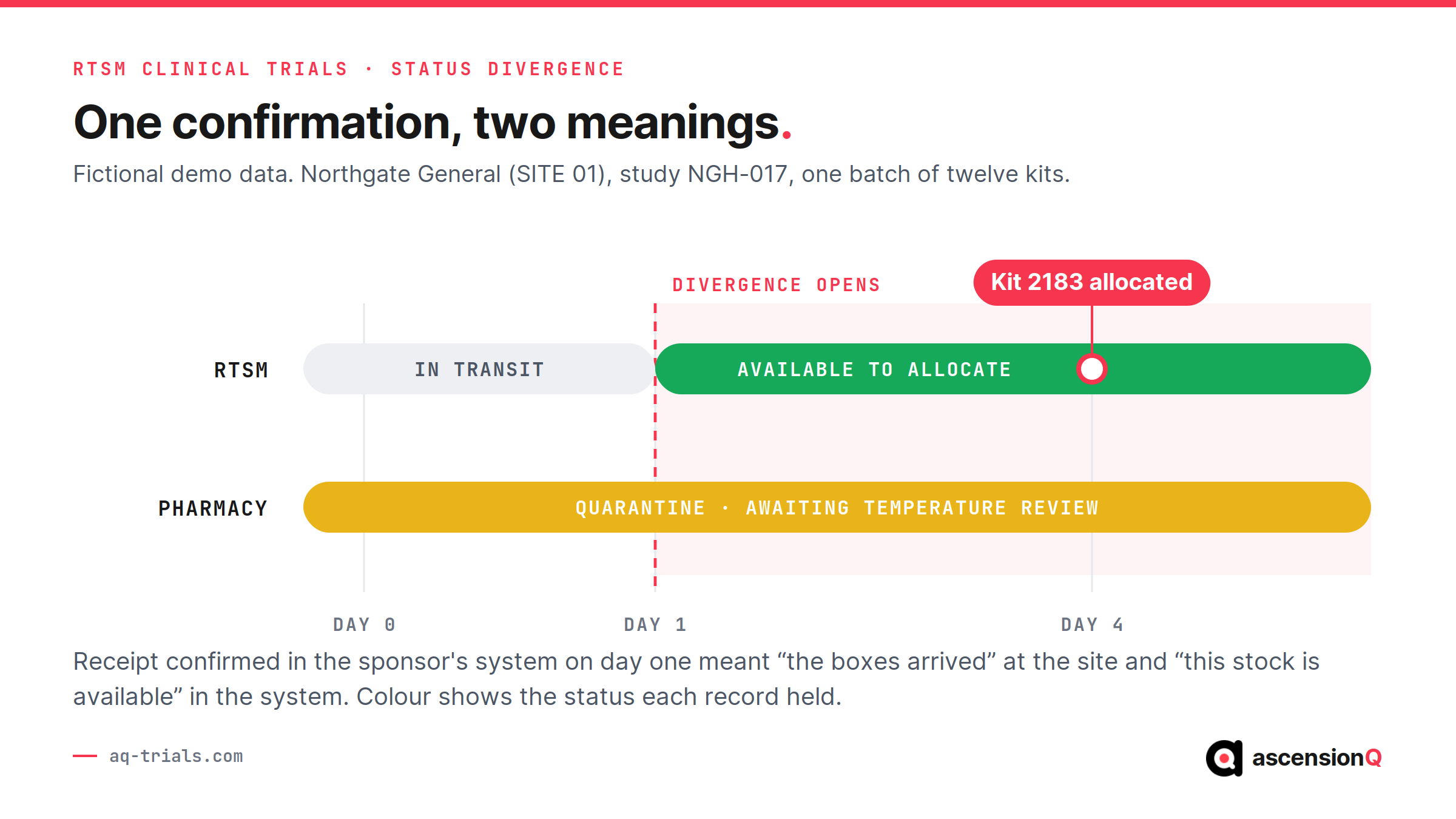
A hypothetical sequence at Northgate General (SITE 01) on study NGH-017 shows how the gap opens. Twelve kits arrive on day zero, and pharmacy quarantines the batch pending review of the transit temperature logger. On day one a technician confirms receipt in the RTSM, and the system moves those kits into the allocatable pool. On day four it allocates kit 2183 from that batch to participant 017-009. The pharmacy record still shows the batch quarantined.
The divergence began at the receipt confirmation. That action meant “the boxes arrived” to the person who made it, and “this stock is available to allocate” to the system that received it. Four disagreement types recur.
- Timing differences arise where one entry lags the other, and close once the second entry is made.
- Status differences arise where the system treats stock as usable and pharmacy holds it quarantined, the highest risk of the four.
- Count differences arise where the shelf and the balance disagree, and each is a discrepancy until explained.
- Allocation differences arise where a kit other than the allocated one was dispensed, separating the records from that visit onward.
Each difference is recorded with its cause and resolution, and the original entry stays readable alongside the correction. The MHRA GXP data integrity guidance expects that traceable history for any change to a GCP record. A difference with a systemic cause moves into the site’s corrective and preventive action process, and a pattern of them reads as a control failure rather than a clerical one.
Also Read: Investigational Product Storage Records: A Compliance Checklist
The sponsor’s system and the site’s ledger answer to different owners, and the site’s half is the one a UK team must keep and defend. AQ’s electronic pharmacy site file page is the parent page for this topic. Book a live demo to see how AQ keeps site records connected across a study.